
Wilo vs KSB Grinder Pump Equipment: Comparison & Best Fit
Introduction
In the realm of municipal and industrial wastewater management, the failure of a grinder pump due to ragging or jamming is rarely a minor inconvenience—it is a distinct operational hazard that leads to Sanitary Sewer Overflows (SSOs), costly emergency call-outs, and accelerated equipment degradation. With the increasing prevalence of “non-flushable” wipes and high-tensile synthetic fibers in the waste stream, the engineering selection of macerating pumping technology has shifted from a focus on simple hydraulic transport to a rigorous analysis of solids-reduction capability and electromechanical resilience.
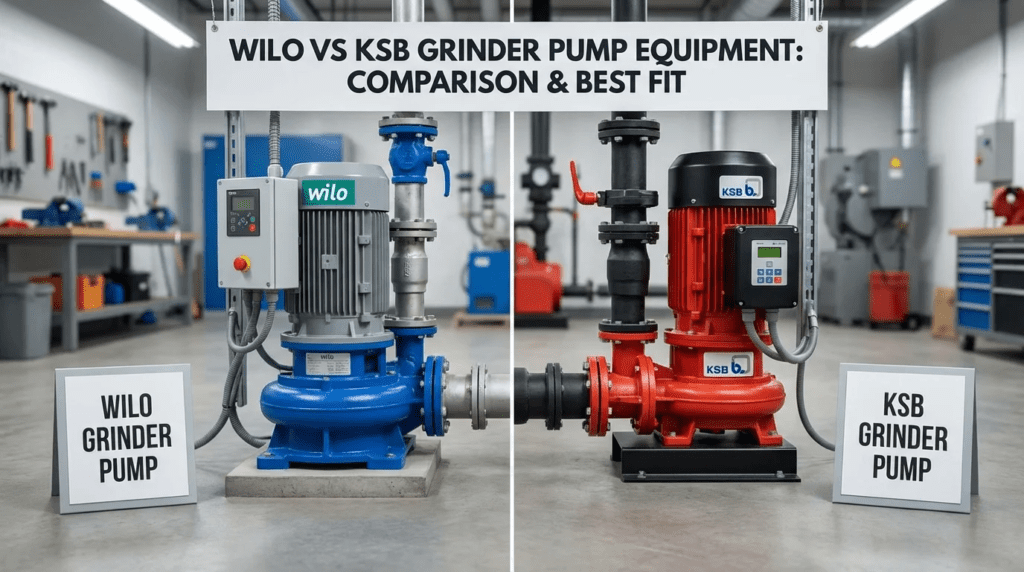
Engineers tasked with designing pressure sewer systems (PSS) or retrofitting troublesome lift stations often find themselves evaluating premium European heavyweights. This article provides a technical deep-dive into Wilo vs KSB Grinder Pump Equipment: Comparison & Best Fit. Both manufacturers originate from German engineering lineages and offer robust submersible solutions, yet their approaches to cutter geometry, hydraulic profiles, and material selection differ in ways that materially impact lifecycle costs and application suitability.
Grinder pumps are typically deployed in low-pressure sewer systems, challenging topographies requiring high head/low flow, and applications serving commercial facilities with variable waste streams. A poor specification here—such as selecting a unit with insufficient starting torque or a cutter material softer than the debris load—can result in Mean Time Between Failures (MTBF) measured in weeks rather than years. This guide aims to strip away marketing narratives and focus on the physics, metallurgy, and operational realities necessary for making an informed engineering decision.
How to Select / Specify
Selecting between high-end grinder pump manufacturers requires a granular look at the operating envelope and the specific nature of the influent. When analyzing Wilo vs KSB Grinder Pump Equipment: Comparison & Best Fit, the engineer must move beyond the basic duty point and evaluate the machine’s ability to maintain that duty point under adverse solids loading.
Duty Conditions & Operating Envelope
The hydraulic selection for grinder pumps differs significantly from solids-handling non-clog pumps. Grinders typically operate at higher speeds (3450 RPM or 1750 RPM) to generate the necessary torque and cutting action, often producing steeper Head-Capacity (H-Q) curves. This is advantageous for pressure sewer systems where static head is high or force mains are long and narrow.
When specifying, consider:
- System Curve Interaction: Ensure the pump’s shut-off head provides a safety factor of at least 15-20% above the maximum static head. In pressure sewers, friction losses can vary dynamically as other pumps in the network cycle on and off.
- Minimum Velocity: Design for a scour velocity of at least 2.0 ft/s (0.6 m/s) in the discharge piping to prevent sedimentation of the macerated slurry.
- Intermittent vs. Continuous Duty: While most lift stations operate intermittently, S1 (continuous duty) rated motors are preferred to handle potential run-out conditions or long pump cycles during storm events without thermal overloading.
Materials & Compatibility
The longevity of a grinder pump is directly correlated to the metallurgy of its cutting mechanism. Standard cast iron or lower-grade stainless steel will dull rapidly against grit and synthetic fibers, leading to increased clearance and eventual jamming.
- Cutter Hardness: Specify cutting elements with a Rockwell C hardness (HRC) of 55-60. Both Wilo and KSB utilize hardened stainless steel alloys (often varying grades of AISI 440C or proprietary equivalents like cobalt-vanadium alloys).
- Volute & Impeller: For municipal wastewater, ASTM A48 Class 30 or 35B cast iron is standard. However, if the application involves industrial effluent with low pH or high chloride content, look for duplex stainless steel options or specialized coatings (e.g., Ceram coatings).
- Mechanical Seals: Dual mechanical seals are mandatory. The lower seal (process side) should be Silicon Carbide vs. Silicon Carbide (SiC/SiC) to resist abrasion from the macerated slurry.
Hydraulics & Process Performance
The interaction between the cutting mechanism and the hydraulic impeller is critical. Some designs place the cutter axially upstream of the impeller, while others use a radial design peripheral to the suction.
- Efficiency Considerations: Grinder pumps are inherently less efficient than non-clog pumps due to the energy consumed by the grinding action and the tighter clearances required. Wire-to-water efficiencies of 30-50% are typical. Focus on “wire-to-process” efficiency—avoiding a single clog saves more money than a 2% gain in hydraulic efficiency.
- NPSH: While Submersible pumps have the benefit of positive suction head (submergence), cavitation can occur at the cutter interface if the inlet is restricted by accumulated debris. Review the NPSH3 curves specifically for the grinder model.
Installation Environment & Constructability
Whether the project is a new lift station or a retrofit into an existing wet well dictates the mounting configuration.
- Guide Rail Systems: Most municipal stations use a dual guide rail system. Ensure the discharge flange/elbow interface (the “duckfoot”) is compatible with existing rails if retrofitting. KSB and Wilo both offer adapter claws, but dimensional verification is the engineer’s responsibility.
- Freestanding: For smaller basins or temporary setups, freestanding installations with flexible hose discharges are common. Check stability; the starting torque of a high-speed grinder can cause the unit to rotate if not properly supported.
- Thermal Dissipation: If the pumps will operate in a “snore” condition or partially submerged, specify cooling jackets (closed-loop glycol or process media cooled) to prevent motor stator burnout.
Reliability, Redundancy & Failure Modes
The primary failure mode for grinder pumps is “jamming” followed by “seal failure.”
- Jamming Torque: Compare the Locked Rotor Torque and the Breakdown Torque. A pump that can reverse direction automatically (via VFD or smart control panel) upon detecting a high-amp spike can often clear its own jams.
- Redundancy: In critical applications, a duplex system (Duty/Standby) is standard. For pressure sewer networks, calculate the hydraulic impact if one pump fails—can the remaining network overcome the head?
- Seal Monitoring: Specify moisture detection probes in the oil chamber and the stator housing. This provides early warning of seal failure before water intrudes into the motor windings.
Controls & Automation Interfaces
Modern grinder pumps are not just mechanical devices; they are part of an electromechanical system.
- Smart Panels: Both Wilo and KSB offer dedicated control panels that monitor motor thermals, seal leakage, and current draw.
- Anti-Jamming Logic: This is a critical specification point. The controller should detect a current spike (indicating a jam), stop the pump, reverse rotation to clear the obstruction, and retry. This feature significantly reduces operator call-outs.
- SCADA Integration: Ensure the pump protection module provides dry contacts or Modbus/BacNet output for “Pump Run,” “Pump Fail,” “Seal Fail,” and “Over-temp” to the plant SCADA system.
Maintainability, Safety & Access
Grinder pumps require maintenance. The ease of accessing the cutter assembly is a major differentiator.
- Cutter Adjustment: As cutters wear, the gap between the rotating and stationary elements increases, reducing cutting efficiency. Look for designs that allow for external shimming or simple gap adjustment without requiring a full teardown of the hydraulic end.
- Field Replaceability: Can the cutter cartridge be replaced in the field by an operator, or does the pump need to be sent to a shop? Modular cutter assemblies are preferred.
- Weight: For smaller horsepower units, weight affects whether a hoist is required or if it can be a two-person lift (though mechanical lifting is always safer).
Lifecycle Cost Drivers
In the context of Wilo vs KSB Grinder Pump Equipment: Comparison & Best Fit, the purchase price (CAPEX) is often dwarfed by the OPEX.
- Energy Consumption: Grinders are energy-intensive. Compare the specific energy (kW per 1000 gallons pumped).
- Maintenance Labor: If a pump clogs monthly, the labor cost exceeds the pump cost within 2-3 years. Robust cutters reduce this frequency.
- Spare Parts: German engineering often implies proprietary parts. Verify the availability and lead times for seal kits and cutter sets from local distributors.
Comparison Tables
The following tables provide a structured comparison to assist engineers in distinguishing between the specific strengths of Wilo and KSB grinder technologies. While both are premium manufacturers, their design philosophies result in different “best fit” scenarios. Note that specific models change; always verify current data sheets.
Table 1: Technology & Feature Comparison
| Feature / Criteria | Wilo (Typical Series: Wilo-Rexa FIT-S, Wilo-Drain MTC) | KSB (Typical Series: Amarex N S, Amarex N Cutter) | Engineering Implication |
|---|---|---|---|
| Cutting Mechanism | Often utilizes a radial “scissor” cut or internal macerator with a hardened spherical cutter. Known for double shear action. | Typically employs an axial cutter design integrated with the suction plate. Some models feature a distinct “S-cutter” geometry. | Radial cutters (Wilo) can be excellent for fibrous wipes. Axial cutters (KSB) often provide robust initial reduction of larger solids. |
| Impeller Technology | Multi-vane open impellers or vortex hybrids designed to work behind the cutter. | Often uses the “S-impeller” or open multivane, optimized for passing the slurry created by the cutter. | KSB’s hydraulic profiles are often derived from their larger non-clog lines, offering good hydraulic efficiency. |
| Motor Efficiency | High focus on IE3/IE4 equivalent motors across the range. | Strong focus on motor efficiency and robust thermal reserves. | Both brands exceed standard NEMA efficiencies, reducing long-term energy costs. |
| Material Hardness | Standard hardened stainless steel (approx. 50-57 HRC). Specialized coatings available. | High-grade Norihard or hardened stainless options (55-60+ HRC). | Hardness dictates maintenance intervals. KSB’s wear materials are historically very robust in abrasive grit applications. |
| Seal Technology | Dual mechanical seals, typically SiC/SiC on media side. Large oil chambers. | Dual mechanical seals within a cohesive cartridge system in some models. | Both offer excellent protection. Cartridge seals (where available) simplify field replacement. |
| Control Integration | Wilo-Control monitoring devices are highly integrated for thermal/seal supervision. | Amacontrol offers comprehensive protection and easy integration into MCCs. | Specifiers should ensure the chosen pump’s protection module is compatible with existing SCADA/telemetry. |
Table 2: Application Fit Matrix
| Application Scenario | Constraint / Challenge | Wilo Suitability | KSB Suitability | Selection Verdict |
|---|---|---|---|---|
| Residential Pressure Sewer (Simplex/Duplex) | Low flow, high head, residential waste (wipes). | High. The Wilo-Drain MTC series is compact and specifically designed for pressure sewer retrofits. | High. KSB Ama-Porter or similar compact grinders are robust, though sometimes larger in footprint. | Competitive. Often decided by local distributor support and package availability. |
| Municipal Lift Station (High Head) | High reliability required, variable flow, heavy ragging. | High. The Rexa FIT series offers excellent anti-clogging reliability and cutting torque. | Very High. Amarex N series is a staple in municipal utilities due to heavy casting and bearing life. | KSB often favored for heavy-duty municipal specs; Wilo favored for efficiency-driven specs. |
| Industrial / Commercial Facilities | Variable chemistry, potential abrasion, high usage. | Medium-High. Good if effluent is primarily organic solids. | High. Material options for abrasion resistance often give KSB an edge in gritty industrial waste. | If abrasion is the main concern, lean toward KSB’s specialized materials. |
| Retrofit into Tight Wet Wells | Physical space constraints, existing guide rails. | High. Compact motor designs and flexible discharge adapters. | High. “Duckfoot” adapters allow KSB pumps to fit on competitors’ rails. | Check dimensional drawings carefully. Both are adaptable. |
Engineer & Operator Field Notes
Specifications on paper often differ from reality in the field. The following notes are compiled from commissioning experiences and long-term operational observations of grinder pump installations.
Commissioning & Acceptance Testing
When commissioning Wilo vs KSB Grinder Pump Equipment, specific checks are required that differ from standard non-clog pumps.
- Rotation Check: This is critical. While a centrifugal pump will pump (inefficiently) in reverse, a grinder pump running in reverse will not cut effectively. The cutting geometry is directional. Running in reverse will likely cause an immediate jam upon the first introduction of solids.
- Amp Draw at Shut-off: Verify the amperage at the shut-off head condition. It should be significantly lower than the Full Load Amps (FLA). If it is high, there may be mechanical drag in the cutter assembly (improper shimming).
- Cutting Test: A true Site Acceptance Test (SAT) should involve introducing a controlled “rag ball” (often a mop head or bundle of wipes, depending on facility protocol) to verify the cutter processes the load without tripping.
Common Specification Mistakes
- Ignoring Minimum Head: Grinder pumps often have steep curves. Operating them at very low head (far right of the curve) can lead to cavitation and motor overload. Ensure the system curve intersects the pump curve within the allowable operating region (AOR).
- Cable Lengths: For deep wet wells, forgetting to specify the exact power cable length results in field splices, which are the number one failure point for submersible pumps.
O&M Burden & Strategy
Maintenance strategies for Wilo and KSB units focus heavily on the cutter interface.
- Clearance Checks: Every 6 months, operators should pull the pump and check the clearance between the rotating cutter and the stationary ring. If the gap exceeds manufacturer specs (typically 0.1-0.5mm), it must be shimmed or tightened. A wide gap causes rags to fold over the blade rather than shear, leading to jams.
- Oil Changes: Change the mechanical seal oil annually. Inspect the old oil for water emulsion (milky appearance), which indicates a seal breach.
- Sharpening vs. Replacement: While some older cutters could be sharpened, modern hardened alloys from KSB and Wilo are designed to be replaced as a cartridge or set. Sharpening removes the hardened outer layer and reduces lifespan.
Troubleshooting Guide
Symptom: Pump trips overload immediately on start.
Cause: Debris jammed in cutter during previous cycle shutdown.
Solution: Lift pump, manually clear debris. Check “soft start” settings—if the ramp-up time is too slow, the motor may not generate enough torque to shear the initial jam. Direct On Line (DOL) starting provides maximum torque but stresses the grid.
Symptom: Flow rate has decreased, but amps are normal.
Cause: Worn impeller or worn cutter plate allowing recirculation within the volute.
Solution: Check wear ring clearances and cutter gap. Readjusting the face clearance can often restore hydraulic performance.
Design Details / Calculations
Proper integration of grinder pumps requires specific design calculations to ensure the system functions as intended.
Sizing Logic & Methodology
When sizing for a pressure sewer system using Wilo or KSB equipment:
- Determine Peak Design Flow: Based on the number of Equivalent Dwelling Units (EDUs). Use probability methods (like the Hunter Curve modified for pressure sewers) because not all pumps run simultaneously.
- Calculate Total Dynamic Head (TDH):
TDH = Static Lift + Friction Losses + Residual Head
Note: For friction losses in small diameter piping (1.25″ – 3″), use the Hazen-Williams formula. However, for macerated slurry, consider using a conservative C-factor (e.g., C=120 for plastic pipe instead of 140) to account for the increased viscosity and solids content. - Select Pump Model: Overlay the system curve on the Wilo/KSB pump curves. Ensure the intersection point is to the left of the motor overload point and to the right of the minimum stable flow.
- Check Velocity: Verify that at the operating point, the velocity in the force main is > 2 fps.
V = (0.4085 * Q) / d^2 (where Q is gpm, d is inches).
Specification Checklist
To ensure a robust procurement regarding Wilo vs KSB Grinder Pump Equipment: Comparison & Best Fit, include these line items in Division 43:
- Cutter Material Certification: Vendor must supply material certs proving hardness >55 HRC.
- Seal Fail Protection: Pump must be supplied with a moisture detection relay compatible with the control panel.
- Cable Entry: Cable entry must be longitudinally sealed (epoxy potted) to prevent capillary action of water into the motor if the cable jacket is cut.
- Factory Testing: Require a non-witnessed factory performance test to HI 11.6 (Submersible Pump Tests) standards.
Standards & Compliance
- Hydraulic Institute (HI): Adhere to HI 11.6 for testing.
- NEC (NFPA 70): Verify hazardous location classification. Many lift stations are Class 1, Division 1 or 2. Ensure the pumps carry the appropriate FM or UL explosion-proof rating.
- NEMA: Motors should meet NEMA MG-1 standards for insulation (Class F or H) and duty cycle.
Frequently Asked Questions
What is the primary difference between Wilo and KSB grinder pumps?
The primary difference often lies in the cutting mechanism design and the hydraulic profiles. KSB (Amarex series) typically utilizes robust axial cutters and leverages hydraulic profiles from their industrial heavy-duty lines, emphasizing abrasion resistance. Wilo (Rexa series) often features innovative radial or double-shear cutting actions and focuses heavily on motor efficiency and integrated intelligent controls. Both are premium German-engineered brands suitable for municipal use.
How do I select the right grinder pump size for a pressure sewer?
Selection involves calculating the Total Dynamic Head (TDH) at the required flow rate. For pressure sewers, you must account for the static lift plus the high friction losses in small-diameter pipes. Crucially, you must analyze the “worst-case” head scenario when multiple pumps in the network are running simultaneously. Select a pump (Wilo or KSB) with a steep H-Q curve to ensure it can overcome varying system pressures without dead-heading.
What is the typical lifespan of a submersible grinder pump?
A high-quality municipal grinder pump from manufacturers like Wilo or KSB typically lasts 10-15 years, provided maintenance is performed. The cutter assembly is a wear part and may require replacement or adjustment every 2-5 years depending on the grit and debris load. The mechanical seals usually last 5-7 years before requiring a rebuild.
Are grinder pumps better than vortex pumps for wastewater?
It depends on the application. Vortex (recessed impeller) pumps are better for passing large solids without touching them, making them ideal for high-flow stations where clogging isn’t driven by long fibers. Grinder pumps are essential for low-flow, high-head applications (like pressure sewers) or small diameter pipes (< 4 inches) where solids must be reduced in size to prevent pipe blockages. Grinders require more maintenance than vortex pumps due to the cutting mechanism.
How much does a municipal-grade grinder pump cost?
For a typical 2HP to 5HP municipal-grade submersible grinder pump (excluding controls and installation), costs generally range from $3,000 to $8,000 per unit. Specialized high-head or explosion-proof models can range from $8,000 to $15,000. While cheaper residential models exist ($800-$1,500), they generally lack the hardened metallurgy and duty cycle required for municipal infrastructure.
Can I retrofit a KSB pump into a Wilo rail system (or vice versa)?
Yes, in most cases. Both manufacturers offer “claw” or “duckfoot” adapters designed to interface with competitor guide rail systems. However, engineers must verify the physical dimensions of the wet well to ensure the new pump body does not conflict with walls, floats, or piping. It is a standard engineering task to request dimensional drawings with the retrofit adapter included.
Conclusion
Key Takeaways
- Metallurgy Matters: Specify cutters with >55 Rockwell C hardness. Soft cutters are a false economy.
- Application Specificity: Use KSB where extreme abrasion/grit is the primary threat. Consider Wilo where complex ragging (wipes) and smart control integration are priorities.
- Torque is King: Ensure the motor has sufficient starting torque to clear settled debris; hydraulic HP is not the only metric.
- System Curve Analysis: Grinder pumps operate on steep curves; ensure the pump does not run off the curve (cavitation) or shut off (dead-head) under variable pressure conditions.
- Maintenance Access: Verify that cutter gaps can be adjusted or cartridges replaced without sending the pump to a rewind shop.
When evaluating Wilo vs KSB Grinder Pump Equipment: Comparison & Best Fit, the engineer is choosing between two of the industry’s most capable manufacturers. There is rarely a “wrong” choice between these two giants, but there is certainly a “better fit” depending on the specific nuances of the project. KSB’s legacy in heavy industrial castings and abrasion-resistant materials makes them a formidable choice for grit-heavy municipal lift stations. Wilo’s focus on precision cutting geometries, high-efficiency motors, and integrated intelligence makes them highly effective in combating the modern plague of synthetic wipes in pressure sewer systems.
Ultimately, the decision should drive toward Total Cost of Ownership (TCO). A pump that costs 15% more upfront but eliminates three emergency de-ragging call-outs per year yields a positive ROI in less than 12 months. Engineers should leverage the technical data provided in this guide to write tight, performance-based specifications that force the supply chain to deliver the reliability that operators deserve.