
Top OEMs for Motor Control Centers (MCCs)
Introduction
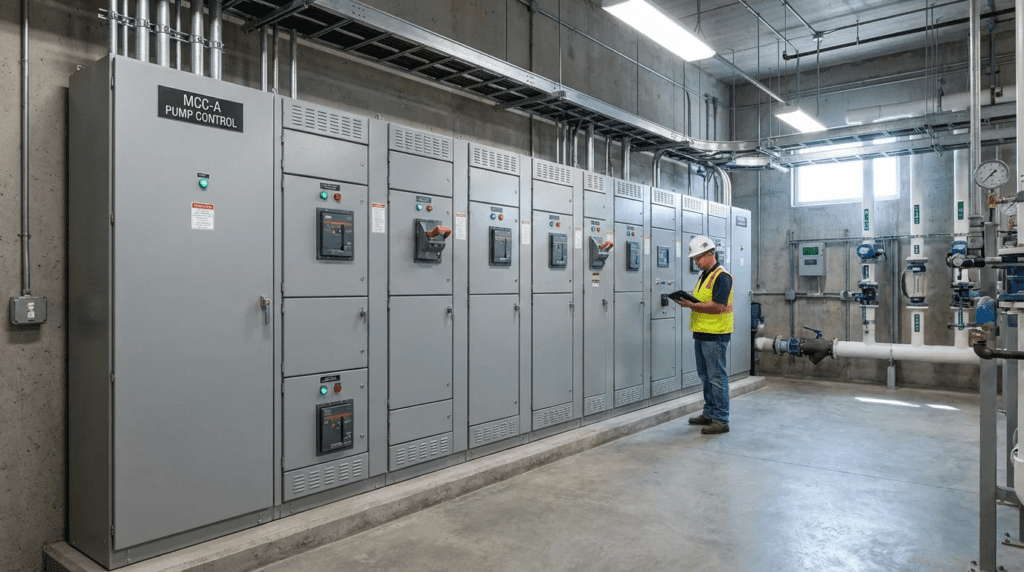
In the architecture of municipal water and wastewater treatment facilities, the Motor Control Center (MCC) serves as the central nervous system for energy distribution and process control. It is the physical interface where high-voltage utility power is stepped down, distributed, and converted into mechanical motion through pumps, blowers, aerators, and clarifier drives. For consulting engineers, plant superintendents, and utility decision-makers, the specification and selection of MCC manufacturers is not merely a purchasing decision; it is a commitment to a twenty-to-thirty-year operational lifecycle.
The operating environment in water and wastewater treatment plants (WWTPs) represents one of the most challenging contexts for electrical equipment. MCCs in these facilities are frequently subjected to high humidity, varying ambient temperatures, and, most critically, corrosive atmospheres containing hydrogen sulfide (H2S) and chlorine gases. Furthermore, the critical nature of these facilities—where pump failure can lead to sanitary sewer overflows (SSOs), regulatory fines, and public health risks—demands equipment that prioritizes reliability, redundancy, and operator safety above all else.
Modern MCC technology has evolved significantly from the simple electromechanical buckets of the late 20th century. The transition to “Intelligent” MCCs (IMCCs) has integrated sophisticated networking, condition monitoring, and predictive analytics directly into the bus structure. This shift allows operators to monitor thermal capacity, power quality, and mechanical load profiles remotely via SCADA, transforming the MCC from a passive power box into an active diagnostic tool. However, this technological complexity introduces new variables into the selection process, including network protocol compatibility, cybersecurity, and firmware management.
This article provides a comprehensive, engineer-focused analysis of the top Original Equipment Manufacturers (OEMs) for Motor Control Centers within the municipal water and wastewater sector. It avoids marketing rhetoric to focus on specification-grade details: bus bracing, arc flash mitigation, thermal management, topology, and lifecycle support. The goal is to equip specifying engineers and facility owners with the technical data required to evaluate vendors objectively and ensure the selected infrastructure aligns with the long-term operational goals of the utility.
How to Select Motor Control Centers for Municipal Infrastructure
Selecting an MCC for a water treatment plant or lift station requires a multidimensional analysis that moves beyond simple ampacity ratings. The specifying engineer must balance safety standards, communication requirements, space constraints, and environmental hardening. The following parameters constitute the critical evaluation criteria for municipal projects.
1. Enclosure and Environmental Hardening
The National Electrical Manufacturers Association (NEMA) ratings are the baseline for selection, but the nuance lies in the application. While NEMA 1 (general purpose) is standard for climate-controlled electrical rooms, municipal specifications often default to NEMA 1A (gasketed) to prevent dust ingress and NEMA 12 (dust-tight/drip-tight) for areas with potential moisture exposure.
However, the primary threat in wastewater headworks and sludge processing areas is corrosion. Copper bus bars and wire connections react aggressively with H2S. Engineers must specify tin-plated or silver-plated copper bus work. Furthermore, for highly corrosive environments, the specification of conformal coating on all printed circuit boards (PCBs) within drives, soft starters, and overload relays is non-negotiable to prevent “whisker” growth and short circuits.
2. Bus Ratings and Short Circuit Withstand
The horizontal and vertical bus ratings dictate the MCC’s capacity. Standard municipal designs often require 600A to 3000A horizontal bus ratings. More importantly, the Short Circuit Current Rating (SCCR) and bus bracing must be calculated based on the available fault current from the upstream transformers. Standard bracing might be 42 kAIC, but facilities with large transformers often require 65 kAIC or 100 kAIC bracing. Specifying inadequate bracing results in catastrophic mechanical failure of the bus structure during a fault event. Engineers should also evaluate the design of the vertical bus isolation; a fully isolated and insulated vertical bus prevents arc propagation between buckets.
3. Arc Flash Mitigation and Safety
NFPA 70E compliance is a major driver in modern MCC design. “Arc Resistant” MCCs are designed to contain the explosive energy of an internal arc fault, directing the blast upward through plenums and away from personnel standing in front of the unit. This is defined by IEEE C37.20.7 testing standards. Engineers must evaluate whether the OEM offers Type 2B accessibility (protection even with instrument doors open). Additionally, features such as through-door interaction (reset buttons, HMI viewing), remote racking systems (allowing operators to disconnect buckets from outside the arc boundary), and infrared (IR) viewing windows for thermal inspection are critical specification points for operator safety.
4. Intelligent Motor Control and Connectivity
The distinction between a standard MCC and an Intelligent MCC (IMCC) lies in the networking. In an IMCC, motor starters, VFDs, and soft starters communicate via a digital network (EtherNet/IP, Modbus TCP, PROFINET) rather than hardwired I/O.
Considerations include:
- Topology: Device Level Ring (DLR) is preferred for redundancy. If one cable breaks, communication persists from the other direction.
- Data Granularity: What data is exposed? Voltage, current, and power factor are standard. Advanced units offer ground fault detection, thermal capacity utilization, and jam/stall detection (useful for ragging pumps).
- Integration: How easily does the MCC integrate with the plant’s existing SCADA/PLC platform? A mismatch here (e.g., forcing a PROFINET MCC into an Allen-Bradley ControlLogix environment) creates massive integration costs and long-term troubleshooting headaches.
5. Wiring and Construction Classes
NEMA defines wiring classes that dictate the manufacturer’s responsibility for internal wiring.
- Class I: Independent units. No inter-wiring between buckets.
- Class II: Interconnected units. The OEM performs all control wiring between buckets (e.g., interlocking a pump starter with a lube oil pump starter).
Most municipal projects specify Class II, Type B or Type C wiring to minimize field labor and risk. Type B involves terminal blocks for customer connection located within the unit or in a vertical wireway. Type C involves master terminal blocks located in a specific section, which simplifies field pulling but increases MCC width.
6. Thermal Management and VFD Integration
As Variable Frequency Drives (VFDs) are increasingly mounted inside MCCs to save wall space, heat rejection becomes the limiting factor. VFDs generate significant heat. Engineers must scrutinize the OEM’s cooling design. Does the MCC require filtered fans (maintenance burden)? Does it use external heat sinks (pushing heat into the electrical room)? Or is it a self-contained layout? Failure to account for HVAC load in the electrical room caused by MCC-mounted drives is a common design oversight.
7. Lifecycle and Obsolescence
An MCC structure lasts 30+ years, but the electronic components (drives, HMIs, overloads) may only last 10-15 years. The “bucket” design is crucial. Can a 2024 bucket be plugged into a 1990 structure? OEMs that maintain backward compatibility allow utilities to upgrade controls without ripping out the steel structure and re-cabling the facility. This modularity is a key factor in calculating Total Cost of Ownership (TCO).
Comparison Table: Top MCC OEMs
The following table compares the five major OEMs dominating the North American municipal water market. This comparison focuses on their flagship NEMA-style MCC product lines, network strengths, and specific suitability for water/wastewater applications. Engineers should interpret “strengths” as the primary differentiator that typically drives selection in a competitive bid specification.
| OEM | Flagship MCC Line | Primary Network Protocol | Arc Flash / Safety Focus | Water/Wastewater Application Fit | Key Differentiator |
|---|---|---|---|---|---|
| Rockwell Automation | CENTERLINE 2100 | EtherNet/IP | ArcShield (IEEE C37.20.7) | High (Dominant in US Municipal) | Seamless integration with Logix processors; IntelliCENTER software creates “digital twin” of MCC. |
| Siemens | tiastar | PROFINET / PROFIBUS / Modbus / EtherNet/IP | Arc Resistant Options | High (Strong engineering support) | High-density designs; robust SIMOCODE motor management system; strong global footprint. |
| Schneider Electric | Model 6 | Modbus TCP / EtherNet/IP | Arc-Blok technology | High (Legacy Square D base) | Extensive install base; excellent retrofit capabilities; TeSys island motor management flexibility. |
| Eaton | Freedom 2100 / FlashGard | EtherNet/IP / Modbus TCP | FlashGard (Industry Leading) | High (Safety-conscious utilities) | FlashGard design allows racking buckets with door closed; distinct focus on personnel safety. |
| ABB | ReliaGear / MNS-MCC | Modbus / EtherNet/IP / IEC 61850 | Arc-proof options | Medium-High (Growing US presence) | ACS880 drive integration; strong blend of NEMA robustness with IEC component precision. |
Top OEMs / System Integrators
The market for Motor Control Centers in North American municipal infrastructure is consolidated around five major manufacturers. While regional panel shops may build custom control panels, the certification, bus bracing testing, and liability requirements for large-scale MCCs limit the field to these major industrial players. The following analysis details the specific offerings of the allowed OEMs within the MOTOR_CONTROL_CENTERS category.
Rockwell Automation (Allen-Bradley)
Rockwell Automation, through its Allen-Bradley brand, holds a commanding market share in the United States municipal water and wastewater sector. Their dominance is driven not necessarily by the steel structure itself, but by the ubiquity of their control platform (ControlLogix/CompactLogix) and the seamless integration of the MCC into that ecosystem.
Product Architecture: CENTERLINE 2100
The CENTERLINE 2100 is Rockwell’s flagship NEMA MCC. Its defining characteristic is the “IntelliCENTER” technology. When specified with IntelliCENTER, the MCC arrives with a pre-configured software database that populates the I/O tree in the PLC. This drastically reduces commissioning time. For a system integrator, mapping a Rockwell MCC into a Rockwell PLC is a matter of hours, whereas mapping a third-party MCC might take days of tag generation.
Technical Strengths
- Network Integrity: Rockwell’s implementation of EtherNet/IP is the industry standard. They utilize robust cabling topology and hardware (Stratix switches) within the MCC to ensure reliable communication.
- ArcShield: This is their arc-resistant offering. It provides Type 2B protection, which directs arc energy away from operators even when instrument doors are open. It utilizes reinforced latches and pressure relief vents on the top of the structure.
- PowerFlex Integration: The integration of PowerFlex 750-series and 520-series VFDs into the MCC buckets is highly standardized. The mounting hardware, cooling, and line reactors are engineered to minimize harmonics and thermal stress.
Application Considerations
Rockwell MCCs are often the “safe bet” for municipalities that already standardize on Allen-Bradley PLCs. The lifecycle cost benefits of simplified integration and common spare parts (drives, contactors, overloads) usually outweigh a higher initial capital cost. However, lead times can be significant, and the proprietary nature of some components can lock utilities into the Rockwell ecosystem.
Siemens
Siemens is a global powerhouse in electrification, and their US-manufactured tiastar MCC line is a direct competitor to Rockwell, offering robust NEMA construction with advanced motor management capabilities.
Product Architecture: tiastar
The tiastar MCC is known for its structural rigidity and high-density capabilities. Siemens engineers often optimize bucket arrangements to reduce the overall footprint of the lineup, which is critical in retrofit applications where electrical room space is fixed. The bus bracing and isolation in tiastar units are exceptionally robust, often exceeding standard spec requirements.
Technical Strengths
- SIMOCODE pro: This is Siemens’ motor management system. It provides detailed diagnostics (current, voltage, power, cos phi, thermal model) and can operate independently of the automation system if necessary. It is widely regarded for its precision and depth of data.
- Flexible Networking: While Rockwell focuses heavily on EtherNet/IP, Siemens excels in protocol flexibility. The tiastar can natively support PROFINET (the standard for Siemens PLCs), PROFIBUS, Modbus, and EtherNet/IP. This makes Siemens a strong contender for plants with mixed control platforms (e.g., a Schneider PLC controlling a Siemens MCC).
- Smart VFD Integration: Siemens integrates their G120 and G120C drives effectively. These drives are known for their energy efficiency and “pump clean” functions (deragging logic) which can be executed at the drive level rather than the PLC level.
Application Considerations
Siemens is frequently selected for projects where space is at a premium or where the engineering specification demands high-level diagnostics (via SIMOCODE) independent of the PLC brand. They are also highly competitive in large-scale wastewater treatment plants requiring complex power distribution schemes.
Schneider Electric
Schneider Electric, incorporating the legacy Square D brand, is deeply embedded in the US municipal market. The Square D brand carries a reputation for durability and electrical safety that resonates with maintenance personnel and electricians.
Product Architecture: Model 6
The Model 6 MCC is the evolution of the classic Square D MCC designs. It retains the ruggedness associated with the brand while integrating modern EcoStruxure connectivity. Schneider’s approach blends the mechanical reliability of NEMA contactors with advanced digital monitoring.
Technical Strengths
- Arc-Blok Technology: This is a passive arc flash mitigation system. Instead of just directing the blast, it is designed to extinguish the arc by limiting the energy propagation. This provides a high level of safety without necessarily requiring the complexity of active arc-flash detection systems in every scenario.
- TeSys Motor Management: Schneider’s TeSys island and TeSys T motor management systems are highly modular. They offer excellent connectivity (Modbus TCP and EtherNet/IP) and provide granular load data to operators.
- Altivar Process Drives: The integration of Altivar 600 and 900 series process drives is a major strength. These drives are specifically designed for fluid management, with built-in pump curves and energy monitoring that can be displayed directly on the MCC door or transmitted to SCADA.
Application Considerations
Schneider Electric is often the preferred choice for facilities with a long history of using Square D equipment. Their ability to retrofit buckets into older Model 4 or Model 5 centers (with some limitations/adaptors) is a significant advantage for partial rehabilitation projects. The Model 6 is widely viewed as a “maintenance-friendly” MCC due to its logical layout and accessible wireways.
Eaton
Eaton (formerly Cutler-Hammer) has carved out a specific niche in the market by focusing heavily on personnel safety and arc flash mitigation. Their solutions are often specified by utilities where safety committees have a strong influence on design standards.
Product Architecture: Freedom 2100 and FlashGard
The Freedom 2100 is their standard NEMA offering, but the FlashGard MCC is the differentiator. FlashGard is designed to prevent arc flash incidents during maintenance operations, specifically during the racking (insertion/removal) of buckets.
Technical Strengths
- FlashGard Racking Mechanism: This system allows the MCC bucket to be disconnected from the vertical bus while the compartment door remains closed and latched. This “closed-door racking” eliminates the most dangerous moment in MCC maintenance—opening the door to disconnect a live bucket. This feature alone often justifies the selection of Eaton in safety-critical environments.
- Power Xpert: Eaton’s dashboard and monitoring architecture provide deep insight into power quality (harmonics, sags, swells), which is valuable for facilities running large VFDs on weak utility feeds.
- VFD Integration: Eaton integrates their DG1 and SVX9000 drives. The DG1 is a general-purpose drive with robust conformal coating, making it suitable for wastewater environments.
Application Considerations
Eaton is the top recommendation for “Mission Critical” safety applications. If a utility has experienced an arc flash incident in the past or has rigorous safety protocols limiting open-door work, FlashGard is the specification of choice. While they support EtherNet/IP and Modbus, their integration into a Rockwell environment is slightly less “plug-and-play” than Rockwell’s own units but is fully functional and widely deployed.
ABB
ABB brings a global perspective to the MCC market. While they are dominant in IEC (European standard) markets, their NEMA products for North America combine European component density with American mechanical robustness.
Product Architecture: ReliaGear and MNS-MCC
ABB offers the ReliaGear (NEMA) and MNS-MCC (often seen in large industrial or hybrid applications). The ReliaGear line is targeted directly at the standard US construction market, ensuring compliance with UL 845 and NEMA standards.
Technical Strengths
- ACS Drive Integration: ABB is a world leader in VFDs. The integration of the ACS880 or ACS580 drives into their MCCs is seamless. These drives are renowned for their Direct Torque Control (DTC) technology, which offers superior motor control and efficiency without encoder feedback.
- Component Quality: ABB manufactures their own contactors, breakers, and soft starters. Their soft starters (PSTX series) are particularly advanced, featuring built-in pump cleaning and torque control profiles that prevent water hammer.
- Arc Mitigation: ABB offers active arc mitigation systems that use light sensors to detect an arc and trip the main breaker in milliseconds, vastly reducing the incident energy levels.
Application Considerations
ABB is an excellent choice for facilities that prioritize VFD performance and energy efficiency. Their drive technology is often considered best-in-class. Additionally, for international consulting firms working on US projects, ABB often bridges the gap between IEC expectations and NEMA requirements.
Application Fit Guidance
Choosing the right OEM often depends on the specific nature of the water or wastewater application. While all five listed OEMs can manufacture a compliant MCC, certain nuances make them better suited for specific scenarios.
Municipal Wastewater Treatment Plants (WWTP)
Preferred: Rockwell Automation or Schneider Electric.
Reasoning: These environments are complex, with hundreds of interconnected loads (pumps, mixers, blowers). The tight integration between the MCC and the SCADA system is paramount. Rockwell’s dominance in the PLC layer makes their MCCs the path of least resistance for integration. Schneider’s strong corrosion resistance options and rugged Square D heritage also perform well here.
Remote Lift Stations / Pumping Stations
Preferred: Eaton or Siemens.
Reasoning: Remote sites are often visited by lone workers. Eaton’s FlashGard provides an extra layer of safety for operators working alone who may need to isolate a bucket. Siemens offers high-density designs that fit well in small, pre-fabricated buildings often used for lift stations.
High-Harmonic Environments (Large VFD Loads)
Preferred: ABB or Eaton.
Reasoning: When a facility has massive aeration blowers or influent pumps on VFDs, harmonics are a major concern. ABB’s ultra-low harmonic (ULH) drive technology, integrated directly into the MCC, simplifies compliance with IEEE 519 standards without requiring massive external filters.
Retrofit and Expansion Projects
Preferred: Schneider Electric or Rockwell Automation.
Reasoning: These two manufacturers have the largest installed base in the US. If a plant has an existing 1990s vintage MCC room, it is highly likely to be Square D or Allen-Bradley. Matching the existing footprint, bus height, and aesthetics (or even splicing into existing bus) is often easier with the original OEM.
Engineer & Operator Considerations
Beyond the selection of the manufacturer, several practical engineering and operational factors determine the success of an MCC installation.
Installation and Environmental Controls
An MCC is only as reliable as the room it sits in. In wastewater plants, H2S is the silent killer of electronics. Engineers must specify:
- Housekeeping Pads: Raise the MCC 4 inches off the floor to prevent water ingress during washdowns or minor floods.
- Positive Pressure: Electrical rooms should be kept at a positive pressure with clean, scrubbed air to prevent corrosive gases from entering.
- Conduit Entry: Ensure the MCC design aligns with the existing or planned conduit stub-ups. Mismatched conduit zones force contractors to use “gutters” or crossover boxes, which look unprofessional and complicate wiring.
Commissioning Risks
With Intelligent MCCs, the “Start-Up” phase has moved from a screwdriver task to a laptop task. Common pitfalls include:
- IP Address Management: In a lineup with 50 smart starters, managing IP addresses is critical. Using DHCP with port persistence (supported by Rockwell and others) allows a maintenance technician to replace a starter without needing a laptop to set the IP address; the switch assigns the IP based on the port the device is plugged into.
- Firmware Mismatches: Ensure the VFD firmware in the MCC is compatible with the PLC add-on instructions (AOIs). This should be verified during the submittal phase, not the startup phase.
Maintenance and Long-Term Support
Operators should evaluate the “bucket” design for serviceability.
- Stab Assembly: The stabs (copper clips that connect the bucket to the vertical bus) wear out over time. Are they easily replaceable?
- Handle Mechanism: The mechanical linkage between the door handle and the breaker is a common failure point. Rugged, metal linkages are preferred over plastic.
- Spare Parts Strategy: Standardizing on one OEM allows a utility to keep a single spare VFD bucket and a single spare starter bucket that can be used anywhere in the plant. Mixing OEMs destroys this inventory efficiency.
Conclusion
The Motor Control Center is the operational backbone of any water or wastewater utility. Its selection should not be relegated to a “lowest bidder” decision by a general contractor. For municipal engineers, the choice involves weighing the safety benefits of Eaton’s FlashGard, the integration ease of Rockwell’s IntelliCENTER, the motor management precision of Siemens’ SIMOCODE, the drive performance of ABB, or the rugged legacy of Schneider’s Square D line.
Ultimately, the “best” OEM is the one that aligns with the utility’s existing SCADA infrastructure, safety protocols, and maintenance capabilities. A specification that mandates NEMA construction, Class II Type B wiring, conformal coating, and intelligent networking—while enforcing strict bus bracing and arc flash safety standards—will ensure the selected equipment survives the harsh realities of the water industry for decades to come. By engaging with these technical details early in the design phase, engineers protect both the public infrastructure and the personnel who operate it.