
Proco vs Bray Ball Valves Equipment: Comparison & Best Fit
Introduction to Flow Control Selection
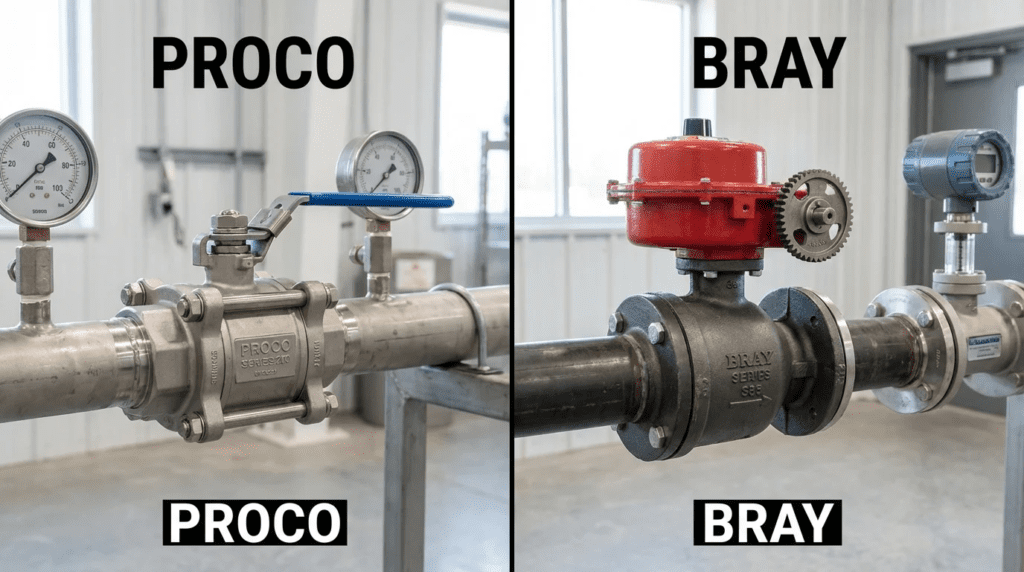
In the complex landscape of municipal water and wastewater treatment design, the “Bill of Materials” (BOM) is often the battleground where reliability meets budget. One of the frequent evaluation points for mechanical engineers and plant superintendents is the selection of piping specialties and isolation devices. When analyzing Proco vs Bray Ball Valves Equipment: Comparison & Best Fit, engineers are technically comparing two industry heavyweights that occupy distinct, yet overlapping, operational niches.
A surprising statistic in facility management reveals that while valves and piping appurtenances represent less than 10% of a plant’s capital expenditure (CAPEX), they account for nearly 40% of the maintenance budget (OPEX) over the facility’s lifecycle. Improper specification—confusing the application of a high-performance mechanical ball valve with a passive elastomeric check device—is a leading cause of premature failure and hydraulic inefficiencies.
Bray Controls is universally recognized for its dominance in rotary isolation valves (Butterfly and Ball), particularly in automated process lines. Conversely, Proco Products is the industry standard for elastomeric expansion joints and “duckbill” check valves. However, in modern plant design, these technologies often compete for the same space on the P&ID, particularly in pump discharge, backflow prevention, and chemical feed applications. This article provides a specification-grade analysis to help engineers navigate the Proco vs Bray Ball Valves Equipment: Comparison & Best Fit decision matrix, ensuring the right technology is applied to the right process stream.
How to Select and Specify: Proco vs Bray Ball Valves Equipment: Comparison & Best Fit
Selecting between a mechanical isolation solution (Bray) and an elastomeric control solution (Proco) requires a deep understanding of the process physics. The decision is rarely about “brand preference” and more about “physics of operation.”
Duty Conditions & Operating Envelope
The primary discriminator in the Proco vs Bray Ball Valves Equipment: Comparison & Best Fit analysis is the nature of the fluid and the required operation.
- Bray Ball Valves (Mechanical Isolation): These are best suited for high-pressure, clean-to-moderately-viscous fluids where positive shut-off is non-negotiable. If the line requires ANSI Class 150 or 300 ratings and operates at temperatures exceeding 250°F (121°C), the metal body and engineered seats (PTFE, RPTFE) of a Bray Series 30 or similar are required. They handle variable flow well but are susceptible to erosion in highly abrasive slurries if not specified with ceramic or hardened trims.
- Proco Equipment (Elastomeric/Check): Proco’s equipment, specifically the Series 700 ProFlex, excels in low-head, high-solids environments. In wastewater outfalls, stormwater, or sludge lines where mechanical hinges might foul, the passive elastomeric memory of Proco equipment offers superior reliability. However, they are limited by temperature (typically < 250°F depending on elastomer) and pressure ratings compared to metal ball valves.
Materials & Compatibility
Corrosion resistance drives the specification. Engineers must match the wetted parts to the media aggression.
- Chemical Compatibility: Bray ball valves offer stainless steel (316SS) or specialized alloy bodies with Teflon-based seats, ideal for harsh chemical dosing (e.g., Sodium Hypochlorite, Ferric Chloride). Proco relies on elastomers like EPDM, Neoprene, Hypalon, or Viton. While Viton is excellent for chemistry, the permeation resistance of a solid PTFE seat in a Bray valve is generally superior for concentrated oxidizers.
- Abrasion Resistance: For grit and sludge, Proco’s rubber construction absorbs kinetic energy and resists abrasion better than standard stainless steel. A Bray ball valve in grit service requires a V-port or specialized coating to prevent the ball from scoring, which leads to leakage.
Hydraulics & Process Performance
The hydraulic profile—specifically head loss and flow coefficient ($C_v$)—differs radically between these equipment types.
Bray Ball Valves: Full-port ball valves offer the highest $C_v$ of almost any valve type, presenting nearly zero obstruction to flow when open. This minimizes pump energy costs and allows for pigging/cleaning of lines. They are the preferred choice for pump suction isolation where Net Positive Suction Head (NPSH) is critical.
Proco Check/Isolation: Elastomeric valves introduce a cracking pressure (head required to open the valve) and maintain a slightly higher head loss profile due to the restriction of the “bill” or sleeve. While negligible in high-head pumped systems, this loss must be calculated in gravity flow or low-head stormwater systems to prevent upstream backing.
Installation Environment & Constructability
Space constraints in valve vaults often dictate equipment choice.
- Compactness: Proco check valves (Series 710/730) slip inside the pipe flange, requiring zero additional lay length. This is a massive advantage in retrofits.
- Actuation Space: Bray ball valves require space for the actuator (pneumatic or electric) and clearance for maintenance access. In tight skids, the “top-works” dimensions of the Bray assembly can be a limiting factor.
Reliability, Redundancy & Failure Modes
Understanding failure modes is critical for risk management (FMEA).
- Bray Failure Mode: Typically involves seat degradation (leaking by) or stem seizure. In automated versions, actuator failure is the most common issue. However, the valve can usually be manually overridden.
- Proco Failure Mode: Elastomer fatigue or inversion. Over time, the rubber loses “memory” and may not seal tight against backpressure. Catastrophic inversion (blowing the duckbill inside out) is rare but possible under extreme surge events if not properly sized.
Lifecycle Cost Drivers
When analyzing Proco vs Bray Ball Valves Equipment: Comparison & Best Fit, the Total Cost of Ownership (TCO) diverges based on maintenance.
Bray valves represent a higher CAPEX, especially with actuation, but offer 20+ years of service with seal replacements. Proco units have a lower initial cost and zero energy consumption (passive operation) but are generally considered consumable items with a 5-15 year replacement cycle depending on UV exposure and cycling frequency. The labor cost to replace a large diameter Proco valve (requiring complete line shutdown and flange disassembly) can outweigh the initial savings if the location is difficult to access.
Comparison Tables
The following tables provide a side-by-side engineering analysis. Table 1 focuses on the equipment attributes, while Table 2 assists in selecting the correct technology for specific plant applications.
| Feature / Attribute | Bray Ball Valves (Series 30/31/Tri-Lok) | Proco Equipment (Series 700/Expansion) |
|---|---|---|
| Primary Mechanism | Rotary Mechanical (Sphere with port) | Passive Elastomeric (Duckbill/Sleeve) |
| Flow Characteristics | High $C_v$, Full Port, Linear flow control (V-ball) | Variable restriction, Requires cracking pressure |
| Sealing Capability | ANSI Class IV to VI (Bubble Tight) | Drop-tight against backpressure, may weep at low head |
| Temperature Range | -20°F to 500°F+ (Metal/Graphite seats) | -40°F to 250°F (Standard Elastomers) |
| Maintenance Profile | Predictable wear; stem packing adjustment; seal kits | Zero routine maintenance; replace unit at end of life |
| Best Fit Application | Precise Isolation, Throttling, High Pressure | Backflow Prevention, Vibration Isolation, Slurries |
| Limitation | Susceptible to clogging in heavy stringy solids | Cannot provide positive lockout/isolation for safety |
| Application Scenario | Recommended Primary Equipment | Engineering Rationale |
|---|---|---|
| Raw Sewage Pump Isolation | Bray (Plug or Ball) | Requires positive mechanical shutoff for pump maintenance. Full port passes solids. |
| Pump Discharge Check Valve | Proco vs. Bray (Hybrid) | Use Proco (Series 700) for sludge to prevent clogging. Use Bray (Check) for clean water to minimize head loss. |
| Chemical Feed Dosing | Bray Ball Valve | Precision throttling and chemical compatibility of PTFE/Hastelloy is superior to elastomers. |
| Stormwater Outfall | Proco (Duckbill) | Passive operation requires no power; rubber resists saltwater/barnacles; no mechanical hinges to rust. |
| Piping Vibration Control | Proco (Expansion Joint) | Bray valves are rigid; Proco expansion joints (Series 200) are mandatory to protect pumps from flange stress. |
Engineer & Operator Field Notes
Real-world performance often deviates from catalog curves. The following insights are derived from field audits and operator logs regarding Proco vs Bray Ball Valves Equipment: Comparison & Best Fit.
Commissioning & Acceptance Testing
When commissioning Bray ball valves, the Site Acceptance Test (SAT) must verify the actuator stops. A common issue is the actuator over-traveling, causing the ball to rotate past full open, creating turbulence and edge wear. Ensure positioners (4-20mA) are calibrated to the actual open/closed resistance, not just the theoretical specs.
For Proco equipment, specifically expansion joints and check valves, the critical check is “Control Rod” installation. Operators often mistake control rods for shipping bolts and remove them. Without control rods, a Proco expansion joint can over-extend during a pressure surge, leading to catastrophic rupture. Verification of torque specs on the mating flanges is also vital; over-torquing can crush the elastomer flange bead, compromising the seal before the plant even starts.
Common Specification Mistakes
A frequent error in RFP documents is specifying “Bubble Tight Shutoff” for a Proco duckbill valve. While they seal remarkably well against backpressure, they are not isolation valves. They cannot be used for Lockout/Tagout (LOTO) safety isolation. If a line needs to be entered for maintenance, a mechanical isolation valve (like a Bray Series 30 or 31) must be installed upstream of the Proco unit.
Conversely, specifying a standard floating ball valve (Bray Series 30) for high-pressure throttling service is a mistake. Floating ball valves are designed for On/Off service. Throttling causes high velocity erosion on the seat. For control applications, specify a Trunnion mounted ball or a V-Port segment valve.
O&M Burden & Strategy
Bray Maintenance:
- Quarterly: Cycle infrequently used valves to prevent stem seizure.
- Annually: Inspect stem packing for leaks; tighten gland nuts if necessary.
- 5-Year: Inspect actuator seals and electrical connections.
Proco Maintenance:
- Semi-Annually: Visual inspection for cracking, checking, or UV damage on the elastomer.
- Annually: Inspect flange bolts for proper torque (elastomers can relax over time, leading to loose bolts).
- Critical Spare Parts: Proco units are generally not repairable; the “spare” is a full replacement unit. Bray valves should have a seat/seal kit on the shelf.
Design Details & Calculations
Sizing Logic & Methodology
Sizing methodology differs fundamentally between these two equipment classes.
Sizing Bray Ball Valves ($C_v$ Method)
Ball valves are sized based on the Flow Coefficient ($C_v$), defined as the number of gallons of water per minute that will flow through the valve with a 1 psi pressure drop.
$$ Delta P = SG times left( frac{Q}{C_v} right)^2 $$
Where:
$Delta P$ = Pressure Drop (psi)
$SG$ = Specific Gravity (1.0 for water)
$Q$ = Flow Rate (GPM)
$C_v$ = Valve Flow Coefficient
Design Goal: Select a valve size where the $Delta P$ is acceptable (typically < 2-3 psi) at maximum flow. Often, a ball valve can be one size smaller than the pipe diameter without significant head loss, saving CAPEX.
Sizing Proco Check Valves (Velocity Method)
Proco valves are sized primarily on velocity. The elastomeric bill requires a specific velocity to open fully.
- Minimum Velocity: Typically 2-4 ft/sec is required to fully open the valve and minimize head loss.
- Maximum Velocity: velocities > 10-12 ft/sec can cause excessive vibration and abrasion on the rubber.
Designers must calculate the head loss not just by $C_v$, but by consulting the manufacturer’s “cracking pressure” and “head loss vs. flow” curves, which are non-linear due to the changing geometry of the opening bill.
Standards & Compliance
Ensure your specification references the correct standards:
- Bray (Ball Valves): API 607 (Fire Safe), ASME B16.34 (Valves Flanged, Threaded), NSF-61 (Drinking Water suitability – Critical for potable applications), MSS SP-110.
- Proco (Elastomers): ANSI/AWWA C508 (Check Valves – relevant sections), ASTM D-2000 (Rubber classification). Ensure EPDM materials are strictly specified for Chloramine resistance in treated water.
Frequently Asked Questions
What is the primary difference in application between Proco and Bray equipment?
The primary distinction in the Proco vs Bray Ball Valves Equipment: Comparison & Best Fit discussion is active vs. passive control. Bray specializes in mechanical, rotary valves (Ball/Butterfly) used for positive isolation, throttling, and automated process control. Proco specializes in passive elastomeric equipment (Expansion Joints, Duckbill Check Valves) used for vibration absorption, flexible connections, and backflow prevention without mechanical actuation.
Can a Proco check valve replace a Bray actuated ball valve for pump protection?
In some cases, yes. A Proco Series 700 check valve can replace a mechanical check valve or an actuated valve used strictly for backflow prevention. It offers lower maintenance (no moving parts) and clog resistance. However, it cannot replace a Bray ball valve if the application requires leak-tight isolation for maintenance or the ability to stop flow against forward pressure.
How do maintenance costs compare between Bray ball valves and Proco rubber valves?
Bray ball valves typically have higher upfront costs and potential actuator maintenance costs but can last 20+ years with seal replacements. Proco rubber valves generally have lower capital costs and zero routine maintenance but are considered consumable items with a shorter total lifespan (7-15 years), necessitating full replacement rather than repair.
Are Proco valves suitable for potable water applications?
Yes, provided they are specified with NSF-61 certified elastomers. Proco offers materials compliant with drinking water standards. Similarly, Bray offers NSF-61 certified ball valves with specific seat and body materials. Always verify the certification for the specific model number being purchased.
Why would an engineer specify both Bray and Proco in the same piping run?
It is best practice to use them in tandem. A typical pump discharge piping run will include a Proco expansion joint (to isolate pump vibration from the pipe) and a Proco check valve (to prevent backflow), followed by a Bray ball or butterfly valve (to isolate the entire line for maintenance). This utilizes the “Best Fit” strength of each manufacturer.
Conclusion
Key Takeaways for Decision Makers
- Different Tools for Different Jobs: Use Bray Ball Valves for high-pressure isolation and precise flow control. Use Proco for backflow prevention in slurries/stormwater and vibration isolation.
- Material Matters: Specify metal/PTFE (Bray) for high temperatures and harsh chemistry. Specify Elastomers (Proco) for abrasion resistance and passive operation.
- Safety First: Never rely on a Proco duckbill for LOTO (Lockout/Tagout). Always pair it with a mechanical isolation valve like a Bray Series 30.
- Head Loss: Bray Full Port Ball Valves offer the lowest head loss. Proco valves introduce a minor restriction that must be calculated in gravity systems.
- Standardization: Standardize on Bray for the “Valve” schedule and Proco for the “Piping Specialties” schedule to streamline spare parts inventory.
Ultimately, the Proco vs Bray Ball Valves Equipment: Comparison & Best Fit analysis resolves not into a winner-takes-all scenario, but into an integrated piping design strategy. Successful municipal and industrial plants utilize Bray’s mechanical precision to manage flow and isolation, while deploying Proco’s elastomeric resilience to manage vibration, surge, and backflow.
For the specifying engineer, the goal is to avoid forcing a technology into an application where it is weak. Avoid mechanical ball valves in static, low-head outfalls where they will seize from lack of use. Avoid elastomeric valves in high-pressure, high-temperature process steam lines. By acknowledging the distinct engineering virtues of both Bray and Proco, utilities can achieve a hydraulic system that balances performance, safety, and 20-year lifecycle value.