
Proco vs Bray Ball Valves Equipment: Comparison & Best Fit
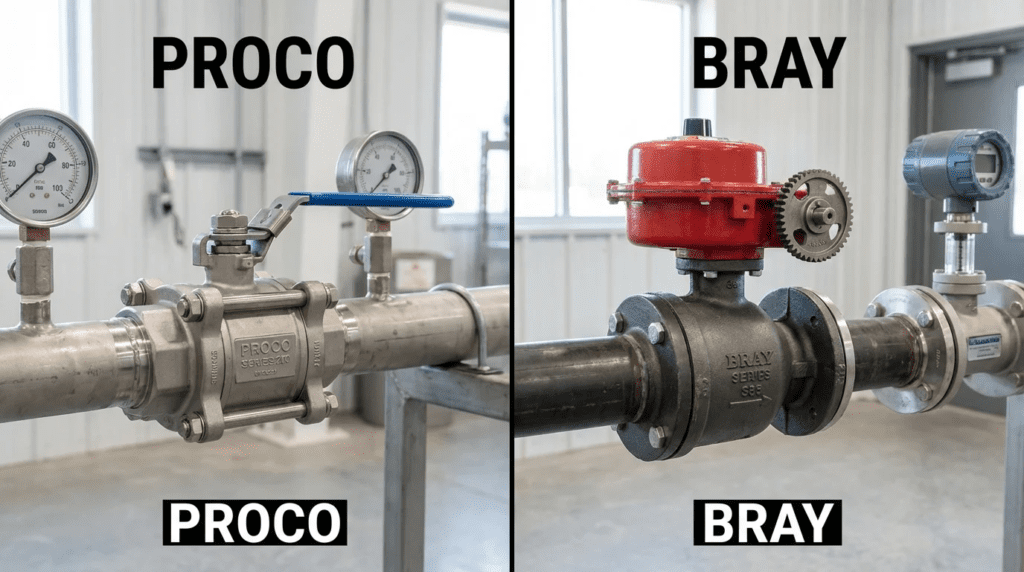
Proco vs Bray: Isolation Valves and Elastomeric Backflow Devices Compared
Introduction
Engineers comparing Proco and Bray are not comparing two versions of the same product. Bray Controls manufactures rotary isolation valves — butterfly and ball — for automated process lines. Proco Products manufactures rubber expansion joints and elastomeric duckbill check valves. Proco does not make ball valves, and anyone searching for a head-to-head on that basis will find the premise does not hold.
What is worth comparing is where these two technologies compete for the same position on a P&ID: pump discharge, backflow prevention, and vibration isolation. That is a real specification decision, and getting it wrong produces either a seized valve in a static outfall or a torn elastomer in a service that needed positive shutoff. This article sets out how to make that choice.
Manufacturer positioning across the wider category is covered in our overview of the top OEMs for ball valves.
How to Select and Specify
The decision is about physics of operation, not brand preference. A mechanical ball valve and a passive elastomeric check device do different jobs, and only one of them can isolate a line for maintenance.
Duty Conditions and Operating Envelope
- Bray rotary valves (mechanical isolation): Suited to applications where positive shut-off is required, where the line must be isolated for maintenance, or where throttling and automated control are needed. Metal bodies with engineered seats handle higher pressures and temperatures than elastomeric devices. In abrasive slurries, standard trim will erode and hardened or specialised trim should be specified.
- Proco elastomeric devices (passive backflow and vibration control): The ProFlex duckbill check valves excel in low-head, high-solids service — outfalls, stormwater, sludge lines — where mechanical hinges foul and metal components seize or corrode. They operate without power, actuation, or moving parts. Their limits are temperature and pressure, both lower than metal valves.
Materials and Compatibility
- Chemical service: Bray offers stainless and alloy bodies with PTFE-based seats, suited to chemical dosing lines. Proco relies on elastomers — EPDM, neoprene, Viton and similar. For concentrated oxidisers, a solid PTFE seat generally outperforms an elastomer on permeation resistance.
- Abrasion: In grit and sludge, rubber absorbs impact energy and resists abrasion better than standard stainless steel. A metal ball in grit service will score, and scoring means leakage.
- Potable water: Both manufacturers offer NSF/ANSI 61 certified options. Verify certification for the specific model and material combination rather than assuming it applies across a product line.
Hydraulics
Full-port ball valves present almost no obstruction when open, giving them among the highest flow coefficients of any valve type. This matters on pump suction where NPSH is tight, and in any line where pumping energy is a significant lifecycle cost.
Duckbill check valves require a cracking pressure to open and retain some head loss across the sleeve. In pumped systems this is usually negligible. In gravity or low-head stormwater systems it must be calculated, or the line will back up upstream.
Installation and Constructability
- Space: Proco’s slip-on and in-line check valve styles add little or no lay length, a real advantage in retrofits and crowded vaults.
- Actuation clearance: An actuated Bray valve needs space for the actuator and access for maintenance. On tight skids the top-works dimension is often the binding constraint.
Failure Modes
- Mechanical valves: Seat degradation causing leak-by, or stem seizure. On automated units, actuator failure is the most common issue, though the valve can usually be operated manually.
- Elastomeric devices: Fatigue and loss of elastic memory, so the bill no longer seals tightly against backpressure. Inversion under extreme surge is rare but possible if sizing is wrong.
Lifecycle Cost
Mechanical valves carry higher capital cost, particularly with actuation, but can give decades of service with seal replacements. Elastomeric devices have lower initial cost and consume no energy, but are consumable items replaced rather than repaired. Where a large-diameter unit sits in a difficult location, the labour and shutdown cost of replacement can outweigh the initial saving.
Comparison
| Attribute | Bray rotary valves | Proco elastomeric devices |
|---|---|---|
| Mechanism | Rotary mechanical — ball or disc | Passive elastomeric — duckbill or sleeve |
| Flow | High flow coefficient; full port available | Requires cracking pressure; variable restriction |
| Sealing | Tight shutoff, bidirectional | Seals against backpressure; may weep at very low head |
| Isolation for maintenance | Yes — suitable for lockout | No — cannot provide positive isolation |
| Solids handling | Full port passes solids; stringy material can catch | Excellent — no hinges or mechanism to foul |
| Power | Required if actuated | None — fully passive |
| Maintenance | Stem packing, seal kits, actuator service | None routine; replace unit at end of life |
| Application | Appropriate technology | Rationale |
|---|---|---|
| Raw sewage pump isolation | Mechanical valve (ball or plug) | Positive shutoff required for pump maintenance |
| Pump discharge backflow, sludge | Elastomeric duckbill | No mechanism to clog; non-slam closure |
| Chemical feed dosing | Mechanical valve, PTFE seat | Throttling control and chemical compatibility |
| Stormwater or tidal outfall | Elastomeric duckbill | Passive, no power, resists marine growth and corrosion |
| Pump vibration isolation | Rubber expansion joint | Protects pump and pipe flanges from stress; no valve performs this function |
Field Notes
Commissioning
On actuated valves, site acceptance testing must verify actuator stops. Over-travel rotates the ball or disc past full open, creating turbulence and edge wear. Positioners should be calibrated against actual open and closed resistance rather than theoretical values.
On expansion joints, the critical check is control rod installation. Operators regularly mistake control rods for shipping hardware and remove them. Without them, a joint can over-extend during a surge and rupture. Flange torque matters equally — over-torquing crushes the elastomer bead and compromises the seal before startup.
Specification Mistakes
The most consequential error is specifying bubble-tight shutoff for a duckbill valve. These seal well against backpressure but they are not isolation valves and cannot be used for lockout/tagout. If a line will be entered for maintenance, a mechanical isolation valve must be installed upstream of the check device. This is a safety requirement, not a preference.
The converse error is specifying a floating ball valve for throttling service. Floating ball designs are intended for on/off duty; throttling drives high-velocity erosion across the seat. For control applications, specify a trunnion-mounted ball or a segmented V-port design.
Maintenance
Mechanical valves:
- Cycle infrequently used valves quarterly to prevent stem seizure
- Inspect stem packing annually; adjust gland nuts as needed
- Inspect actuator seals and electrical connections on a multi-year cycle
- Keep seat and seal kits on the shelf
Elastomeric devices:
- Inspect semi-annually for cracking, checking and UV damage
- Check flange bolt torque annually, as elastomers relax over time
- Hold a full replacement unit as the spare — these are not repairable
Design Details
Sizing Mechanical Valves
Ball and butterfly valves are sized on flow coefficient, the flow in gallons per minute producing a one psi pressure drop:
ΔP = SG × (Q / Cv)²
where ΔP is pressure drop in psi, SG is specific gravity, Q is flow in gpm and Cv is the valve flow coefficient. Select a size where pressure drop is acceptable at maximum flow, typically under two to three psi for isolation duty. A valve one size below line diameter is often acceptable without meaningful head loss.
Sizing Duckbill Check Valves
These are sized on velocity rather than Cv, because the opening geometry changes as the bill opens:
- Minimum velocity: sufficient flow is needed to open the valve fully and minimise head loss
- Maximum velocity: excessive velocity causes vibration and accelerates abrasion
Head loss must be read from the manufacturer’s cracking pressure and head-loss curves, which are non-linear. A Cv-based calculation will not represent the device correctly.
Standards
- Mechanical valves: ASME B16.34, MSS SP-110, and NSF/ANSI 61 for potable service
- Elastomeric check valves: relevant sections of AWWA C508, ASTM D2000 for rubber classification, and NSF/ANSI 61 where potable
- Specify EPDM where chloramine resistance is required in treated water
Frequently Asked Questions
Does Proco make ball valves?
No. Proco Products manufactures rubber and PTFE expansion joints, braided flexible connectors, pipe penetration seals, and the ProFlex series of rubber duckbill check valves. Searches pairing Proco with ball valves are comparing products that do not exist in their range. The meaningful comparison is between mechanical isolation valves and passive elastomeric backflow devices.
Can a duckbill check valve replace an actuated ball valve?
Only where the ball valve was performing a backflow prevention function. A duckbill offers lower maintenance and better clog resistance in that role. It cannot replace a valve needed for leak-tight isolation, for stopping flow against forward pressure, or for any application requiring lockout.
How do maintenance costs compare?
Mechanical valves have higher upfront and actuator costs but long service life with seal replacement. Elastomeric devices have lower capital cost and no routine maintenance, but are consumables requiring full replacement rather than repair. The crossover depends heavily on access — replacing a large unit in a deep vault is expensive regardless of the unit price.
Why specify both in the same piping run?
Because they do different jobs. A typical pump discharge includes an expansion joint to isolate vibration, a check device to prevent backflow, and a mechanical isolation valve to allow the line to be shut down for maintenance. This is complementary specification, not competition.
Conclusion
Key Takeaways
- Different product categories: Bray makes rotary isolation valves; Proco makes expansion joints and duckbill check valves. They are not substitutes.
- Safety boundary: Never rely on a duckbill for lockout. Pair it with a mechanical isolation valve upstream.
- Solids: Elastomeric devices outperform mechanical checks in sludge, grit and stormwater.
- Head loss: Full-port ball valves offer the lowest restriction. Duckbills introduce a cracking pressure that must be calculated in gravity systems.
- Consumable versus repairable: Budget elastomeric devices as replacement items, mechanical valves as rebuildable assets.
The useful question is not which manufacturer is better but which mechanism belongs in each position. Mechanical valves manage isolation, throttling and control. Elastomeric devices manage backflow, surge and vibration in services that would foul or seize a mechanism. Well-designed pump stations use both, and the specification errors that cause real trouble come from asking one to do the other’s job.
Comparable evaluations across the category are covered in our analyses of Singer Valve and AVK equipment and of Ross Valve and Val-Matic ball valves.