
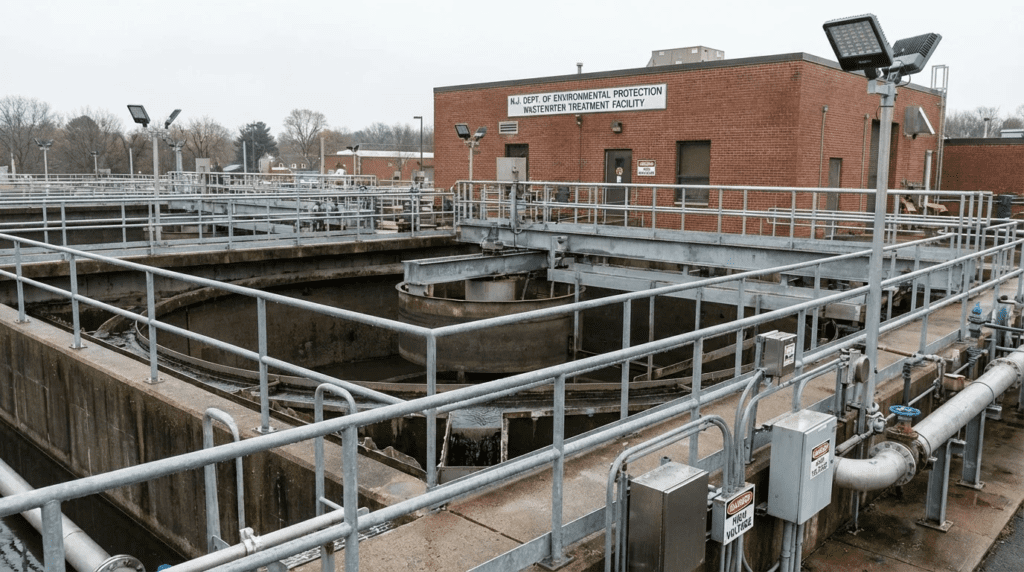
Introduction: The State of New Jersey’s Water Infrastructure
New Jersey represents one of the most complex and dense water infrastructure environments in the United States. As the most densely populated state in the nation, New Jersey’s wastewater sector manages a massive hydraulic load through a network of approximately 260 dedicated wastewater treatment plants (WWTPs). The state’s infrastructure is a study in contrasts: it features some of the oldest combined sewer systems in the Northeast alongside cutting-edge resource recovery facilities piloting net-zero energy technologies.
The regulatory environment is governed strictly by the New Jersey Department of Environmental Protection (NJDEP). Currently, the sector is pivoting from a focus solely on sanitary treatment to a broader mandate encompassing wet weather management (CSO Long Term Control Plans), climate resilience (post-Superstorm Sandy hardening), and nutrient reduction to protect sensitive estuaries like Barnegat Bay. The state treats approximately 1.5 billion gallons of wastewater daily, serving a population of over 9.2 million. For consulting engineers and equipment vendors, New Jersey offers a robust market driven by consent decrees, the New Jersey Water Bank (I-Bank) financing, and urgent modernization needs.
Recent Developments & Infrastructure Drivers
Over the last three years, the New Jersey wastewater sector has been defined by three primary drivers: Climate Resilience, CSO Mitigation, and Emerging Contaminants.
Following the devastation of Superstorm Sandy, major regional authorities like the Passaic Valley Sewerage Commission (PVSC) and the Bayshore Regional Sewerage Authority have engaged in massive “harding” projects. These include the construction of flood walls, elevation of critical electrical switchgear, and the installation of standby power generation facilities capable of running plants independently from the grid during catastrophic failures.
Simultaneously, the NJDEP has mandated Long Term Control Plans (LTCPs) for 21 communities with Combined Sewer Overflows. This has triggered a wave of capital spending estimated at over $2 billion over the next decade. Projects involve gray infrastructure (storage tanks, tunnel expansions) and green infrastructure (rain gardens, permeable pavement) to reduce hydraulic peaking. Furthermore, New Jersey has been a proactive leader in regulating PFAS (per- and polyfluoroalkyl substances), pushing facilities to investigate advanced treatment technologies such as Granular Activated Carbon (GAC) and Ion Exchange (IX) ahead of federal mandates.
Funding for these initiatives is heavily supported by the New Jersey Infrastructure Bank (I-Bank) in partnership with the NJDEP, leveraging State Revolving Funds (SRF) and recent allocations from the federal Infrastructure Investment and Jobs Act (IIJA).
Top 20 Largest Wastewater Treatment Plants in New Jersey
The following list ranks New Jersey’s wastewater treatment facilities by Design Capacity (MGD). These facilities represent the backbone of the state’s sanitary infrastructure.
| Rank | Plant Name | Location | Design Capacity (MGD) | Population Served | Operating Authority |
|---|---|---|---|---|---|
| 1 | Newark Bay Treatment Plant | Newark | 330 MGD | 1.5 Million | Passaic Valley Sewerage Commission (PVSC) |
| 2 | Middlesex County Central WWTP | Sayreville | 147 MGD | 800,000 | Middlesex County Utilities Authority |
| 3 | Bergen County UA Water Pollution Control Facility | Little Ferry | 109 MGD | 550,000 | Bergen County Utilities Authority |
| 4 | Joint Meeting of Essex & Union Counties WWTP | Elizabeth | 85 MGD | 500,000 | JMEUC |
| 5 | Delaware No. 1 WPCF | Camden | 80 MGD | 500,000 | Camden County MUA (CCMUA) |
| 6 | Trenton Sewer Utility | Trenton | 20 MGD | 225,000 | City of Trenton/TMW |
| 7 | Rahway Valley Sewerage Authority | Rahway | 40 MGD | 250,000 | Rahway Valley SA |
| 8 | Ocean County UA – Northern WPCF | Brick Twp | 32 MGD | 250,000 | Ocean County Utilities Authority |
| 9 | Atlantic County Regional WPCF | Atlantic City | 40 MGD | 230,000 | Atlantic County Utilities Authority |
| 10 | Secaucus/North Bergen MUA | North Bergen | 29 MGD | 200,000 | North Bergen MUA |
| 11 | Ocean County UA – Central WPCF | Bayville | 28 MGD | 200,000 | Ocean County Utilities Authority |
| 12 | Somerset-Raritan Valley SA | Bridgewater | 23 MGD | 180,000 | Somerset-Raritan Valley SA |
| 13 | Western Monmouth Utilities Authority | Manalapan | 26 MGD | 165,000 | Western Monmouth UA |
| 14 | Two Bridges Sewerage Authority | Lincoln Park | 20 MGD | 150,000 | Two Bridges SA |
| 15 | Bayshore Regional SA | Union Beach | 16 MGD | 100,000 | Bayshore Regional SA |
| 16 | Hamilton Township WPCF | Hamilton | 16 MGD | 90,000 | Hamilton Township MUA |
| 17 | Ewing-Lawrence Sewerage Authority | Lawrenceville | 16 MGD | 85,000 | Ewing-Lawrence SA |
| 18 | Stony Brook Regional SA | Princeton | 14 MGD | 80,000 | Stony Brook Regional SA |
| 19 | Gloucester County UA | West Deptford | 27 MGD | 150,000 | Gloucester County UA |
| 20 | Parsippany-Troy Hills WWTP | Parsippany | 16 MGD | 60,000 | Township of Parsippany-Troy Hills |
Detailed Profiles: Top 5 Largest Facilities
1. Newark Bay Treatment Plant (PVSC)
- Location: Newark, Essex County, NJ
- Design Capacity: 330 MGD (Peak wet weather flow > 550 MGD)
- Service Area: 48 municipalities across Bergen, Essex, Hudson, Union, and Passaic counties.
- Treatment Process: The plant utilizes high-purity oxygen activated sludge. Processes include coarse bar screens, aerated grit chambers, primary clarifiers (12 units), secondary aeration tanks (12 units), and final clarifiers using polymer addition. Disinfection is achieved via sodium hypochlorite followed by dechlorination.
- Infrastructure Highlights: PVSC operates one of the largest sludge management programs on the East Coast. It accepts liquid waste (trucked-in waste) for revenue generation. The facility is currently undergoing a massive resiliency upgrade, including the “Standby Power Generation Facility” to prevent outages during storm surges.
- Compliance: Operates under a strict NJPDES permit discharging into the New York/New Jersey Harbor Estuary.
2. Middlesex County Central WWTP (MCUA)
- Location: Sayreville, Middlesex County, NJ
- Design Capacity: 147 MGD
- Service Area: Central New Jersey/Lower Raritan River Basin.
- Treatment Process: A pure oxygen activated sludge plant. The facility includes 6 primary clarifiers and 8 secondary clarifiers. It utilizes 35-foot deep aeration tanks for high-efficiency biological treatment.
- Infrastructure Highlights: MCUA is notable for its “Meadowlife” biosolids product. The authority dries sludge pellets for beneficial reuse as fertilizer. The plant also features a 6.7 MW Landfill Gas-to-Energy facility nearby that helps power operations.
3. Bergen County UA (Little Ferry)
- Location: Little Ferry, Bergen County, NJ
- Design Capacity: 109 MGD
- Service Area: 47 municipalities in Bergen County.
- Treatment Process: Secondary treatment using activated sludge. The facility discharges into the Hackensack River.
- Infrastructure Highlights: BCUA has heavily invested in Combined Heat and Power (CHP) systems, utilizing biogas from anaerobic digesters to offset energy costs. They are also piloting projects related to fats, oils, and grease (FOG) receiving to boost gas production.
4. Joint Meeting of Essex & Union Counties (JMEUC)
- Location: Elizabeth, Union County, NJ
- Design Capacity: 85 MGD
- Service Area: Densely populated urban corridor including Elizabeth and Newark suburbs.
- Treatment Process: Conventional activated sludge with recent upgrades to screenings and grit removal to protect downstream equipment. Discharge is to the Arthur Kill.
- Infrastructure Highlights: Notable for its Co-Generation Facility which uses methane gas from the sludge digestion process to produce electricity and heat for the treatment plant.
5. Delaware No. 1 WPCF (Camden County MUA)
- Location: Camden, Camden County, NJ
- Design Capacity: 80 MGD
- Service Area: 37 municipalities in Camden County.
- Treatment Process: Pure oxygen activated sludge system. Discharges to the Delaware River.
- Infrastructure Highlights: CCMUA is a national leader in sustainability. The plant is energy independent during dry weather flows, utilizing solar panels, biogas cogeneration, and effluent heat recovery. They utilize a fluidized bed incinerator for sludge volume reduction.
Regional & Municipal Tiers
Regional Leaders (Rank 6-10): Authorities like Ocean County UA and Atlantic County UA dominate the coastal regions, utilizing ocean outfalls and advanced pumping stations to manage flows in tourist-heavy areas. ACUA is particularly noted for its collocated wind farm (Jersey-Atlantic Wind Farm) which powers the treatment plant.
Major Municipal Plants (Rank 11-20): Facilities like Trenton Sewer Utility and Hamilton Township operate large-scale municipal systems. Many of these older municipal plants are currently the focus of significant CSO abatement projects.
Plants with Approved Budgets & Expansion Projects
Driven by the availability of low-interest loans from the NJ I-Bank and federal grants, New Jersey is seeing a surge in capital improvement projects. Below are key projects categorized by status.
A. Major Projects Under Construction (2024-2026)
PVSC Standby Power Generation Facility (SPGF)
- Location: Newark, NJ
- Project Scope: Construction of a 34-megawatt standby power plant to ensure the facility continues treatment during grid failures (a lesson learned from Superstorm Sandy).
- Total Budget: Approx. $180 Million
- Funding: FEMA Public Assistance grants (90%) and PVSC capital funds.
- Timeline: Construction active; expected completion late 2025/early 2026.
- Key Contractors: Design by AECOM; Construction management by Black & Veatch.
- Drivers: Climate resilience and prevention of raw sewage discharge during storm surges.
North Hudson Sewerage Authority – River Road CSO Improvements
- Location: West New York/Weehawken, NJ
- Project Scope: Construction of solids and floatables screening facilities and wet weather pump stations to mitigate CSO discharges into the Hudson River.
- Total Budget: $45 Million (Phase dependent)
- Funding: NJ I-Bank Loans (SRF).
- Technology: Netting systems and vortex separators.
- Current Status: Various phases in construction.
Ocean County Utilities Authority (OCUA) – Outfall Replacement
- Location: Barrier Island/Atlantic Ocean
- Project Scope: Replacement and rehabilitation of ocean outfall infrastructure to ensure hydraulic capacity and structural integrity.
- Total Budget: ~$30 Million
- Funding: Revenue Bonds and NJ I-Bank.
- Drivers: Aging infrastructure (corrosion) and hydraulic constraints.
B. Projects in Design/Planning Phase (2025-2027)
- Joint Meeting (JMEUC) Flood Mitigation: ~$35M planned for flood protection walls and elevating substations. Funding pending via I-Bank.
- Trenton Water Works/Sewer Utility Lead & CSO: Trenton is under administrative orders to address water quality and CSOs. Expect capital planning exceeding $100M over the next 5 years for distribution and collection system upgrades.
- Middlesex County (MCUA) Pump Station Upgrades: Design phases for Edison and Sayreville pump station rehabilitations to handle increased flows and replace 40-year-old mechanicals.
C. Summary Statistics: NJ Capital Market
- Total Active Capital Investment: >$650 Million currently active or bidding.
- Primary Project Drivers:
- Resilience/Hardening: 40%
- CSO Abatement: 35%
- Asset Renewal: 25%
- Funding Breakdown: NJ I-Bank is the dominant lender, financing nearly 70% of municipal projects due to favorable terms and principal forgiveness options.
Regulatory & Compliance Landscape
The New Jersey Department of Environmental Protection (NJDEP) is the primary regulatory body. New Jersey often sets standards stricter than federal EPA guidelines.
- CSO Long Term Control Plans (LTCPs): 21 permit holders (including PVSC, North Hudson, and Hackensack) must implement approved plans to reduce overflow events. This is the single largest regulatory driver for engineering work in the state.
- PFAS Regulations: NJDEP has established Maximum Contaminant Levels (MCLs) for PFOA (14 ppt) and PFOS (13 ppt). While primarily affecting drinking water, wastewater plants are now required to monitor influent/effluent and investigate industrial sources of these “forever chemicals.”
- Nutrient Standards: Coastal facilities discharging near Barnegat Bay are under increasing pressure to reduce Nitrogen loadings to prevent eutrophication, driving investments in denitrification filters and anoxic zones.
Infrastructure Challenges & Opportunities
Aging Infrastructure: Much of New Jersey’s sewer collection system is over 80 years old. Inflow and Infiltration (I&I) is a massive challenge, causing plants to hit hydraulic capacity during rain events even if biological capacity is sufficient. Opportunity exists for trenchless technology (CIPP) vendors.
Energy Neutrality: With high energy costs in the Northeast, facilities like CCMUA are proving that energy neutrality is possible. There is a growing market for anaerobic digestion enhancements, biogas conditioning systems, and solar integration.
Workforce: NJ faces a “Silver Tsunami” of retiring operators. Automated control systems (SCADA upgrades) are being deployed not just for efficiency, but to bridge the knowledge gap left by retiring senior staff.
Technology Trends in New Jersey
- Peracetic Acid (PAA): Several NJ plants are piloting or switching to PAA for disinfection to avoid the safety hazards of chlorine gas and the aquatic toxicity of chlorinated byproducts.
- Advanced Digestion: Thermal Hydrolysis Processes (THP) are being evaluated by larger authorities to improve biogas yield and reduce class A biosolids volume.
- Flood Walls & Submersible Gear: “Hardening” technology—including submarine doors for pump stations and raising MCCs (Motor Control Centers) above the 500-year flood plain—is standard spec for post-Sandy renovations.
Directory of Facilities
Browse our directory of water and wastewater treatment plants in New Jersey. Click on a facility for detailed contact and technical information.
Regional Authorities (>50 MGD)
- Passaic Valley Sewerage Commission (PVSC)
- Middlesex County Utilities Authority (MCUA)
- Bergen County Utilities Authority (BCUA)
- Joint Meeting of Essex & Union Counties
- Camden County MUA
Large Municipalities (10-50 MGD)
- Trenton Sewer Utility
- Rahway Valley Sewerage Authority
- Atlantic County Utilities Authority
- Gloucester County Utilities Authority
- Secaucus MUA
Resources for Engineers & Operators
- New Jersey Water Environment Association (NJWEA): The primary professional organization, hosting the annual Atlantic City conference—the largest water conference in the Northeast.
- New Jersey Infrastructure Bank (I-Bank): The go-to source for low-interest financing for environmental infrastructure projects.
- NJDEP Division of Water Quality: The regulatory authority for NJPDES permits.
Frequently Asked Questions
- What is the largest wastewater treatment plant in New Jersey?
- The Passaic Valley Sewerage Commission (PVSC) Newark Bay Treatment Plant is the largest, with a design capacity of 330 MGD and wet weather handling capabilities exceeding 500 MGD.
- How many wastewater treatment plants are in New Jersey?
- There are approximately 260 dedicated wastewater treatment plants in New Jersey, ranging from massive regional authorities to small package plants serving private communities.
- What is the NJ I-Bank?
- The NJ Infrastructure Bank (I-Bank) is an independent state financing authority that provides low-interest loans to municipalities and utilities for water and wastewater infrastructure projects, often in partnership with the NJDEP.
- Are NJ treatment plants regulating PFAS?
- Yes, NJDEP has some of the strictest PFAS standards in the country. Wastewater plants are currently required to monitor for PFOA, PFOS, and PFNA, and many are conducting source tracking to identify industrial contributors.
- What funding is available for CSO projects in NJ?
- Funding is primarily available through the NJ I-Bank, which manages the Clean Water State Revolving Fund (CWSRF). Recent federal allocations from the IIJA have increased the amount of principal forgiveness (grants) available for CSO communities.