
Westfall Manufacturing vs SPX Lightnin for Mixers: Pros/Cons & Best-Fit Applications
Introduction
In the design of water and wastewater treatment facilities, the rapid and uniform dispersion of chemicals—coagulants, disinfectants, and neutralizing agents—is a fundamental determinant of process efficiency. A well-documented inefficiency in the municipal sector is chemical overdosing to compensate for poor mixing, which inflates chemical spend without improving the underlying process. For engineers and plant directors, the choice of mixing technology is not merely a component selection; it is a critical control point that dictates operational expenditure (OPEX) for the life of the facility.
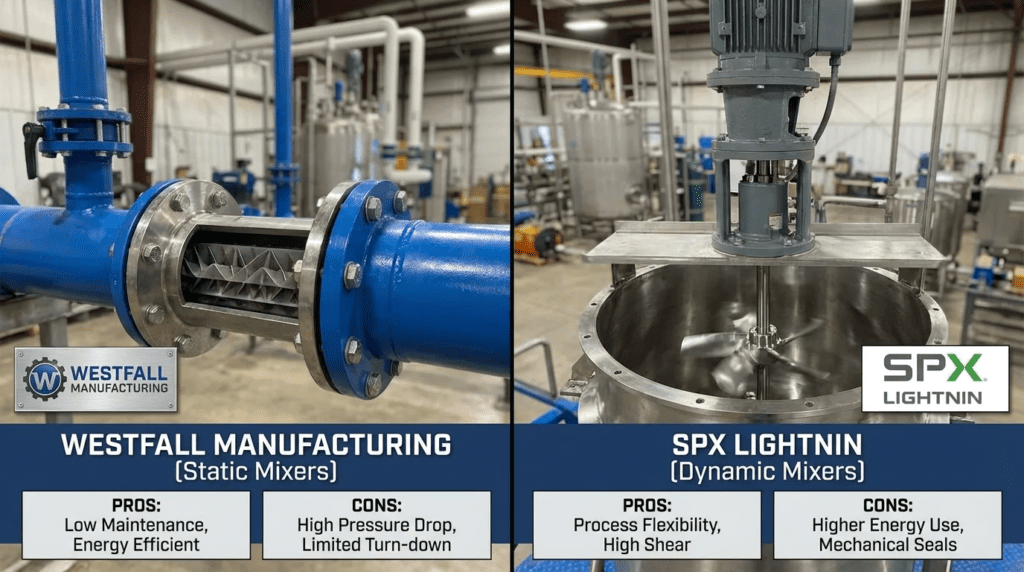
When evaluating market leaders, engineers frequently encounter a strategic decision regarding Westfall Manufacturing vs SPX Lightnin for Mixers: Pros/Cons & Best-Fit Applications. This comparison is rarely a straightforward “apples-to-apples” evaluation of two similar machines. Instead, it represents a choice between two distinct engineering philosophies: the high-efficiency static (motionless) mixing approach championed by Westfall Manufacturing, and the robust dynamic (mechanical) mixing approach exemplified by SPX Lightnin.
These technologies find their homes in critical unit processes such as flash mixing, flocculation, chlorination, and dechlorination. However, the operating environments differ significantly. Westfall’s static solutions are predominant in space-constrained pipeline applications where head loss management is paramount. Conversely, SPX Lightnin’s dynamic mixers dominate open basins, solids suspension applications, and scenarios where flow variability (turndown) renders static mixing ineffective. A poor specification here can lead to disastrous consequences: insufficient G-values (velocity gradients), short-circuiting, massive energy penalties from unnecessary head loss, or mechanical failures in harsh environments.
This article provides a rigorous, engineer-to-engineer analysis of these two approaches. Mixers sit within the wider family of water treatment equipment, but they are unusual in that two fundamentally different machine architectures compete for the same process duty—a situation that makes the manufacturer comparison inseparable from the technology comparison. It moves beyond catalog data to explore the fluid mechanics, reliability profiles, and total cost of ownership (TCO) inherent in selecting between static and dynamic mixing strategies for municipal and industrial applications.
Related Mixer Manufacturer Comparisons
The static-versus-dynamic framing that structures this article covers two of the three manufacturers that most commonly appear on a municipal mixer shortlist. Philadelphia Mixing Solutions occupies a third position that neither of the above fully represents, and the pairwise comparisons below examine what changes when it enters the evaluation.
Westfall and Philadelphia Mixing
The comparison of Westfall Manufacturing vs Philadelphia Mixing for mixers pits a static, inline philosophy against a dynamic, tank-mounted one, but with a different emphasis than the Lightnin comparison. Philadelphia Mixing’s engineering identity is built around impeller hydrodynamics and computational modeling of the mixing zone, with a portfolio weighted toward custom-engineered agitators rather than catalog units. That shifts the evaluation from “which machine fits this pipe” to “what flow pattern does this basin actually need.”
The practical decision point is whether the mixing duty is defined by a pipeline or by a vessel. Where chemical must be dispersed into a pressurized line within a few pipe diameters, the static approach is the more direct answer and the comparison resolves quickly. Where the duty involves a basin with a specific geometry, baffling arrangement, and residence time requirement, a custom-engineered agitator with modeled flow patterns can deliver results that no inline device can, and the comparison turns on modeling rigor and impeller selection rather than head loss.
SPX Lightnin and Philadelphia Mixing
The SPX Lightnin vs Philadelphia Mixing for mixers comparison is the genuine head-to-head, since both manufacturers produce dynamic mechanical agitators for the same duties. Here the differentiators are narrower and more consequential at submittal review: impeller families and their published power numbers, gearbox service factors and sourcing, shaft design methodology including critical speed analysis, seal arrangements for enclosed vessels, and the depth of application engineering support offered during design.
Engineers evaluating this pairing should focus on what is actually submitted rather than on brand reputation. Require the critical speed calculation, the power draw at the specified impeller diameter and speed, the gearbox service factor with the AGMA basis stated, and the L10 bearing life at the design load. Two dynamic mixers that appear equivalent on a datasheet can differ substantially in shaft slenderness ratio and gearbox derating, and those differences determine whether the unit runs for twenty years or develops a vibration problem in its third.
Using the Three Comparisons Together
Read as a set, these comparisons describe a decision lattice. Inline dispersion with minimal footprint points toward the static approach. Solids suspension, flocculation, and variable-intensity duty point toward dynamic agitation. Within dynamic agitation, catalog breadth and drive integration point one way while custom flow-pattern engineering points another. A specification naming alternates drawn from different points on that lattice produces meaningful competition; one naming three similar dynamic units produces only the appearance of it.
How to Select / Specify
Selecting the correct mixing technology requires a holistic review of the hydraulic profile, process chemistry, and physical constraints of the plant. Below are the critical engineering criteria when evaluating Westfall Manufacturing vs SPX Lightnin for Mixers.
Duty Conditions & Operating Envelope
The primary differentiator between these technologies is their response to flow variation. Static mixers (Westfall) derive their mixing energy entirely from the fluid’s momentum. Therefore, their performance is intrinsically linked to flow velocity.
- Flow Turndown: Engineers must evaluate minimum, average, and peak flows. If the plant experiences high turndown ratios (for example, above 3:1 or 4:1), a static mixer may fail to generate sufficient turbulence at low flows, resulting in a poor Coefficient of Variation (CoV). In contrast, SPX Lightnin dynamic mixers apply external energy via a motor and impeller, maintaining constant mixing intensity regardless of the hydraulic flow rate.
- Reynolds Number: For Westfall static mixers, the Reynolds number must be calculated to ensure turbulent flow (typically above 2,000 to 4,000 depending on design) is maintained across the operating range.
- Solids Content: For high-solids wastewater or sludge blending, dynamic mixers often perform better as they can prevent settling in tanks. However, specialized non-clogging static mixers exist for sludge lines.
Materials & Compatibility
Water and wastewater streams are aggressive. The material selection must account for both the process fluid and the concentrated chemical being injected.
- Corrosion Resistance: Westfall fabricates mixers from exotic materials (titanium, nickel alloys, FRP, and coated 316L stainless) to withstand aggressive injection points like sodium hypochlorite or ferric chloride. Since static mixers are often integral to the pipe spool, the liner integrity is critical.
- Abrasion: In grit chambers or raw sewage applications, impeller wear on dynamic mixers is a maintenance concern. Hardened alloys or rubber-lined impellers are specification options. For static mixers, abrasion can alter the geometry of the mixing vanes over time, changing the head loss characteristics.
- Coatings: For potable water, all wetted parts must be NSF/ANSI/CAN 61 and 372 certified. Both manufacturers offer compliant solutions, but the application method differs (dip coating or lining for static versus coating of shafts and impellers for dynamic).
Hydraulics & Process Performance
The energy required for mixing comes from somewhere: either the pump (static) or a dedicated motor (dynamic).
- Head Loss (Static): Westfall Manufacturing is known for low-head-loss designs. However, all static mixers induce head loss. Engineers must calculate this loss at peak flow and ensure the upstream pumps have sufficient TDH (Total Dynamic Head).
- Power Input (Dynamic): SPX Lightnin mixers consume electrical power continuously. The specification must define the G-value (in reciprocal seconds) and mixing time. Dynamic mixers allow for adjustable G-values via variable speed drives, offering process control flexibility that static mixers lack.
- Mixing Quality (CoV): The standard specification target is often a CoV of 0.05 (95 percent homogeneity) at 10 pipe diameters downstream. Westfall mixers achieve this through geometric vane arrangements; Lightnin mixers achieve this through impeller pumping rates and tank turnover calculations.
Installation Environment & Constructability
Space Constraints: This is often the deciding factor.
Westfall (Static): Installed inline, often within a standard pipe spool length. Requires effectively zero additional footprint but demands specific upstream and downstream straight pipe runs to function correctly (typically 1 to 3 diameters upstream, 3 to 10 downstream). Ideally suited for retrofits in crowded pipe galleries.
SPX Lightnin (Dynamic): Requires overhead clearance for motor and gearbox removal and structural support (bridges or mounting plates) capable of withstanding torque and bending moments. Not viable for buried pipelines or tight pipe galleries without wet wells.
On retrofit projects, the mounting interface deserves as much attention as the machine. Existing bridges, davits, and deck plates were designed for a specific unit’s weight, torque reaction, and bolt pattern, and reusing them requires either a matching replacement or a fabricated transition. The same logic that governs adapter and adaptation kit selection applies here: the load path must be verified before the machine is selected, not after, because discovering that the support cannot carry the new unit converts an equipment replacement into a structural project.
Reliability, Redundancy & Failure Modes
MTBF (Mean Time Between Failures):
Westfall static mixers have no moving parts. Their service life is essentially the life of the pipe material (20 to 50 years). Failure modes are limited to corrosion, erosion, or catastrophic clogging (ragging).
SPX Lightnin dynamic mixers have mechanical seals, bearings, gearboxes, and motors. While highly reliable (commonly specified at 100,000 hours or more of L10 bearing life), they have defined failure modes requiring monitoring. Redundancy is usually required for dynamic mixers in critical applications, whereas redundancy for static mixers is achieved via parallel pipe trains.
Controls & Automation Interfaces
In modern SCADA-integrated plants, the level of control required dictates the technology.
- Static (Passive): No direct control interface. Mixing energy is purely a function of flow. Chemical dosing pumps must be paced efficiently to match the flow, as the mixer cannot adjust its performance.
- Dynamic (Active): Lightnin mixers paired with variable speed drives offer excellent optimization. During low-flow or low-load periods, impeller speed can be reduced to save energy while maintaining suspension, or increased during shock loading. This requires I/O points for speed reference, running status, and vibration and temperature alarms. Coordinating the mixer scope with variable frequency drive OEM selection matters more here than in most applications, because the drive must be capable of the constant-torque duty and low-speed operation that agitation demands rather than the variable-torque profile typical of pump and fan loads.
Maintainability, Safety & Access
Operator safety and ergonomic access are critical for long-term success.
- Westfall: Maintenance is minimal, but inspection is difficult. Inspecting the condition of an inline mixer usually requires shutting down the line and breaking flanges. Access ports can be specified but add cost.
- SPX Lightnin: Requires routine preventive maintenance (oil changes, greasing). Access to the gearbox on top of a tank can be a fall hazard, requiring platforms and railings. In-tank maintenance (impeller issues) requires confined space entry or crane removal.
Lifecycle Cost Drivers
When analyzing Westfall Manufacturing vs SPX Lightnin for Mixers, the cost structure is inverted.
- CAPEX: Large diameter static mixers can be expensive due to custom fabrication and exotic materials. Dynamic mixers have high costs for motors, drives, and structural supports.
- OPEX: Static mixers have zero direct energy costs, but the “phantom” cost of head loss must be calculated (additional pumping energy). Dynamic mixers have direct electrical costs and ongoing maintenance labor and parts costs. Generally, for continuous high-flow applications, low-head-loss static mixers offer a lower TCO.
Selection & Specification Framework
The criteria above are individually well understood. Poor outcomes come from applying them out of sequence—most often by choosing a mixing technology on footprint or capital cost, then computing the G-value or head loss afterward to justify the selection already made.
Step 1: Define the Process Duty Before the Machine
State what the mixing must accomplish in process terms: instantaneous dispersion of a coagulant, gentle floc growth without shear, solids suspension at a defined settling velocity, gas-liquid mass transfer, or bulk blending to dampen concentration swings. Each of these implies a different energy intensity, a different residence time, and in most cases a different machine architecture. A specification that says “provide adequate mixing” cannot reject a non-compliant submittal.
Step 2: Establish the Full Hydraulic Range
Tabulate minimum, average, and peak flow, and compute the turndown ratio. This single number frequently settles the static-versus-dynamic question on its own: a plant with a 5:1 turndown will not achieve reliable inline mixing at minimum flow without parallel trains or a staged arrangement, regardless of which manufacturer is selected.
Step 3: Worked G-Value and Head Loss Example
Consider a rapid mix duty on a 24-inch line carrying 10 MGD, approximately 15.5 cubic feet per second, giving a velocity of about 4.9 feet per second in the pipe. For a static mixer with a head loss coefficient of 1.5, the head loss is the coefficient multiplied by the velocity head: 1.5 times (4.9 squared divided by 64.4), or approximately 0.56 feet of water—about 0.24 psi. Converting that to continuous pumping energy at this flow gives roughly 1.0 water horsepower, or about 1.3 brake horsepower at a combined pump and motor efficiency near 75 percent. That is the true energy cost of the static mixer, and it is the correct figure to compare against a dynamic alternative’s motor rating.
Now size the dynamic alternative. A rapid mix basin providing 30 seconds of detention at this flow requires roughly 465 cubic feet of volume. Targeting a G-value of 800 reciprocal seconds, the required power input follows from the Camp-Stein relationship: power equals G squared multiplied by the dynamic viscosity and the volume. Working in consistent units, this lands in the vicinity of 6 to 7 horsepower delivered to the water, before drive and gearbox losses. The comparison is therefore roughly 1.3 brake horsepower for the inline static approach against something on the order of 8 to 9 connected horsepower for the mechanical approach—a difference that compounds across 8,760 operating hours per year and typically dominates the twenty-year cost comparison for a continuous rapid mix duty. This is precisely why static mixing has displaced mechanical flash mixing in many water treatment plants, and equally why the calculation must be repeated for the flocculation duty, where the required G-value is an order of magnitude lower and the residence time an order of magnitude longer.
Step 4: Screen Dynamic Candidates on Shaft and Drive Mechanics
For any dynamic mixer, require the critical speed calculation with the operating speed shown to sit clear of every lateral critical, the gearbox service factor with its AGMA basis, the L10 bearing life at design load, and the power draw computed at the specified impeller diameter and rotational speed. These four items separate a durable installation from one that develops a vibration or gearbox problem, and none of them is visible in a general arrangement drawing.
Step 5: Verify the Physical and Structural Interface
Confirm overhead clearance for shaft and gearbox removal, structural capacity of the mounting bridge or deck for both static weight and torque reaction, baffle arrangement in the vessel, and for static mixers the availability of the required straight pipe runs both upstream and downstream. Retrofits fail on this step more often than on any process consideration.
Step 6: Compare on Twenty-Year Cost With Energy Modeled Correctly
Build the comparison from installed capital including structural and electrical scope, energy computed as shown above (pumping energy for static, motor energy for dynamic, both at realistic load profiles rather than nameplate), maintenance labor and parts, and the cost of process consequences—principally chemical overdosing where mixing is inadequate. That last term is the one most often omitted and frequently the largest.
Comparison Tables
The following tables provide a structured comparison to assist engineers in quickly delineating the capabilities of static versus dynamic mixing technologies. Table 1 focuses on the technological differences between the two approaches, Table 2 provides a decision matrix for specific water and wastewater applications, and Table 3 positions both against the wider manufacturer field.
Technology and Manufacturer Comparison
| Feature / Criteria | Westfall Manufacturing (Static/Motionless) | SPX Lightnin (Dynamic/Mechanical) |
|---|---|---|
| Primary Mechanism | Utilizes fluid momentum via fixed geometric inserts (vanes/plates) to create turbulence. | Utilizes external energy via motor, gearbox, and rotating impeller to pump fluid. |
| Energy Source | Hydraulic head (pressure drop). | Electrical power (motor). |
| Turndown Capability | Limited. Mixing efficiency drops as velocity decreases (Reynolds number dependency). | Excellent. Can maintain high mixing intensity even at zero throughput flow. |
| Head Loss | Low to Moderate (model dependent). Engineered specifically to minimize the loss coefficient. | Negligible impact on hydraulic profile; adds energy to the system. |
| Maintenance Profile | Near zero. Periodic inspection for wear and scaling. No moving parts. | Moderate. Oil changes, seal replacements, bearing checks, motor maintenance. |
| Typical Footprint | Inline (zero additional footprint). Fits within pipe spool. | Basin or tank mount, or side-entry. Requires structural support and clearance. |
| Primary Limitation | Cannot mix effectively at very low flows; susceptible to clogging with heavy rags. | Higher OPEX (energy plus maintenance); mechanical complexity. |
Application Fit Matrix
| Application Scenario | Best-Fit Technology | Engineering Rationale |
|---|---|---|
| Flash Mixing (Coagulation) | Westfall (Static) | Instantaneous dispersion in under a second is critical. High turbulence at the injection point is achieved more efficiently inline than in large back-mixed tanks. |
| Flocculation Basins | SPX Lightnin (Dynamic) | Requires gentle, controlled energy input (low G-value) and variable speed to build floc without shearing it. Long residence times favor tanks. |
| Chlorination / Dechlorination | Westfall (Static) | Ideally suited for pipe injection. Ensures rapid contact for CT compliance before entering contact basins or discharge. |
| Sludge Holding / Blending | SPX Lightnin (Dynamic) | Solids suspension requires active pumping to prevent settling. Static mixers can clog or fail to suspend solids in large volumes. |
| Chemical Equalization | SPX Lightnin (Dynamic) | Large tanks used to dampen pH or concentration spikes require active turnover, regardless of influent flow rate. |
| Ozone Injection | Westfall (Static) | Sidestream injection with static mixers provides high mass transfer rates for gas-liquid mixing under pressure. |
| Reactor Vessel Agitation | Dynamic (custom-engineered) | Defined flow pattern, controlled residence time distribution, and often gas or solids handling within an enclosed vessel. |
Positioning Within the Wider Manufacturer Field
| Manufacturer / Pairing | Design Emphasis | Governing Decision Axis | Strongest Fit |
|---|---|---|---|
| Westfall Manufacturing | Static inline mixing; low loss coefficient geometry; exotic material fabrication | Head loss and footprint | Flash mix, chlorination, ozone sidestream, crowded pipe galleries |
| SPX Lightnin | Dynamic agitation; broad impeller catalog; drive and control integration | Energy independence from flow and control flexibility | Flocculation, sludge blending, equalization, solids suspension |
| Westfall vs Philadelphia Mixing for Mixers | Inline static versus custom-engineered agitation | Whether the duty is defined by a pipeline or a vessel | Projects choosing between an inline retrofit and a basin solution |
| SPX Lightnin vs Philadelphia Mixing for Mixers | Catalog breadth versus modeled flow-pattern engineering | Impeller selection rigor and shaft or drive mechanics | Basin and vessel duties where flow pattern governs performance |
Engineer & Operator Field Notes
Real-world performance often diverges from catalog curves. The following observations are drawn from field experience in commissioning and operating both static and dynamic mixing systems.
Commissioning & Acceptance Testing
Westfall (Static):
Commissioning a static mixer is largely a verification of the hydraulic profile.
Field Test: Inject a tracer (dye or salt) upstream and measure concentration at the specified downstream distance, typically 10 pipe diameters. Calculate the CoV.
Checkpoint: Verify that the pressure drop across the mixer matches the submittal curve. High pressure drop may indicate blockage or construction debris; low pressure drop may indicate insufficient flow for design mixing.
SPX Lightnin (Dynamic):
Commissioning involves mechanical and electrical verification.
Field Test: Vibration analysis to establish a baseline signature is mandatory. Check motor amperage draw against the predicted curve to ensure the impeller pitch and fluid density match the design.
Checkpoint: Check for vortexing. If a vortex reaches the impeller, it causes air entrainment and severe mechanical stress. Verify baffle integrity in the tank.
Common Specification Mistakes
Overlooking Turndown in Static Mixers:
A common error is sizing a static mixer for Peak Wet Weather Flow (PWWF) and ignoring the Average Dry Weather Flow (ADWF). If the velocity at ADWF is too low, the mixer becomes a passive obstruction rather than a turbulence generator.
Solution: Specify a mixer design that functions across the full hydraulic range, or use parallel trains with staged isolation so that velocity through the active train stays in the design band.
Ignoring Critical Speed in Dynamic Mixers:
For units with long shafts in deep tanks, engineers sometimes fail to rigorously check the critical speed (natural frequency) of the shaft. Running a mixer near its critical speed produces resonant vibration and eventual failure.
Solution: Specify that the operating speed must be at least 20 percent away from any lateral critical speed, and require the calculation as a submittal item.
Specifying a Drive Without Checking Torque Characteristics:
Agitation is a constant-torque load, unlike pumping. A drive selected on horsepower alone may lack the low-speed torque capability the mixer requires, and a standard motor loses cooling airflow as speed falls.
Solution: Specify inverter-duty motors and confirm the drive’s constant-torque rating and minimum speed against the mixer’s requirement.
O&M Burden & Strategy
The “Fit and Forget” Assumption:
While static mixers are often sold as maintenance-free, they are prone to scaling and ragging. In wastewater applications, struvite or grease can build up on the vanes, altering the loss coefficient.
Strategy: Install differential pressure transmitters across the mixer. A rising differential pressure is an early warning of fouling. Schedule annual inspections via access ports.
Dynamic Mixer Lubrication:
Mixer gearboxes are robust but unforgiving of poor lubrication.
Strategy: Implement an oil analysis program. Sample gearbox oil every 6 months to check for metal shavings (bearing wear) or moisture ingress. This predictive maintenance is far cheaper than a gearbox replacement.
Mixing Within Enclosed Reactor Vessels
Mixing requirements change substantially once the vessel is enclosed and the process involves gas evolution, electrode surfaces, or a controlled residence time distribution. In electrolytic oxidation reactors and comparable enclosed systems, the agitator is doing more than dispersing a chemical: it is managing boundary layer conditions at active surfaces, preventing gas blanketing, and maintaining a defined flow pattern that the process kinetics depend on. Impeller selection in this context is driven by the required pumping-to-shear ratio and by clearance from internals rather than by tank turnover alone, and seal arrangement becomes a containment requirement rather than a convenience. Engineers extending a basin mixing specification to an enclosed reactor without revisiting these parameters typically end up with adequate bulk blending and poor process performance.
Design Details / Calculations
Accurate sizing prevents energy waste and ensures process compliance. Below are the governing logic and calculations for comparing Westfall Manufacturing vs SPX Lightnin for Mixers.
Sizing Logic & Methodology
1. Determine the G-Value (Velocity Gradient)
The G-value describes the intensity of mixing, expressed in reciprocal seconds (s−1).
- Flash Mixing: G is typically 700 to 1,000 s−1 for a short duration.
- Flocculation: G is typically 20 to 80 s−1, usually tapered across successive stages.
Camp-Stein relationship:
G = √(P ÷ (μ × V))
Where P is the power input to the water in watts, μ is the dynamic viscosity in pascal-seconds, and V is the volume of the mixing zone in cubic metres. Rearranged for design, the required power is P = G2 × μ × V.
2. Calculating Head Loss (Static Mixers)
To verify whether a static mixer fits the hydraulic profile, use the standard minor loss equation:
hL = K × (v2 ÷ 2g)
Where K is the head loss coefficient specific to the mixer model, typically 0.9 to 3.0 for standard mixers, with low-head designs falling below 1.0. v is the fluid velocity and g is gravitational acceleration (9.81 m/s2, or 32.2 ft/s2).
Design Check: Calculate the head loss at peak flow, then convert it into an equivalent annual energy cost so it can be compared directly against the motor rating of a dynamic alternative.
3. Calculating Power Draw (Dynamic Mixers)
For dynamic mixers, power is a function of the impeller characteristics:
P = Np × ρ × N3 × D5
Where Np is the power number, an impeller geometry constant on the order of 0.3 for hydrofoils and considerably higher for pitched-blade and flat-blade turbines. ρ is fluid density, N is rotational speed in revolutions per second, and D is impeller diameter.
Design Check: Note the fifth-power relationship with diameter. Small changes in impeller diameter have very large impacts on power draw, so oversizing the impeller as a safety margin is an expensive mistake rather than a conservative one.
Specification Checklist
When writing the specification, ensure these distinct items are included:
For static mixers:
- CoV Requirement: Specify the required coefficient of variation, commonly 0.05 or lower, at a stated number of pipe diameters downstream.
- Maximum Head Loss: State the maximum permissible head loss in psi or feet at the design flow.
- Hydraulic Range: State minimum, average, and peak flow, with the CoV requirement applying across the full range rather than at design flow only.
- Injection Ports: Specify number, size, and quill type (retractable versus fixed).
- Straight Runs: State the available upstream and downstream straight pipe, and require the manufacturer to confirm performance within it.
- Internal Finish: Surface roughness requirement where fouling or scaling is a concern.
- Materials: Body, vane, and liner materials with a chemical compatibility statement for the injected chemical at full concentration.
For dynamic mixers:
- Service Factor: Minimum gearbox service factor of 1.5 or 2.0, with the AGMA basis stated.
- L10 Bearing Life: Minimum 100,000 hours at design load.
- Impeller Type: Hydrofoil for flow-controlled blending; pitched-blade turbine for solids suspension; radial-flow turbine where gas dispersion is required.
- Shaft Design: Calculate and certify lateral critical speeds, with the operating speed at least 20 percent clear of each.
- Power Verification: Submitted power draw computed at the specified impeller diameter, speed, and fluid density.
- Drive: Inverter-duty motor where variable speed is used, with constant-torque rating and minimum speed confirmed.
- Guarding and Access: Rotating shaft guarding, platform and railing provisions, and lifting arrangements for gearbox removal.
Standards & Compliance
Mixer specifications commonly reference AWWA C651 and AWWA C652 for disinfection of mains and storage facilities, which bear on mixing effectiveness in chlorination duties, and the WEF Manual of Practice No. 8 / ASCE MOP 76 together with AWWA/ASCE water treatment plant design guidance for G-value and detention time criteria. Gearbox ratings follow AGMA standards, with the service factor basis stated explicitly. Motors follow NEMA MG-1, with Part 31 applicable to inverter-duty machines on variable speed applications. Rotating equipment guarding is governed by OSHA 29 CFR 1910.212, and confined space entry for in-tank maintenance by 29 CFR 1910.146. All wetted components in potable service require certification to NSF/ANSI/CAN 61, with lead content governed by NSF/ANSI/CAN 372.
Frequently Asked Questions
What is the primary difference between Westfall and SPX Lightnin mixers?
The primary difference is the source of mixing energy. Westfall Manufacturing produces static mixers that use the fluid’s own velocity and pressure drop to create turbulence via fixed vanes. SPX Lightnin produces dynamic mixers that use electric motors and rotating impellers to actively agitate the fluid. Westfall is best for inline pipeline mixing, while Lightnin is best for tank and basin mixing.
How do I calculate the energy cost of a static mixer?
While static mixers have no motor, they consume energy by resisting flow. Calculate the head loss at average flow, convert it into water horsepower using the flow rate, then divide by the combined pump and motor efficiency to obtain brake horsepower. Multiply by annual operating hours and the electricity rate. This phantom load is usually lower than a dynamic mixer’s motor draw for a rapid mix duty, but it must be evaluated rather than assumed to be zero.
Can static mixers handle wastewater with rags?
Standard twisted-tape or complex-vane static mixers can clog in raw wastewater. Open-vane and non-clog designs exist specifically to allow solids to pass. Engineers must specify the fluid type carefully; installing a potable water mixer design in a wastewater sludge line will result in rapid clogging regardless of manufacturer.
Why would I choose a dynamic mixer if a static mixer is cheaper to maintain?
Choose a dynamic mixer when the application requires mixing in a tank or basin rather than a pipe, when flow variability means velocity may drop too low for a static mixer to function, when heavy solids must be kept in suspension independent of throughput, or when process flexibility through variable speed control is required. Each of these is a duty a static mixer cannot perform at any price.
What is the typical CoV target for water treatment?
For chemical flash mixing, the common target is a coefficient of variation of 0.05, or 5 percent, measured 5 to 10 pipe diameters downstream of the mixer. This indicates that chemical concentration varies by no more than 5 percent across the pipe cross-section, ensuring uniform reaction and minimizing chemical waste.
How much straight pipe does a static mixer require?
Requirements vary substantially by model and manufacturer. Low-profile designs may require only a few pipe diameters upstream and downstream, while conventional element-type mixers require considerably more. Because the available straight run is often the binding constraint in a retrofit, state the actual dimension in the specification and require the manufacturer to confirm the CoV guarantee within it rather than accepting a generic catalog figure.
How do I choose an impeller type for a dynamic mixer?
Impeller selection follows from the pumping-to-shear ratio the duty requires. Hydrofoils generate high axial flow with low shear and suit blending and mild solids suspension. Pitched-blade turbines produce a mixed axial and radial pattern with more shear and suit heavier solids suspension. Radial-flow turbines generate high shear at the blade tips and suit gas dispersion and rapid chemical dispersion. Selecting on horsepower without specifying impeller type leaves the most consequential decision to the supplier.
Does a variable frequency drive on a mixer save meaningful energy?
It can, but less dramatically than on a pump. Mixer power scales with the cube of rotational speed, so modest speed reductions do yield substantial savings where the process tolerates lower intensity—tapered flocculation being the clearest case. However, agitation is a constant-torque load, minimum speed must remain above the point where solids settle or the required G-value is lost, and motor cooling degrades at reduced speed. The savings are real where the process genuinely permits turndown and illusory where it does not.
Conclusion
Key Takeaways
- Flow Dependency: Static mixer performance relies on flow velocity. Do not use where high turndown drives the flow toward laminar conditions. Dynamic mixer performance is independent of throughput.
- Define the Process Duty First: Instantaneous dispersion, gentle floc growth, solids suspension, and gas-liquid transfer are different problems that imply different machine architectures.
- Energy: Compare the head loss cost of static mixers against the motor power cost of dynamic mixers, computed at realistic load profiles rather than nameplate ratings.
- Application: Use static mixing for inline flash mixing, chlorination, and ozone sidestream injection. Use dynamic mixing for flocculation basins, sludge tanks, and solids suspension.
- Shaft and Drive Mechanics Decide Reliability: Critical speed, gearbox service factor, and L10 bearing life separate a twenty-year installation from a vibration problem, and none is visible on a general arrangement drawing.
- Maintenance: Static mixers are low-maintenance but hard to inspect; trend differential pressure to catch fouling. Dynamic mixers require routine mechanical maintenance but offer easier access.
- Space: Static mixers are the only viable choice for buried pipes and crowded galleries, and the mounting interface governs dynamic mixer retrofits.
In the analysis of Westfall Manufacturing vs SPX Lightnin for Mixers: Pros/Cons & Best-Fit Applications, the engineering decision should rarely be based on brand preference alone. It is a decision dictated by hydraulic physics and physical constraints.
Westfall Manufacturing provides the stronger solution for inline applications where head loss must be minimized and space is at a premium. Their capability to deliver high-efficiency mixing with low loss coefficients makes them a common standard for chemical injection in pressure piping. However, their reliance on fluid momentum makes them vulnerable in systems with extreme flow variability.
SPX Lightnin remains a benchmark for open-tank applications and scenarios requiring solids suspension or variable energy input. While the operational burden of mechanical seals and gearboxes is higher, the ability to decouple mixing intensity from plant flow rate provides a level of process control that static mixers cannot match.
For the consulting engineer, the best practice is to utilize static technology for the rapid mix and disinfection components of the plant to save energy and space, while reserving dynamic technology for flocculation and sludge handling where residence time and active agitation are non-negotiable.