
Westfall Manufacturing vs Philadelphia Mixing for Mixers: Pros/Cons & Best-Fit Applications
Introduction
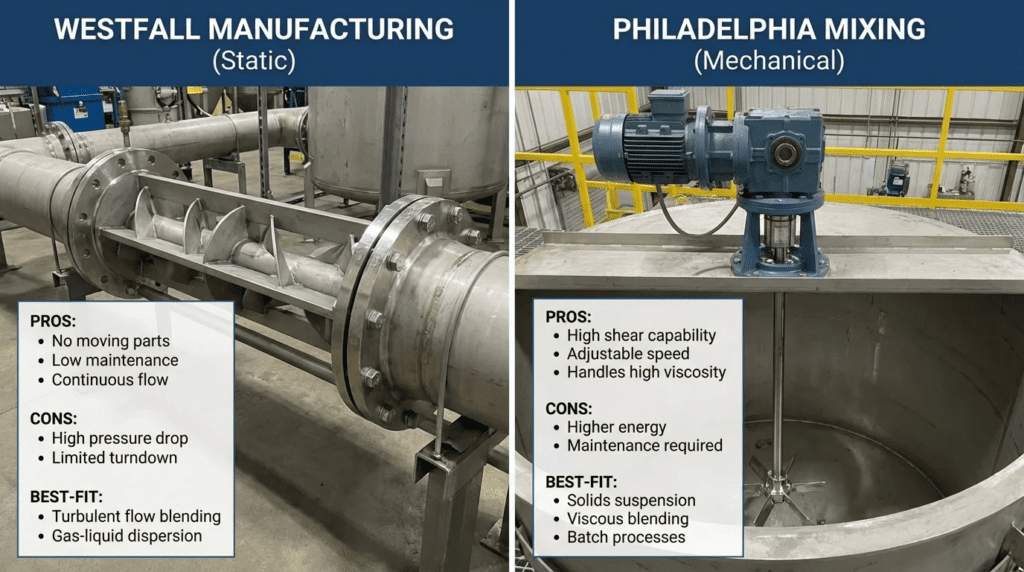
One of the most persistent and costly inefficiencies in water and wastewater treatment plants is poor chemical dispersion. Inadequate mixing leads to chemical overuse, formation of disinfection byproducts, and unstable process control. When designing rapid mix, flash mix, or blending systems, engineers are often faced with a fundamental choice between two distinct technological philosophies: high-efficiency static mixing (exemplified by Westfall Manufacturing) and robust mechanical agitation (exemplified by Philadelphia Mixing Solutions). The decision to specify Westfall Manufacturing vs Philadelphia Mixing for Mixers: Pros/Cons & Best-Fit Applications is not merely a brand comparison; it is a choice between hydraulic energy and mechanical energy.
Westfall Manufacturing is widely recognized as the industry benchmark for static mixing, particularly low-head-loss vane mixers installed directly in the pipeline. Philadelphia Mixing Solutions (now part of SPX FLOW) represents the archetype for top-entry mechanical agitators and dynamic mixing within tanks or basins. While both achieve the goal of homogeneity, they operate in completely different physical environments. Westfall relies on the kinetic energy of the flow stream, converted into turbulence via fixed internal geometries. Philadelphia relies on external electrical energy driving a gearbox and impeller to induce flow patterns independent of the hydraulic throughput.
Specifying the wrong technology can have severe lifecycle consequences. Placing a static mixer in a line with massive flow turndown can result in zero mixing at low flows. Conversely, installing a massive mechanical mixer for a simple chlorination injection point introduces unnecessary maintenance (seals, oil changes) and energy costs. This article provides a deep technical analysis to help engineers select the correct mixing methodology, focusing on real-world performance, reliability, and total cost of ownership.
How to Select and Specify Mixing Technologies
When evaluating Westfall Manufacturing vs Philadelphia Mixing for Mixers: Pros/Cons & Best-Fit Applications, the selection process must move beyond initial capital cost. The decision framework involves analyzing the hydraulic profile, the chemical kinetics, and the physical constraints of the facility. The following criteria outline the engineering logic required to specify the correct equipment.
Duty Conditions & Operating Envelope
The primary differentiator between static and mechanical mixing is the source of mixing energy. This fundamental difference dictates the operating envelope.
- Flow Turndown (Static/Westfall): Static mixers rely on fluid velocity to generate turbulence (Reynolds number). If the plant experiences wide flow variations (e.g., 10:1 turndown), a static mixer sized for peak flow may act as a laminar pipe at minimum flow, providing negligible mixing. High-performance vane mixers (like Westfall Model 2800) offer better turndown than orifice plates, often maintaining CoV (Coefficient of Variation) across a 3:1 or 4:1 range, but they have physical limits.
- Flow Independence (Mechanical/Philadelphia): Mechanical mixers are decoupled from the plant flow rate. A flash mixer in a tank can input high energy (G-value) even if the flow through the tank is near zero. This makes mechanical mixing superior for batch processes, sequencing batch reactors (SBRs), or plants with extreme diurnal flow variations where hydraulic energy is inconsistent.
- Head Loss Constraints: Westfall mixers introduce head loss to create mixing. If the hydraulic profile is gravity-fed with limited available head (e.g., 12 inches or less), the added head loss of a static mixer might break the hydraulic grade line. Mechanical mixers add energy to the system and typically do not induce significant head loss, making them neutral to the hydraulic profile.
Materials & Compatibility
The construction materials define longevity, particularly in aggressive chemical applications.
- Static Mixer Construction: Westfall units are often fabricated from 316L Stainless Steel, Titanium, Hastelloy, or FRP (Fiberglass Reinforced Plastic). Because they are often installed in aggressive injection zones (chlorine, ferric chloride), material selection must account for the undiluted chemical stream at the injection quill. Erosion-corrosion is a specific risk in static mixers if grit levels are high, as the mixing elements act as flow obstructions.
- Mechanical Mixer Construction: Philadelphia-style mixers utilize long shafts and impellers. While the wetted parts can be alloy or rubber-lined, the critical vulnerability lies in the interface—the mechanical seal or stuffing box. In wastewater applications with high H2S, copper components in motors and wiring must be protected. Ragging (accumulation of fibrous material) on impellers is a material handling issue unique to mechanical mixers in wastewater.
Hydraulics & Process Performance
Engineers must quantify “mixing” to compare these technologies. The two standard metrics are the G-value (velocity gradient) and CoV (Coefficient of Variation).
- Mixing Speed (Time Scale): Westfall static mixers provide near-instantaneous mixing (often within 3-10 pipe diameters). This is critical for rapid chemical reactions like coagulation, where hydrolysis occurs in fractions of a second. If the reaction is slower (e.g., flocculation), the short residence time of a static mixer is insufficient.
- Residence Time: Philadelphia mechanical mixers operate in tanks with defined residence times (minutes to hours). This is necessary for processes requiring contact time, such as keeping solids in suspension (sludge blending) or slow-growth crystal formation. Static mixers cannot keep solids in suspension in a large basin; they can only mix what passes through the pipe.
Installation Environment & Constructability
The physical footprint often dictates the choice between Westfall Manufacturing vs Philadelphia Mixing for Mixers: Pros/Cons & Best-Fit Applications.
- Footprint: Westfall mixers are inline devices. The “wafer” style or short laying length models fit between pipe flanges. This requires zero floor space, making them ideal for retrofits in crowded pipe galleries. However, they require upstream and downstream straight pipe runs (typically 1-3 diameters upstream, 3+ downstream) to function correctly.
- Structural Load: Philadelphia mixers require a mounting structure—usually a concrete bridge or steel platform over a tank. The engineering design must account for dynamic loads (torque, bending moments) transmitted to the structure. Headroom is also a constraint; lifting a long shaft out of a tank requires significant vertical clearance or a split-shaft design.
Reliability, Redundancy & Failure Modes
The failure modes are diametrically opposed.
- Westfall (Static): Extremely high MTBF (Mean Time Between Failures). There are no moving parts. Failure is usually catastrophic (clogging due to large debris) or gradual (erosion of mixing vanes). There is no “redundancy” in a single pipe; redundancy requires parallel piping trains.
- Philadelphia (Mechanical): Failure modes include gearbox bearing failure, seal leaks, motor burnout, or shaft deflection. Redundancy is often achieved by having multiple mixers in a basin or shelf-spare motors. However, a mechanical mixer can be repaired without stopping the plant flow (if the tank can be bypassed or if mixing is temporarily suspended), whereas replacing a static mixer requires breaking the line.
Lifecycle Cost Drivers
OPEX vs. CAPEX:
- Energy: Static mixers consume energy via pump pressure (head loss). This is a permanent parasitic load on the feed pumps. However, modern high-efficiency designs (like Westfall’s flow conditioner/mixer hybrids) produce very low head loss (often < 2 psi).
- Maintenance: Mechanical mixers incur ongoing costs: oil changes, seal replacements, and energy bills for the motor. A 50HP flash mixer running 24/7 consumes significant electricity. Static mixers have zero direct electrical costs and near-zero maintenance costs, offering a lower Total Cost of Ownership (TCO) in applications where flow-based mixing is viable.
Comparison Tables: Technology & Application Fit
The following tables provide a direct comparison between the two dominant mixing philosophies represented by Westfall Manufacturing and Philadelphia Mixing. Table 1 focuses on the technical attributes, while Table 2 assists engineers in selecting the correct technology for specific process applications.
Table 1: Technical Comparison – In-Line Static vs. In-Tank Mechanical
| Feature | Westfall Manufacturing (Static/Vane Type) | Philadelphia Mixing (Mechanical/Impeller) |
|---|---|---|
| Energy Source | Hydraulic Head (System Pump/Gravity) | Electric Motor / Gearbox |
| Primary Mechanism | Flow division and radial turbulence via fixed vanes | Axial or radial flow via rotating impeller |
| Head Loss | Variable (Low to High depending on model). Typically 0.5 – 5.0 psi. | Negligible (Does not restrict hydraulic flow). |
| Turndown Capability | Limited (Mixing efficiency drops as velocity drops). Effective range ~3:1 to 10:1 depending on design. | Excellent (Independent of flow). VFDs allow precise energy input adjustment. |
| Maintenance Profile | Zero Routine Maintenance. Inspect for wear/fouling during shutdowns. | Regular Maintenance Required. Gearbox oil, seal checks, motor greasing. |
| Typical CoV | 0.01 – 0.05 (Excellent homogeneity) at design flow. | Variable depending on tank geometry and retention time. |
| Space Requirement | In-Line (Fits within pipe flange). Requires limited straight run. | Requires tank/basin surface area and overhead clearance for shaft removal. |
Table 2: Application Fit Matrix
| Application | Westfall (Static) Fit | Philadelphia (Mechanical) Fit | Best Choice |
|---|---|---|---|
| Flash Mixing (Coagulant) | Excellent. Instant dispersion utilizes chemical kinetics efficiently. Saves space. | Good. Preferred only if flow variation is extreme or head loss is not permitted. | Static |
| Flocculation | Poor. Cannot provide the requisite residence time (20-40 mins) or gentle, tapered energy input easily. | Excellent. Allows variable G-values for tapered flocculation and prevents shearing of floc. | Mech |
| Disinfection (Chlorine/Dechlor) | Excellent. High turbulence ensures rapid contact, preventing streaming and hot spots. | Fair. Often overkill for simple chemical induction unless in a contact basin. | Static |
| Sludge Blending (Digesters) | Poor to Fair. High viscosity sludge causes massive head loss. Risk of clogging with rags. | Excellent. Can handle high solids, fibrous material, and keeps large volumes homogeneous. | Mech |
| pH Control / Neutralization | Good. Effective for in-line correction before discharge. | Excellent. Preferred for batch neutralization tanks where time is needed for reaction stabilization. | Depending |
| Chemical Induction | Excellent. Using static mixers for gas/liquid induction improves mass transfer. | Good. Surface aerators are a form of mechanical mixing for gas induction. | Static |
Engineer & Operator Field Notes
Implementing a mixing solution goes beyond catalog selection. The following field notes address the practical realities of commissioning, operating, and troubleshooting, directly relevant to the choice of Westfall Manufacturing vs Philadelphia Mixing for Mixers: Pros/Cons & Best-Fit Applications.
Commissioning & Acceptance Testing
Static Mixers (Westfall):
Acceptance testing for static mixers is notoriously difficult because you cannot “see” the mixing inside the pipe.
- CFD vs. Reality: Rely heavily on Computational Fluid Dynamics (CFD) reports during the submittal phase. In the field, performance is verified via chemical tracing (e.g., lithium or fluorescent dye) or by measuring the Coefficient of Variation (CoV) of a surrogate parameter (like pH or conductivity) at multiple points across the pipe diameter downstream.
- Head Loss Verification: During SAT (Site Acceptance Testing), verify the pressure drop across the mixer at peak flow using differential pressure gauges. Ensure it matches the submittal curve.
Mechanical Mixers (Philadelphia):
Mechanical commissioning focuses on the machinery health.
- Vibration Analysis: Baseline vibration readings are mandatory. High vibration often indicates shaft runout, impeller imbalance, or critical speed issues (operating near natural frequency).
- Power Draw: Measure amperage at various speeds. If the amp draw is lower than expected, the impeller may not be engaging the fluid correctly (aeration/vortexing issues). If higher, the fluid density or viscosity may be higher than designed.
Common Specification Mistakes
Engineers often copy-paste G-values (e.g., G=750 sec⁻¹) from a mechanical mixer spec to a static mixer spec. This is flawed logic. Static mixers achieve mixing via high intensity over a very short time (high G, low t), whereas mechanical mixers use lower intensity over longer time. Specify mixing performance (CoV) rather than G-value for static mixers.
- Oversizing Mechanical Mixers: Specifying a 20HP mixer where a 5HP unit would suffice leads to “vortexing,” where the mixer spins the entire tank contents without creating vertical turnover. This requires installing costly baffles to break the vortex.
- Undersizing Static Mixers for Turndown: Failing to calculate the Reynolds number at minimum flow. If the plant runs at 10% capacity at night, the static mixer may act as a simple pipe, resulting in chemical streaming and permit violations.
- Injection Port Placement: For Westfall style mixers, the injection quill location is critical. It should ideally be integral to the mixer or immediately upstream. Placing it too far upstream allows the chemical to stratify before hitting the mixing elements.
O&M Burden & Strategy
The “Fit and Forget” Myth:
While Westfall static mixers are marketed as maintenance-free, they are not “inspection-free.”
- Static Mixer PM: In wastewater or raw water applications, vanes can catch rags or build up biofilm. Annual inspection (via confined space entry or removal of the spool) is necessary to ensure the hydraulic area isn’t compromised.
- Mechanical Mixer PM: Requires a rigorous schedule.
- Weekly: Check gearbox oil levels, listen for noise, check seal leaks.
- Quarterly: Grease bearings.
- Annually: Oil analysis (wear metals), check motor insulation (megger test), check impeller bolt torque.
Design Details & Calculation Logic
To accurately specify equipment in the context of Westfall Manufacturing vs Philadelphia Mixing for Mixers: Pros/Cons & Best-Fit Applications, engineers must understand the governing physics.
Sizing Logic: The Mathematics of Mixing
1. The G-Value (Velocity Gradient)
Camp and Stein’s velocity gradient ($G$) is the standard metric for mixing energy.
$$G = sqrt{frac{P}{mu V}}$$
Where:
- $P$ = Power input (Watts)
- $mu$ = Dynamic viscosity of the fluid (Pa·s)
- $V$ = Volume of the mixing zone ($m^3$)
For Mechanical Mixers (Philadelphia): $P$ is the power delivered by the impeller to the fluid (shaft power x efficiency). Engineers control $P$ via motor size and VFD speed.
For Static Mixers (Westfall): $P$ is derived from head loss.
$$P = gamma Q Delta H$$
Where $gamma$ is specific weight, $Q$ is flow rate, and $Delta H$ is head loss. This equation proves why static mixers struggle at low flows: as $Q$ drops, $Delta H$ drops squarely, meaning Power ($P$) drops cubically. Mixing energy vanishes rapidly as flow decreases.
2. Coefficient of Variation (CoV)
The CoV is the statistical measure of homogeneity. A CoV of 0.05 (5%) is generally considered “complete mixing” for water treatment.
$$CoV = frac{sigma}{bar{x}}$$
Where $sigma$ is the standard deviation of concentration samples and $bar{x}$ is the mean concentration.
Pro Tip: Westfall Model 2800 mixers typically guarantee a CoV of 0.05 within 3-5 pipe diameters. Mechanical mixers may require 5-15 minutes of residence time to achieve similar homogeneity in a large tank.
Specification Checklist
When drafting the Section 11 specifications:
For Westfall (Static):
- Head Loss Limit: Clearly state maximum allowable pressure drop at peak flow (e.g., “Max 2.0 psi at 20 MGD”).
- Laying Length: Define the face-to-face dimension to ensure fit-up.
- Injection Ports: Specify number, size, and material (e.g., “Two 1-inch NPT ports, Hastelloy C-276”).
- Coating: Internal coating must be NSF-61 certified for potable water.
For Philadelphia (Mechanical):
- Service Factor: Require AGMA Service Factor of at least 1.5 or 2.0 for heavy wastewater duty.
- L-10 Bearing Life: Specify minimum 100,000 hours.
- Impeller Type: Define hydrofoil vs. pitched blade turbine based on whether flow or shear is the priority.
- Critical Speed: The shaft’s first critical speed must be at least 125% of the maximum operating speed to prevent resonance.
Frequently Asked Questions
What is the primary advantage of Westfall static mixers over Philadelphia mechanical mixers?
The primary advantage of Westfall static mixers is the lack of moving parts, resulting in near-zero maintenance and no electrical power requirements. They utilize the hydraulic energy already present in the pipeline to generate turbulence. This makes them ideal for remote locations, confined spaces, and applications where consistent dosing is required without the operational burden of gearboxes and motors.
How do I select between a static mixer and a mechanical mixer for flash mixing?
Select a static mixer if your flow rate is relatively constant (turndown < 3:1), you have available hydraulic head to sacrifice, and the chemical reaction is instantaneous. Select a mechanical mixer (Philadelphia style) if you have high flow variability, limited head pressure, require extended residence time, or are mixing into a large open basin where an inline device is impractical.
Can Westfall mixers handle high-solids wastewater sludge?
While some static mixers are designed for sludge (using non-clogging geometries), they generally introduce significant head loss due to the high viscosity of sludge. Mechanical mixers are typically preferred for sludge blending tanks because they can maintain homogeneity without blocking the flow path. However, for inline sludge conditioning (e.g., polymer addition before dewatering), specialized low-obstruction static mixers are often used effectively.
Why is “head loss” a critical factor in the Westfall vs. Philadelphia comparison?
Head loss represents energy consumption. In a gravity-fed water treatment plant, there may only be a few feet of elevation difference available between processes. Installing a restrictive static mixer might cause the upstream tanks to overflow. Mechanical mixers do not restrict flow, making them the only viable option in hydraulic profiles with zero available head.
What is the typical lifespan of a Philadelphia mixer gearbox?
With proper maintenance (oil changes, seal inspection), a high-quality mixer gearbox from manufacturers like Philadelphia Mixing can last 20+ years. However, seals and bearings are wear items. Mechanical seals typically last 3-5 years depending on the abrasiveness of the environment, and bearings are usually rated for an L-10 life of 100,000 hours.
Do static mixers work at low flow rates?
Performance at low flow is the main weakness of static mixers. Because mixing energy is derived from velocity, mixing efficiency drops significantly as flow decreases. If a plant operates at 10% capacity, a static mixer sized for 100% capacity may fail to mix the chemical, leading to “streaming.” In contrast, mechanical mixers can be operated at full speed regardless of the plant flow rate.
Conclusion
KEY TAKEAWAYS
- Energy Source: Westfall uses hydraulic pressure (head loss); Philadelphia uses electricity (motors). Choose based on which energy source is most available and efficient for your site.
- Turndown is Critical: If flow varies by more than 3:1, proceed with caution on static mixers or use variable-geometry designs. Mechanical mixers handle infinite turndown.
- Reaction Time: Static mixers are superior for instantaneous chemical reactions (Flash Mix). Mechanical mixers are superior for time-dependent processes (Flocculation/Blending).
- Maintenance: Static mixers offer “install and ignore” simplicity for clean water. Mechanical mixers require a rigorous PM schedule but offer repairability without breaking the pipe.
- Space: Westfall fits in the pipe; Philadelphia requires a tank and overhead structure.
The engineering decision between Westfall Manufacturing vs Philadelphia Mixing for Mixers: Pros/Cons & Best-Fit Applications ultimately centers on the balance between control and complexity. Westfall Manufacturing represents the elegant, passive solution: high-efficiency vane mixers that deliver exceptional homogeneity with minimal footprint, provided the hydraulic conditions are stable. This is often the superior choice for pumped injection lines, chlorination, and rapid coagulation in pressurized systems.
Philadelphia Mixing Solutions represents the robust, active solution: mechanical agitators that provide absolute control over the energy input regardless of hydraulic throughput. This approach is indispensable for large basins, solids suspension, and gravity-flow systems where head loss cannot be tolerated. Ideally, a modern treatment plant will utilize both technologies—static mixers for precise chemical induction in pipelines and mechanical mixers for bulk blending in tanks—leveraging the specific physics of each to optimize treatment performance and lifecycle costs.