
Top OEMs for MBBR and IFAS Systems
1. Introduction to MBBR and IFAS Technologies
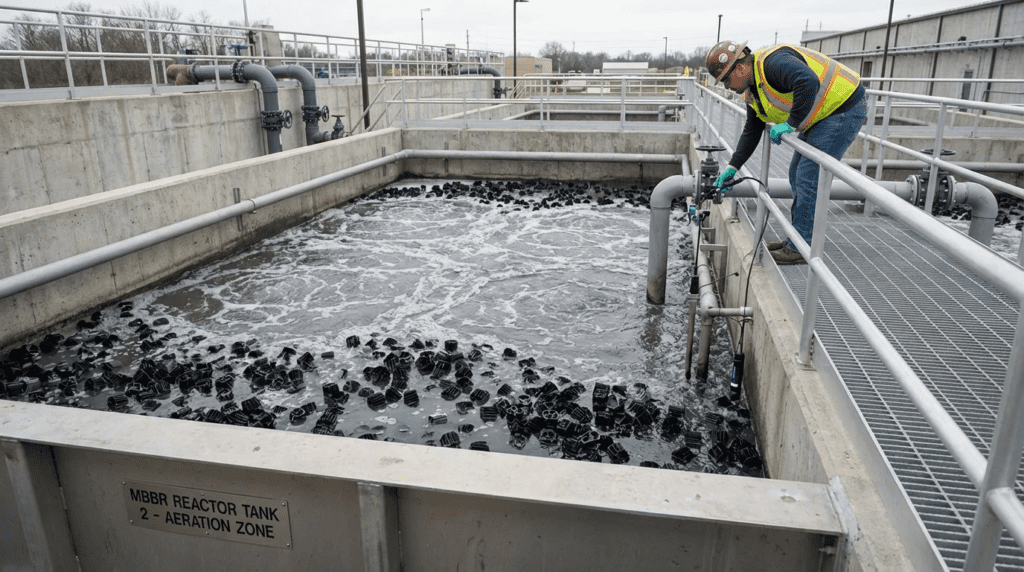
Moving Bed Biofilm Reactors (MBBR) and Integrated Fixed-Film Activated Sludge (IFAS) systems represent a significant evolution in biological wastewater treatment. As regulatory agencies impose increasingly stringent limits on nutrient discharges—specifically Total Nitrogen (TN) and Total Phosphorus (TP)—and as municipal and industrial facilities face limitations on available land for expansion, these intensified treatment processes have become critical tools for consulting engineers and utility owners.
Unlike conventional Activated Sludge Processes (ASP), which rely exclusively on suspended biomass, MBBR and IFAS utilize engineered plastic media to support the growth of biofilm. This media provides a protected surface area for autotrophic and heterotrophic bacteria to thrive, effectively decoupling the hydraulic retention time (HRT) from the solids retention time (SRT) for the attached growth portion of the biomass.
In an MBBR system, the entire biological treatment occurs within the biofilm attached to the carriers, which circulate freely in the reactor. There is typically no sludge recycle (RAS) in a pure MBBR configuration, making it a once-through biological process often followed by solids separation. This configuration is widely utilized for industrial pretreatment, high-strength wastewater, and lagoon upgrades where simplicity and robustness are paramount.
IFAS systems, conversely, are hybrid configurations. They combine suspended growth (MLSS) with attached growth (biofilm) in the same aeration basin. By adding media to a conventional activated sludge basin, engineers can significantly increase the biomass inventory without overloading secondary clarifiers. This is particularly advantageous for municipal plants requiring retrofit for nitrification and denitrification within existing concrete basins. The fixed-film biomass handles a substantial portion of the nitrification load, allowing the suspended growth phase to operate at a lower SRT, thereby improving sludge settling characteristics and increasing hydraulic capacity.
Why OEM Selection Matters:
The selection of an Original Equipment Manufacturer (OEM) in this category is not merely a procurement of plastic media. It is the acquisition of a process guarantee, hydraulic engineering, and critical auxiliary components. The efficiency of an MBBR or IFAS system relies heavily on the media geometry (specifically the protected surface area), the aeration grid design (which must provide oxygen while keeping media in suspension without shearing biofilm), and the retention sieves (screens). Poorly designed screens can lead to catastrophic headloss or media loss, while inadequate mixing can result in media piling and septic zones. Therefore, engineering due diligence must focus on OEMs with proven hydraulic modeling capabilities and robust mechanical designs.
2. How to Select MBBR and IFAS Equipment
For consulting engineers and utility decision-makers, selecting the right MBBR or IFAS system involves a multi-dimensional analysis that goes beyond capital cost. The following engineering criteria define the suitability and long-term viability of the equipment.
Process Function and Performance Requirements
The core metric for any biofilm system is the Surface Area Loading Rate (SALR), typically expressed as g/m²/day of BOD or Ammonia. Engineers must critically evaluate the “Protected Surface Area” claimed by the OEM. Not all surface area is created equal; only the area protected from collision shear forces can support a stable biofilm.
For nitrification applications, the biofilm diffusion layer thickness is critical. OEMs must demonstrate that their media geometry allows for adequate substrate and oxygen diffusion into the deeper layers of the biofilm. In IFAS applications, the interaction between the suspended Mixed Liquor Suspended Solids (MLSS) and the media is vital. If the MLSS concentration is too high, it can abrade the biofilm or clog the media voids. Engineers should request process modeling that accounts for temperature sensitivity, as biofilm activity drops significantly in cold water (below 10°C), necessitating larger reactor volumes or higher media fill fractions.
Hydraulics and Retention Sieve Design
The retention sieve (screen) is the mechanical heart of the system, keeping the media within the reactor while allowing treated water to pass. This is the most common point of failure. Engineers must evaluate:
- Hydraulic Flux: The flow rate per unit area of screen. Conservative designs operate at lower flux rates to prevent media pinning against the screen surface.
- Headloss Constraints: The addition of screens introduces headloss. In gravity-flow hydraulic profiles, this can be a major constraint. OEMs must provide hydraulic calculations at peak wet weather flow (PWWF).
- Scouring Mechanisms: Screens require active scouring, usually via air knives or proximity to the aeration grid, to prevent plugging by media or rags.
Materials of Construction
Media: Most media is manufactured from High-Density Polyethylene (HDPE). Engineers should specify virgin HDPE to ensure longevity and resistance to brittle fracture over a 20-year lifecycle. Recycled plastics may degrade faster under the constant mechanical stress of collision.
Screens and Grids: Stainless steel (304L or 316L) is the standard for retention screens and aeration grids. In industrial applications with high chlorides or corrosive off-gases, higher alloys or non-metallic composites may be required.
Integration with Aeration Systems
Aeration in MBBR/IFAS systems serves a dual purpose: oxygen transfer and mixing (media suspension). Standard fine-bubble diffusers are often unsuitable for pure MBBRs because the media can damage the membranes, and the coalescing effect of the media reduces transfer efficiency (alpha factor).
Many OEMs utilize medium-bubble or coarse-bubble aeration specifically designed of stainless steel to withstand the abrasive environment. In IFAS systems, some designs allow fine-bubble diffusers if protected by cages or if the media fill fraction is low, but this introduces maintenance risks. The energy balance calculation must account for the energy required to keep the media rolling (mixing limited) versus the energy required for biological oxidation (oxygen limited).
Operating Cost and Energy Efficiency
While MBBR/IFAS systems reduce footprint, they are generally more energy-intensive than conventional activated sludge. The presence of media interferes with bubble rise, and the need for coarse/medium bubble aeration results in lower Standard Oxygen Transfer Efficiency (SOTE). Engineers must evaluate the lifecycle energy cost. However, this cost is often offset by the elimination of sludge recirculation pumping (in pure MBBR) or the avoidance of massive civil works for basin expansion.
Lifecycle Cost and Maintenance
Media Replacement: While media is theoretically indefinite, some loss occurs over time due to wear or screen bypass. A replacement rate of 1-2% per year should be factored into OpEx models.
Screen Cleaning: Manual cleaning of retention screens is labor-intensive. Automatic air scouring systems are mandatory for reliable operation.
Grid Maintenance: Accessing aeration grids beneath a floating layer of media requires emptying the tank or specialized removal equipment. Systems with retrievable aeration grids offer significant O&M advantages.
3. Comparative Engineering Analysis
The following table compares the leading OEMs based on their specific technological approach, typical application strengths, and operational considerations. Engineers should use this data to align project requirements (e.g., tight footprint, cold weather nitrification) with the vendor’s core competencies.
| OEM Name | Typical Applications | Engineering Strengths | Limitations | Best-Fit Scenarios |
|---|---|---|---|---|
| Veolia (AnoxKaldnes) | Municipal BNR, Industrial Pretreatment, Lagoon Upgrades | Originators of the technology; immense database of kinetic rates; wide variety of media types (K1, K3, K5, Z); robust process guarantees. | Premium pricing; strict design standards can reduce flexibility for non-standard civil layouts. | Large municipal retrofits requiring guaranteed TN/TP limits; high-liability industrial projects. |
| Headworks International | Municipal IFAS, Industrial Bio-Roughing, Marine | “ActiveCell” media offers high protected surface area; robust retention sieve designs; strong expertise in integrated headworks and biology. | Focus on specific media geometries may limit options for extremely low-energy applications. | Projects where footprint is the absolute primary constraint; industrial high-load applications. |
| World Water Works | Industrial Food/Bev, Municipal Ammonia Removal, DAF integration | Specializes in coupling MBBR with Dissolved Air Flotation (DAF) for solids separation; proprietary Ideal MBBR technologies. | System approach often requires utilizing their specific separation equipment for maximum efficiency. | Industrial facilities needing a complete train (Biology + Separation); rapid deployment systems. |
| Nexom | Cold Climate Lagoons, Small/Mid-size Municipal | Expertise in cold-water nitrification; simple, low-maintenance designs tailored for smaller operators and rural utilities. | Less focus on massive metropolitan mega-plants compared to global conglomerates. | Lagoon retrofits for ammonia compliance; small to mid-sized municipal mechanical plants. |
| Ovivo | Municipal Nutrient Removal, IFAS Retrofits | Strong integration with existing clarifiers and digestion equipment; extensive municipal rep network and support; flexible media sourcing. | Typically acts as a system integrator rather than a proprietary media developer (though valid for most municipal specs). | General municipal plant expansions where seamless integration with other unit processes is required. |
4. Top OEM Manufacturers
The following manufacturers represent the tier-one suppliers for MBBR and IFAS systems. They are selected based on their installed base, engineering depth, financial stability, and ability to support process performance guarantees.
Veolia Water Technologies (AnoxKaldnes)
Veolia, through its acquisition of AnoxKaldnes, is widely recognized as the pioneer of the modern MBBR technology. The AnoxKaldnes process is the benchmark against which other systems are often compared. Their portfolio includes a range of media types (K1, K3, K5, and Z-carriers), each designed for specific specific gravity and surface area requirements.
Engineering Focus: Veolia excels in process modeling. Their kinetic equations for nitrification and denitrification on biofilm are derived from thousands of installations. They offer distinct solutions for carbon removal, nitrification, and post-denitrification. Their engineering packages typically include the media, retention sieves (often cylindrical or flat panel depending on hydraulic profile), and the medium-bubble aeration grid.
Operational Note: Veolia’s designs often emphasize “filling fractions” (the percentage of tank volume occupied by media). They provide detailed guidance on expanding capacity by simply adding more media (up to a maximum threshold, typically 60-65%) without new civil construction.
Headworks International
Headworks International is a major player in the biofilm space, leveraging their history in screening equipment to solve the most common MBBR problem: sieve blinding. Their “ActiveCell” process is their proprietary MBBR/IFAS offering.
Engineering Focus: Headworks emphasizes the durability of the retention sieves and the specific geometry of their media to prevent “nesting” (media clumping together). Their systems are designed to handle high hydraulic throughputs. They are particularly strong in the industrial sector and marine applications where space is at a premium. Their designs frequently utilize wedgewire screens which offer low headloss and high durability.
Operational Note: Headworks often employs a design philosophy that integrates the screening at the headworks with the biological protection, ensuring that ragging issues do not migrate into the MBBR reactor, which is a critical maintenance advantage.
World Water Works
World Water Works (WWW) has carved a distinct niche by tightly integrating MBBR technology with advanced solids separation, specifically Dissolved Air Flotation (DAF). Their “Ideal MBBR” often replaces the traditional gravity clarifier with a DAF unit, creating a very compact system.
Engineering Focus: The WWW approach tackles the issue of sloughing biomass. Biofilm sloughs off in clumps that can be difficult to settle in conventional clarifiers. By using DAF, WWW ensures high capture rates of these light solids. This makes their system highly effective for industrial wastewaters with high variation in loading and lighter specific gravity solids.
Operational Note: This OEM is a strong candidate for industrial “side-stream” treatment or main-stream treatment in food and beverage applications where FOG (Fats, Oils, and Grease) might be present, as the DAF handles FOG superiorly to clarifiers.
Nexom
Nexom focuses heavily on the unique challenges of small to medium-sized municipalities, particularly in colder climates. While they are famous for the SAGR (Submerged Attached Growth Reactor), they are also a primary provider of flow-through MBBR technologies for lagoon upgrades.
Engineering Focus: Nexom’s engineering is characterized by simplicity. Their systems are designed for operators who may not be full-time wastewater engineers. They focus on cold-water nitrification kinetics, ensuring that the system meets ammonia limits even when water temperatures drop near freezing—a condition where conventional activated sludge often fails.
Operational Note: Their designs often utilize chain-driven or simple mechanical components that are easily serviced by local public works departments. They are a “best-fit” for rural and suburban utility upgrades.
Ovivo
Ovivo is a massive global water equipment integrator that offers MBBR and IFAS as part of a broader suite of municipal treatment solutions. They bring the weight of a large engineering organization to the table, capable of delivering turnkey biological treatment trains.
Engineering Focus: Ovivo’s strength lies in the integration of the IFAS/MBBR zone with downstream clarification and upstream grit removal. Because they manufacture the clarifiers and digestion equipment as well, they can optimize the hydraulic profile of the entire plant. They utilize standard, high-quality media and emphasize robust stainless steel fabrication for grids and screens.
Operational Note: Ovivo is often the preferred choice for large municipal bid-spec projects where a single point of responsibility for the entire secondary treatment train is desired to minimize interface risks between vendors.
5. Application Fit Guidance
Selecting the correct OEM requires matching the specific constraints of the facility with the vendor’s philosophy.
Municipal Wastewater (Nitrification/Denitrification)
For municipal plants needing to meet low Total Nitrogen limits within existing tanks, Veolia and Ovivo are the primary contenders. Their experience with IFAS integration into existing activated sludge basins allows for capacity increases of 50-100% without new concrete. The focus here is on “intensification.”
Industrial Wastewater (High Load)
For high-strength industrial waste (Dairy, Brewery, Pulp & Paper), World Water Works and Headworks International excel. These applications often favor pure MBBR configurations over IFAS to avoid sludge bulking issues associated with high carbohydrate loads. The ability to couple MBBR with DAF (World Water Works) is a distinct advantage here.
Small Communities & Lagoon Retrofits
Nexom is the clear leader for lagoon-based ammonia removal. Their systems are designed to drop into the hydraulic profile of a lagoon system or sit as a compact add-on, minimizing the operational complexity for small staff.
Greenfield vs. Retrofit
- Retrofits: Favor IFAS solutions from Veolia or Ovivo that leverage existing aeration basins.
- Greenfield: Allows for optimized pure MBBR designs. World Water Works and Headworks can design the tank geometry specifically for the mixing patterns of their media, resulting in smaller footprints than standard concrete basins.
6. Engineer & Operator Considerations
Installation and Commissioning
Media Conditioning: New plastic media is hydrophobic. It takes time (weeks) to develop a biofilm and become neutrally buoyant. During startup, media may float excessively, blinding screens. Engineers must specify a staged startup procedure where airflow is managed carefully until the biofilm establishes.
Screen Leveling: Retention sieves must be perfectly leveled. Even slight deviations can cause flow maldistribution, leading to media piling on one side of the reactor.
Maintenance Access
Operators must have access to the retention screens. Walking on floating media is unsafe and impossible. Designs must include walkways or retrieval mechanisms for the screens. The most common maintenance task is removing rags that have bypassed the headworks and stapled themselves to the media or screens.
Mixing and Aeration Challenges
Pattern Disruption: The media disrupts the vertical rise of bubbles. This increases the residence time of the gas (good) but promotes bubble coalescence (bad). Operators should monitor Dissolved Oxygen (DO) levels at multiple points in the basin to ensure no dead zones are forming where media accumulates and becomes septic.
Air Scour: The air scouring system for the screens must be on a separate control loop, often pulsed to conserve energy but aggressive enough to dislodge solids.
Long-Term Reliability Risks
Media Attrition: While rare, media can wear down or break. Broken pieces can pass through screens and damage downstream pumps or sludge processing equipment. Periodic “media audits” (sampling media to check for wear and biofilm health) are recommended every 2-3 years.
Screen Structural Failure: The dynamic load of water and thousands of pounds of moving plastic exerts fatigue stress on screens. Wedgewire screens are generally more robust than perforated plates in the long term.
7. Conclusion
The selection of an MBBR or IFAS system is a strategic decision that dictates the facility’s biological capacity for decades. While the fundamental concept—plastic carriers in a tank—seems simple, the engineering nuance lies in the hydraulics, screen design, and process modeling.
For large municipal retrofits targeting nutrient removal, Veolia (AnoxKaldnes) and Ovivo offer the security of massive installed bases and deep process knowledge. For industrial applications requiring robust solids handling and high-rate treatment, World Water Works and Headworks International provide specialized, high-performance solutions. For smaller communities focused on lagoon upgrades and cold-weather performance, Nexom provides the most operator-friendly approach.
Engineers must look beyond the cost per cubic meter of media. The true value lies in the OEM’s ability to guarantee the protected surface area, simulate the hydraulic profile to prevent headloss issues, and provide a screen design that withstands the rigorous mechanical environment of a moving bed reactor.