ABB vs VEGA CSO/Storm Equipment: Comparison & Best Fit
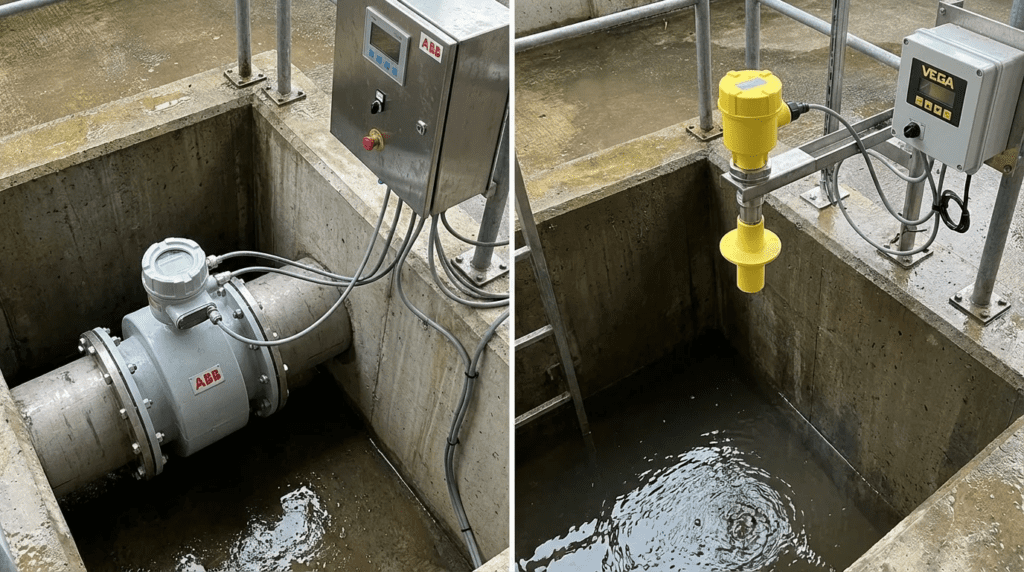
ABB vs VEGA CSO/Storm Equipment: Comparison & Best Fit
Introduction
Combined sewer overflow and stormwater monitoring is one of the most hostile operating environments in the water sector. Unlike controlled treatment plant headworks, CSO outfalls and remote retention basins face rapid hydraulic surges, condensing humidity, heavy ragging and potential submersion. A single failed sensor during a compliance event produces regulatory exposure or a gap in critical hydrologic data that cannot be recovered after the fact.
This is one of the few equipment comparisons in this category where both named companies genuinely compete. ABB and VEGA are both instrumentation manufacturers, and CSO and stormwater monitoring is squarely within what they supply. Neither makes CSO structures, screens, storage tanks or wet weather treatment equipment — that comes from process equipment manufacturers — but the level and flow measurement that makes a CSO monitoring program work is exactly their business.
Their approaches differ meaningfully in technology stack, frequency range and integration philosophy. Specifications are often copied from previous projects without accounting for advances in 80 GHz radar or laser level measurement, producing suboptimal performance in tight civil structures. This article provides an engineer-to-engineer analysis of both within the specific context of stormwater and CSO applications, examining constructability, signal processing in turbulent flow, and lifecycle operability. Broader supplier positioning is covered in our overview of the top water treatment equipment manufacturers.
How to Select and Specify CSO & Storm Instrumentation
Duty Conditions & Operating Envelope
Define the worst-case hydraulic scenario first. Stormwater systems sit dry for weeks, accumulating spider webs and fauna that obstruct sensors, then face rapid submersion.
- Rapid level change: In flash flood scenarios, levels rise faster than standard transmitter damping settings allow. Specify sensors with fast update rates and programmable reaction times.
- Dead band: In shallow manholes or weir boxes, the blocking distance — the minimum distance a sensor needs to read accurately — is critical. Older ultrasonic units required a foot or more. Modern 80 GHz radar measures effectively within inches of the antenna face.
- Turbulence and foam: High-velocity influent generates heavy foam. Ultrasonic sound waves are absorbed by foam, causing loss of echo. Radar microwaves generally penetrate light foam better but can struggle with dense, conductive industrial foam.
Materials & Compatibility
Corrosion in CSO structures is aggressive because hydrogen sulfide generates anaerobically during dry weather flow periods.
- Housing material: Aluminum housings corrode in sewer atmospheres. PVDF or PEEK antennas with 316L stainless or engineered polymer housings are the engineering standard.
- Ingress protection: Weatherproof ratings are insufficient. For CSOs, specify IP68 capable of continuous submersion. Even where the sensor is mounted above the high-water mark, surcharge events pressurize the manhole.
Hydraulics & Process Performance
For open channel flow across weirs and flumes, the primary measurement is level, converted to flow via a hydraulic curve.
Accuracy stacking: Total flow error is the combination of primary device error and level sensor accuracy. A few millimeters of sensor drift grows disproportionately in the flow calculation. The two manufacturers take different approaches: VEGA focuses heavily on the precision of the radar chip, while ABB often integrates advanced linearization curves within the transmitter.
Installation Environment & Constructability
Physical constraints in CSO chambers are the leading cause of measurement failure. Ladder rungs, pump cables and irregular concrete walls create false echoes.
- Beam angle: A narrow beam angle is superior in tight spaces to avoid mapping internal structures. High-frequency radar at 80 GHz delivers beam angles as tight as a few degrees, whereas ultrasonic and lower-frequency radar spread considerably more and hit the walls.
- Mounting hardware: Gimbal mounts are often necessary to align the sensor perpendicular to the water surface, especially in arched sewer crowns.
Reliability, Redundancy & Failure Modes
At critical compliance points, redundancy is often mandated. A common strategy uses dissimilar technologies: non-contact radar as the primary sensor and a submersible hydrostatic pressure transducer as backup.
Controls & Automation
Remote CSO sites frequently rely on battery or solar power, making power consumption a key specification parameter.
- Loop power: Two-wire, loop-powered devices are standard for these sites.
- Digital protocols: HART is essential for remote diagnostics. Modbus is common for connecting directly to cellular data loggers. Both manufacturers offer Bluetooth connectivity for local configuration, which is a genuine safety advantage since it keeps operators out of the confined space during setup.
Maintainability, Safety & Access
Confined space entry is expensive and dangerous, so the ideal selection requires zero maintenance. Ultrasonic sensors often need the transducer face cleaned due to condensation or spider webs. Radar is largely immune to temperature gradients and condensation, extending maintenance intervals significantly.
Lifecycle Cost Drivers
The capital difference between a high-end radar and a mid-range ultrasonic sensor is modest. The operating cost of a single truck roll to clean a sensor or recalibrate a drifting unit exceeds that differential immediately. Total cost of ownership analysis heavily favors non-contact radar in wastewater applications.
Comparison Tables
| Manufacturer | Technology Strengths | Best-Fit CSO Applications | Considerations | Maintenance |
|---|---|---|---|---|
| VEGA |
|
|
|
Low: Radar ignores condensation and buildup; ceramic cells resist abrasion. |
| ABB |
|
|
|
Medium: Laser lenses may require cleaning; ultrasonic requires standard preventive maintenance. |
| Application | Preferred Technology | Where ABB fits | Where VEGA fits | Critical Constraint |
|---|---|---|---|---|
| Remote CSO overflow weir | Non-contact radar | Laser level offers precise measurement for narrow weirs | Compact IP68 radar units are cost-effective for mass deployment across many outfalls | Power consumption on battery or solar |
| Deep stormwater tunnel | High-frequency radar | Strong signal processing in the transmitter | Excellent dynamic range at 80 GHz; maintains signal over long distances | Signal attenuation and beam spread |
| Pressurized storm force main | Electromagnetic flowmeter | Best fit: WaterMaster and AquaMaster are established for buried service | Limited offering; typically relies on strap-on ultrasonic or insertion probes | Burial rating and turndown ratio |
| Wet well with heavy grease | Non-contact radar | Ultrasonic units often fail here as soft coating absorbs sound | Radar microwaves penetrate grease layers on the surface and ignore antenna buildup | Blocking distance and false echo suppression |
Engineer & Operator Field Notes
Commissioning & Acceptance Testing
Verification of false echo suppression is the most critical commissioning step, because stormwater structures are notoriously irregular.
- Mapping the well: Both manufacturers offer software to map out obstructions. VEGA’s Bluetooth app lets an operator stand at ground level and visualize the echo curve on a phone. ABB typically uses an interface on the transmitter head or laptop-based software. Field crews generally prefer the phone interface for speed and safety.
- Simulation mode: Verify the loop current by forcing the sensor output and confirming SCADA receives correct values at both endpoints of the range.
Common Specification Mistakes
Over-specifying accuracy: Engineers often request millimeter accuracy for a storm sewer. In a pipe with turbulent, surging flow, surface ripples far exceed that. Specifying hyper-accuracy drives cost without delivering usable data. Repeatability is more important than absolute accuracy in dynamic flows.
Ignoring cable length: For remote sensors, ensure the cable is factory-potted and long enough to reach the telemetry cabinet. Field splicing sensor cables in a wet manhole is a recipe for ground loops and signal failure.
O&M Burden & Strategy
- Ultrasonic: Requires wiping the face every few months depending on grease and condensation. Calibration checks annually due to speed-of-sound shifts from temperature gradients.
- Laser: Requires clean lenses. Not recommended for sewers with heavy steam or fog, since the light beam scatters.
- Radar: Effectively install and forget. Radar is unaffected by air temperature, pressure or gas composition. Cleaning is rarely required with proper drip loops.
Troubleshooting
Reading stuck at high level. The sensor is locking onto a ladder rung or the near-zone ring. Increase the blocking distance or perform a new false signal suppression map while the level is low.
Loss of echo during rain. Excessive foam or turbulence scattering the signal. Check signal strength. If using ultrasonic, switch to radar. If using radar, verify the unit is not installed directly above the turbulent inflow stream.
Design Details & Integration
Beam Footprint Sizing
Beam angle is typically defined as the angle at which energy density drops by half, though the beam continues beyond that point.
Spot diameter: D = 2 × H × tan(α/2), where D is the beam spot diameter, H is the distance to the water surface and α is the beam angle.
Example at 10 meters depth: An older ultrasonic sensor with a 10-degree angle produces a spot roughly 1.75 meters across. An 80 GHz radar with a 3-degree angle produces a spot roughly 0.52 meters across. That smaller footprint substantially reduces the risk of detecting sidewalls or pumps in deep, narrow pump stations.
Controls Integration Strategy
ABB Integration
ABB excels where the project involves a complete system. Where the site includes ABB drives and controllers, using ABB instrumentation allows streamlined asset management, with common menu structures and device descriptions that simplify life for the instrumentation technician.
VEGA Integration
VEGA supports the standard technology-agnostic device management framework but has moved heavily toward Bluetooth connectivity via its mobile app. For standalone monitoring sites where an operator visits with a tablet or phone, the interface is often cited as more intuitive than push-button programming.
Standards & Compliance
- MCERTS: For environmental compliance monitoring, equipment should carry appropriate certification for flow monitoring where the regulator requires it.
- Hazardous area classification: CSO structures may be classified due to methane, with the specific division or zone depending on ventilation and the plant’s NFPA 820 classification drawings. Where classified, intrinsically safe barriers must be included in the panel design.
- IP68: Mandatory for the sensor head given surcharge potential.
Frequently Asked Questions
Do ABB or VEGA make CSO treatment equipment?
No. Neither supplies CSO screens, storage structures, vortex separators or wet weather treatment systems. Both are instrumentation manufacturers, and level and flow monitoring in CSO structures is genuinely within their product lines — which is why this particular comparison holds up better than most vendor pairings in this category.
How do the two compare on pricing?
VEGA’s compact radar units are competitively priced, often close to mid-range ultrasonic sensors, which undercuts the perception that radar is expensive. ABB’s laser equipment commands a premium but solves specific problems radar cannot. For electromagnetic flowmeters, ABB is a market leader with competitive pricing on large-bore sensors, whereas VEGA does not compete in the full-bore magnetic flowmeter space.
Why is 80 GHz radar preferred over 26 GHz for CSOs?
The higher frequency allows a much smaller antenna, often flush-mounted, and a considerably tighter beam angle. In cluttered CSO manholes with rungs, cables and debris, the narrow beam misses obstructions and hits the water surface, producing a cleaner signal. Both manufacturers acknowledge the physics; VEGA has transitioned its water portfolio to 80 GHz more aggressively.
Can these sensors measure flow in partially filled pipes?
Indirectly. Both provide level sensors that pair with an external controller or use internal logic to calculate flow from channel geometry. For high-accuracy area-velocity measurement, which requires both level and velocity, dedicated flow monitors from specialist suppliers are sometimes required. ABB offers partial flow solutions within its flowmeter range, while VEGA focuses on providing the precise level input for the calculation.
What is the difference between air gap and submersible sensors?
Air gap sensors — radar, ultrasonic, laser — hang above the liquid and measure down. They are non-contact and require less maintenance. Submersible hydrostatic pressure sensors sit at the bottom of the well. In CSOs, air gap sensors are preferred to avoid ragging and debris damage, though submersible pressure sensors serve well as a backup for when water rises into the manhole neck and submerges the radar.
How do I power these sensors at remote sites?
Both offer loop-powered two-wire devices running on low DC voltage, making them suitable for solar and battery telemetry systems. Power consumption is low. Where very fast warm-up is needed to save battery by sleeping between readings, check the specific start-up time in the datasheet.
Does foam affect radar level measurement?
Yes, but less than ultrasonic. Light, airy foam is generally transparent to radar. Dense, conductive foam can reflect the signal, so the sensor measures the top of the foam rather than the liquid. Higher-frequency radar generally penetrates foam better. In extreme foaming applications, a submersible hydrostatic sensor is the most reliable backup.
Conclusion
KEY TAKEAWAYS
- Both are instrumentation suppliers: Neither makes CSO treatment structures. Level and flow monitoring is genuinely their business.
- Technology shift: The industry is moving rapidly from ultrasonic to 80 GHz radar for CSO monitoring, driven by better performance in condensing and foaming environments.
- VEGA strength: Best suited to pure level and pressure instrumentation, particularly where ease of setup and tight beam angles are priorities.
- ABB strength: The better choice for holistic system integration and large-bore pressurized flow measurement.
- Constructability: Always calculate beam spot size. In a narrow manhole, high-frequency radar is effectively mandatory.
- Lifecycle: Non-contact radar offers the lowest total cost of ownership given minimal maintenance compared with contacting or ultrasonic sensors.
The decision rarely comes down to a quality gap. Both provide industrial-grade, reliable instrumentation capable of surviving the municipal environment. The differentiation lies in application focus.
For standalone level monitoring in difficult, tight or remote wet wells, VEGA’s focus on high-frequency radar and mobile configuration makes it a strong candidate where set-and-forget reliability is the goal. For applications requiring large-diameter inline flow measurement or deep integration with existing ABB automation architecture, ABB offers a unified solution that simplifies the broader control system. Resist the urge to copy specifications from decade-old projects — specifying ultrasonic level for raw sewage is dated when radar is available at comparable cost. Related evaluations appear in our comparison of Siemens and YSI CSO and storm instrumentation, ABB and Emerson instrumentation, and YSI and SCADATA instrumentation.