
Endress+Hauser vs Thermo Fisher Conventional Dry Pit Equipment: Comparison & Best Fit
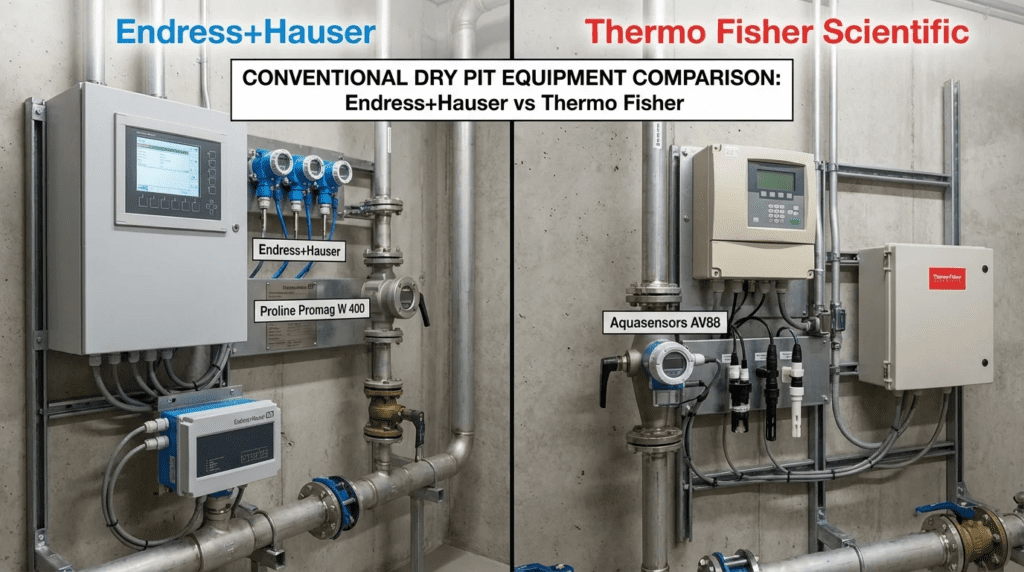
Endress+Hauser vs Thermo Fisher Conventional Dry Pit Equipment: Comparison & Best Fit
Introduction
In the municipal water and wastewater sector, the dry pit is a misnomer that regularly leads to expensive equipment failures. Designed to separate mechanical and electrical equipment from the wet well, dry pits and valve vaults are hostile environments — high humidity, potential for accidental flooding, corrosive hydrogen sulfide and confined space access restrictions. Selecting the right equipment for these spaces is a calculation of lifecycle reliability and operator safety, not brand preference.
A scope note belongs up front. Neither Endress+Hauser nor Thermo Fisher manufactures conventional dry pit pumping equipment. Dry pit pumps, suction and discharge piping and the pump station package come from pump manufacturers — Xylem Flygt, Gorman-Rupp, Smith & Loveless, Vaughan, Fairbanks Nijhuis and similar. Both companies discussed here supply instrumentation: Endress+Hauser is an independent, family-owned process instrumentation manufacturer, and Thermo Fisher Scientific supplies process and laboratory analytical instrumentation.
What makes an Endress+Hauser vs Thermo Fisher Conventional Dry Pit Equipment: Comparison & Best Fit evaluation worthwhile is that the instrumentation in these spaces fails at a much higher rate than the pumps, and for reasons that are entirely specifiable. Engineers are choosing between two philosophies: the industrial-process-centric approach of Endress+Hauser and the laboratory-precision-centric approach of Thermo Fisher, whose Orion and Eutech lines were adapted from bench analytical work.
This article examines how each handles flow metering, liquid analysis and level monitoring in dry pit applications. The distinction matters because a poor specification here yields sensors that drift from humidity, transmitters that fail during minor flooding, and maintenance protocols that force operators to spend excessive time in permit-required confined spaces. Broader supplier positioning is covered in our overview of the top water treatment equipment manufacturers.
How to Select and Specify
Duty Conditions & Operating Envelope
The primary differentiator in dry pit instrumentation is the ability to withstand accidental submergence. The pit is nominally dry, but sump pump failures or seal leaks produce temporary flooding.
- Ingress protection: Specify continuous submergence ratings for the sensor element. IP68 is the baseline. The transmitter is the weak link — remote-mount options with potted or sealed enclosures address this.
- Humidity and condensation: Temperature differentials between cold wastewater and warm, humid ambient air create persistent condensation. Instrumentation needs potting or conformal coating on circuit boards to prevent bridging and corrosion.
- Temperature cycling: Equipment must hold calibration stability across wide ambient swings common in unconditioned underground vaults.
Materials & Compatibility
Hydrogen sulfide attacks copper and silver components in electronics, and it is present whenever the dry pit shares an atmosphere with the collection system.
- Housing materials: Prioritize polycarbonate, PBT or 316L stainless over coated aluminum, which flakes and corrodes in damp, acidic environments.
- Cable jackets: Sensor cables running from pit to control panel must resist microbial attack and chemical degradation. Polyurethane or specialized PVC jackets are standard.
- Sensor body construction: For analytical sensors, body material must be compatible with the specific wastewater chemistry, particularly where industrial solvents reach the influent.
Hydraulics & Process Performance
- Electromagnetic flowmeters: The standard for conductive fluids. Key metrics are turndown ratio and straight pipe requirements. Reduced-run options exist for tight spaces, where standard models require several diameters upstream.
- Accuracy against repeatability: In billing applications, absolute accuracy matters. For process control such as pacing chemical feed, repeatability matters more than absolute accuracy.
- Low flow cutoff: Dry pit pumps often run on variable speed drives. Instrumentation must read low velocities cleanly, which requires advanced signal processing rather than a blunt cutoff.
Installation Environment & Constructability
- Remote against integral mounting: This is the decisive specification point. Integral transmitters place sensitive electronics in the pit. Remote transmitters place them in an accessible, safe location. For dry pits, remote mounting is almost always the superior engineering choice — it mitigates flood risk and improves operator access.
- Cable length constraints: Analog analytical signals degrade over distance from impedance and noise. Digital sensor protocols allow significantly longer cable runs without signal loss, which is what makes remote installation practical.
Reliability & Failure Modes
- Coating detection: Grease and struvite coat sensors in wastewater. Smart instrumentation should alarm on electrode coating or high glass impedance before the reading fails outright.
- Empty pipe detection: Dry pit piping drains or air-locks. Flowmeters must drive output to zero rather than generating false readings from sloshing fluid.
- Service life: Solid-state sensors such as optical dissolved oxygen typically last longer between service than membrane-based electrochemical sensors, reducing entries into the pit.
Pro Tip: Digital Communication Protocols
In dry pit applications, avoid analog signals from sensor to transmitter where possible. High humidity causes ground loops and signal drift in analog lines. Specify digital sensor-to-transmitter communication, ideally inductive, to eliminate moisture interference at the connection point.
Controls & Automation
- Integration: Both manufacturers support standard industrial protocols, but the depth of available data varies. Endress+Hauser devices provide extensive diagnostic data over the bus, enabling predictive maintenance. Thermo Fisher devices generally focus on the primary process variable and basic status.
- Legacy support: Many municipal specifications still require analog with HART. Verify the transmitter supports the specific HART revision used by the plant’s handheld communicators.
Maintainability, Safety & Access
- Calibration strategy: Can the sensor be calibrated in the shop and hot-swapped in the field? This capability significantly reduces the time operators spend in confined space.
- Cleaning mechanisms: Does the sensor require manual cleaning, or does it support automatic air or water blast cleaning? Automatic systems are complex to install in dry pits but reduce long-term labor.
- Consumables: Assess the cost and frequency of reagent replacement for analyzers, or reference junction replacement for pH probes.
Lifecycle Cost Drivers
- Capital: Thermo Fisher solutions, leveraging their laboratory scale, sometimes offer lower initial hardware cost for basic analytical loops. Endress+Hauser flow and level solutions command a premium for robust housings and diagnostics.
- Operating: The cost of confined space entry — permits, gas detection, tripod, two-person crew — often exceeds the cost of the sensor itself. Technologies that extend maintenance intervals or allow shop calibration usually deliver lower total cost despite higher capital.
Comparison Tables
| Attribute | Endress+Hauser | Thermo Fisher Scientific |
|---|---|---|
| Core philosophy | Industrial process automation: ruggedness, hazardous areas, plant-wide integration, extreme environments | Laboratory to process: high-precision analytical chemistry, bringing bench-grade accuracy from the Orion heritage into the field |
| Relevant product lines | Promag electromagnetic flowmeters, Micropilot radar level, Liquiline transmitters with Memosens digital sensors | Orion online analyzers, ultrasonic flow, suspended solids and turbidity instrumentation |
| Sensor connectivity | Inductive digital (Memosens): non-contact connection, waterproof, corrosion resistant, allows pre-calibration in the shop | Direct analog or proprietary digital: often requires physical metal contact; newer lines feature digital heads but analog remains common in specifications |
| Best-fit applications | Main plant flow metering, chemical dosing, critical control loops needing extensive diagnostics, plant standardization | Drinking water compliance monitoring, specific ion analysis, effluent monitoring where correlation with the plant lab is the priority |
| Limitations | Higher initial cost for simple monitoring loops; complexity may exceed what a basic standalone vault requires | Portfolio is less unified following acquisitions; mechanical robustness of some housings is less suited to abusive wastewater pits than heavy industrial lines |
| Maintenance profile | Predictive: diagnostics warn of impending failure; shop calibration via digital sensors reduces field time | Routine: relies on reagent replenishment and traditional calibration methods similar to laboratory protocols |
| Application | Primary Constraint | Endress+Hauser | Thermo Fisher | Selection Logic |
|---|---|---|---|---|
| Raw sewage pump station flow | Vibration, accidental flooding, grease coating | Strong fit: Promag with reduced straight-run option | Limited fit: clamp-on ultrasonic only where the pipe cannot be cut | Mag meters are the standard for durability in raw sewage. Clamp-on ultrasonics struggle with liner delamination in older pipe. |
| Effluent compliance monitoring | Regulatory accuracy, correlation with lab data | Good fit: Memosens glass or non-glass sensors | Strong fit: Orion online monitors | Where the plant lab uses Orion benchtop meters, matching process probes simplifies the correlation argument with regulators. |
| Remote valve vault level and pressure | Limited power or SCADA; damp environment | Strong fit: battery-powered mag meters or radar; wireless options | Limited fit: generally requires powered analyzers | Endress+Hauser has a stronger portfolio for remote, battery-operated industrial instrumentation. |
| Chemical dosing | Corrosive chemicals, material compatibility | Strong fit: Coriolis or mag meters with PTFE and PFA liners | Moderate fit: specialized chemical analyzers | For measuring the flow of the chemical, Endress+Hauser is superior. For analyzing the residual, Thermo Fisher may hold specific ion advantages. |
Engineer & Operator Field Notes
Commissioning & Acceptance Testing
- Loop checks in humidity: During site acceptance, open terminal housings and verify desiccant packs are installed — a common omission. For inductive digital sensor systems, verify the connection head; moisture there is irrelevant, which is a real commissioning advantage. For analog systems, ensure all cable glands are tightened to torque to prevent breathing during thermal cycling.
- Verification against calibration: Endress+Hauser devices often include built-in verification that generates a pass/fail report without external standards, which is excellent for baseline documentation. Thermo Fisher commissioning typically centers on multi-point calibration using buffer solutions, mirroring laboratory validation.
- Documentation: Ensure as-left parameters record the specific damping settings. Dry pit pumps create pulsating flow, and some damping is usually needed to stabilize the signal for SCADA.
Common Specification Mistakes
Never specify an integral transmitter with a display on the sensor for a deep vault or one classified as a permit-required confined space. It forces operators to enter the pit just to read a fault code. Always specify remote wall-mount transmitters with enough cable to reach a grade-level pedestal or control room.
- Over-specifying accuracy: Demanding laboratory-grade accuracy from a sewage lift station mag meter is wasteful. Sludge coating and flow profile distortion negate it within weeks. Specifying moderate accuracy with high repeatability and abrasion-resistant liners is better engineering.
- Ignoring grounding rings: In plastic or lined pipe common in dry pits, the process fluid must be referenced to the sensor ground. Omitting grounding rings or reference electrodes is the leading cause of unstable mag meter readings at startup.
O&M Burden & Strategy
- The swap strategy: Inductive digital sensor technology lets an operator take a pre-calibrated sensor from the shop, pull the old sensor and click the new one in. No wiring, no field calibration. This cuts pit time from most of an hour to a few minutes.
- The buffer strategy: Traditional sensors require bringing buffer solutions into the pit, or pulling the sensor up, to perform a two-point calibration. This increases contamination risk and extends downtime.
- Consumables: Analyzers using reagents require calculating reagent autonomy — how long a bottle lasts — and scheduling site visits accordingly. Reagent-free amperometric or optical sensors reduce site visits where the measurement allows.
Troubleshooting
- Drifting readings on analog sensors. Moisture in the junction box or cable splice. Replace with a continuous run carrying no splices in the pit, or switch to digital sensors.
- No flow reading on a mag meter. Electrode coating or empty pipe. Check electrode impedance — effectively infinite resistance means the pipe is empty; high but conductive suggests grease.
- pH sensor flatline. Broken glass or a dried-out reference junction. Replace the sensor. Note that sensors stored dry in a warehouse for a long period often fail immediately on installation.
Design Details & Calculations
Sizing Methodology
Do not match the meter size to the pipe size.
- Determine peak and minimum flow from the pump’s operating point on the system curve.
- Calculate velocity as flow divided by the cross-sectional area of the meter bore. Target the range between roughly 2 and 10 ft/s (0.6 to 3 m/s).
- Check scour velocity: Below roughly 2 ft/s, solids settle and blind the electrodes at the bottom of the mag meter. If the pipe size yields less, reduce the meter size using concentric reducers to accelerate flow through the sensor.
- Verify head loss introduced by the reduced meter does not meaningfully affect pump capacity, which is rarely an issue with full-bore mag meters.
Specification Checklist
- Transmitter mounting: Remote mount, NEMA 4X minimum for the transmitter, IP68 for the sensor
- Cable type: Manufacturer-supplied digital cable; field splicing of sensor cables prohibited within the dry pit
- Power supply: 24VDC preferred over line voltage for safety in damp pits, unless the device has high power draw
- Coating protection: For mag meters in sludge service, specify a cleaning electrode where available, or a high-energy excitation frequency capable of working through coating
Standards
- AWWA metering standards: Applicable performance standards for the meter type specified
- NEC (NFPA 70) Chapter 5: Hazardous location requirements. Many dry pits are unclassified, but where connected to a wet well without positive gas separation they may be classified. Intrinsically safe barriers are often easier to implement than explosion-proof conduit.
- MCERTS: Where environmental monitoring reporting requires it, verify the analyzer is certified for the specific range.
Frequently Asked Questions
Do Endress+Hauser or Thermo Fisher make dry pit pumps?
No. Both are instrumentation manufacturers. Conventional dry pit pumping equipment comes from pump manufacturers including Xylem Flygt, Gorman-Rupp, Smith & Loveless, Vaughan and Fairbanks Nijhuis. This comparison addresses the flow, level and analytical instrumentation installed in dry pits and valve vaults, which is where most of the avoidable failures in these structures actually occur.
What is the difference between inductive digital sensors and standard analog sensors?
Standard analog sensors send a weak electrical signal directly from probe to transmitter, which leaves it highly susceptible to moisture, corrosion and electrical noise. Inductive digital technology digitizes the signal inside the sensor head and transmits it without physical contact to the cable. That makes the connection waterproof and immune to corrosion, addressing the leading failure mode in dry pit instrumentation.
Why are magnetic flowmeters preferred over clamp-on ultrasonic in dry pits?
Pipes in these applications are often lined with cement mortar or glass, or are old and pitted. Clamp-on ultrasonic meters struggle to transmit sound through debonded liners or corroded pipe walls. Magnetic flowmeters measure the fluid directly using Faraday’s law, delivering consistent accuracy regardless of pipe wall condition, which is why they are the standard for lift stations.
How often should dry pit analytical sensors be calibrated?
It depends on parameter and technology. Optical dissolved oxygen sensors typically need calibration once or twice a year. pH sensors in wastewater usually require cleaning monthly and calibration quarterly. Digital smart sensors from either manufacturer allow operators to swap a pre-calibrated sensor in minutes rather than calibrating in the pit.
Can Orion probes be used with plant controllers directly?
Historically, Orion probes were designed for laboratory meters. Thermo Fisher now offers process-grade controllers outputting analog and standard industrial digital signals compatible with municipal controllers. Engineers must specify the online process series rather than the laboratory series to ensure SCADA compatibility.
What is the typical lifecycle of these instruments in a dry pit?
With proper installation — remote transmitters, moisture protection — the electronic transmitter should last well over a decade. Wetted sensors vary widely: mag meter flow tubes can last twenty years or more, while analytical sensors are consumables, with pH probes lasting months to a year and optical dissolved oxygen caps lasting a few years.
Which manufacturer is better for regulatory compliance reporting?
Both meet applicable environmental standards. Thermo Fisher is often preferred by lab managers because the online readings correlate closely with their benchtop instruments using the same technology. Endress+Hauser is often preferred by operations and maintenance for its predictive diagnostics and build quality. Best fit depends on whether the priority is lab correlation or uptime and maintenance reduction.
Conclusion
Key Takeaways
- Scope: Neither company makes dry pit pumps. This is about the instrumentation installed in those structures, which is where most avoidable failures occur.
- Environment dictates choice: Where the pit is prone to humidity, condensation or flooding, potted electronics and inductive digital connections offer better survivability.
- Lab correlation: Where the facility relies on Orion bench equipment for compliance, matching process sensors simplifies regulatory validation.
- Maintenance strategy: For facilities with limited staff, shop-calibrated hot-swap capability lowers safety risk by cutting confined space entry time.
- Flow against analysis: Endress+Hauser is the stronger choice for flow and level infrastructure. Thermo Fisher is a strong contender for specific analytical parameters.
- Installation rule: Always specify remote-mounted transmitters. Never locate the display inside the dry pit.
The engineer is balancing industrial robustness against analytical heritage. For general plant automation — flow metering, level control and robust general analysis — Endress+Hauser provides a more cohesive plant-wide ecosystem designed for the rigors of wastewater maintenance, with a focus on ingress protection and digital signal transmission that addresses the primary root causes of dry pit failure.
Thermo Fisher Scientific remains a significant player where specific ion analysis is required, or where the utility wants strict continuity between process instrumentation and the compliance laboratory. The safest specification combines the ruggedness of the former with the precision of the latter, acknowledging that dry pits are rarely truly dry. Related evaluations appear in our comparison of Seepex and Xylem Flygt pumping equipment, ABB and Emerson instrumentation, and Krohne and Hach instrumentation for cavitation monitoring.