Centrifugal Pumps Wet Well Design and Minimum Submergence to Prevent Vortexing
INTRODUCTION
One of the most persistent and costly misconceptions in municipal and industrial water treatment is viewing a wet well merely as a concrete holding tank. In reality, the wet well is a complex hydraulic structure that dictates the reliability of the pumping equipment. A startling number of premature pump failures—often attributed to “defective manufacturing”—are actually the result of poor intake hydraulics. Industry data suggests that up to 30% of chronic pump vibration and bearing failures in wastewater lift stations stem directly from adverse hydraulic phenomena generated by improper sump geometry.
For engineers responsible for Centrifugal Pumps Wet Well Design and Minimum Submergence to Prevent Vortexing, the challenge lies in balancing civil construction costs with hydraulic requirements. If the wet well is too small or shallow, the pumps will suffer from air entrainment and pre-swirl. If the design is overly conservative, capital costs skyrocket without necessarily improving performance. This tension is where critical specification errors occur.
This technology is fundamental to every raw water intake, wastewater lift station, and industrial effluent sump. From small duplex package stations to massive influent pumping works handling hundreds of millions of gallons per day, the physics remain consistent. The interaction between the fluid and the pump suction bell is governed by specific rules of submergence and geometry. When these rules are violated, the consequences include cavitation, vibration, reduced impeller life, and catastrophic mechanical seal failure.
This article provides a rigorous, engineer-focused examination of Centrifugal Pumps Wet Well Design and Minimum Submergence to Prevent Vortexing. We will move beyond basic sizing to explore the nuances of ANSI/HI 9.8 standards, the specific mechanisms of vortex formation, and actionable design strategies that ensure lifecycle reliability for critical pumping infrastructure.
HOW TO SELECT / SPECIFY
Designing a wet well that supports long-term pump health requires a holistic approach. It is not enough to select a pump from a catalog; the engineer must design the environment in which that pump operates. The following selection criteria are essential for achieving optimal Centrifugal Pumps Wet Well Design and Minimum Submergence to Prevent Vortexing.
Duty Conditions & Operating Envelope
The first step in intake design is defining the complete operating envelope. While most specifications focus on the Best Efficiency Point (BEP), wet well hydraulics are most stressed at the extremes of the curve.
- Maximum Flow (Runout): As flow increases, velocity into the suction bell increases. This is the critical point for vortex formation. A design that is stable at BEP may generate strong surface vortices at runout flows.
- Minimum Flow: At low flows, thermal accumulation and recirculation can occur, but from a wet well perspective, low flow often coincides with low liquid levels. This is where submergence becomes the limiting factor.
- Variable Frequency Drive (VFD) Operation: VFDs allow pumps to operate across a wide range. The wet well design must account for the lowest speed (minimum scouring velocity) and the highest speed (maximum suction inlet velocity).
- Future Capacity: Designing a wet well for “Day 1” flows while installing pumps for “Year 20” flows is a common error. If the pumps are oversized for current flows, they may cycle frequently or operate at low levels, increasing the risk of air entrainment.
Materials & Compatibility
The physical construction of the wet well influences hydraulic stability and longevity. Smooth surfaces promote laminar flow, while rough, corroded surfaces can induce turbulence.
- Surface Roughness: In concrete wet wells, rough finishes can exacerbate flow disturbances. Specifications should call for smooth trowel finishes in critical approach channels.
- Microbiologically Induced Corrosion (MIC): In wastewater applications, H2S generation leads to sulfuric acid attack on concrete. Corroded, pitted floors disrupt flow patterns near the floor clearance area, potentially triggering subsurface vortices.
- Baffle Materials: Anti-rotation baffles and splitters are often required to correct flow. These should be fabricated from 316 Stainless Steel or FRP to withstand the corrosive headspace environment, as carbon steel supports will fail rapidly, sending debris into the pump suction.
Hydraulics & Process Performance
This is the core of Centrifugal Pumps Wet Well Design and Minimum Submergence to Prevent Vortexing. The hydraulic design must ensure uniform flow distribution to the pump impellers.
- Uniform Velocity Profile: The approach flow to the pump should be uniform, steady, and free of swirl. The Hydraulic Institute (HI) Standard 9.8 recommends approach velocities be kept low (typically under 1.5 ft/s or 0.5 m/s) as the fluid enters the pump bay.
- NPSH Available (NPSHa): While minimum submergence is often dictated by vortex prevention, it must also satisfy NPSH requirements. The engineer must calculate NPSHa at the lowest operating level (LWL) and ensure a safety margin over NPSH Required (NPSHr) plus a recommended margin (typically 3-5 ft or 1.0-1.5 m).
- Air Entrainment: Free-falling water from influent pipes is a primary source of entrained air. While centrifugal pumps can handle small amounts of air (1-2%), anything above 3% drastically reduces head and efficiency, leading to air binding.
Installation Environment & Constructability
Theoretical designs must be constructible. The physical constraints of the site often force compromises that must be mitigated.
- Excavation Depth: Deep wet wells act as excellent suppressors of surface vortices but drive up shoring and dewatering costs. Engineers must perform a cost-benefit analysis between a deeper wet well and a larger surface area wet well with lower approach velocities.
- Footprint Restrictions: In retrofit applications where the wet well cannot be expanded, formed suction intakes (FSI) or draft tubes may be necessary to condition the flow within a limited space.
- Fillets and Benching: Square corners are dead zones where solids accumulate and septic conditions breed. 45-degree fillets at the floor-wall intersection serve a dual purpose: they direct solids to the pump suction and eliminate stagnation zones that feed subsurface vortices.
Reliability, Redundancy & Failure Modes
Understanding how Centrifugal Pumps Wet Well Design and Minimum Submergence to Prevent Vortexing impacts failure modes is critical for establishing redundancy.
- Vibration and Bearing Failure: Pre-swirl (rotation of fluid entering the eye) changes the angle of attack on the impeller vanes. This causes cavitation and unbalanced radial loads, leading to rapid seal and bearing failure.
- Unbalanced Flow in Multiplex Systems: In systems with 3+ pumps, the center pumps often experience different flow conditions than the end pumps. If the influent pipe is perpendicular to the pump lineup, the center pump may receive high-velocity jet flow, while end pumps suffer from starvation.
- Redundancy: Designing for N+1 redundancy is standard, but the wet well hydraulics must be verified for the “All Pumps Running” scenario to ensure the peak velocity limits are not exceeded.
Maintainability, Safety & Access
A well-designed wet well requires less manual intervention, reducing operator exposure to hazardous environments.
- Self-Cleaning Geometry: A flat-bottom wet well is a maintenance burden. Trench-type wet wells with “ogee” ramps allow the pumps to scour the floor during each pump-down cycle, reducing the need for vacuum trucks.
- Bar Screen Interface: Automated bar screens must be positioned far enough upstream to allow flow to re-stabilize before reaching the pump intakes. Screen blinding causes uneven velocity profiles that can travel downstream to the pumps.
- Confined Space Entry: If baffles or splitters are required, they must be positioned so they do not obstruct personnel access for pump removal or inspection.
Lifecycle Cost Drivers
The total cost of ownership (TCO) is heavily influenced by the initial hydraulic design.
- Energy Efficiency: A pump suffering from pre-swirl or air entrainment operates off its curve, consuming more energy for less flow. Over a 20-year lifecycle, a 5% efficiency loss due to poor intake conditions can exceed the cost of the pump itself.
- Component Replacement: If improper submergence causes cavitation, impellers may need replacement every 2-3 years instead of 10-15 years.
- Civil Works CAPEX: While a compliant HI 9.8 intake structure may require more concrete and complex formwork (fillets, splitters) initially, the reduction in OPEX (maintenance and energy) typically provides a payback of under 5 years.
COMPARISON TABLES
The following tables provide a structured comparison of wet well geometries and vortex classifications. Use Table 1 to select the general layout strategy based on flow and application constraints. Use Table 2 to identify and categorize vortex issues observed in existing installations.
Table 1: Common Wet Well Geometries for Centrifugal Pumps
| Geometry Type | Best-Fit Applications | Hydraulic Features | Limitations & Considerations | Typical Maintenance |
|---|---|---|---|---|
| Rectangular Intake | Standard municipal lift stations, industrial sumps. | Simple approach flow; relies on straight walls to guide fluid. Requires splitters for multiple pumps. | Prone to dead zones in corners. Requires strict adherence to approach lengths (5D minimum). | Moderate. Solids settle in corners unless fillets are installed. |
| Trench-Type Intake | High-solids wastewater, large capacity stations. | Uses an ogee ramp to accelerate flow towards a trench where pump bells are located. Superior self-cleaning. | High civil construction complexity. Sensitivity to width sizing (must maintain scouring velocity). | Low. The “cleaning cycle” minimizes sludge accumulation. |
| Circular (Caisson) Wet Well | Deep lift stations, small packaged stations. | Structural efficiency for deep excavations. | Hydraulically challenging. Without baffles, the entire volume tends to rotate, creating massive pre-swirl. | High. Difficult to prevent rotation without installing complex internal baffles. |
| Formed Suction Intake (FSI) | Space-constrained retrofits, large vertical turbine pumps. | Engineered elbow that conditions flow immediately at the suction. Decouples pump from wet well hydraulics. | High equipment cost. May require larger hatch openings for installation. | Very Low. Eliminates most vortex issues at the source. |
Table 2: Vortex Classification and Severity
| Vortex Type | Visual / Physical Indicator | Surface vs. Subsurface | Severity & Consequence | Mitigation Strategy |
|---|---|---|---|---|
| Type 1 & 2 | Surface swirl or shallow dimple. No air entering. | Surface | Negligible. Generally acceptable for most centrifugal pumps. | None required. |
| Type 3 & 4 | Dye core or coherent trash pulling. | Surface | Moderate. Indicates unstable flow. Can fluctuate into Type 5. | Increase submergence or add floating rafts/baffles. |
| Type 5 & 6 | Air bubbles pulling into intake; full air core (funnel) from surface to pump. | Surface | Critical. Causes vibration, loss of prime, noise, and impeller damage. | Emergency shutdown. Requires structural modification (curtain walls) or raised water levels. |
| Floor/Wall Vortex | Not visible from surface. Detectable via vibration or hydrophones. | Subsurface | High. Creates unbalanced loads and cavitation-like erosion on impeller. | Install floor cones (under suction bell) and floor/wall fillets. |
ENGINEER & OPERATOR FIELD NOTES
Successful implementation of Centrifugal Pumps Wet Well Design and Minimum Submergence to Prevent Vortexing extends beyond the design drawings. The following field notes address commissioning, operational strategies, and troubleshooting.
Commissioning & Acceptance Testing
Verifying hydraulic performance is difficult once the wet well is filled with opaque wastewater. Acceptance testing requires a strategic approach.
- Physical Modeling: For large stations (typically >40 MGD or >5000 HP total), a physical scale model test (1:4 to 1:10 scale) is mandatory. This is the only way to empirically verify the absence of coherent vortices before pouring concrete.
- Computational Fluid Dynamics (CFD): For medium-sized stations, CFD is a cost-effective alternative to physical modeling. However, the CFD model must be validated and capable of predicting free-surface effects (multiphase flow).
- Site Acceptance Testing (SAT): During startup with clear water (if possible), perform a “drawdown test.” Run the pump at full speed while lowering the wet well level. Observe the surface for vortex formation. Record the elevation where Type 3 vortices (dye core) begin to form. This becomes the hard “Low Level Alarm” setpoint.
Common Specification Mistakes
In reviewing hundreds of municipal bids, the following errors appear frequently regarding Centrifugal Pumps Wet Well Design and Minimum Submergence to Prevent Vortexing:
- Ignoring Approach Velocity: Specifying the pump correctly but feeding it via a pipe that enters the wet well at >4 ft/s. The high-velocity jet shoots across the wet well, hits the back wall, and creates chaotic turbulence at the pump suction.
- Using Sump Volume Only: Sizing the wet well based solely on “cycle time” (to prevent motor overheating) often results in a wide, shallow sump. This geometry is prone to vortexing. It is better to have a deeper, narrower sump that satisfies both cycle time and submergence requirements.
- Lack of Fillets: Drawing a rectangular box with 90-degree corners. This is a guarantee for solids deposition and subsurface vortex generation.
O&M Burden & Strategy
Operational strategies must align with the hydraulic limitations of the station.
- Cleaning Cycles: Grease caps can form rigid surfaces that suppress visible vortices but hide the underlying issue. Periodic aggressive cleaning is necessary to ensure the water level sensor reads accurately and the effective volume remains available.
- Scouring Velocity: Program the PLC to perform a “snore” cycle (pumping down to minimum submergence) once daily during peak flow to scour the floor. Monitor vibration during this cycle; if it exceeds ISO limits, raise the stop elevation.
- Stop Elevations: Operators often lower the “Pump Stop” setpoint to increase effective storage volume. This is dangerous. The stop elevation must never encroach on the minimum submergence required to prevent vortexing (S).
Troubleshooting Guide
If an existing station is experiencing issues, use this diagnostic logic:
- Symptom: Growling noise that sounds like gravel passing through the pump.
- Probable Cause: Cavitation or Air Entrainment.
- Check: Is the noise constant or intermittent?
- Constant: Likely Recirculation Cavitation (pump operating too far left on curve) or Classic NPSH Cavitation.
- Intermittent (varying with level): Likely Vortexing.
- Test: Raise the wet well level by 1-2 feet.
- If the noise stops, the issue is insufficient submergence causing vortexing.
- If the noise persists, the issue is likely suction recirculation or internal pump damage.
- Quick Fix: Floating rafts on the surface can break surface vortices temporarily. Permanently, you may need to install a “curtain wall” to lower the effective intake ceiling or install floor cones.
DESIGN DETAILS / CALCULATIONS
Precise calculation is the defense against hydraulic instability. The following outlines the methodology for determining Centrifugal Pumps Wet Well Design and Minimum Submergence to Prevent Vortexing per ANSI/HI 9.8.
Sizing Logic & Methodology
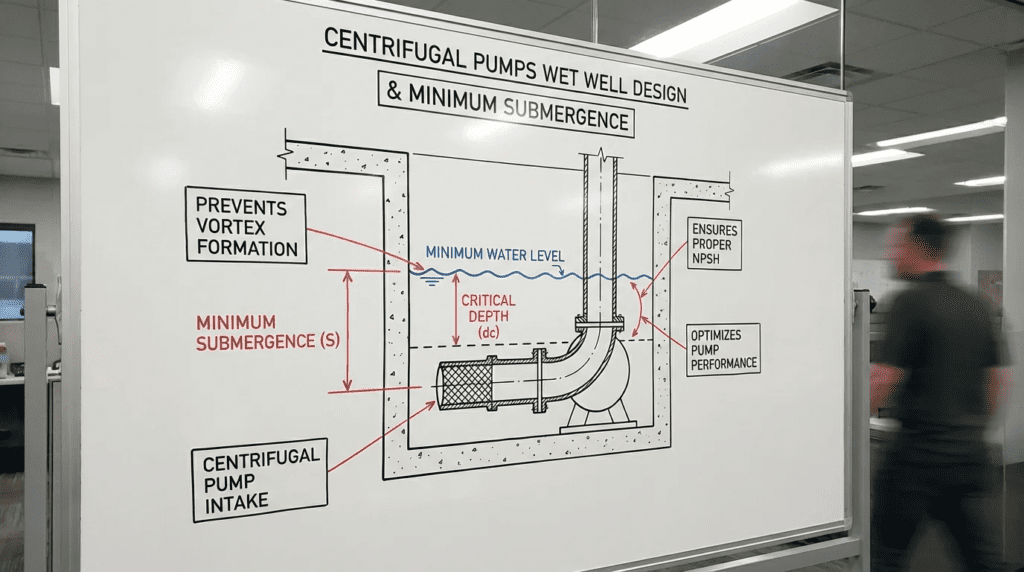
The design process begins with the bell diameter (D). All critical dimensions are functions of D.
- Determine Inlet Bell Diameter (D): Select a bell diameter such that the inlet velocity is between 2.0 and 5.5 ft/s (0.6 to 1.7 m/s).
Typical Formula: $V = Q / A$ - Calculate Minimum Submergence (S): This is the depth of liquid required above the suction bell lip to prevent surface air core vortices.
The simplified ANSI/HI formula is:
$S = D(1.0 + 2.3F_d)$
Where $F_d$ is the Froude number: $F_d = V / sqrt{gD}$
V = Velocity at suction bell inlet
g = Gravitational acceleration
D = Bell outside diameter - Set Floor Clearance (C): The distance between the floor and the bell lip.
Target: 0.3D to 0.5D. Too low increases entrance loss; too high promotes swirl. - Set Wall Clearance (B): The distance from the back wall to the bell centerline.
Target: 0.75D. This is critical. If the pump is too far from the back wall, flow can circulate behind the pump, creating strong vortices.
Specification Checklist
To ensure a compliant design, the specification must include:
- Standard Compliance: “Intake design shall comply with ANSI/HI 9.8-2018 (or latest edition) regarding geometry and submergence.”
- Fillet Requirement: “Wall-to-floor intersections and corners shall be filleted with a minimum radius or chamfer to prevent solids accumulation and vortex formation.”
- Anti-Rotation Devices: “If approaching flow is non-uniform, a floor splitter or anti-rotation baffle aligned with the pump centerline is required.”
- Level Control: “The ‘Pump Stop’ elevation shall be set no lower than the calculated Minimum Submergence (S) plus a safety margin of 6 inches.”
Standards & Compliance
Adherence to standards protects the engineer from liability.
- ANSI/HI 9.8 (Rotodynamic Pumps for Pump Intake Design): The primary standard for geometry, submergence, and model testing.
- HI 9.6.6 (Pump Piping): Governs the piping leading into the wet well, ensuring straight runs and proper velocity.
- AWWA E103: Provides guidelines for horizontal centrifugal pumps but references HI for intake structures.
FAQ SECTION
What is minimum submergence in the context of centrifugal pumps?
Minimum submergence is the vertical distance from the free liquid surface to the inlet of the pump suction bell required to prevent the formation of air-entraining surface vortices. It is distinct from NPSH requirements. While NPSH prevents cavitation due to vapor pressure limits, minimum submergence prevents the physical ingestion of air from the surface. HI 9.8 provides the specific formula based on the Froude number to calculate this depth.
How does wet well geometry affect pump performance?
Wet well geometry dictates the flow pattern entering the pump. Poor geometry (such as sharp corners, excessive width, or pumps located too far from walls) causes non-uniform velocity profiles and pre-swirl. This turbulence reduces pump efficiency, causes vibration, accelerates bearing wear, and can lead to impeller cavitation damage, significantly shortening the equipment’s mean time between failures (MTBF).
What is the difference between surface and subsurface vortices?
Surface vortices form at the liquid surface and extend downward; if strong enough (Type 5 or 6), they draw air into the pump. Subsurface vortices originate from the floor or walls of the wet well and enter the pump from below. While subsurface vortices do not entrain air, they create low-pressure cores that cause localized cavitation and severe vibration. Both types are destructive but require different mitigation strategies (e.g., deeper water for surface vortices vs. floor splitters/cones for subsurface vortices).
Why is the Froude number important for intake design?
The Froude number is a dimensionless ratio of inertial forces to gravitational forces. In wet well design, it is used to quantify the potential for vortex formation. A higher Froude number indicates higher suction inlet velocities relative to the depth, increasing the risk of vortexing. ANSI/HI 9.8 uses the Froude number as the primary variable in the minimum submergence calculation formula.
Can I use a “vortex breaker” to fix an existing problem?
A “vortex breaker” (typically a cross-vane or plate attached to the suction bell) can disrupt the core of a vortex, but it is a band-aid solution. It does not correct the underlying poor approach flow or lack of submergence. In wastewater applications, these devices are prone to collecting rags (ragging), which can block flow and starve the pump. The preferred solution is always correcting the wet well geometry or operating levels.
How close should the pump be to the wet well floor?
According to ANSI/HI 9.8, the floor clearance (distance from the floor to the suction bell lip) should generally be between 0.3D and 0.5D, where D is the suction bell diameter. If the clearance is less than 0.3D, entrance losses increase, potentially affecting NPSH. If the clearance exceeds 0.5D, the risk of subsurface vortices forming under the bell increases significantly.
CONCLUSION
KEY TAKEAWAYS
- Submergence is Calculated, Not Guessed: Use the ANSI/HI 9.8 formula based on bell diameter and Froude number. Do not rely solely on manufacturer data sheets which often only list submergence for mechanical cooling.
- Geometry Matters: Adhere to the 0.75D back-wall clearance and 0.3D-0.5D floor clearance rules. Deviating creates dead zones and swirl.
- Velocities Must Be Low: Approach velocity in the channel should be < 1.5 ft/s. Suction bell velocity should be < 5.5 ft/s.
- Avoid “Day 1” Oversizing: Designing for massive future flows results in low velocities and settling today. Use variable speed drives or staged implementation.
- Air is the Enemy: Even 3-4% entrained air can degrade pump performance by over 20%. Proper submergence is the only reliable prevention.
The success of any pumping station is defined before the first cubic yard of concrete is poured. Centrifugal Pumps Wet Well Design and Minimum Submergence to Prevent Vortexing is not merely a box-checking exercise; it is a critical engineering discipline that directly correlates to the lifecycle cost and reliability of the facility.
Engineers must advocate for proper hydraulic design, even when it competes with structural economies. A slightly deeper excavation or the inclusion of fillets and baffles incurs a minor upfront cost compared to the decades of operational expense associated with clearing air-bound pumps, replacing cavitated impellers, and managing chronic vibration issues. By strictly applying ANSI/HI 9.8 standards and understanding the physics of flow, engineers can deliver infrastructure that operates reliably, efficiently, and invisibly for generations.