
Aeration Troubleshooting: Low DO
Introduction
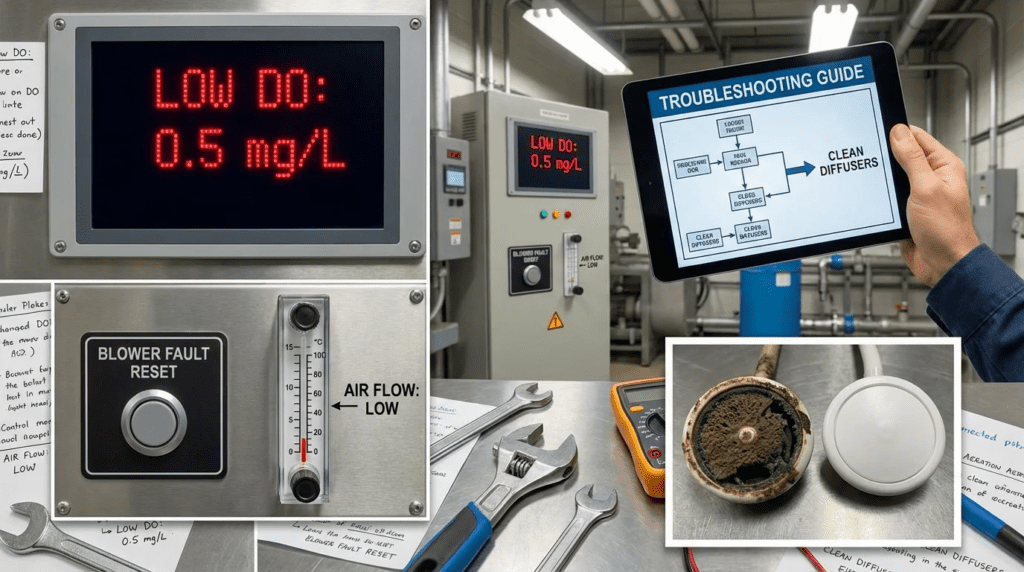
There is no scenario more frustrating for a plant operator than an aeration basin visibly boiling with air, blowers at full output, and dissolved oxygen refusing to climb. Aeration Troubleshooting: Low DO is a multi-disciplinary problem that sits at the intersection of blower performance, fluid dynamics, and biological metabolism.
Failing to maintain adequate dissolved oxygen in an activated sludge process triggers a cascade of consequences. Chronic low DO conditions favour filamentous organisms such as Thiothrix, Sphaerotilus natans, and Type 021N, which produce bulking, poor settling in secondary clarifiers, and eventual solids violations. Nitrifying organisms are oxygen-sensitive: as bulk DO falls toward and below about 2 mg/L, nitrification rates decline progressively, and at sustained low levels ammonia breakthrough follows.
The instinctive response to low DO is to add air — start the standby blower, open the valves, and accept the energy cost. What this misses is that air volume is not oxygen transfer. If the standard oxygen transfer efficiency of the diffusers has degraded through fouling, or the process alpha factor has fallen because of surfactants, pushing more air yields rapidly diminishing returns at exponentially increasing cost.
This article provides a diagnostic framework for resolving low dissolved oxygen in municipal and industrial plants, within the broader context of wastewater aeration systems. It guides engineers and supervisors through isolating whether a low DO event is biological, an automation failure, a mechanical limitation, or a design flaw.
How to Select and Specify Corrective Measures
Duty Conditions & Operating Envelope
- Load peaks: Specifications must account for diurnal variation and seasonal shifts. Industrial slug loads can multiply the actual oxygen requirement within hours. Size corrective equipment on peak instantaneous demand, not average daily load.
- Temperature: Wastewater temperature affects both oxygen saturation and biological rate. Summer is the difficult case — metabolic oxygen demand rises while the saturation concentration of oxygen in water falls.
- Blower turndown and top end: When specifying replacement blowers, confirm the turndown ratio handles nocturnal low flow, and equally that the upper limit can deliver the required airflow against the elevated backpressure of aged diffusers without surging.
Materials & Compatibility
Diffuser membrane selection directly governs long-term transfer efficiency and is a frequent root cause of premature DO failure.
- EPDM: The municipal standard. Susceptible to swelling and plasticizer loss on exposure to petroleum oils, solvents, or elevated temperature, which produces coarse bubbling and reduced transfer.
- Silicone: Superior resistance to oils, greases, and industrial chemicals, and it retains elasticity longer. A sound specification for industrial plants whose low DO stems from membrane degradation.
- PTFE-coated EPDM: A non-stick surface that reduces calcium carbonate scaling and biological fouling, preserving transfer efficiency for longer in hard water.
Hydraulics & Process Performance
- Alpha factor depression: Alpha is the ratio of oxygen transfer in mixed liquor to that in clean water. Surfactants, high solids concentrations, and undegraded complex organics reduce it. Specifying fine-bubble diffusers into an inherently low-alpha environment produces persistent low DO unless airflow is substantially oversized.
- Dynamic wet pressure: As diffusers foul, the pressure required to pass air through them rises. Blower specifications must include adequate discharge pressure reserve; without it, airflow falls and the process is starved.
- Minimum mixing: If airflow is reduced during low load, the system must still meet minimum mixing energy, commonly around 0.12 SCFM per square foot of floor area, or solids settle and create anaerobic zones that exert a sudden oxygen demand when resuspended.
Installation Environment & Constructability
- Grid density: High-density, full-floor coverage reduces airflow flux per diffuser. Lower flux produces smaller bubbles and higher transfer efficiency, so maximizing grid density is a primary strategy for raising DO without increasing blower size.
- Basin access: Retrofits in operating plants are difficult. Specify wet-installation capability or retractable grids where the basin cannot be drained, or stipulate bypass requirements explicitly.
- Piping headloss: Confirm that upgraded drop pipes and headers do not introduce excessive friction, which consumes blower pressure before the air reaches the diffusers.
Reliability, Redundancy & Failure Modes
- Common failure modes: Blower surge, membrane tearing producing coarse bubbles, broken laterals or headers, and probe fouling.
- Redundancy: Standard practice and the Ten States Standards require standby blower capacity, with the standby capable of meeting peak oxygen demand.
- Air filtration: Clogged blower inlet filters are a hidden cause of low DO. Reduced inlet pressure reduces the mass of air delivered for the same volumetric reading. Specify multi-stage filtration in dusty environments and put filter differential on the round sheet.
Controls & Automation Interfaces
- Sensor placement and calibration: A probe in the immediate plume of a diffuser reads high, causing the control system to throttle blowers back while the rest of the basin runs short. Optical sensors require less maintenance and calibrate more predictably than galvanic types.
- Pressure minimization logic: Keeping the most demanding zone’s valve near full open and adjusting blower speed minimizes discharge pressure. A poorly tuned implementation can starve secondary zones, producing localized low DO that looks like a diffuser problem.
- Ammonia-based control: Cascading ammonia measurement into the DO setpoint prevents the over- and under-aeration cycling that afflicts fixed-setpoint loops, at the cost of higher instrument maintenance.
Maintainability, Safety & Access
- In-situ acid cleaning: Provisions for injecting acid into the air headers dissolve mineral scale from diffusers, restoring transfer efficiency without draining the basin. Both gas-phase and liquid acid methods are used; specify the provision at design because retrofitting it is far more expensive.
- Probe cleaning: Specify automated air-blast or water-wash mechanisms on optical probes to prevent biological slime producing false low readings.
- Isolation: Ensure isolation valves on common headers allow safe maintenance on individual zones without shutting down the biological process.
Lifecycle Cost Drivers
- Capital against operating cost: Replacing fouled diffusers is capital- and labour-intensive. The operating penalty of running blowers at elevated pressure to force air through fouled membranes frequently repays the replacement within a short horizon.
- Wire-to-water efficiency: Total cost of ownership must evaluate blower, motor, drive, and diffuser efficiency together. Turning up the blower is the cheapest fix today and the most expensive one over the asset life.
Comparison Tables
| Symptom | Probable Root Cause | Verification Method | Remediation |
|---|---|---|---|
| High airflow, visible coarse bubbles, low DO | Torn membranes or broken lateral headers. | Drain basin, or run a pattern test with shallow water and observe for localized boiling. | Replace damaged membranes; repair headers. |
| Blower at maximum, high discharge pressure, low airflow, low DO | Severe diffuser fouling — mineral scale or biological slime. | Compare blower discharge pressure against the commissioning dynamic wet pressure baseline. Isolate zones to compare backpressure. | In-situ acid cleaning, bump sequence, or membrane replacement. |
| Normal airflow, fine bubbles, sudden DO collapse | Industrial slug load, or alpha depression from surfactants. | Influent COD test. Check for foaming. Run a bench alpha test. | Source control. Increase solids inventory temporarily. Supplemental oxygen if the permit is at risk. |
| Airflow oscillating, DO erratic, occasional blower surge | Poorly tuned control loops; valve hunting; probe in a dead zone. | Trend valve position against blower speed and DO. Lock valves manually and observe DO response. | Retune loops with signal characterization active. Relocate probes. Clean and calibrate. |
| Low DO specifically in hot months | Reduced oxygen saturation combined with increased metabolic demand. | Calculate the summer actual oxygen requirement. Check basin temperature profile. | Bring standby blower online. If already at capacity, the equipment is undersized for peak summer conditions. |
| Membrane | Key Features | Best Fit | Limitations | Maintenance Profile |
|---|---|---|---|---|
| Standard EPDM | High elasticity, good initial transfer efficiency, cost-effective. | Conventional municipal activated sludge without heavy industrial input. | Transfer efficiency degrades if exposed to oils and grease, producing a gradual DO decline over years. | Regular bumping and periodic acid cleaning in hard water. |
| Silicone | Resistant to oils, fats, greases, and elevated temperature. | Industrial wastewater — food processing, dairy, pulp and paper — and complex municipal blends. | Higher capital cost; lower tear strength than EPDM. | Resistant to fouling; retains transfer efficiency longer. |
| PTFE-coated EPDM | Non-stick surface reduces scaling and biofouling. | Plants with hard water prone to mineral scaling. | Premium cost; the coating can be damaged by aggressive pressure washing. | Lowest maintenance burden among elastomers. |
| Ceramic (rigid) | Rigid media, very fine bubbles, high chemical resistance. | Plants seeking maximum transfer efficiency and prepared for rigorous maintenance. | Unsuitable for intermittent aeration, since mixed liquor penetrates the pores. Fragile. | High. Requires frequent in-situ acid and chemical cleaning. |
Engineer & Operator Field Notes
Commissioning & Acceptance Testing
- Clean water oxygen transfer testing per ASCE/EWRI 2-06. This is the only mechanism that holds the diffuser manufacturer accountable for the efficiency claimed.
- Off-gas testing under actual process conditions per ASCE/EWRI 18-18. This measures oxygen remaining in the gas leaving the basin surface; high off-gas oxygen means low transfer efficiency. It is the definitive field diagnostic for alpha suppression, and it is under-used because few plants know it exists.
- Pattern testing: before filling a retrofitted basin, run the blowers with a few inches of clean water over the diffusers. Look for dead zones, uneven distribution, and leaks at joints. Uneven distribution guarantees localized low DO in service.
- Record the baseline dynamic wet pressure per zone. Without it, future fouling cannot be quantified.
Common Specification Mistakes
- Optimistic alpha: designing on an alpha of 0.65 where the reality is nearer 0.45 undersizes the blowers by a substantial margin, and the error is invisible until the plant is loaded.
- Ignoring turndown: specifying large centrifugal blowers for peak load without confirming they can turn down to average load. Operators end up blowing air to atmosphere simply to keep the machines out of surge, which wastes the energy the plant was trying to save.
- Improper probe location: probes adjacent to influent drops or mixer discharge do not represent bulk mixed liquor. Locate them in representative zones along a plug-flow basin.
Pro Tip: The Ghost Low DO
Before authorizing an emergency blower repair or a basin-draining inspection, pull the DO probe. Wipe it clean, confirm the optical cap is within its service life, and calibrate it in water-saturated air. Operators regularly chase a low DO reading that exists only because biological slime has blinded the sensor. Verify the instrument before intervening in the process.
O&M Burden & Strategy
- Diffuser bumping: periodically override the controls and pass maximum airflow through a zone for a short interval. This flexes the membranes and sheds accumulated slime. Weekly is common practice.
- Trending dynamic wet pressure: a gradual rise in blower discharge pressure at constant airflow is the early warning of diffuser fouling. Equally useful, and easier to obtain, is trending each zone’s control valve position at constant airflow — a valve migrating open is telling you the same thing.
- Spare parts: hold at least one complete DO sensor assembly, spare optical caps, blower inlet filter elements, and a working inventory of diffuser membranes in controlled storage.
Step-by-Step Diagnostics
When the plant cannot hold DO setpoint, work the hierarchy in order. Most of the expensive mistakes in this area come from starting at step four.
- Verify the instrument. Clean and calibrate the probes. Compare the control system reading against a portable meter at the same location and depth.
- Check mechanical delivery. Are the blowers moving the airflow the system reports? Check inlet filters for restriction. Listen for surge. Compare discharge pressure against the commissioning baseline.
- Inspect the basin surface. Rolling boils indicate broken diffusers or headers, meaning air is bypassing the mixed liquor. Still patches indicate header blockage or uneven floor level.
- Analyze the process. Pull an influent sample. Did the plant receive a high-strength slug? Have solids concentrations risen through poor wasting, raising endogenous demand and depressing alpha?
- Review the automation. Is the control valve actually opening? An actuator can report full open on the control system while the physical disc is stripped or jammed.
Design Details / Calculations
Converting Actual to Standard Oxygen Requirement
Diffusers and blowers are rated at standard conditions: 20 °C, one atmosphere, zero dissolved oxygen, clean water. Plants operate at field conditions. The conversion is:
SOR = AOR ÷ { α × F × [ ( β × τ × Ω × C*∞,20 − C ) ÷ C*∞,20 ] × θ(T−20) }
- α (alpha factor): ratio of transfer in wastewater to clean water, typically 0.40 to 0.65 for fine bubble. Depressed alpha is the leading process cause of low DO.
- β (beta factor): ratio of wastewater to clean water oxygen saturation, typically 0.95 to 0.98.
- F (fouling factor): accounts for pore blockage over time, typically 0.8 to 0.9 for design.
- τ (tau): temperature correction on saturation concentration.
- Ω (omega): pressure correction for site elevation and mid-depth diffuser submergence.
- C: operating dissolved oxygen concentration, typically 1.5 to 2.0 mg/L. Targeting 3.0 mg/L reduces the driving gradient significantly and requires substantially more blower capacity for no process benefit.
- C*∞,20: saturation concentration at standard conditions, approximately 9.09 mg/L.
- θ (theta): temperature coefficient for transfer, commonly 1.024.
- T: actual wastewater temperature in degrees Celsius.
Common Mistake: The Summer Trap
Designers frequently calculate aeration requirements at a single average temperature. In summer, water temperature can reach the high twenties Celsius. Biological rates rise with temperature while oxygen solubility falls — a twin penalty acting in the same direction. Blowers that perform adequately in spring routinely fail to hold DO in August for this reason alone. Calculate extreme summer and extreme winter cases independently and size on the worse of the two.
Specification Checklist
- Site conditions: exact elevation for atmospheric pressure, and maximum and minimum liquid temperatures.
- Flux rates: limit design airflow per diffuser. Higher flux enlarges bubbles and reduces transfer efficiency, so state a maximum per element rather than only a total.
- Turndown ratio: specify the required blower turndown without surge or blow-off, stated as a ratio.
- Piping materials: corrosion-resistant submerged headers with thermal expansion accounted for.
- Testing: require clean water oxygen transfer testing to ASCE/EWRI 2-06 for projects of significant size, or independently produced transfer efficiency curves for the exact diffuser model proposed.
- Baseline documentation: require dynamic wet pressure per zone at commissioning as the reference for future fouling assessment.
Standards & Compliance
- ASCE/EWRI 2-06: Measurement of Oxygen Transfer in Clean Water.
- ASCE/EWRI 18-18: Standard Guidelines for In-Process Oxygen Transfer Testing.
- Ten States Standards: minimum aeration capacity requirements, including the ability to maintain 2.0 mg/L dissolved oxygen in the aeration tanks at all times, and equipment redundancy.
- NEMA / IEC: enclosure ratings for blower motors and drive panels appropriate to the environment.
FAQ
What is a typical alpha factor for a municipal aeration system?
In conventional activated sludge treating domestic wastewater, alpha typically falls between 0.45 and 0.65 for fine-bubble diffusers. In systems operating at very high solids concentrations it can be substantially lower. Overestimating alpha is a primary reason systems fail to meet dissolved oxygen requirements in the field, and the error is baked in at design.
Why is DO low when the blowers are running at full output?
Either transfer efficiency has collapsed or demand has risen beyond design. Likely causes are severely fouled diffusers restricting airflow and enlarging bubbles, torn membranes producing coarse bubbles that surface without dissolving, an industrial slug load, or alpha depression from surfactants. Establish which before adding air.
How do I choose between EPDM and silicone diffusers?
EPDM for typical municipal service, where it is elastic and cost-effective. Silicone where the low DO problem stems from chronic fouling and degradation caused by industrial input, fats and oils, solvents, or elevated temperature, since it resists chemical attack and biofouling better and preserves transfer efficiency longer.
How often should fine-bubble diffusers be replaced?
With regular bumping and acid cleaning, quality EPDM membranes commonly last five to ten years in municipal service before hardening and shrinkage cause serious transfer efficiency loss. Silicone and PTFE-coated membranes last longer. Rather than replacing on a calendar, monitor dynamic wet pressure and off-gas efficiency to determine when replacement is economically justified.
What is bumping, and why does it help?
Bumping is briefly increasing airflow to a zone to maximum, often by overriding the automation, for a short period. The membranes flex, shedding biological slime and opening the pores, which temporarily restores transfer efficiency. Performed regularly it slows the gradual deterioration that otherwise ends in a basin-draining membrane replacement.
What is the difference between AOR and SOR?
The actual oxygen requirement is the mass of oxygen the biology needs under field conditions, fighting dirty water, elevated temperature, elevation, and an existing dissolved oxygen residual. The standard oxygen requirement is what the equipment must be capable of transferring under clean-water reference conditions. Engineers calculate AOR from the process, then convert upward to SOR using the site variables, and specify equipment against SOR.
Why does DO drop every summer at the same flow?
Two effects act together. Biological rates increase with temperature, so oxygen is consumed faster. And the saturation concentration of oxygen in water falls as water warms, so the driving gradient for transfer is smaller. The plant is trying to dissolve oxygen into water that holds less of it, while the biology consumes it faster.
Once DO is stable, how do I reduce the energy it costs?
By addressing the diffuser condition that forced the header pressure up, then implementing control logic that lowers it. Those strategies are set out in aeration energy optimization. Where the diagnosis concludes the equipment was never adequate for peak conditions, the sizing framework is in aeration system sizing and turndown design, and the supplier landscape for replacement equipment is surveyed in the review of aeration equipment manufacturers.
Conclusion
KEY TAKEAWAYS
- Air Volume Is Not Oxygen Transfer: pushing more air through fouled or torn diffusers wastes energy and does not sustainably resolve low DO.
- Verify the Instrument First: a blinded probe is the cheapest cause and the most expensive one to chase past.
- Isolate the Root Cause: use probe calibration, dynamic wet pressure trending, and visual basin observation to separate mechanical failure from biological overload.
- Understand Alpha: surfactants and high solids depress transfer substantially, and an optimistic alpha at design becomes a permanent capacity shortfall.
- Expect the Summer Squeeze: peak demand coincides with minimum solubility. Size on that condition, not the annual average.
- Baseline and Trend: record dynamic wet pressure at commissioning and trend it, along with valve position at constant airflow, to catch fouling early.
Resolving low dissolved oxygen requires respecting the relationship between mechanical air delivery, fluid dynamics, and biological metabolism. When operators face a boiling basin with near-zero DO, reactive responses — more blowers, more chemicals — raise lifecycle cost without addressing the constraint.
Work the diagnostic hierarchy: verify the instrumentation, validate the mechanical condition of blowers and diffusers, then analyze process variables including alpha depression, solids inventory, and temperature-driven saturation limits. Corrective specifications demand attention to duty conditions, ensuring retrofitted equipment has the turndown, chemical resistance, and flux characteristics to perform under field conditions rather than on a clean-water data sheet.
Shifting from a “more air” reflex to a strategy focused on preserving transfer efficiency, maintaining tight control loops, and specifying fouling-resistant grids is what permanently breaks the cycle of chronic low dissolved oxygen.