
Butterfly Valves Sizing and Selection: Cv
INTRODUCTION
One of the most frequent and costly errors in municipal water and wastewater engineering is sizing a control valve to match the adjacent pipe diameter without performing proper hydraulic calculations. This “line-sizing” approach routinely results in valves that operate nearly closed, leading to severe control hunting, premature seat wear, and destructive cavitation. To avoid these operational nightmares, engineers must master the principles of Butterfly Valves Sizing and Selection: Cv. Understanding the flow coefficient (Cv) is the critical first step in specifying a valve that provides stable process control, minimizes head loss, and delivers a reliable service life.
Butterfly valves are ubiquitous across municipal utility plants, industrial wastewater facilities, and public works distribution systems. They are utilized for isolation and modulating control in raw water intakes, aeration air headers, pump station discharge lines, and chemical feed systems. Due to their compact face-to-face dimensions, high flow capacity, and relative cost-effectiveness, they are often the default choice for large-diameter piping networks.
However, the deceptive simplicity of a butterfly valve often leads to improper specification. When engineers select the wrong seat material, misunderstand operating torque requirements, or miscalculate the required Cv for modulating applications, the consequences are severe. Poor choices result in snapped shafts, shredded elastomeric seats, water hammer, and massive premature replacement costs. This article provides a highly technical, unbiased framework to help engineers, plant directors, and operators successfully navigate the specification, sizing, and lifecycle management of butterfly valves.
HOW TO SELECT / SPECIFY
Duty Conditions & Operating Envelope
The first step in specifying any butterfly valve is defining the precise operating envelope. Engineers must determine the minimum, normal, and maximum flow rates, as well as the corresponding upstream and downstream pressures under each condition. Typical liquid velocities in municipal systems range from 8 to 16 ft/s. Exceeding these velocities can induce severe hydrodynamic torque and vibration.
It is crucial to distinguish between isolation (on/off) and modulating (throttling) operating modes. An isolation valve requires minimal analysis of partial-open hydraulics, whereas a modulating valve relies entirely on accurate flow coefficient data across its entire stroke. Furthermore, engineers must account for future capacity. A valve sized for a 20-year future peak flow may operate at a 10% opening during its first five years, placing it squarely in the cavitation zone. In such cases, specifying smaller parallel valves or utilizing reduced-trim options is necessary.
Materials & Compatibility
Material selection dictates the longevity of the valve in harsh utility environments. For standard water and wastewater service, ductile iron (ASTM A536) bodies are standard, offering high tensile strength. Discs are typically specified as stainless steel (316SS), aluminum bronze, or ductile iron with an epoxy coating. For highly corrosive industrial wastewater or desalination applications, duplex stainless steel or super-austenitic alloys may be required.
Seat and seal materials require rigorous chemical and temperature compatibility checks. EPDM (Ethylene Propylene Diene Monomer) is the industry standard for potable water and aeration air up to approximately 250°F (120°C). However, EPDM will rapidly degrade in the presence of hydrocarbons. If the wastewater contains fats, oils, and greases (FOG), or petroleum derivatives, Buna-N (Nitrile) is the correct specification. For highly aggressive chemical dosing lines, PTFE (Teflon) lined valves are necessary, though they require higher operating torques.
Mastering Butterfly Valves Sizing and Selection: Cv Principles
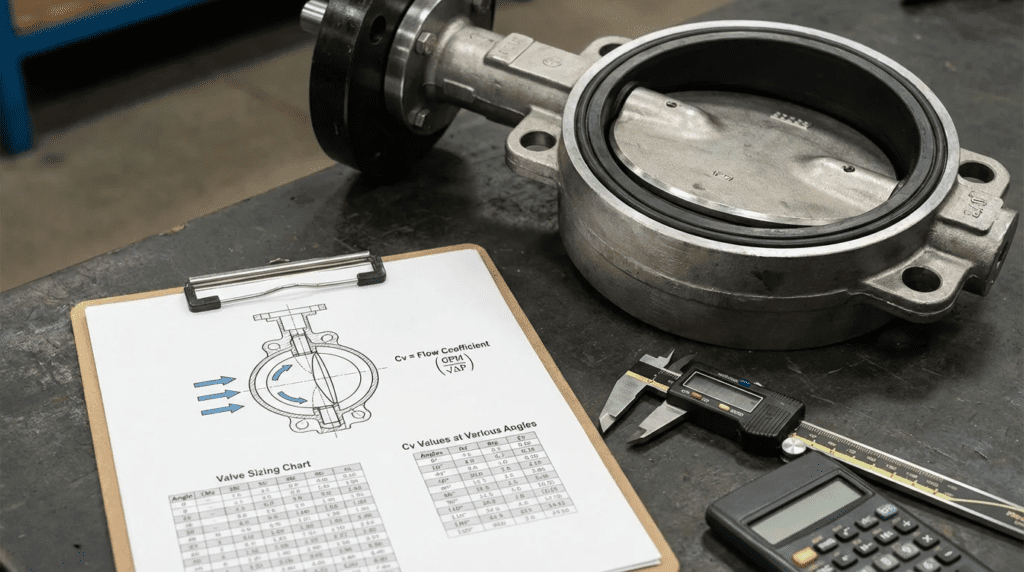
The flow coefficient, Cv, is defined as the volume of water in US gallons per minute (GPM) at 60°F that will flow through a valve with a pressure drop of 1 psi. In butterfly valve applications, the inherent flow characteristic is non-linear; it typically mimics an equal-percentage curve between 20° and 60° of opening before flattening out.
For isolation valves, the goal is a high fully-open Cv to minimize parasitic head loss and pumping costs. For modulating valves, sizing is vastly different. A properly sized control butterfly valve should operate between 30% and 70% open during normal flow conditions. Sizing a valve such that normal flow requires it to be 15% open concentrates the pressure drop across a tiny annular space, generating high-velocity jets that cause cavitation, noise, and rapid seat erosion.
Installation Environment & Constructability
Butterfly valves are manufactured in three primary body styles: wafer, lug, and flanged. Wafer style valves are sandwiched between pipe flanges and rely on the flange bolts for structural integrity; they cannot be used for dead-end service. Lug style valves feature threaded inserts, allowing removal of downstream piping while keeping the valve under pressure (dead-end service), though their pressure rating is often reduced in this configuration.
Flanged style (AWWA C504) valves are standard for large-diameter municipal applications (typically 24-inch and larger) due to their robust structural rigidity and resistance to pipeline stresses. When detailing the installation, engineers must account for disc clearance. The disc of a butterfly valve swings into the adjacent piping. If installed too close to a pump discharge, check valve, or pipe reducer, the disc may physically strike the adjacent equipment, preventing full operation.
Reliability, Redundancy & Failure Modes
Understanding failure modes is critical for establishing MTBF (Mean Time Between Failures) expectations. The most common mechanical failure in elastomeric-seated butterfly valves is seat tearing or extrusion due to high-velocity flow at low opening angles. Another critical failure mode is shaft shearing.
Shaft failure is usually the result of under-calculating operating torque. Torque in a butterfly valve consists of three components: seating/unseating torque (friction between disc and seat), bearing friction torque (shaft rotating in bearings under pressure load), and hydrodynamic torque (forces exerted by the fluid attempting to close the valve). Hydrodynamic torque peaks at roughly 70° to 80° open. If the actuator is not sized to overcome this peak, the valve will stall, or worse, the shaft will shear under the torsional stress.
Controls & Automation Interfaces
Automating a butterfly valve requires specifying the correct actuator—pneumatic, hydraulic, or electric—and the appropriate control interface. For municipal plants, electric multi-turn or quarter-turn actuators are prevalent. When integrating with SCADA, specifications must define the communication protocol (e.g., Modbus, Profibus, Ethernet/IP) and the required feedback signals (4-20mA position feedback, open/close limit switches, fault alarms).
For modulating applications, a smart positioner is critical. It compares the 4-20mA control signal from the PLC to the actual physical position of the valve shaft. High-quality positioners offer self-calibration and diagnostic capabilities, tracking total valve strokes and breakaway torque trends, which are invaluable for predictive maintenance.
Maintainability, Safety & Access
Maintenance ergonomics are frequently overlooked during the design phase. Actuators located 15 feet in the air without platform access will be neglected by maintenance staff. Specifications should require chain-wheel operators for manual valves installed out of reach, or remote-mounted displays for automated valves.
Safety considerations must include Lockout/Tagout (LOTO) provisions. Manual gear operators must accept a padlock in the fully closed position. Furthermore, operators must understand that closing a large butterfly valve too quickly will induce severe water hammer. Actuator operating speeds (stroke times) must be calculated based on the transient surge analysis of the pipeline, typically ranging from 60 to 120 seconds for large transmission mains.
Lifecycle Cost Drivers
The Total Cost of Ownership (TCO) for a butterfly valve extends far beyond its initial CAPEX. While a bare-stem resilient-seated butterfly valve is relatively inexpensive, the OPEX implications of a poor selection are massive.
The primary lifecycle cost driver is pumping energy. A valve with a restrictive internal geometry and a low fully-open Cv will create permanent head loss. Over a 20-year lifecycle, the electrical cost to pump water through that localized pressure drop can exceed the capital cost of the valve by a factor of ten. Other TCO drivers include the labor hours required for seat replacement and the inventory costs of maintaining critical spare actuators and positioners.
PRO TIP: Actuator Torque Safety Factors
Never size an actuator based solely on the clean-water seating torque. Always apply a safety factor (typically 1.25 to 1.5) to account for seat swelling, long periods of inactivity (which increases breakaway torque), and mineral scaling on the disc edge. In wastewater and sludge applications, a safety factor of 1.5 to 2.0 is highly recommended.
COMPARISON TABLES
To assist engineers in navigating Butterfly Valves Sizing and Selection: Cv, the following tables break down the primary design topologies and their application suitability. Understanding the mechanical differences between concentric, double offset, and triple offset geometries is vital for matching the valve to the process constraints.
| Technology / Type | Design Features | Best-Fit Applications | Limitations | Maintenance Profile |
|---|---|---|---|---|
| Concentric (Rubber Seated) | Stem is centered in the disc. Disc remains in constant contact with the rubber seat through 90° stroke. | Standard water/wastewater, aeration air, low-pressure slurries. (AWWA C504) | Constant friction causes higher seat wear. Limited to lower pressures (typically <250 psi) and temps. | High. Seats require periodic replacement due to frictional wear and elastomer degradation. |
| Double Offset (High Performance) | Stem is offset from the center of the disc and the pipe centerline. Camming action lifts disc off seat. | High-pressure water distribution, steam, industrial wastewater, chemical processing. | Higher CAPEX. Unidirectional sealing preferred (though bi-directional is available with de-rating). | Medium. Less seat friction extends lifespan significantly compared to concentric designs. |
| Triple Offset (Metal Seated) | Three distinct offsets. Conical sealing profile. Zero friction during stroke; contacts seat only at final closure. | Extreme temperatures, severe scaling fluids, high-pressure steam, strict zero-leakage needs. | Highest CAPEX. Highly sensitive to pipeline debris which can scratch the metal sealing surface. | Low. Minimal mechanical wear. If seat is damaged by debris, repair is complex and costly. |
| Application Scenario | Recommended Valve Type | Key Constraints & Sizing Focus | Relative Cost |
|---|---|---|---|
| Pump Discharge Isolation | Concentric Flanged (AWWA C504) | Maximize full-open Cv to reduce head loss. Actuator must handle high hydrodynamic torque during pump start/stop. | $ |
| Aeration Blower Modulating Control | High-Performance Double Offset | Critical Cv sizing for gas flow. Must handle 200°F+ discharge temps. Tight control resolution needed. | $$ |
| Primary Sludge Isolation | Concentric with Buna-N Seat | Elastomer compatibility with FOG. Torque safety factor of 1.5x minimum due to solids build-up. | $ |
| High-Pressure RO Feed (Desal) | Double Offset (Duplex SS) | Corrosion resistance (chlorides). High differential pressure sizing. Cavitation checks are mandatory. | $$$ |
ENGINEER & OPERATOR FIELD NOTES
Commissioning & Acceptance Testing
Commissioning is the final line of defense before handing a system over to the operations team. A critical component is the Factory Acceptance Test (FAT). For critical or large-diameter valves, specifications should demand certified hydrostatic shell testing (typically 1.5x working pressure) and seat leakage testing (typically 1.1x working pressure) in accordance with AWWA C504 or API 598 standards.
During the Site Acceptance Test (SAT), engineers must verify the stroke time and limit switch settings. A common issue during SAT is finding that the automated valve travels slightly past 90 degrees or stops short, resulting in leakage. Stroke the valve fully open and closed multiple times, verifying the PLC receives the correct 4-20mA feedback corresponding exactly to the mechanical position indicator.
Common Specification Mistakes
The most pervasive error in Butterfly Valves Sizing and Selection: Cv is “line sizing” a modulating valve. If a 16-inch pipe requires flow control, engineers often default to a 16-inch valve. However, hydraulic calculations frequently reveal that a 10-inch or 12-inch valve provides the correct Cv to control the flow within the ideal 30% to 70% open range. Using the 16-inch valve means it will modulate at 10-15% open, causing velocity jets to strip the elastomer seat and inducing severe vibration.
Another common mistake is specifying “wafer style” valves for pump discharge headers where maintenance might require removing the downstream spool. Because wafer valves rely on the compressive force of both adjacent flanges, removing one flange causes the valve to lose its seal and potentially blow out of the line. Always specify lug-style or flanged valves if end-of-line service or one-sided maintenance is anticipated.
O&M Burden & Strategy
Resilient-seated butterfly valves require active lifecycle management. A fundamental rule of utility operation is that valves must be exercised. An isolation valve left open for five years will likely suffer from a cold-flow bonded seat or extreme mineral scaling, causing the breakaway torque to exceed the actuator’s capacity.
Plant superintendents should enforce a preventive maintenance schedule where all critical butterfly valves are stroked at least 25% closed and reopened every 6 months. Critical spare parts inventory should include replacement seat rings (liners), packing gland kits, and at least one spare positioner/actuator assembly for critical modulating zones.
Troubleshooting Guide
When butterfly valves malfunction, identifying the root cause quickly prevents cascading system failures:
- Symptom: Continuous leakage when fully closed. Root Cause: Incorrect limit switch calibration stopping the actuator before full seat engagement, debris trapped between the disc and seat, or abrasive wear of the elastomer. Fix: Recalibrate limit switches. If unresolved, isolate and replace the seat.
- Symptom: Actuator hunting (constantly adjusting position). Root Cause: Valve is oversized for the required Cv, meaning tiny angular changes cause massive flow changes, confusing the PID loop. Fix: Tune the PLC PID deadband, or permanently resolve by reducing the valve trim or line size.
- Symptom: Severe popping or crackling noise (Cavitation). Root Cause: High pressure drop across the valve causing the fluid’s static pressure to drop below its vapor pressure, forming bubbles that violently collapse. Fix: Limit the differential pressure, ensure the valve operates more than 30% open, or introduce backpressure downstream.
COMMON MISTAKE: Misunderstanding Flow Direction
While many butterfly valves are technically bi-directional, high-performance offset valves usually have a “preferred” sealing direction. Installing them backwards against the pressure differential can reduce their pressure rating by up to 50% and increase leakage rates. Always verify the flow arrow cast into the valve body.
DESIGN DETAILS / CALCULATIONS
Sizing Logic & Methodology
The rigorous process of Butterfly Valves Sizing and Selection: Cv relies on standardized ISA (International Society of Automation) equations. For incompressible fluids (water), the fundamental sizing equation is:
Cv = Q * √(G / ΔP)
Where:
- Cv = Valve flow coefficient
- Q = Flow rate in GPM
- G = Specific gravity of the fluid (Water = 1.0)
- ΔP = Pressure drop across the valve (P1 – P2) in psi
Step-by-Step Sizing Approach:
- Calculate the required Cv for the Maximum, Normal, and Minimum expected flow rates.
- Select a nominal valve size from the manufacturer’s catalog where the Normal required Cv falls between the valve’s 40% and 60% open position.
- Verify that the Maximum required Cv does not exceed the valve’s capacity at 80% open.
- Verify that the Minimum required Cv is not below the valve’s capacity at 20% open.
- Calculate the Cavitation Index (σ). If σ < 1.5, cavitation is likely, and a different valve type or system pressure adjustment is required.
Specification Checklist
A bulletproof engineering specification protects the municipality from substandard equipment. Ensure your procurement documents include the following mandates:
- Design Standard: Specify “Valves shall be designed, manufactured, and tested in accordance with the latest revision of AWWA C504” (for rubber-seated valves).
- Body Material: Specify ASTM A536 Ductile Iron, Grade 65-45-12.
- Disc Type & Edge: Require a 316SS disc edge or a solid 316SS disc. State that “disc edges shall be machined and polished to a smooth finish to minimize seat wear.”
- Seat Retention: For large valves, specify “seats shall be mechanically retained and adjustable/replaceable in the field without removing the valve from the line.” Avoid glued-in or vulcanized seats for sizes above 24 inches.
- Actuator Torque Sizing: State “Actuators shall be sized to provide 150% of the manufacturer’s maximum published seating/unseating torque at the maximum design differential pressure.”
- Testing & Certifications: Require NSF/ANSI 61 certification for all wetted components in potable water systems.
Standards & Compliance
Compliance with industry standards ensures interoperability and baseline quality. AWWA C504 is the bible for rubber-seated butterfly valves (3-inch through 72-inch) in water service. It governs body dimensions, shaft diameters, seat testing, and maximum flow velocities (up to 16 ft/s). For larger custom applications, AWWA C516 applies to valves 78-inch and larger.
If specifying high-performance double-offset valves for industrial wastewater or sludge processing, engineers should refer to API 609. For automated valves, electrical enclosures for the actuators must comply with NEMA standards—typically NEMA 4X for corrosive washdown environments, or NEMA 6P (IP68) if temporary vault flooding is a risk.
FAQ SECTION
What is the flow coefficient (Cv) in butterfly valve selection?
The flow coefficient (Cv) is an empirical value defining a valve’s flow capacity. It equals the number of US gallons per minute of water at 60°F that will flow through the valve with exactly a 1 psi pressure drop. In [[Butterfly Valves Sizing and Selection: Cv]], it is the primary metric used to ensure a valve is not oversized (causing control hunting) or undersized (causing excessive head loss and cavitation).
Why is line-sizing a butterfly control valve a bad practice?
Line-sizing assumes the valve should be the same diameter as the adjacent pipe. However, if a line-sized valve only needs to open 15% to pass the required flow, the water velocity squeezing through that tiny gap becomes incredibly high. This causes destructive cavitation, immense noise, and rapid destruction of the valve seat. Valves must be sized based on their Cv, often resulting in a valve 1-2 sizes smaller than the pipeline.
What is the difference between a concentric and double offset butterfly valve?
In a concentric valve, the stem passes directly through the centerline of the disc and the pipe. The disc rubs against the rubber seat constantly during its 90-degree travel, causing wear. A double offset valve displaces the stem behind the disc and off-center. This camming action lifts the disc entirely off the seat after just a few degrees of rotation, drastically reducing friction, enabling higher pressure ratings, and extending lifespan.
How do I prevent cavitation in a butterfly valve?
Cavitation occurs when localized pressure inside the valve drops below the fluid’s vapor pressure, causing bubbles to form and then violently collapse. To prevent it, ensure the valve operates between 30% and 70% open. If pressure drops are extreme, consider placing two valves in series to stage the pressure drop, install an orifice plate downstream to provide backpressure, or select a valve specifically designed with anti-cavitation trim.
What is the typical lifespan of a resilient-seated butterfly valve?
In clean water municipal applications, the iron body and disc of a well-specified AWWA C504 butterfly valve can easily last 30 to 50 years. However, the elastomeric seats (EPDM/Buna-N) and shaft packings typically require replacement every 10 to 15 years, depending on cycling frequency and water chemistry. Actuators require more frequent preventive maintenance, usually every 1 to 3 years.
Can I use a wafer-style butterfly valve at the end of a pipeline?
No. Wafer-style valves lack threaded bolt holes and rely entirely on the compressive force of both the upstream and downstream pipe flanges to remain in place and maintain a seal. If you remove the downstream pipe, the valve will blow out. For end-of-line (dead-end) service, you must specify a lug-style or flanged butterfly valve.
CONCLUSION
KEY TAKEAWAYS
- Never line-size for control: A modulating butterfly valve should be sized using precise Cv calculations to operate between 30% and 70% open during normal flow.
- Understand torque limits: Actuators must be sized with a 1.25 to 1.5 safety factor above the manufacturer’s stated seating torque to overcome long-term stiction and scaling.
- Match elastomer to fluid: EPDM is strictly for water/air without hydrocarbons; specify Buna-N if fats, oils, or greases are present in wastewater.
- Cavitation destroys valves: Operating a butterfly valve below 20% open under high differential pressure will cause cavitation, shredding seats and snapping shafts.
- Demand AWWA/API standards: Strict adherence to AWWA C504 (or API 609 for high-performance) ensures baseline structural integrity and verifiable testing metrics.
Mastering the intricacies of Butterfly Valves Sizing and Selection: Cv is a core competency required for municipal and industrial fluid handling. While butterfly valves are highly economical and structurally efficient, their non-linear flow characteristics demand rigorous upfront hydraulic engineering. The decision matrix requires balancing capital costs, operating energy (head loss), structural constraints, and long-term maintenance accessibility.
Engineers must break the habit of simply matching pipe sizes and instead evaluate the fluid’s velocity, the differential pressure across the disc, and the precise flow coefficient required across all operating modes. By thoroughly analyzing the duty conditions, selecting the correct mechanical geometry (concentric vs. offset), specifying compatible elastomers, and utilizing stringent testing standards like AWWA C504, project teams can guarantee reliable process control.
When in doubt during complex applications—such as extreme turndown ratios, severe transient surge risks, or highly corrosive industrial effluents—involving surge analysts and valve specialists is highly recommended. By prioritizing precision in the sizing phase, utility decision-makers and plant operators will ensure a resilient infrastructure that operates safely, efficiently, and with minimal lifetime maintenance burden.