
Crispin Valve vs DHC International for Butterfly Valves: Pros/Cons & Best-Fit Applications
Introduction
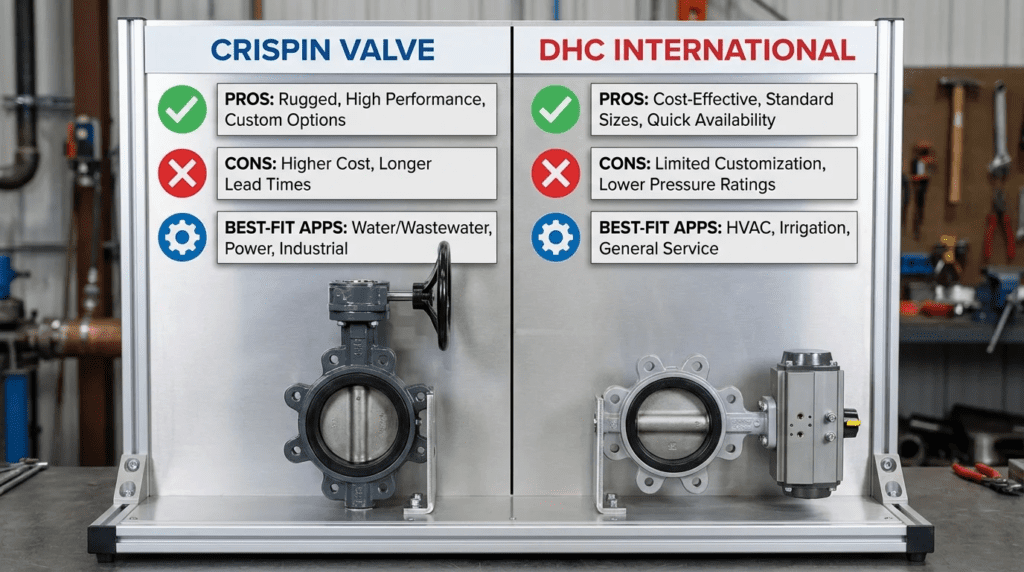
The substitution request is a familiar scenario for municipal consulting engineers and plant superintendents: a specification calls for a domestic standard, yet a contractor submits an international alternative to reduce capital costs. This creates a critical decision point regarding Crispin Valve vs DHC International for Butterfly Valves: Pros/Cons & Best-Fit Applications. Butterfly valve failures in water treatment are far more often attributable to improper application than to manufacturing defects, but the choice of manufacturer significantly influences long-term availability of parts, adherence to AWWA standards, and total lifecycle ownership costs.
Butterfly valves serve as workhorses of water and wastewater treatment plants, utilized for isolation, throttling, and flow control across a wide range of line sizes. The market includes legacy North American manufacturers such as Crispin, known for the K-Flo butterfly series and for air valves, alongside global manufacturers who often specialize in high-performance or large-diameter custom solutions. Misjudging the differences between these approaches can lead to cavitation damage, premature seat failure, or actuation incompatibilities.
This article provides engineering analysis to assist decision-makers in evaluating these options. By focusing on hydraulic performance, material integrity, and maintenance realities, engineers can move beyond the brochure to make data-driven specification decisions.
A verification caution before relying on this comparison. We have not been able to confirm DHC International’s manufacturing base, product range, or AWWA C504 certification status against primary sources, and our own articles have described the company inconsistently — this page identified it as Korean while a companion page rendered the name in a way suggesting Chinese origin. Those cannot both be correct, and the unverified claims have been removed below.
The point is not academic. A domestic-versus-import comparison is only useful if the country of origin is actually known, and Build America, Buy America compliance on federally funded work turns on documented origin rather than supplier reputation. Verify the manufacturer’s identity, factory location, certifications, and North American representation directly before including any supplier in a bid list. Specific claims about lead times, size ranges, and seat technology in the tables below should be treated as unverified. The engineering framework — how to evaluate seat construction, velocity class, torque, cavitation, and coating — holds regardless of which manufacturers are compared.
This site also carries two companion butterfly valve comparisons covering the same three manufacturers in different pairings, which would be better served as one three-way comparison. The wider AWWA C504 field includes DeZURIK, Val-Matic, Bray, AVK, and Mueller among others. See our guide to butterfly valve manufacturers, and our comparisons of Henry Pratt and Crispin Valve, Henry Pratt and DHC International, and Mueller and Val-Matic.
How to Select and Specify Butterfly Valves
The engineering team must look past brand loyalty and analyze the specific operational envelope of the project. Manufacturers often occupy different niches regarding standard off-the-shelf municipal compliance versus custom industrial engineering.
Duty Conditions & Operating Envelope
The first step in specification is defining the exact nature of the service. AWWA C504 is the governing standard for municipal water, but industrial applications may require API 609.
- Flow Profiles: Engineers must calculate the maximum velocity through the valve. Municipal AWWA Class B valves are rated for velocities up to 16 ft/s. In high-pressure industrial wastewater headers or pump discharge applications exceeding that, a more robust disc design or a high-performance valve may be required to prevent flow-induced vibration.
- Throttling vs. Isolation: If the valve is intended for modulating service, the aspect ratio of the disc and the seat design are critical. Symmetrical discs provide predictable flow characteristics but may suffer from dynamic torque reversals. Offset disc designs, double or triple offset, can provide better torque stability in throttling applications.
- Pressure Classes: Standard municipal specifications usually call for Class 150B or 250B. Engineers must verify that the proposed valve meets the working pressure plus surge allowance. Industrial lines may require ASME pressure classes instead.
Reading the Class Designation
In AWWA C504 the numeric portion of the class designation is the pressure rating and the letter suffix is a velocity rating: Class A valves are rated to 8 ft/s in the upstream piping, Class B to 16 ft/s. A Class 150A and a Class 150B valve carry the same pressure rating but are not interchangeable in a high-velocity line. Class and size availability has changed between editions of the standard, so confirm the specified combination exists in the required size before issuing bid documents.
Materials & Compatibility
- Seat Materials: EPDM is standard for water, but Buna-N is required for wastewater with hydrocarbons. The bonding method matters: a seat-on-body design, vulcanized or mechanically retained, is robust for debris-laden water. Seat-on-disc or cartridge seat designs allow for easier field replacement but can be more susceptible to damage from large solids.
- Shaft Material: For wastewater, Type 316 or 17-4 PH stainless steel is recommended to prevent crevice corrosion in the packing area.
- Coatings: Fusion bonded epoxy is effectively mandatory for municipal service. Engineers must specify the dry film thickness and require holiday testing regardless of the manufacturer.
Hydraulics & Process Performance
The flow coefficient determines the head loss across the valve when fully open. A valve with a thicker disc, designed to handle higher pressures, will have a lower coefficient and higher head loss, increasing pumping energy costs over time.
Engineers should request flow coefficient curves for both manufacturers under consideration. A lens-shaped municipal disc typically offers lower head loss in low-pressure water applications, whereas a heavier industrial disc might create slightly higher restriction but offer greater resistance to cavitation at high pressure drops.
Installation Environment & Constructability
- Face-to-Face Dimensions: This is a frequent problem in retrofit projects. AWWA C504 defines short-body and long-body dimensions. International manufacturers may default to ISO or API face-to-face dimensions unless explicitly specified to meet AWWA C504. Verify the flange drilling as well.
- Actuator Orientation: Large valves require significant clearance for the actuator. Import valves may require custom bracketry or adaptors if the actuator is sourced separately, potentially complicating field installation.
Reliability, Redundancy & Failure Modes
- Shaft Connection: Tangential taper pins are the industry standard. They must be mechanically secured to prevent backing out under vibration. Splined connections are superior for high-cycle modulation but are more expensive.
- Seat Failure: The most common failure mode is seat tearing or debonding. Vulcanized seats offer excellent longevity but are non-replaceable in the field; the entire valve must be removed. Mechanically retained seats allow for adjustment and replacement but introduce hardware that can corrode or loosen.
Controls & Automation Interfaces
Modern plants rely on SCADA integration. The valve must adhere to ISO 5211 standards for actuator mounting to ensure compatibility with major actuator brands. Domestic suppliers often have pre-engineered packages with these actuator manufacturers. With international suppliers, the integration burden may be higher, requiring careful verification of stem diameters, keyway sizes, and mounting bolt patterns to ensure the actuator mates correctly without custom machining.
Maintainability, Safety & Access
- Packing Adjustment: Can the packing be adjusted without removing the actuator? This is a critical maintenance feature.
- Lockout/Tagout: Ensure the manual override on the actuator has provisions for positive locking in the off position.
Lifecycle Cost Drivers
The initial purchase price of an import valve may be lower than a domestic equivalent. However, the operating cost analysis must include:
- Energy Cost: Head loss calculations based on actual flow coefficient.
- Spare Parts: Lead time for a replacement seat or shaft. Domestic suppliers typically offer substantially shorter lead times for spares than international shipments.
- Lifespan: An AWWA C504 valve is designed and proof-tested for a defined cycle life. Industrial variants may be rated differently.
Comparison Tables
The following tables provide a comparison to assist in the specification process, assuming a standard municipal water and wastewater context.
| Feature / Attribute | Crispin Valve (K-Flo Series) | DHC International |
|---|---|---|
| Primary Focus | Municipal water and wastewater, air release | Industrial, power, large custom water |
| Primary Standards | AWWA C504, NSF-61, ANSI | API 609, ISO, AWWA C504 on request |
| Seat Design Technology | Typically seat-on-body rubber, molded or mechanically retained. | Diverse: rubber lined, high performance, triple offset metal seated. |
| Size Range | Strongest in mid-range municipal sizes. | Strongest in large diameter and custom. |
| Supply Chain & Parts | Domestic US manufacturing and assembly base. Standard lead times. | International manufacturing. Longer lead times for non-stock items. |
| Typical Strengths | Compliance with US municipal specs. Domestic sourcing options. Air valve integration. | High-pressure ratings. Triple offset technology. Cost-effectiveness on large valves. |
| Limitations | Limited offerings for extreme temperature or pressure industrial applications. | Representation network varies by region. Documentation requires strict review. |
| Application Scenario | Best Fit Strategy | Notes & Constraints |
|---|---|---|
| Potable Water Distribution (4″-24″) | Domestic AWWA supplier | Requires strict NSF-61 and AWWA C504. Standardized parts inventory is priority. |
| Large Diameter Intake/Outfall (>60″) | Competitive bid | At this size, custom fabrication capabilities become cost-competitive. Verify actuation interface rigorously. |
| High Pressure Pump Discharge | High-performance valve | Standard AWWA rubber seated valves may struggle. Double or triple offset designs handle high differential pressure better. |
| Filter Gallery Isolation (Modulating) | Domestic AWWA supplier | Requires precise control and proven cycles. Domestic support for rapid actuator service is critical. |
| Aeration Blower Air Service (High Temp) | High-performance valve | Standard rubber seats degrade in hot air service. Metal-seated or high-temperature polymer valves are superior here. |
Engineer & Operator Field Notes
Commissioning & Acceptance Testing
During the Factory Acceptance Test, particularly for imported valves, engineers should witness the seat leakage test and the hydrostatic shell test.
- Shell Test: Conducted above the rated pressure per the governing standard. Watch for porosity in the casting, particularly in the neck area where the shaft penetrates the body.
- Seat Test: For AWWA rubber-seated valves, the allowance is generally bubble tight. Do not accept minimal leakage unless the specification allows a defined leakage class.
- Torque Verification: A common issue when pairing valves with third-party actuators is under-sizing. The break-from-seat torque after the valve has sat closed for weeks is significantly higher than dynamic torque. Ensure the site acceptance test includes opening the valve against full differential pressure.
O&M Burden & Strategy
- Routine Inspection: Operators should cycle valves that are normally open or normally closed at least once a month. This prevents the rubber seat from adhering to the metal disc or body, which can cause the rubber to tear upon actuation.
- Packing Leaks: V-type packing is typically self-adjusting or easily tightened. Industrial valves may use adjustable gland followers. Operators must know the torque specifications for gland bolts; over-tightening increases stem friction and can stall the actuator.
- Spare Parts Inventory: For domestic valves, stocking a spare operator and packing kit is usually sufficient. For import valves, it is worth purchasing a complete spare valve for critical sizes, because lead times for specific replacement parts may exceed the acceptable downtime of a treatment train.
Troubleshooting Guide
Symptom: Actuator hunts or oscillates in modulating service.
Root Cause: Often not the actuator, but the valve hydrodynamics. A standard symmetric disc valve used above 60 to 70 degrees open can experience flow reversals that cause torque fluctuations.
Fix: Restrict the opening range in SCADA, or switch to an offset design.
Symptom: Valve leaks past seat when fully closed.
Root Cause: Debris trapped in the seat or improper stop setting.
Fix: Flush the line by opening the valve slightly. If leakage persists, check the actuator closed-limit switch, which may be stopping the disc short of the seat. This is a common commissioning error regardless of manufacturer.
Design Details and Sizing Logic
Sizing Logic & Methodology
Do not size the valve simply to match the line size. Line size is determined by pipe friction economics; valve size is determined by control characteristics.
- Calculate the required flow coefficient from design flow, specific gravity, and allowable pressure drop.
- Check Velocity: Ensure velocity is within the valve’s class velocity rating. If it exceeds that rating, consult the factory; a high-performance upgrade is typically recommended.
- Cavitation Analysis: Calculate the cavitation index. If the index falls below the manufacturer’s limit, the valve is at risk. Anti-cavitation approaches differ substantially between municipal and industrial product lines.
Specification Checklist
To ensure a level playing field between competing manufacturers, include these mandatory items:
- Standard Compliance: “Valves shall comply with the latest revision of AWWA C504.” This forces an international supplier to provide their AWWA line rather than their API industrial line.
- Proof of Design: “Manufacturer must submit an affidavit of compliance for proof-of-design tests per the current edition of AWWA C504.” This requires the manufacturer to prove the valve design has been cycle tested to the standard’s requirements.
- Torque Safety Factor: “Actuators shall be sized with a minimum safety factor of 1.5 times the maximum seating and unseating torque.”
- Origin of Casting: If the project carries Build America, Buy America requirements, domestic sourcing must be documented, not assumed. Require foundry markings and mill certifications traceable to the country of melt and pour.
Standards & Compliance
- AWWA C504: Rubber-seated butterfly valves, 3 in. through 72 in.
- AWWA C516: Rubber-seated butterfly valves, 78 in. and larger.
- API 609: Butterfly valves, double flanged, lug and wafer type. An industrial standard; take care when mixing with municipal specifications.
- NSF/ANSI 61 & 372: Drinking water system components. Mandatory for potable water.
Frequently Asked Questions
What is the primary difference between these manufacturers?
The primary difference lies in market focus and design heritage. Crispin is a domestic manufacturer focused on AWWA C504 municipal water specifications with rubber-seated designs. International manufacturers typically carry a broader portfolio including API 609 industrial valves, triple-offset metal-seated valves, and large custom fabrications. While both can meet municipal specifications, the domestic option is the conventional choice for US waterworks, while the import is often positioned as an engineered or cost-saving alternative for large or industrial applications.
When should I specify a triple offset valve over a standard rubber-seated valve?
Triple offset valves should be specified for high-temperature service, applications requiring metal seats, or fire-safe requirements. For standard water and wastewater distribution at ambient temperature and moderate pressure, a standard rubber-seated valve is preferred due to lower cost and better tolerance for grit and solids.
How does seat-on-body versus seat-on-disc impact maintenance?
In seat-on-body designs, the rubber seat is located in the valve body. This protects the seat from direct flow impingement but makes replacement difficult, often requiring valve removal. Seat-on-disc designs place the sealing ring on the disc edge, allowing easier adjustment and replacement without removing the valve from the line, but the seal is more exposed to high-velocity erosion. For wastewater, seat-on-body is generally preferred to minimize snagging on solids.
Are import valves compatible with standard US actuators?
Usually, but verification is required. Most industrial valves use the ISO 5211 mounting standard. However, the specific stem diameter, keyway dimensions, and bolt circle must be coordinated. A common issue with imported valves is undersized stems relative to the torque output of large US actuators, requiring stress analysis to prevent stem twisting.
What is the typical lead time difference?
Lead times vary with market conditions and should be confirmed at bid time rather than assumed from published figures. As a general pattern, domestic assembly operations offer shorter lead times for standard sizes, while imported valves shipped by sea freight take longer, though import suppliers may hold US stock of smaller commodity-grade valves. For large custom projects, timelines tend to converge.
Why is proof of design testing critical in this comparison?
AWWA C504 requires a proof-of-design test in which a prototype valve is cycled and pressure tested to the standard’s requirements. This ensures the design, including shaft diameter, disc thickness, and seat interference, is robust. Requesting the report ensures that whichever manufacturer is selected, the specific model supplied has been validated, preventing the supply of untested lightweight variants.
Conclusion
Key Takeaways
- Application Rules: Use a domestic AWWA supplier for standard municipal distribution where parts availability and specification compliance are paramount. Consider international suppliers for large-diameter custom fabrication or high-performance industrial crossovers.
- Specification Safety: Always mandate AWWA C504 compliance and proof-of-design submittals to normalize quality levels between domestic and import options.
- Hydraulics Matter: Do not assume flow coefficients are identical. Industrial discs may have higher head loss than municipal designs; calculate the long-term energy cost.
- Material Compatibility: For wastewater, verify 316 stainless trim and hydrogen-sulfide-resistant rubber regardless of manufacturer.
- Actuation Interface: Verify ISO 5211 mounting compatibility to avoid field fabrication of brackets, especially when mixing international valves with domestic actuators.
The choice is not merely a comparison of two brands, but a selection between two manufacturing philosophies. The domestic option represents the established, specification-driven market tailored for municipal consistency. The international option represents a globalized, heavy-industrial approach offering customization and potential cost advantages in large-scale applications.
For the design engineer, the best fit is determined by the risk profile of the application. For critical isolation duty in a potable water plant where downtime is unacceptable, a domestic support network often outweighs initial cost savings. Conversely, for a massive intake structure or a high-pressure industrial effluent line, specialized engineering and heavy-duty construction may offer superior performance. By rigorously defining the operating envelope, engineers can write specifications that ensure whichever valve is installed will perform reliably for its service life.