
Henry Pratt vs DHC International for Butterfly Valves: Pros/Cons & Best-Fit Applications
Introduction
For municipal and industrial consulting engineers, the butterfly valve is often treated as a commodity item, a simple isolation device inserted into piping without much thought given to the manufacturer beyond the flange rating. This oversight is a primary driver of premature seal failure, actuator sizing errors, and unexpected downtime. A substantial share of valve operational issues stem not from the technology itself, but from a mismatch between the valve’s design capabilities and the specific application’s hydraulic reality.
When evaluating market options, engineers often encounter a choice between established domestic manufacturers and international manufacturers. Specifically, comparing Henry Pratt vs DHC International for Butterfly Valves: Pros/Cons & Best-Fit Applications reveals a divergence in engineering philosophy, seat design, and lifecycle cost implications. Henry Pratt, a brand closely associated with the AWWA C504 standard in North America, represents the heavy-duty, specification-driven end of the spectrum. Conversely, international manufacturers often bridge the gap between industrial versatility and cost-effective municipal compliance.
This article provides analysis for plant directors, utility engineers, and system designers. It moves beyond marketing brochures to examine the metallurgy, seating geometry, and hydraulic performance of the compared offerings. By understanding the distinct engineering advantages and limitations of each, decision-makers can avoid the common trap of specifying a transmission-main valve for a chemical feed line, or vice versa.
A verification caution before relying on this comparison. We have not been able to confirm DHC International’s manufacturing base, product range, or AWWA C504 certification status against primary sources, and our own articles have described the company inconsistently — one identifies it as Korean, another renders the name in a way that suggests Chinese origin. Those cannot both be right.
This matters because the entire value of a domestic-versus-import comparison rests on knowing which country of origin is actually involved, and because Build America, Buy America compliance on federally funded work turns on documented origin rather than on a supplier’s general reputation. Engineers should verify the manufacturer’s identity, factory location, product certifications, and North American representation directly before including this supplier in a bid list, and should treat the specific claims below about lead times, size ranges, and seat technology as unverified. The engineering framework in this article — how to evaluate seat construction, velocity class, torque, and coating — holds regardless of which manufacturers are being compared.
This site also carries two companion butterfly valve comparisons covering the same three manufacturers in different pairings. Three pairwise articles would be better served as one three-way comparison, and the pages are consolidation candidates. The wider AWWA C504 field also includes DeZURIK, Val-Matic, Bray, AVK, and Mueller among others.
For the supplier landscape, see our guide to butterfly valve manufacturers, and our related comparisons of Henry Pratt and Crispin Valve, Crispin and DHC International, and Val-Matic and Proco.
How to Select / Specify Butterfly Valves
Selecting the correct butterfly valve requires a multi-dimensional analysis of the process conditions. The engineer must look past the purchase price and evaluate the valve’s ability to maintain a drop-tight seal under dynamic loading conditions over 20 years or more.
Duty Conditions & Operating Envelope
- Flow Profiles: Is the flow continuous or intermittent? High-velocity applications can induce cavitation and vibration that damage standard resilient seats. Heavy-duty disc designs are favored for high-velocity isolation, whereas streamlined discs may be preferable for lower pressure drop requirements in standard flow ranges.
- Pressure Class vs. Working Pressure: AWWA C504 classes combine a pressure rating with a velocity rating. A common mistake is selecting a Class 150 valve for a system with potential surge pressures exceeding 200 psi.
- Frequency of Operation: A valve cycled daily for filter backwash has vastly different wear characteristics than a transmission main isolation valve operated once every five years. High-cycle applications require robust shaft-to-disc connections and fatigue-resistant seat materials.
Reading the Class Designation
In AWWA C504 the numeric portion of the class is the pressure rating and the letter suffix is a velocity rating: Class A valves are rated to 8 ft/s in the upstream piping, Class B valves to 16 ft/s. A Class 150A and a Class 150B valve share a pressure rating but are not interchangeable in a high-velocity line. Class and size availability has changed between editions of the standard, so confirm the specified combination exists before issuing bid documents.
Materials & Compatibility
- Seat Design: Henry Pratt is known for the molded-in or vulcanized seat design, where the rubber is bonded directly to the body. This reduces the risk of seat washout but makes field replacement difficult or impossible. Cartridge-style or boot seats in smaller diameters and adjustable mechanical seats in larger sizes offer different maintenance trade-offs.
- Disc Materials: Ductile iron with 316 stainless steel edges is standard. However, for industrial wastewater containing chlorides or grit, fully encapsulated discs or special alloys may be required.
- Shaft Metallurgy: 17-4 PH or 316 stainless steel are industry standards. Engineers must verify that the shaft diameter provided meets the deflection criteria of AWWA C504 to prevent seal leakage during high-pressure shutoff.
Hydraulics & Process Performance
- Head Loss: In gravity flow systems or pump suction lines, head loss is critical. Manufacturers optimize disc shapes to minimize obstruction. Engineers should compare flow coefficients at 100% open for competing models of the same nominal size.
- Cavitation: If the valve is used for throttling, check the cavitation index. Butterfly valves have high pressure recovery factors, making them prone to cavitation at high pressure drops. Anti-cavitation trim is rarely standard on commodity butterfly valves.
Installation Environment & Constructability
- Face-to-Face Dimensions: While manufacturers generally adhere to industry standards, retrofits require precise verification. Buried service lines involve specific considerations that differ from standard vault-installed valves.
- Actuation Space: The actuator mounting pad and orientation must account for wall clearance. A common constructability issue arises when the actuator handwheel interferes with adjacent piping or vault walls.
- Lug vs. Wafer vs. Flanged: In municipal work, double-flanged bodies are preferred for their rigidity and ability to hold dead-end service. Wafer styles rely on flange bolts for alignment and are generally discouraged for critical isolation in water mains.
Reliability, Redundancy & Failure Modes
- Shaft Shear: The most catastrophic failure mode. It typically occurs due to instantaneous over-torque from actuator failure or water hammer.
- Seat Debonding or Tearing: In bonded seats, failure usually implies a complete valve replacement or factory refurbishment. In cartridge seats, a tear can sometimes be repaired, though success rates vary.
- Service Life: For AWWA C504 valves, service life is generally long. Premature failure is almost always due to improper sizing or lack of exercise.
Maintainability, Safety & Access
- Packing Adjustment: Can the packing be adjusted under pressure? Both typically offer adjustable chevron V-packing, but access varies by actuator mounting.
- Lockout/Tagout: Actuators must accommodate robust lockout hardware.
- Buried Service: Valves buried underground are zero-maintenance by necessity. Pratt’s reputation is built on buried service reliability where the cost of excavation far exceeds the cost of the valve.
Lifecycle Cost Drivers
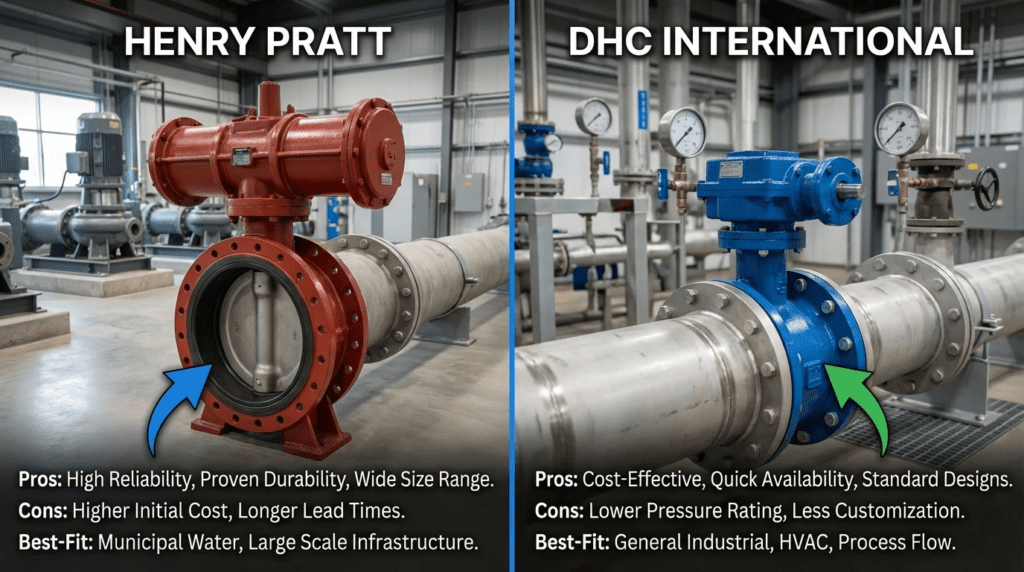
- Capital Cost: International manufacturers generally offer a lower initial price point for standard configurations. Pratt often commands a premium due to domestic manufacturing and brand legacy.
- Operating Cost: If a valve requires excavation for repair, operating cost dominates. A valve with a 40-year buried lifespan offers lower total cost than a cheaper alternative that fails in 15 years. Conversely, for an easily accessible plant air line, lower capital cost may yield the better total cost.
Comparison Tables
The following tables provide a technical comparison to assist engineers in the specification process. These are tools for rapid assessment, not absolute rules.
| Attribute | Henry Pratt Company (Mueller) | DHC International |
|---|---|---|
| Primary Focus | Municipal water and wastewater, power generation. Heavily specification-driven under AWWA C504. | Industrial, commercial, and standard municipal applications. |
| Seat Technology | Vulcanized (bonded): Rubber is bonded to the body in a way that prevents washout. Suited to high velocities. | Cartridge, booted, or bonded: Varies by line; verify the specific model offered. |
| Size Range | Broad range including large-diameter transmission mains. | Strongest presence in the commodity and mid-range sector. |
| Key Strengths | Domestic manufacturing with established BABA-compliant supply chains. Long installed base history. Custom engineering for complex actuation. | Competitive pricing. Lead times for standard products. Broad adaptability for general industrial use. |
| Typical Limitations | Higher capital cost and longer lead times for custom builds. More valve than needed for simple HVAC or non-critical lines. | Domestic sourcing compliance must be verified explicitly for federally funded projects. Less customization for massive diameter civil projects. |
| Maintenance Profile | Low frequency, high difficulty: Designed to last decades untouched. If the seat fails, the valve usually must be pulled for factory repair. | Medium frequency, variable difficulty: Cartridge seats allow for potential replacement, but typically require valve removal from line. |
| Application | Service Characteristics | Henry Pratt Fit | DHC International Fit | Selection Logic |
|---|---|---|---|---|
| Potable Water Transmission (Buried) | High reliability required; zero maintenance access; soil loads. | Best Fit | Conditional | Buried service demands the most robust seat-to-body bonding to prevent failure. |
| Wastewater Treatment Plant (Inside) | Moderate pressure; accessible; potential grit and solids. | Strong Fit | Strong Fit | Both perform well. If budget is constrained and the valve is accessible, the lower-cost option offers value. For critical influent headers, the heavier-duty option is preferred. |
| Industrial Cooling / HVAC | Clean water; temperature variations; budget-sensitive. | More than required | Best Fit | The heavy-duty AWWA features are unnecessary cost adders for standard HVAC loops. |
| Pump Isolation | Turbulence; vibration; potential water hammer. | Best Fit | Good Fit | Rigid shaft and disc designs resist flow-induced vibration better in high-energy pump stations. |
| Chemical Feed / Corrosive | Aggressive media; requires special liners. | Specialty | Strong Fit | Industrial-focused brands often have broader stock of lined or special alloy valves. |
Engineer & Operator Field Notes
Commissioning & Acceptance Testing
- Open/Closed Stops: A common failure mode is the actuator over-driving the disc into the seat. For resilient seated valves, the closed position is defined by seat interference, not a hard metal stop. Actuators must be set to torque or position limits that respect the manufacturer’s seating torque.
- Factory Acceptance Test: For valves larger than 24 inches, engineers should require a certified FAT including a hydrostatic shell test and a seat leakage test. Verify the manufacturer’s testing capabilities for large orders.
- Documentation: Ensure the submittal package includes the specific torque curve for the valve as manufactured, not just a catalog average. Seating torque can vary based on rubber compound batch hardness.
Common Specification Mistakes
- Mixing Standards: Do not mix API 609 (industrial and refinery) and AWWA C504 (municipal water). They have different face-to-face dimensions and testing protocols. Specifying API 609 for a municipal water plant may disqualify standard municipal offerings or force a specialized industrial quote.
- Domestic Sourcing Requirements: If the project is federally funded through the State Revolving Funds or WIFIA, Build America, Buy America rules apply to iron and steel products including valves. Domestic manufacturers have established supply chains for this. International suppliers may have compliant lines, but this must be verified explicitly during the submittal phase. Failure to verify origin can lead to rejection of installed valves.
- Actuator Sizing Safety Factors: Specifying a 2.0 safety factor on an actuator for a valve that already has conservative torque ratings can result in an actuator capable of shearing the valve shaft if the limit switches fail. A 1.25 to 1.5 safety factor is typically sufficient.
O&M Burden & Strategy
- Exercise Programs: All resilient-seated butterfly valves require cycling at least annually. This prevents the rubber seat from taking a permanent compression set and clears tuberculation buildup on the disc edge.
- Packing Leaks: Operators prefer valves with accessible packing glands. Some compact designs may require actuator removal to access packing bolts. Verify accessibility in the drawing phase.
- Gearbox Maintenance: Many failures are actually gearbox failures. Whether using Rotork, AUMA, or a manufacturer’s proprietary gear, check oil levels and grease fittings annually. Submerged gearboxes must be properly sealed; standard ratings often degrade over years of submersion.
Design Details & Calculations
Sizing Logic & Methodology
A butterfly valve should rarely be line size by default. While convenient, line-sizing often results in a valve that operates only between 0 and 20% open to control flow, leading to wire-drawing of the seat.
- Determine Flow Conditions: Identify minimum, normal, and maximum flow.
- Calculate Velocity: Ensure velocity at maximum flow does not exceed the valve’s class velocity rating.
- Check Control Range: Butterfly valves have a modified equal percentage characteristic and are effective for control only between roughly 20% and 70% open. If the calculated opening angle at normal flow is below 20%, reduce the valve size using reducers to push the operating point into the controllable range.
- Calculate Dynamic Torque: Dynamic torque is a function of the torque coefficient, diameter, and pressure drop. Note that peak dynamic torque often occurs at 60 to 70% open, not fully closed.
Specification Checklist
- Proof of Design: Require an affidavit of compliance with the proof-of-design provisions of the current edition of AWWA C504.
- Coating: Specify interior and exterior epoxy coating conforming to AWWA C550. Demand holiday testing to ensure no pinholes in the coating, which leads to corrosion under the liner.
- Actuator Interface: Specify ISO 5211 mounting pads. This standardizes the interface, allowing actuator brands to be changed in the future without custom machining.
Standards & Compliance
AWWA C504 (Rubber-Seated Butterfly Valves): The governing standard for municipal water, covering 3 in. through 72 in. Verify the specific series offered by any manufacturer is C504 compliant rather than assuming it.
NSF/ANSI 61 and 372: Mandatory for all potable water contact. Verify current certification for the specific rubber compound and coating used.
Frequently Asked Questions
What is the primary difference between these manufacturers?
The primary difference lies in market focus and design philosophy. Henry Pratt is a US-centric manufacturer specializing in custom, heavy-duty AWWA C504 valves for municipal water and power, often featuring vulcanized seats. International manufacturers typically operate with a broader focus on industrial, HVAC, and standard municipal applications, often utilizing cartridge or resilient seated designs that offer cost advantages for standard duties.
How do you select the right pressure class for a butterfly valve?
Selection is based on the maximum line pressure and the required shutoff capability. AWWA C504 defines Class 25, 75, 150, and 250 designations, each paired with an A or B velocity suffix. Engineers should calculate the maximum potential surge pressure and select a class that exceeds this value. For industrial applications, ANSI Class 150 or 300 ratings are used, which correspond to different pressure-temperature ratings.
When should I specify a bonded seat versus a cartridge seat?
Specify a bonded seat for high-velocity, vacuum, or critical buried service applications where seat movement or washout would be catastrophic. Specify a cartridge or booted seat for general industrial, HVAC, or chemical applications where the ability to replace the seat is desirable, or where chemical compatibility requires changing seat materials.
Are international valves compatible with AWWA C504 specifications?
Many international manufacturers produce specific product lines that meet AWWA C504. However, not all of their valves are C504 compliant; many are designed to API or MSS standards. Engineers must explicitly verify that the submitted model meets the C504 proof-of-design and leakage requirements if the project demands it.
Why do butterfly valves fail in wastewater applications?
Failures in wastewater are often caused by debris such as grit, rags, and struvite accumulating in the seat area or wrapping around the disc stem. Seat-on-body designs are generally preferred over seat-on-disc for raw sewage to minimize obstruction. Additionally, struvite scale can build up on the disc, increasing the torque required to seat or unseat the valve, eventually causing the actuator to stall or the shaft to shear. Regular cycling is the best prevention.
How much does a 24-inch butterfly valve cost?
Cost varies significantly by specification and by market conditions. A standard industrial wafer valve, an AWWA C504 flanged valve with a manual gear operator, and a valve with electric actuation and specialty coatings occupy substantially different price tiers, and material markets move. Obtain current quotes rather than relying on published ranges.
Conclusion
Key Takeaways for Engineers & Operators
- Specification Drives Brand: If your specification rigidly follows AWWA C504 with domestic manufacturing requirements, a domestic manufacturer is the path of least resistance and highest compliance.
- Application Over Loyalty: For standard industrial lines, HVAC loops, or non-critical isolation, a lower-cost manufacturer often provides a cost-effective solution with faster availability.
- Seat Design Matters: Choose bonded seats for longevity and vacuum service. Choose cartridge seats for reparability and chemical flexibility.
- Verify Torque: A large share of valve issues are actuator-related. Ensure the actuator is sized for the valve’s actual break-away torque, including safety factors for inactivity.
- Don’t Oversize: Avoid line-sizing control valves. Validate velocity and cavitation parameters to prevent premature seat erosion.
The decision is not a binary choice between good and bad, but rather a strategic selection between heavy-duty custom and standardized versatile.
For municipal water transmission mains, buried service, and critical plant headers where a 30-year installed life is the baseline expectation, Henry Pratt’s conservative design philosophy and robust AWWA compliance make it a standard-bearer. The premium in capital cost is justified by the reduction in long-term risk and excavation costs.
Conversely, for industrial wastewater, auxiliary plant systems, HVAC, and projects with aggressive budget or schedule constraints, a competitively priced international supplier offers a compelling value proposition, provided compliance is verified.
Engineers must ultimately act as the bridge between the hydraulic requirements and the procurement budget. By analyzing the duty cycle, media characteristics, and maintenance accessibility, the choice becomes a calculated engineering decision rather than a simple price comparison.