
Mueller vs Val-Matic Butterfly Valves Equipment: Comparison & Best Fit
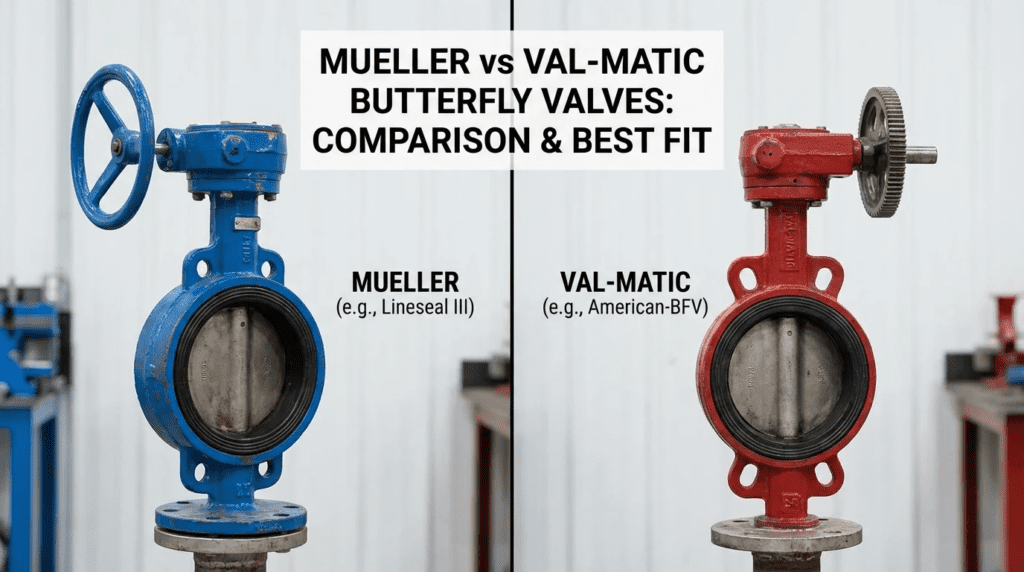
Mueller vs Val-Matic Butterfly Valves: Comparison and Best Fit
Introduction
Butterfly valves are routinely treated as a commodity specification, and the consequences show up years later during a main break when an aged valve will not seat. The cost of a seized or leaking isolation valve during a catastrophic line failure dwarfs the capital difference between valve makes, which is why the generic AWWA C504 label is a starting point rather than a specification.
Mueller Co. and Val-Matic are both established suppliers to the North American water market, and both build to AWWA standards. Their design approaches differ in seat retention, disc geometry and shaft sealing, and those differences matter in specific environments — high-cycle pump control behaves nothing like infrequent isolation in buried service.
Manufacturer positioning across the category is covered in our overview of the top OEMs for butterfly valves.
How to Select and Specify
Duty Conditions
Both manufacturers offer valves in the standard AWWA pressure classes. The differences emerge at the margins of the operating envelope.
- Flow velocity: AWWA C504 valves are generally rated to 16 ft/s. Where the application involves higher velocity — emergency drawdown, for example — request the manufacturer’s disc strength calculation rather than assuming the standard rating covers it.
- Throttling service: Where the valve controls flow rather than simply isolating, disc geometry governs performance. Offset disc designs generally provide a wider effective control range before cavitation than symmetric designs. Request cavitation data for the specific opening angles the valve will actually see, typically between 30 and 70 degrees.
Materials
- Seats: EPDM is the standard for potable water and resists chloramines well. Buna-N suits wastewater with hydrocarbon content. The specification decision that matters is whether field replaceability of the seat is a hard requirement — a mechanically retained seat allows field adjustment, while a bonded seat generally means factory return or unit replacement.
- Disc edge: This is the primary wear interface. Type 316 stainless steel should be specified for the disc edge regardless of the disc body material, to prevent tuberculation that will shred the rubber seat.
- Shaft: Verify shaft diameter meets the AWWA C504 requirement for the size, to prevent deflection under load.
Hydraulics
Flow coefficient determines head loss at full open, and in continuous pumping duty that translates directly into energy cost over the asset life. On a large plant, a modest head loss difference across a bank of valves accumulates into real annual pumping cost. Request certified flow test data for the specific models and diameters being compared rather than relying on catalogue generalities or marketing claims about hydraulic efficiency.
Installation Environment
Buried service: The critical specification is the actuator, which must be a grease-packed, sealed gear unit with an enclosure rating appropriate to the groundwater conditions. Contractor familiarity and parts availability also carry genuine weight in buried distribution work, where valves are installed in quantity and rarely revisited.
Plant and gallery service: Here accessibility changes the calculation. Seat adjustability without removing the valve from the line has real value when the valve is reachable, and compact actuator mounting matters in constrained galleries. Face-to-face dimension and actuator orientation frequently decide the selection.
Reliability and Failure Modes
- Shaft sealing: V-type or self-adjusting chevron packing is standard. Preference should go to designs allowing packing replacement without major disassembly.
- Seat failure: A seat cut by debris leaks. A mechanically retained seat offers a path to field repair, though this is a demanding task rarely executed perfectly in the field. A bonded seat generally means replacement.
Lifecycle Cost
- Acquisition: Bulk distribution valve procurement is price-sensitive and competitive.
- Energy: Head loss differences matter in high-head continuous pumping and are negligible in infrequent isolation duty.
- Maintenance labour: If operators are not trained in seat adjustment, the repairable feature of a premium valve is never exercised and the valve becomes a replacement item regardless of what was paid for it.
Comparison
| Attribute | Mueller (Lineseal family) | Val-Matic (AWWA butterfly range) | Why it matters |
|---|---|---|---|
| Seat retention | Molded-in or mechanically retained depending on size | Mechanically retained, field-adjustable on many models | Adjustable seats allow leakage correction in service; bonded seats are simpler but harder to repair |
| Disc geometry | Streamlined, symmetric or slightly offset | Offset designs available | Offset reduces seat interference during travel, lowering torque and wear |
| Shaft sealing | V-type packing or O-rings | Adjustable V-type packing | Adjustable packing extends intervals between major maintenance |
| Market position | Very large installed base in distribution | Strong presence in plant and pump station work | Affects parts availability and contractor familiarity |
| Typical best fit | Buried distribution and transmission | Plant galleries, pump stations, higher-cycle service | Matches design strengths to environment |
| Application | Governing requirement | Decision driver |
|---|---|---|
| Buried distribution isolation | Infrequent operation, no maintenance access, robust actuator | Capital cost and ruggedness |
| Filter effluent control | Modulating service, frequent cycling | Control range — favours offset disc designs |
| High service pump discharge | High flow, continuous operation | Energy cost — compare certified head loss data |
| Aeration air service | Elevated temperature potential | Seat material compatibility; verify high-temperature options |
Field Notes
Commissioning
Seat integrity verification is the priority during acceptance testing. Rubber seats stick after long storage, and the first cycles reveal whether the disc edge is sliding or catching.
- Torque verification: Set actuator stops correctly. Over-torquing a butterfly valve closed does not improve the seal — it compresses the rubber past its recovery point and shortens seat life.
- Cycle testing: Run the valve full open to full closed several times. Popping noises indicate the disc edge is catching on the seat rather than sliding smoothly.
A second frequent error is ignoring the actuator extension in buried applications. If the ground settles, a rigid extension transfers load into the valve bonnet, causing misalignment and leakage. Specify a slip joint or intermediate coupling to isolate ground movement.
Operations
Valve exercising is the single most valuable maintenance task on any butterfly valve. Annual or semi-annual cycling prevents calcification and rubber adhesion. Distribution valves left static for years become seized valves, and this is true across manufacturers.
Packing adjustment on accessible designs lets operators respond to shaft leakage, but requires training — uneven tightening scores the shaft. Self-adjusting arrangements require less intervention but offer fewer options when a leak develops.
Troubleshooting
- Will not close completely: Debris in the body bottom, common in wastewater, or actuator limit drift. Back-flush by opening slightly and reclosing. Check stops. Do not force.
- Leakage past seat: Seat wear, disc edge corrosion, or insufficient seating torque. On adjustable designs attempt seat adjustment; otherwise check for lodged debris and verify actuator output.
Design Details
Velocity
V = (0.4085 × Q) / d², where V is velocity in ft/s, Q is flow in gpm and d is diameter in inches. Keep velocity below 16 ft/s for standard C504 applications; above that, consult the manufacturer regarding torque increases and disc loading.
Torque
Actuator sizing depends on three components:
- Seating torque: friction between seat and disc edge
- Bearing torque: shaft bearing friction under hydrostatic load
- Dynamic torque: fluid forces acting to close the valve
Offset disc designs generally produce lower seating torque than symmetric designs, sometimes permitting smaller actuators on large valves. Require torque calculation sheets in the submittal, showing the safety factor applied to worst-case conditions.
Standards
- AWWA C504: Rubber-seated butterfly valves
- AWWA C516: Rubber-seated butterfly valves, 78 in. and larger
- NSF/ANSI 61 and 372: Potable water components, lead-free
- ASTM A536: Ductile iron castings
- Proof of design: Require evidence the manufacturer has completed the cycle testing C504 specifies for the model offered
Frequently Asked Questions
What is the difference between AWWA C504 and C516?
C504 covers rubber-seated butterfly valves in the sizes used for most municipal distribution and plant piping. C516 covers large-diameter rubber-seated butterfly valves, 78 in. and larger. For the great majority of municipal work, C504 is the governing standard for both manufacturers’ product lines.
Can these valves be used for throttling?
Yes, within limits. The effective control range for most butterfly valves falls between roughly 30 and 70 degrees open. Continuous operation below 30 degrees causes seat erosion from high local velocity and risks cavitation. Verify the cavitation index at the actual operating point before committing to throttling duty.
Why does offset disc design matter?
An offset design moves the shaft axis away from the disc and pipe centreline, so the disc cams into the seat only at the end of the closing stroke. This reduces continuous friction between the disc edge and rubber during travel, lowering operating torque and extending seat life. It generally permits a smaller actuator for the same valve.
Which is better for buried service?
Both are capable. The practical considerations in buried distribution are capital cost across quantity, contractor familiarity, parts availability, and actuator robustness — head loss differences rarely justify a premium underground, because the valve spends its life fully open and is operated a handful of times. Reserve the hydraulic optimisation argument for pumped service where it actually pays.
What lifespan should be expected?
With proper exercising, twenty to thirty years is a reasonable expectation in clean water service for either manufacturer. The seat is the limiting component. In aggressive oxidant environments, rubber degrades faster and elastomer selection becomes the governing decision. Mechanically retained seats offer a repair path that bonded seats do not.
Conclusion
Key Takeaways
- Environment drives selection: Buried distribution and accessible plant piping reward different design attributes.
- Seat technology is the real differentiator: Bonded versus mechanically retained determines whether repair is possible.
- Compare certified data: Request flow test and torque calculation sheets rather than accepting hydraulic efficiency claims.
- Specify proof of design and actuator safety factors explicitly to avoid undersized actuation.
- Match to your crew: A repairable valve is only an advantage if someone is trained and willing to repair it.
The useful analysis is not which manufacturer is superior but which design attributes match the service. A robust, widely stocked, standardised valve is the right answer for buried distribution, where access is nil and quantity is high. A more adjustable, hydraulically optimised valve earns its premium in galleries and pump stations, where it is reachable, cycled frequently, and where head loss is paid for in energy every hour.
Related evaluations across the category appear in our comparisons of concentric and eccentric butterfly valve designs, Henry Pratt and Crispin Valve, and Henry Pratt and DHC International.