
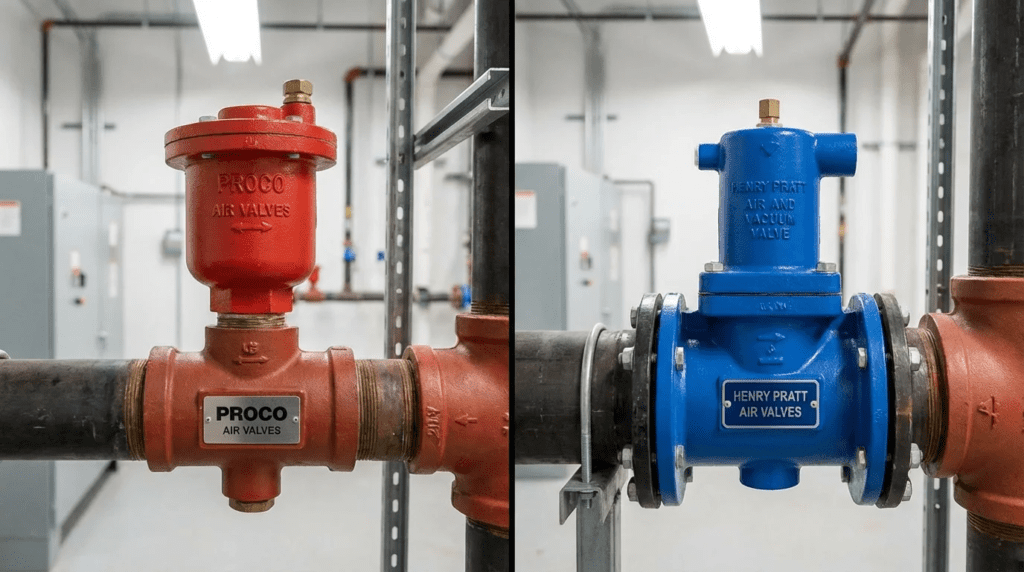
Proco vs Henry Pratt Air Valves Equipment: Comparison & Best Fit
Introduction
The catastrophic collapse of a pipeline due to vacuum conditions or the rupture of a force main caused by trapped air pockets remains a persistent threat in municipal water and wastewater infrastructure. Despite the critical nature of air management, air valves are often the most undervalued component in the hydraulic profile, frequently selected based on line size rather than thermodynamic and hydraulic performance. This article provides an in-depth analysis of Proco vs Henry Pratt Air Valves Equipment: Comparison & Best Fit to aid in specification and procurement.
Air valves serve three distinct functions: venting air during filling (exhaust), admitting air during draining (vacuum break), and releasing entrained air during operation (release). While the fundamental physics remain constant, the mechanical execution differs between manufacturers.
Choosing the wrong equipment can lead to accelerated corrosion from trapped oxygen, pump inefficiency due to artificial head, or water hammer events that fatigue piping systems. This guide moves beyond the catalog data to examine the engineering realities: materials of construction, maintenance intervals, and failure modes. It sits within our coverage of air valve manufacturers.
Verify both catalogs before using this comparison to specify: Proco Products is established in expansion joints and elastomeric duckbill check valves; we have not been able to confirm a current Proco air valve product line. Henry Pratt is a butterfly, plug and related valve manufacturer, and an air valve line under that brand is likewise unconfirmed. The AWWA C512 air valve field in North America is served primarily by Val-Matic, APCO (DeZURIK), Crispin, ARI and AVK.
The selection criteria, sizing methods and field practice below are sound and apply to any AWWA C512 air valve. The brand-level claims are not the part to rely on. A comparison between two manufacturers that both genuinely build air valves appears in our article on Val-Matic vs AVK air valves.
How to Select / Specify Air Valve Technologies
Duty Conditions & Operating Envelope
- Venting Capacity (SCFM): Do not assume a 2-inch valve from one vendor has the same discharge capacity as another. Compare the discharge curves at specific differential pressures, usually 2-5 psi.
- Sealing Pressure: A critical, often overlooked parameter is the minimum sealing pressure. Some air valves require 5-10 psi to seal drip tight. If the valve is located at a high point with low static head, it may leak continuously.
- Vacuum Collapse Protection: Calculate the potential vacuum volume during a column separation event. The valve must admit air fast enough to prevent the pipe from buckling. This is a function of the effective orifice area, not the connection flange size.
Materials & Compatibility
- Body Material: Municipal specifications typically demand Ductile Iron (ASTM A536) or Cast Iron (ASTM A126), coated with fusion-bonded epoxy to resist external corrosion.
- Internal Mechanisms: The float and linkage mechanisms are the most failure-prone components. 316 Stainless Steel is the baseline recommendation for wastewater. Polymers may be acceptable for potable water but can degrade in aggressive industrial effluents.
- Seat Material: Buna-N or EPDM are standard. In wastewater applications with high grease content, the seat geometry matters more than the material. A steep seat angle prevents debris accumulation.
Hydraulics & Process Performance
- Wastewater Considerations: In sewage applications, short body air valves are prone to clogging because the mechanism is too close to the fluid line. Long body or extended body valves keep the sealing mechanism elevated, utilizing an air gap to prevent solids from fouling the seat.
- Anti-Slam Devices: For high-pressure pumps, the rapid expulsion of air during startup can cause the float to slam shut, creating a secondary surge. Look for anti-slam or throttling devices that restrict airflow as the water column approaches the valve.
Installation Environment & Constructability
- Vault Height: Air valves are typically installed at high points, often in shallow vaults. The overall height of the valve assembly including the isolation valve is critical; ensure vault clearance allows for top-cover removal for maintenance.
- Flooding Risks: If the vault is prone to flooding, the air valve must be piped to a vent stack above the flood rim. This adds backpressure to the discharge; the valve sizing must account for the friction loss of the vent piping.
Reliability, Redundancy & Failure Modes
- Self-Cleaning Mechanisms: Some designs incorporate a linkage that creates a mechanical advantage, ensuring the valve opens against internal pressure but also seats firmly.
- Redundancy: For critical transmission mains, it is best practice to install two air valves isolated by a manifold, or to keep a shelf spare. Standardized flange dimensions usually make swapping between manufacturers physically possible, provided the height clearance exists.
Lifecycle Cost Drivers
- Backwash Accessories: In wastewater, valves require regular backflushing. A valve supplied with factory-integrated backwash valves and quick disconnects saves significant operator time.
- Spare Parts Availability: Local stock availability for specific internal kits should be verified during selection.
Comparison Tables
| Feature / Criteria | Henry Pratt (Mueller) | Proco Products |
|---|---|---|
| Primary Focus | Heavy municipal water and wastewater valves; butterfly, plug and related lines. | Expansion joints, duckbill check valves and flexible piping solutions. |
| Design Philosophy | Robust, heavy cast bodies designed for 20+ year municipal lifecycles. | Cost-effective, functional designs often targeting specific industrial or commercial applications. |
| Wastewater Designs | Long body configurations are the municipal norm for keeping mechanisms free of fats, oils and grease. | Specification requires scrutiny to confirm sewage-grade internals are available. |
| Pressure Ratings | Standard municipal classes: 125, 250, 300. | Standard commercial ranges; verify for high-pressure transmission main applications. |
| Certifications | AWWA compliance and NSF-61 are standard expectations for public works. | Verify specific model compliance with AWWA C512 if mandated by municipal code. |
| Maintenance Profile | Rebuild kits widely available through municipal distribution. | Depending on model size, replacement may be more cost-effective than rebuild. |
| Application Scenario | Engineering Rationale |
|---|---|
| Municipal Potable Water Transmission | Requires strict AWWA C512 compliance and long-term asset management integration. |
| Raw Sewage Force Mains | Extended body design minimizes clogging risks. Access to standardized backwash accessories is critical for operations. |
| Industrial Cooling Water / HVAC | Cost-efficiency is prioritized, with less stringent requirement for AWWA documentation. |
| Outfall Scenarios (Passive) | Elastomeric duckbill check valves, which is the product category Proco is actually known for, are widely used at outfalls where a passive non-mechanical device outperforms a mechanical valve in salt water. Note that a duckbill check is a backflow device, not an air valve, and does not provide vacuum relief. |
| High-Head Pump Stations | Robust anti-slam devices are necessary to prevent surge damage. |
Engineer & Operator Field Notes
Commissioning & Acceptance Testing
- The “Burp” Test: During initial line filling, operators must verify that the valve is actually venting. Listen for the high-velocity air escape. If it goes silent too early, the float may have blown shut prematurely due to excessive differential pressure, a sign of undersizing or lack of a throttling device.
- Sealing Verification: Once pressurized, check for weeping. A new valve should be dry. Weeping suggests construction debris has already lodged in the seat.
- Isolation Valve Check: Ensure the isolation valve under the air valve is fully open. Partially closed valves restrict the orifice area, rendering the air valve’s vacuum protection useless.
Common Specification Mistakes
The most expensive air valve is the one that is undersized for vacuum conditions, leading to a collapsed pipe.
- Specifying by Line Size: Engineers often write “install 2-inch air release valve” simply because the pipe has a 2-inch tap. A 2-inch valve might be sufficient for release but inadequate for vacuum relief during a catastrophic drain event.
- Ignoring Coating Specs: In wastewater vaults, hydrogen sulfide will attack standard epoxies. Specify 316 stainless bodies or high-build solids epoxy internal and external coatings.
- Overlooking Freeze Protection: In northern climates, air valves in unheated vaults will freeze. Condensation inside the valve turns to ice, locking the float. Heat tracing or insulated covers are mandatory accessories that are often missed in bid packages.
O&M Burden & Strategy
- Preventive Maintenance: Monthly visual inspection for leaks; quarterly backflush in wastewater to remove the grease cap; annual isolation, disassembly of the top cover, inspection of float linkage for corrosion, and seat cleaning.
- Spare Parts Strategy: Utilities often stock rebuild kits of seat and O-rings. For smaller commercial-grade valves, the labor cost to rebuild often exceeds the cost of a new unit, so stocking complete replacement units is often smarter.
Design Details & Sizing Methodologies
Sizing Logic & Methodology
1. Air Release Sizing (Operation)
The goal is to vent air coming out of solution. Air entrainment is typically around 2% of the flow volume at standard temperature and pressure. Determine the flow rate, calculate 2% of it, and select an orifice size that can vent this volume at the working pressure.
2. Air/Vacuum Sizing (Filling & Draining)
This is the critical safety sizing. On filling, the valve must vent air at the same rate the pipe fills to prevent backpressure. On draining, the valve must admit air to replace the water, so the required air flow equals the water drainage flow. The valve must admit that volume without exceeding a pressure differential of 5 psi, or the pipe collapse pressure, whichever is lower. Thin-walled and flexible pipe can collapse at modest negative pressures, with the critical value depending strongly on diameter, wall thickness and material; the pipe manufacturer’s published collapse rating, not a rule of thumb, should set the allowable differential.
Specification Checklist
- Compliance: Must meet AWWA C512 (latest revision).
- Test Data: Manufacturer must provide certified air flow curves for both inflow and outflow.
- Body Construction: ASTM A536 Ductile Iron or 316 Stainless Steel.
- Float: 316 Stainless Steel; no plastic floats for wastewater.
- Seat: EPDM or Buna-N, field replaceable.
- Hardware: All external bolts and nuts must be 316 stainless to prevent vault corrosion.
Frequently Asked Questions
What is the difference between an Air Release Valve and a Combination Air Valve?
An Air Release Valve has a small orifice and is designed to release small pockets of entrained air while the system is pressurized and operating. A Combination Air Valve combines the functions of an air/vacuum valve (large orifice for filling and draining) and an air release valve into a single unit. For most municipal force mains, combination air valves are the standard choice for high points.
Why do wastewater air valves leak?
Leakage is usually caused by debris, grit, ragging or grease getting stuck between the float and the seat. In low-pressure systems, there may not be enough pressure to force the seal tight. Selecting a sewage-grade valve extends the distance between the fluid and the mechanism, significantly reducing though not eliminating leakage risks.
When should I specify a Vacuum Breaker instead of a standard Air Valve?
A vacuum breaker is a specific type of air valve designed primarily for rapid air intake to prevent collapse. While a combination valve offers this feature, dedicated vacuum breakers are often used on large, thin-walled pipelines or at siphons where vacuum protection is the paramount safety concern.
What is the typical lifespan of these valves?
In potable water applications, a high-quality cast iron air valve can last 20-25 years, with internal maintenance every 5-7 years. In wastewater applications, the lifespan is significantly shorter due to corrosive gases and grease; expect 10-15 years for the body, with more frequent internal rebuilds every 3-5 years.
Conclusion
KEY TAKEAWAYS
- Sizing Matters: Never size based on pipe diameter alone. Calculate required SCFM for both filling and vacuum protection.
- Wastewater Reality: For sewage, always specify long body or extended body designs to prevent fouling. Short-body valves will fail rapidly.
- Maintenance: Specify isolation valves and backwash accessories. Without them, the air valve becomes a permanent liability that operators cannot service.
- Safety Factor: Ensure the valve sizing accounts for the collapse pressure of the pipe. The cost of a larger air valve is negligible compared to a collapsed main.
For the design engineer, the responsibility is to look beyond the brand name and focus on the performance curve. Ensure the vacuum capacity protects your pipe class, the materials withstand your fluid chemistry, and the installation allows for the inevitable maintenance these components require. By adhering to rigorous sizing methodologies under AWWA M51, specifying appropriate accessories, and confirming that each bidder actually manufactures an AWWA C512 air valve in the required size and class, a compliant installation can be achieved from any qualified supplier.