
Desalting Theory
Desalination, or desalting, refers to processes that remove salts and minerals from saline water to produce fresh water suitable for human consumption or irrigation. As supplies of fresh water across the globe grow scarce while demand continues rising, desalination technologies have become increasingly critical for providing populations with adequate water.
Desalting technologies can be separated into two broad categories: thermal processes, predominantly multi-stage flash distillation (MSF) and multiple-effect distillation (MED), and membrane processes like reverse osmosis (RO). This article will provide an overview of the fundamental theory behind these desalination techniques.
As one of the core desalination fundamentals, desalting theory explains why separating salt from water always requires an energy input, how much energy that separation demands at minimum, and why different technologies approach that minimum in very different ways. Every desalting process, whether it boils water, pushes it through a membrane, or pulls ions out with an electric field, works against the same thermodynamic driving force: the natural tendency of dissolved salts to stay mixed with water. Understanding that driving force is the starting point for evaluating process efficiency, recovery limits, and brine characteristics.
The Thermodynamic Basis of Desalting
Mixing salt and water is a spontaneous process, so un-mixing them requires work. The minimum work of separation is set by the osmotic pressure of the feedwater, which for dilute solutions can be estimated with the van ‘t Hoff relationship: π = iCRT, where i is the number of ions per dissolved formula unit, C is molar concentration, R is the gas constant, and T is absolute temperature.
Worked example: Seawater at roughly 35,000 mg/L total dissolved solids behaves approximately like a 0.6 M sodium chloride solution. At 25°C (298 K), the ideal estimate is π ≈ 2 × 0.6 mol/L × 0.0831 L·bar/(mol·K) × 298 K ≈ 30 bar. Because real seawater is non-ideal, its measured osmotic pressure is somewhat lower, typically about 27 bar (roughly 390 psi). Multiplying that pressure by one cubic meter of product gives a theoretical minimum of about 0.75 kWh/m³ at near-zero recovery, and the minimum rises to roughly 1.1 kWh/m³ at 50% recovery because the remaining brine becomes progressively more concentrated.
Practical plants always use more energy than this theoretical floor because real processes run at finite rates, with friction, heat transfer, and concentration losses. Modern seawater RO plants with energy recovery devices typically consume on the order of 2.5–4 kWh/m³ including pretreatment, while brackish water RO uses considerably less because its osmotic pressure is a small fraction of seawater’s.
Thermal Desalination Theory
Thermal desalination relies on phase changes to separate pure water vapor from saline feedwater. Salts and minerals have different phase change temperatures than water, allowing for their separation. More precisely, dissolved salts are essentially nonvolatile at desalination temperatures, so the vapor leaving boiling seawater is nearly pure water, while the dissolved salts slightly raise the boiling point of the remaining brine (by roughly 0.5°C for seawater) and must be accounted for in heat-transfer design.
In MSF, the feedwater is heated under pressure to produce water vapor, which is condensed to yield desalinated water. The feedwater is heated in successive stages, each held at a lower pressure than the last, causing water to evaporate and condense repeatedly. Since the boiling point of water decreases with pressure, evaporating feedwater in sequential chambers with reducing pressures allows most of the water to flash evaporate with limited heating requirements.
MED also utilizes evaporation and condensation to desalt water, but does so with decreased energy usage by recycling latent heat. The feedwater flows through a series of tubes while hot steam condenses outside each one. The condensation process transfers heat through the tube walls to evaporate feedwater inside the tubes. The steam condensate and distillate water are collected separately after each stage.
Both thermal techniques require extensive heating apparatus and energy inputs, making their operation costs generally higher than membrane methods. However, thermal plants can handle higher salinity feedwater. The efficiency of a thermal plant is commonly expressed as its gain output ratio (GOR), the mass of distillate produced per mass of heating steam; because each kilogram of water requires about 2,257 kJ to evaporate, a GOR of roughly 8–10, typical of MSF, means that latent heat is being reused many times over across the stages.
Membrane Desalination Theory
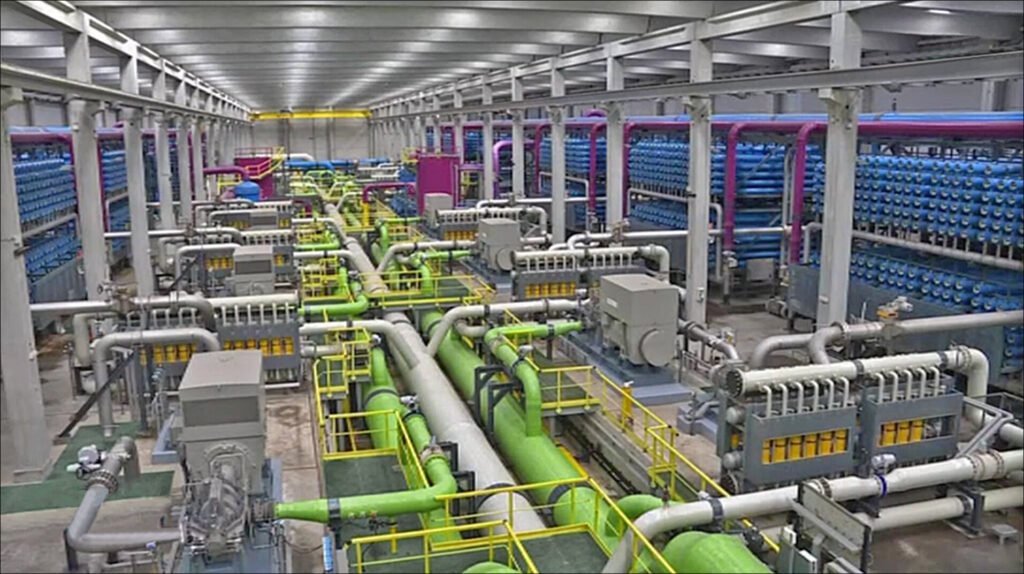
Reverse osmosis desalination utilizes semipermeable membranes and hydraulic pressure differentials to separate purified water from saline feedwater. By forcing saltwater against an RO membrane with an applied pressure over the inherent osmotic pressure, pure water molecules are sieved from the solution while contaminants are left behind.
RO membranes are dense, essentially nonporous polymer films, most commonly thin-film composite polyamide. Water dissolves into and diffuses through the membrane far faster than dissolved salt ions, which are largely rejected by charge and hydration effects rather than by simple size exclusion. This solution-diffusion mechanism explains why water flux rises with net driving pressure while salt passage stays nearly constant, so higher operating pressure generally improves permeate quality. As feedwater is pressurized on one side of the membrane, pure water diffuses through to the other, known as the permeate. The concentrated salt solution left behind is discharged as brine waste.
The amount of pressure required for RO separation depends on the composition and salinity of the feedwater. The required applied pressure must exceed the intrinsic osmotic pressure generated by the salt concentration gradient across the membrane. RO membranes are designed to withstand high pressures with optimized water fluxes.
Membrane fouling and scaling must also be prevented through feedwater pretreatment and anti-scaling chemicals. Overall, reverse osmosis systems provide reliable, energy-efficient desalination with relatively low capital and operation costs. RO technology now accounts for over 60% of installed desalination capacity worldwide.
Key Performance Parameters in Desalting Theory
Several parameters link desalting theory to plant performance:
- Recovery: the fraction of feedwater converted to product water. Higher recovery lowers feedwater and pretreatment demand but raises brine concentration, osmotic pressure, and scaling risk.
- Concentration factor: assuming near-complete salt rejection, brine concentration equals feed concentration divided by (1 − recovery). At 45% recovery, 35,000 mg/L seawater produces brine of roughly 35,000 ÷ 0.55 ≈ 63,600 mg/L.
- Salt rejection: the percentage of dissolved salts retained by an RO membrane, typically above 99.5% for modern seawater elements.
- Concentration polarization: the buildup of salt at the membrane surface, which raises the local osmotic pressure above the bulk value and increases scaling potential.
- Temperature: warmer water lowers viscosity and increases RO flux, commonly by around 3% per °C, although salt passage also rises.
Electrically Driven Desalting
A third theoretical approach removes the salt rather than the water. In electrodialysis (ED) and electrodialysis reversal (EDR), an applied voltage drives dissolved ions through alternating cation- and anion-selective membranes, leaving desalted water in the dilute channels. Because the energy used scales with the amount of salt removed rather than the volume of water produced, electrically driven processes are most economical for brackish feedwater with relatively low dissolved solids. Together with thermal and membrane processes, these approaches make up the three methods of desalination used in practice.
Applying Desalting Theory
Engineers turn these principles into design decisions when selecting pumps, membranes, energy recovery devices, and evaporator configurations, which are covered in more detail in our guide to desalination equipment. For a step-by-step look at how feedwater moves through intake, pretreatment, separation, post-treatment, and brine disposal, see our overview of what happens in desalination.
Future Outlook
Several emerging desalination technologies aim to build upon existing thermal and membrane techniques to improve freshwater affordability and recovery efficiency further. These advances include forward osmosis, membrane distillation, adsorption desalination, and capacitive deionization.
Additionally, renewable energy sources like solar, wind, and wave power may help reduce desalination plants’ overall energy demands and carbon footprint. Improved brine management solutions are needed to extract minerals and mitigate environmental impacts from hyper-saline discharge.
As desalination theory evolves, it will be integral in resolving global water scarcity issues and securing freshwater access for growing populations worldwide.
Frequently Asked Questions
What is desalting theory?
Desalting theory is the body of thermodynamic and transport principles that explains how dissolved salts can be separated from water. It covers the minimum energy required for separation, the phase-change behavior exploited by thermal processes, the solution-diffusion mechanism of reverse osmosis, and the ion transport that drives electrodialysis.
Why does desalination require so much energy?
Salt and water mix spontaneously, so separating them requires work against the feedwater’s osmotic pressure. For typical seawater, the theoretical minimum is roughly 0.75–1.1 kWh/m³ depending on recovery, and real plants use more because of friction, heat-transfer, and concentration losses.
How does osmotic pressure affect reverse osmosis design?
The applied feed pressure must exceed the osmotic pressure of the water being treated, including the higher concentration that develops at the membrane surface and toward the end of the membrane train. That is why seawater RO systems typically operate at about 55–80 bar, while brackish systems run at much lower pressures.
Why do thermal desalination plants handle high-salinity water better than RO?
In thermal processes, the dissolved salts only slightly raise the boiling point, so feed salinity has a modest effect on energy use. In RO, required pressure rises in proportion to salinity, so very saline feeds quickly reach the pressure limits of standard membrane elements.