
Xylem vs WesTech Filtration Equipment: Comparison & Best Fit
Introduction
One of the most persistent challenges in water and wastewater treatment design is the “black box” mentality regarding filtration. Engineers often focus heavily on media selection—anthracite size, sand uniformity coefficients, or GAC iodine numbers—while underestimating the critical mechanical and hydraulic interfaces that support that media. In practice, a large share of catastrophic filter failures originate not in the media but in the underdrain systems, wash troughs, and backwash control strategies. When a filter fails, it is rarely because the sand stopped straining; it is because the support structure collapsed, nozzles clogged, or maldistribution caused media upset.
This article provides a technical analysis of Xylem vs WesTech Filtration Equipment: Comparison & Best Fit, focusing on two prominent players in the North American municipal and industrial market. While both manufacturers offer robust portfolios, their engineering philosophies differ significantly.
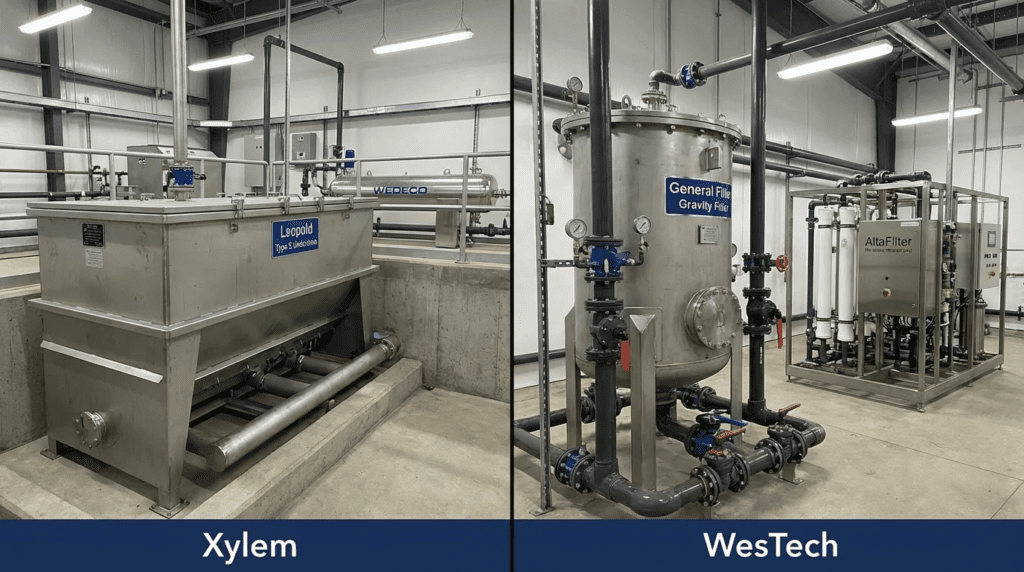
Xylem, primarily through its Leopold brand, is a long-established standard for gravity media filtration in large municipal concrete basins, heavily utilizing HDPE block underdrains with porous plate caps. WesTech, conversely, often excels in integrated package plants, custom steel tank fabrication, and diverse underdrain configurations ranging from nozzle-based plate floors to folded plate designs. These technologies are critical in potable water production, tertiary wastewater treatment, and industrial process water polishing.
The consequences of poor selection are severe: media loss, mudball formation, short-circuiting, and premature structural failure requiring expensive confined-space demolition. This comparison sits within the broader set of water filtration methods available to a treatment plant, and the equipment decision only makes sense once the process decision—granular media, membrane, cloth, or a combination—has been settled. This guide aims to help consulting engineers and utility decision-makers navigate the nuances by examining hydraulic performance, constructability, and long-term maintainability.
Related Filtration Equipment Comparisons
The Xylem-versus-WesTech pairing is one node in a set of manufacturer comparisons that most filtration procurements touch. Three of them form a triangle among the same group of suppliers, allowing an engineer to work through the field pairwise; the fourth addresses a different equipment class entirely, sitting upstream of the treatment plant rather than within it.
DuPont Memcor and Aqua-Aerobic
The comparison of DuPont Memcor vs Aqua-Aerobic for filtration pits membrane filtration against cloth media and granular approaches, which is a process decision rather than an equipment one. Membrane systems deliver an absolute barrier with a defined pore size, producing consistent effluent quality irrespective of influent variability, and they are frequently the only credible answer where the permit demands a log-removal credit for pathogens. Cloth and disc filtration achieves excellent solids removal at far lower energy and with much simpler operation, but it filters by depth and surface capture rather than by absolute exclusion.
The evaluation criteria differ accordingly. Membrane systems are compared on flux rate, transmembrane pressure trends, cleaning chemical consumption, and expected membrane replacement interval. Cloth systems are compared on hydraulic loading, backwash volume as a fraction of throughput, and cloth replacement cycle. Comparing them on capital cost per unit of flow, as specifications sometimes do, obscures the fact that they are not solving the same problem.
DuPont Memcor and WesTech
The DuPont Memcor vs WesTech for filtration comparison sets membrane technology against conventional granular media and package plant approaches. The decision usually turns on effluent requirement and operator capability together. Where the requirement is conventional turbidity compliance and the plant has mechanically oriented staff, granular media in a well-designed basin remains the lower-risk and lower-cost answer. Where the requirement includes pathogen log removal, reuse-quality effluent, or protection of a downstream reverse osmosis train, membranes earn their operating complexity.
A consideration that engineers underweight is the failure profile. Granular media degrades gracefully—performance declines gradually and gives warning through rising headloss and turbidity. Membrane systems tend to hold performance and then fail integrity, which is why integrity testing is a required part of their operating regime rather than an optional diagnostic.
Aqua-Aerobic and WesTech
The Aqua-Aerobic vs WesTech for filtration comparison is the closest of the three to a like-for-like evaluation, since both address tertiary polishing without moving to membranes. Cloth disc filtration offers a very small footprint, low headloss, and backwash volumes that are a small fraction of throughput, which matters where the backwash return load is a constraint on the liquid train. Granular media offers greater tolerance of solids surges and a more familiar operating regime, at the cost of footprint and backwash volume.
The practical determinant is usually the site: a tertiary filter being retrofitted into a constrained plant frequently cannot accommodate granular media basins at all, which resolves the comparison before performance enters into it.
Traveling Water Screen Manufacturers
Distinct from the plant-side comparisons above, traveling water screen manufacturers serve the intake structure rather than the treatment process. These are the coarse protection devices at a surface water intake, removing debris, aquatic life, and gross solids before water reaches the raw water pumps. The engineering considerations are largely unrelated to filter underdrains—through-screen velocity for fish protection under regulatory intake requirements, screen panel material and mesh selection, spray wash pressure, and the mechanical duty of a continuously moving belt in a river environment.
They belong in the same discussion because the quality of intake screening directly sets the solids and debris load that everything downstream must handle. A poorly performing intake screen shows up as accelerated clarifier and filter maintenance, and it is frequently the true root cause when a filtration system underperforms against its design basis.
How to Select / Specify
Selecting between Xylem (Leopold) and WesTech requires moving beyond brand preference and analyzing the specific engineering constraints of the project. The framework below outlines the critical parameters.
Duty Conditions & Operating Envelope
The first step in specification is defining the hydraulic profile. Xylem’s Leopold underdrain lines are designed for specific hydraulic loading rates and backwash intensities. They perform well in high-rate filtration applications, typically 4 to 8 gpm per square foot, where simultaneous air and water backwash is required to scour the media without fluidizing the support gravel, or where integrated media support eliminates gravel entirely.
WesTech equipment, particularly their package units and continuous backwash filters, may be better suited to variable flow conditions or footprint-constrained applications. Engineers must evaluate:
- Hydraulic Loading Rate: Standard gravity filters typically run at 2 to 6 gpm per square foot. High-rate applications may push this to 8 to 10, requiring robust anti-cavitation underdrain designs.
- Backwash Intensity: Does the site have sufficient water supply for a water-only wash, or is an air scour system mandatory to reduce waste wash water volume? Both manufacturers offer air scour, but the distribution mechanisms differ—plastic block orifices versus nozzles and headers.
- Solids Loading: High influent turbidity spikes favor systems with robust surface wash or aggressive air scour capability.
Materials & Compatibility
Material science is a major differentiator. Leopold underdrains are predominantly high-density polyethylene. This offers excellent corrosion resistance but introduces thermal expansion challenges during installation in concrete basins. If not grouted correctly, thermal cycling can shear anchors.
WesTech offers a broader range of material approaches. Their filter bottoms can be monolithic concrete with nozzles, HDPE blocks, or stainless steel fabrications. In industrial applications involving high temperatures or aggressive chemistry, the ability to custom-fabricate stainless steel or specialty alloy internals often provides a best-fit advantage over standard HDPE blocks.
Hydraulics & Process Performance
The core of the comparison lies in head loss and distribution uniformity.
- Xylem (Leopold): The dual-lateral block design is engineered to balance pressure along the length of the lateral, producing highly uniform air and water distribution, which is critical for preventing dead zones where mudballs form.
- WesTech: Hydraulic characteristics vary by model. Nozzle-based systems can be more susceptible to blinding if fines penetrate the underdrain, but they allow individual nozzle replacement. Their integrated package systems place an adsorption clarifier ahead of the filter, altering the solids loading profile substantially compared with conventional filters.
Installation Environment & Constructability
Retrofit versus new construction is often the deciding factor. Leopold blocks are widely used for retrofitting existing shallow concrete basins. Their low profile allows engineers to maximize media depth within an existing hydraulic grade line, and the blocks snap together and grout into place relatively quickly.
WesTech is frequently favored for greenfield sites using steel package plants. Skid-mounted systems arrive pre-piped and wired, significantly reducing on-site civil work and installation labor. For large concrete civil works, WesTech offers competitive underdrain alternatives, though Xylem holds a considerable installed-base advantage in large civil retrofits.
Reliability, Redundancy & Failure Modes
Failure modes differ distinctly:
- Block Systems: The primary failure mode is grout failure or debonding of the integrated media support cap. If the grout between blocks, or between blocks and the wall, fails, media migrates into the plenum and a complete tear-out becomes necessary.
- Nozzle Systems: The primary failure mode is nozzle breakage or clogging. Individual nozzles can be replaced, but a broken nozzle creates a geyser during backwash that disrupts the media bed.
Maintainability, Safety & Access
Maintenance access is difficult for all gravity filters. Once media is installed, the underdrain is inaccessible without a vacuum truck, so reliability is the primary maintenance metric. However, package plants often feature external valve galleries and lower heights, providing better ergonomic access for operators compared with the deep galleries of large concrete gravity filters.
Lifecycle Cost Drivers
- CAPEX: Package plants generally offer lower capital cost for small to medium flows, below roughly 5 MGD, because of reduced civil cost. Leopold blocks may carry higher material cost but lower installation cost in large-scale retrofits.
- OPEX: Energy cost is driven by backwash frequency and volume. Efficient concurrent air and water backwash can hold waste wash water to a low single-digit percentage of throughput, reducing pumping cost and treatment surcharges.
- Replacement: Integrated media support caps eliminate gravel support layers, reducing media replacement cost but increasing risk. A damaged cap cannot be topped off the way gravel can; the block usually must be repaired or replaced.
Selection & Specification Framework
The criteria above are individually well understood. Poor outcomes generally follow from sequencing them badly—most often by choosing a technology on capital cost or precedent, then discovering during hydraulic profile development that the head is not available or the basin is too shallow for the required media depth.
Step 1: Settle the Process Before the Equipment
Determine what the filter must actually achieve: conventional turbidity compliance, pathogen log removal credit, tertiary polishing to a reuse standard, or pretreatment protecting a downstream membrane process. This decision selects the technology class—granular media, cloth, or membrane—and only then does the manufacturer comparison become meaningful. A broader review of available filtration equipment and technology is worth completing before the shortlist narrows, because the technology choice constrains everything downstream of it.
Step 2: Establish the Hydraulic Profile Envelope
Determine the available head between the upstream and downstream water surfaces, and allocate it explicitly: clean bed loss, terminal headloss at the backwash trigger, underdrain loss, effluent piping and valve loss, and rate control device loss. Filters are frequently specified before this allocation is complete, and the result is a plant that cannot reach its terminal headloss setpoint and therefore backwashes prematurely, wasting water and shortening runs.
Step 3: Worked Filter Sizing and Backwash Example
Consider a plant with a peak day demand of 12 MGD including recycle flows, designed for conventional dual media filtration at 5 gpm per square foot. The required filter area is 12 MGD converted to gpm, or 8,333 gpm, divided by 5, giving 1,667 square feet of total filter area. Applying redundancy so the plant meets peak flow with one cell out of service, a six-cell arrangement gives 1,667 divided by 5 remaining cells, or roughly 333 square feet per cell—call it 20 feet by 17 feet. With all six in service the loading drops to about 4.2 gpm per square foot, comfortably within the conventional range.
The backwash check is where designs fail. At a water backwash rate of 15 gpm per square foot, a single 333 square foot cell requires 5,000 gpm of backwash supply—60 percent of the plant’s entire peak production rate, delivered for perhaps 10 minutes. That implies either a dedicated backwash pump of that capacity or a washwater tank holding at least 50,000 gallons plus reserve. Air scour at 3 scfm per square foot requires roughly 1,000 scfm of blower capacity. Neither figure is optional, and both are routinely discovered late, after the filter arrangement is fixed and the space for the tank or the blower room has been allocated to something else.
Step 4: Verify Media Depth Fits the Basin
Add up the underdrain height, the support layer or cap, the media depth required by the process, and the freeboard needed for backwash expansion, typically 20 to 50 percent of the media depth. Compare the total against the available basin depth. This calculation is what drives the retrofit preference for low-profile underdrains, and running it early frequently changes the technology decision.
Step 5: Specify Installation Quality, Not Just Product
For block underdrains, specify surface preparation, grout type appropriate to the substrate condition, leveling tolerance, and anchor pull-out testing. For nozzle floors, specify torque values, gasket materials, and the acceptance test for nozzle seating. Underdrain failures are dominated by installation defects rather than product defects, which means the specification’s inspection and testing provisions matter more than its product clauses.
Step 6: Compare on Total Installed and Lifecycle Cost
Build the comparison from equipment cost, the civil cost each option implies, backwash water volume and its treatment cost as it returns to the head of the plant, media and cap or nozzle replacement cycles, and the labor and downtime associated with each failure mode. A package plant and a concrete basin can show similar equipment costs and very different total project costs once concrete, excavation, and site labor are included.
Comparison Tables
The following tables break down the technical distinctions to assist in the best-fit determination. Table 1 focuses on the specific technologies, Table 2 provides a selection matrix based on application scenarios, and Table 3 compares the broader filtration technology classes.
| Feature / Parameter | Xylem (Leopold) Block Underdrains | WesTech Block / Folded Plate Underdrains | WesTech Package Systems |
|---|---|---|---|
| Primary Technology | Dual-lateral HDPE underdrain block | HDPE block or folded plate with nozzles | Integrated adsorption clarifier plus filter |
| Media Support | Integrated media support cap (porous plate) or gravel | Direct retention screen or gravel | Mixed media, typically |
| Backwash Strategy | Concurrent air and water | Air and water, sequential or concurrent | Air and water with clarifier flush |
| Best Fit Application | Large municipal concrete basins; retrofits | Municipal and industrial concrete basins | Small to mid municipal; remote sites |
| Key Strengths | Widely specified; strong distribution uniformity; low profile | Customizable sizing; robust construction | Small footprint; pre-engineered; rapid install |
| Limitations | Dependent on grout quality; difficult to repair a single block | May require deeper basins depending on gravel configuration | Fixed capacity increments; difficult to expand |
| Typical Service Interval | 15–20 years internal; cap inspection required | 15–20 years; nozzle checks required | Higher frequency on valves and actuators due to complexity |
| Application Scenario | Best Fit Manufacturer/Type | Primary Decision Driver | Engineer’s Note |
|---|---|---|---|
| Large municipal water plant (above 20 MGD) | Xylem (Leopold) | Hydraulic efficiency and installed base | Standardization simplifies O&M; concrete civil works favor block underdrains. |
| Small municipal or subdivision (below 2 MGD) | WesTech package | Civil cost reduction | Steel package units eliminate expensive concrete basin construction. |
| Existing shallow basin retrofit | Xylem (Leopold) | Media depth maximization | Low profile underdrains allow deeper media in shallow tanks without raising walls. |
| Industrial process or high temperature | WesTech custom | Material customization | Ability to fabricate stainless steel internals for aggressive water chemistry. |
| Iron and manganese removal | WesTech integrated aeration | Integrated oxidation and filtration | Package units combining oxidation and filtration reduce process steps and footprint. |
Two of these scenarios deserve a further note. Iron and manganese removal and hardness reduction frequently arrive as a combined requirement in groundwater plants, and the design of integrated water filtration and softening systems changes the filter duty substantially: precipitated hardness and oxidized metals load the bed differently from surface water floc, backwash frequency rises, and media selection shifts toward manganese-oxidizing or greensand-type media rather than conventional anthracite over sand. Specifying a conventional dual media filter for a plant that will later add softening is a common and expensive sequencing error.
| Technology Class | Removal Mechanism | Typical Loading | Backwash / Reject Volume | Footprint | Best-Fit Duty |
|---|---|---|---|---|---|
| Granular Media (Gravity) | Depth filtration; straining, adsorption, flocculation | 2–8 gpm/ft² | Moderate to high | Large | Conventional potable treatment; robust to solids surges |
| Granular Media (Pressure) | Depth filtration in a closed vessel | 3–10 gpm/ft² | Moderate to high | Moderate | Industrial process water; systems with available pressure |
| Cloth / Disc | Surface capture on woven or pile media | 4–8 gpm/ft² of cloth | Low | Very small | Tertiary polishing; constrained retrofits |
| Membrane (MF/UF) | Absolute size exclusion at defined pore size | Flux based, not area loading | Low to moderate, plus chemical cleaning | Small | Pathogen log removal; reuse; RO pretreatment |
| Continuous Backwash Sand | Upflow depth filtration with continuous media washing | 2–6 gpm/ft² | Continuous small reject stream | Moderate | Tertiary duty with no interruption for backwash |
Engineer & Operator Field Notes
The success of a filtration installation is often determined not during the design phase but during installation and commissioning. Below are practical observations from the field.
Commissioning & Acceptance Testing
Regardless of the manufacturer, the boil test is non-negotiable. During the Site Acceptance Test, before media is installed, the filter must be filled with water to just above the laterals or nozzles and air scour engaged.
- The Expectation: The air pattern should be uniform across the entire floor.
- The Reality: With block underdrains, look for dead spots indicating blocked orifices, or geysers indicating a blown media support cap. With nozzle systems, look for vigorous localized bubbling indicating a loose or missing nozzle.
- Level Tolerance: Underdrains must be installed level within tight tolerances, typically about one-eighth of an inch or 3 mm. If the floor is not level, air scour migrates to the high point, causing violent agitation in one area and no scour in another.
Common Specification Mistakes
For steel package plants, a parallel error is under-specifying the coating system. The interior of a steel filter vessel is an aggressive environment because of media abrasion during backwash. High-build epoxy or polyurethane linings should be mandatory to prevent corrosion leading to structural failure.
O&M Burden & Strategy
Media Maintenance: Operators should conduct core sampling annually, digging into the media bed to check for stratification and mudball formation. In systems with an integrated media support cap, operators must take care not to puncture the cap with sampling tools. In gravel-supported systems, mixing of gravel and sand indicates a hydraulic upset that needs investigation before it worsens. Understanding how the bed is supposed to behave—the mechanics of natural and gravity filtration through a graded sand bed—is what allows an operator to read a core sample rather than merely take one.
Spare Parts:
- Block systems: Stock media support cap repair kits. A whole block cannot easily be replaced in a live filter, so patches are the first line of defense.
- Nozzle systems: Stock spare nozzles, commonly around 10 percent surplus, along with gaskets.
Troubleshooting Guide
Symptom: Mudballs on the surface.
Cause: Insufficient backwash rise rate or inadequate air scour. In block systems, check whether air headers have become waterlogged. In nozzle systems, check for blocked distribution laterals.
Symptom: Media in the clearwell.
Cause: Underdrain failure. Immediate shutdown is required. Inspect the clearwell for the type of media, anthracite versus sand, to determine whether the breach is partial or total.
Symptom: Filter runs shortening over successive cycles.
Cause: Progressive media fouling, incomplete backwash, or a change in upstream coagulation performance. Check terminal headloss and turbidity breakthrough separately—runs ending on headloss point to media or underdrain fouling, while runs ending on turbidity point upstream to coagulation and flocculation.
Symptom: Air binding during filtration.
Cause: Negative pressure developing within the media bed, typically when terminal headloss exceeds the available head above the media. Dissolved gases come out of solution and accumulate in the bed, reducing effective area and causing erratic performance.
Fix: Reduce the terminal headloss setpoint or increase submergence over the media; this is a hydraulic profile problem rather than an equipment fault.
Backwash Water Quality and Return Load
Backwash water quality is worth designing for rather than accepting. Using finished water for backwash protects the media and the underdrain from fouling but consumes production. Using settled or recycled water reduces that penalty at the cost of gradually fouling the media support and, in systems with integrated caps, the porous plate itself. Equally important is what happens to the spent backwash: returning it to the head of the plant imposes a solids and hydraulic load that is frequently omitted from the plant mass balance, and where it is returned in a slug rather than equalized, it can disrupt coagulation for hours. Provide equalization on the backwash return and meter it back at a controlled rate.
Design Details / Calculations
When engineering the system, rigorous calculations are required to ensure the selected equipment performs within the manufacturer’s stated curves.
Sizing Logic & Methodology
To properly size the filter area, use the following logic:
- Determine Peak Flow (Qpeak): This must include plant recycle flows, which are frequently omitted and can add 5 to 10 percent.
- Select Redundancy: The plant must meet peak flow with one filter out of service for backwash or repair.
- Calculate Area: Area equals peak flow divided by the hydraulic loading rate.
- Typical loading: 3 to 5 gpm/ft² conventional; 6 to 8 gpm/ft² high rate.
- Verify Backwash Supply:
- Water only: 15 to 20 gpm/ft².
- Air and water: air at 2 to 4 scfm/ft² plus water at 8 to 10 gpm/ft².
- Check Media Depth Against Basin: Underdrain height plus support layer plus media depth plus expansion freeboard must fit the available basin depth.
Calculation nuance: Block underdrains have specific published headloss coefficients, and engineers must verify that the available head in the plant profile accounts for clean bed loss plus underdrain loss plus piping loss plus rate control loss. Package plants often arrive with their own pump skids, meaning the engineer sizes the electrical supply for the backwash pumps rather than relying on gravity hydraulics alone.
Specification Checklist
- Duty: Peak flow including recycle, hydraulic loading at all-in-service and one-out-of-service conditions, and design filter run length.
- Cell Geometry: Number of cells, dimensions, and the length-to-width ratio, since long narrow cells generally give better air scour uniformity.
- Underdrain: Type, profile height, published headloss coefficient, and required maldistribution factor with the calculation submitted.
- Media Support: Integrated cap or graded gravel, with the gravel gradation schedule where applicable.
- Media: Type, effective size, uniformity coefficient, depth of each layer, and specific gravity, with certification to AWWA B100.
- Backwash: Water rate, air rate, sequence and duration, expansion percentage, and the supply source with tank or pump capacity demonstrated.
- Hydraulic Profile: Head allocation across clean bed, terminal headloss, underdrain, piping, valves, and rate control, with submergence over media stated.
- Installation: Leveling tolerance, surface preparation, grout type and substrate condition assessment, anchor pull-out testing, and nozzle torque values where applicable.
- Air Scour Piping: Inverted loop above maximum water level to prevent media backflow into the blowers, with air release provisions.
- Coatings: Interior lining system for steel vessels, with dry film thickness and holiday testing requirements.
- Testing: Boil test before media placement, backwash distribution verification, and filter-to-waste provisions for post-backwash ripening.
- Backwash Return: Equalization volume and controlled return rate to the head of the plant.
Standards & Compliance
Filtration equipment specifications commonly reference Ten States Standards (Recommended Standards for Water Works) for filtration rates, redundancy, backwash provisions, and filter-to-waste requirements, together with AWWA/ASCE water treatment plant design guidance and the AWWA Manual M37 on operational control of coagulation and filtration. Granular filter media is specified to AWWA B100, and granular activated carbon to AWWA B604. All wetted components in potable service require certification to NSF/ANSI/CAN 61, with lead content governed by NSF/ANSI/CAN 372. Steel tank fabrication follows AWWA D100 where applicable, with coatings to the relevant AWWA D102 or NSF-certified lining systems. Concrete structures follow ACI 318 with tolerances to ACI 117, which is the standard to cite when specifying the floor flatness these underdrains require. Where the filter is credited for pathogen removal, the governing framework is the Surface Water Treatment Rule family under 40 CFR Part 141.
Frequently Asked Questions
What is the main difference between block underdrain systems and integrated package plants?
The difference is integration and application. Block underdrain systems refer to the underdrain and air scour equipment installed in custom-built concrete civil basins, where the engineer designs the structure around the equipment. Package systems are modular, pre-engineered treatment trains that typically include clarification and filtration within a steel or concrete vessel, designed for a smaller footprint and faster installation with far less site civil work.
How long do HDPE block underdrains last compared with nozzle systems?
HDPE block underdrains generally have a design life of twenty years or more, often outlasting the mechanical equipment in the plant, and failures are usually installation-related rather than material degradation. Nozzle-based systems also have long structural lives, but individual plastic nozzles can become brittle or clogged and may require replacement cycles on the order of 7 to 10 years depending on water chemistry and backwash aggression.
Can a nozzle floor be retrofitted into a basin designed for block underdrains?
Yes, but it requires hydraulic engineering rather than a straight substitution. Block underdrains are typically low profile, on the order of 12 inches. Replacing them with a nozzle floor or false bottom may consume media depth or freeboard. Conversely, retrofitting low-profile blocks into basins built for other systems is common precisely to gain vertical space for deeper media beds, such as adding a GAC cap.
Is an integrated media support cap better than a gravel support layer?
An integrated cap replaces the graded gravel layers, freeing vertical space for active media and eliminating the risk of gravel upset, where gravel migrates and mixes into the sand. However, caps can foul with iron, manganese, or biological growth if backwash water quality is poor. Gravel is lower technology but robust and repairable; an integrated cap is space-saving and eliminates a failure mode, but introduces a different one and demands clean backwash water.
Which manufacturer is less expensive?
There is no single answer, and the honest comparison is total installed cost rather than equipment cost. For large municipal projects, block underdrains in concrete basins are often more cost-effective because the civil works scale efficiently. For small to mid-sized plants, package units are frequently cheaper on a total installed basis because they eliminate complex concrete formwork and reduce site labor and schedule.
What causes filter underdrain failure?
Pressure surges during backwash initiation or uncontrolled air release are the most common mechanical cause. Air trapped in the underdrain and released violently can lift blocks or shatter nozzles, which is why slow-opening backwash valves and properly located air release are specification items rather than details. Poor grouting during installation is the other dominant cause, leading to bypass and structural uplift.
How much backwash water should a filter use?
Expressed as a fraction of production, well-designed filters using concurrent air and water backwash commonly hold waste washwater to a low single-digit percentage of throughput. Water-only backwash consumes considerably more because it must fluidize the bed to achieve scour, whereas air scour does the scouring mechanically and water only carries the released solids away. Where washwater volume is a constraint, whether from source limitations or from the return load on the liquid train, air scour capability moves from desirable to essential.
Why do filters need filter-to-waste after backwash?
Immediately after backwash the media bed is clean but hydraulically unsettled, and the first several minutes of filtrate carry elevated turbidity and particle counts as the bed ripens. Filter-to-waste diverts this initial filtrate rather than sending it to the clearwell, and it matters most where the filter carries pathogen removal credit, since the ripening period is precisely when breakthrough risk is highest. Where filter-to-waste is not provided, the alternative is a slow-start rate control regime that limits the initial flow through a freshly washed bed.
Conclusion
Key Takeaways
- Settle the process before the equipment — granular media, cloth, and membrane solve different problems, and the manufacturer comparison is only meaningful once the technology class is fixed.
- Application Drives Choice: Block underdrains in concrete basins suit large custom gravity filters; package systems suit small footprint, modular, or industrial applications.
- Run the backwash supply calculation early — a single cell can demand a backwash rate approaching the plant’s entire production, and the tank or pump capacity implied is routinely discovered after the space for it has been allocated elsewhere.
- Retrofit Advantage: Low-profile HDPE blocks are generally superior for retrofitting shallow basins to increase media depth within an existing hydraulic grade line.
- Installation quality dominates failure statistics — leveling and grouting defects cause far more underdrain failures than manufacturing defects, so inspection and testing provisions matter more than product clauses.
- Require the maldistribution calculation — if backwash is not uniform, the filter will foul regardless of brand.
- Design the backwash return — spent washwater returned as a slug disrupts coagulation upstream; equalize it and meter it back at a controlled rate.
When analyzing Xylem vs WesTech Filtration Equipment: Comparison & Best Fit, engineers are choosing between two well-developed philosophies. Xylem’s Leopold brand represents an established standard for large hydraulic throughput and concrete basin integration, offering strong distribution uniformity through its dual-lateral design. It is the conservative, specification-heavy choice for major municipalities.
WesTech represents flexibility and integration. Their strength lies in providing complete process trains combining clarification and filtration in compact footprints, and in the ability to custom-engineer solutions for industrial or difficult water chemistries. They are often the better fit for design-build projects where speed of installation and reduced civil works are prioritized.
Ultimately, the best fit is determined by the constraints of the site: space, existing civil structures, and the hydraulic profile. By focusing on the hydraulic interface—specifically backwash efficacy—engineers can select the system that ensures long-term process integrity and compliance.