
Xylem Wedeco vs Ozonia BioGas Equipment: Comparison & Best Fit
Xylem Wedeco vs Ozonia BioGas Equipment: Comparison & Best Fit
Introduction
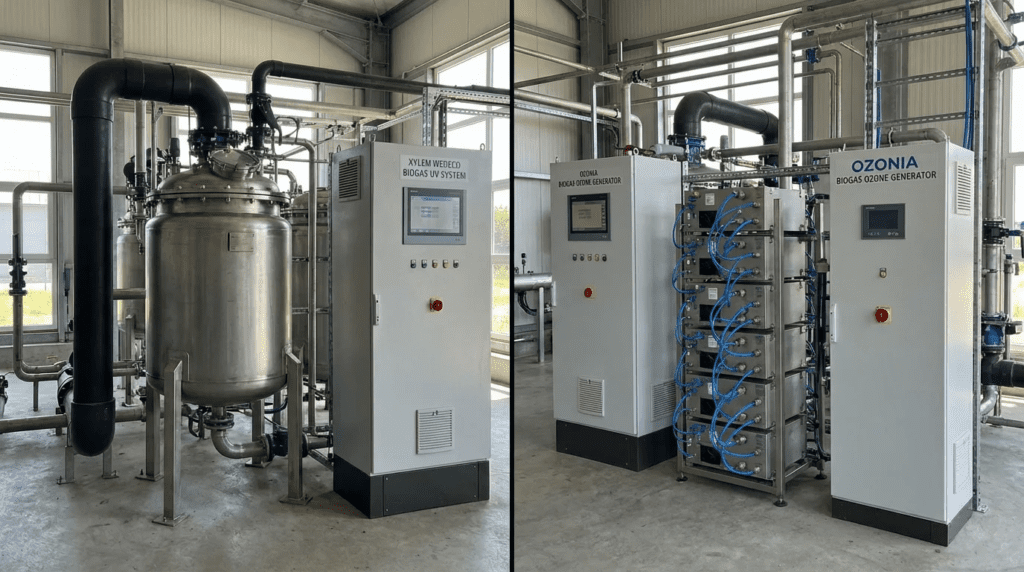
A scope correction belongs at the top of this comparison. Wedeco and Ozonia are ozone and UV disinfection brands, not biogas systems manufacturers. Wedeco is Xylem’s ozone and UV line; Ozonia is now part of Veolia Water Technologies, having come across with the SUEZ Water Technologies acquisition. Neither supplies digesters, gas holders, biogas upgrading skids or combined heat and power packages, and neither appears on bid lists for those.
Engineers arriving at a Xylem Wedeco vs Ozonia BioGas Equipment: Comparison & Best Fit query are usually working one of two problems. Either they are comparing ozone generation equipment and encountered the two dominant brands, or they are looking at oxidation as a route to hydrogen sulfide control somewhere in the digestion train. This article addresses both, honestly. The ozone generator comparison is substantive and worth having. The biogas desulfurization angle needs a caveat: ozone injection is not a mainstream biogas H2S removal technology. Established routes are iron sponge and other scavenging media, biological scrubbers, caustic wet scrubbing, and micro-aeration of the digester headspace. An engineer specifying H2S removal should be evaluating those, not ozone generators.
Where ozone genuinely earns its place is disinfection, micropollutant oxidation and advanced oxidation processes — and there, the choice between these two platforms carries real consequences. A specification error can drive a significant variance in specific power consumption over a twenty-year asset life, which dwarfs the capital difference.
Broader supplier positioning is covered in our overview of the top OEMs for biogas systems.
How to Select and Specify Ozone Systems
Duty Conditions & Operating Envelope
Define the operating envelope first. Engineers must determine required ozone concentration by weight relative to feed gas capability — liquid oxygen against pressure swing adsorption. The two platforms have different efficiency curves, with a point beyond which power consumption climbs steeply relative to concentration gained.
- Flow and dosage: Define peak instantaneous and average daily flow. Ozone systems have turndown limits. Where the plant will see extreme low-flow conditions in early years, a single large generator may trip on low gas flow or overheat.
- Gas pressure: Check contactor back-pressure requirements. Deep U-tube contactors require higher discharge pressures. Ensure the generator vessel is code-stamped for the requisite pressure plus margin.
- Turndown method: Specify whether modulation is achieved through power supply frequency and voltage manipulation or by banking multiple cells. Linear turndown prevents overdosing and wasted oxygen.
Materials & Compatibility
The dielectric — the component facilitating corona discharge — is the primary point of divergence between these platforms.
- Dielectric material: Wedeco uses a glass dielectric design marketed under the Effizon name, valued for resistance to thermal shock and mechanical stress. Ozonia employs designs built around controlled discharge gap geometry, allowing high power densities.
- Vessel construction: The ozone vessel must be 316L stainless at minimum. Where the installation sits in an area with corrosive ambient conditions, higher alloys or cladding may be required.
- Gasket compatibility: Ozone is an aggressive oxidant. All wetted seals must be PTFE or perfluoroelastomer. EPDM and standard fluoroelastomers degrade rapidly. This is a critical submittal review item.
Hydraulics & Process Performance
- Cooling water hydraulics: The great majority of energy entering an ozone generator becomes heat. Specify maximum temperature rise and pressure drop across the vessel, and define the cooling loop as closed or open.
- Gas flow hydraulics: High gas flow at low concentration requires larger piping and diffusers. Low gas flow at high concentration reduces pipe size but increases generator stress.
Installation Environment & Constructability
- Footprint: Compare skid density. Vessel geometry differs between platforms, with implications for both horizontal footprint and vertical maintenance clearance.
- Tube pull space: A critical architectural constraint. A vessel of a given length requires at least that much clearance on one end to remove electrodes. Failing to account for this in building layout is a serious design error that cannot be fixed later.
- HVAC requirements: These units generate significant ambient heat. The electrical room housing the power supplies must be conditioned.
Reliability, Redundancy & Failure Modes
- Dielectric failure mode: In older designs, one dielectric failure could trip the whole vessel. Modern systems from both suppliers use individual fusing, so a single tube failure blows its fuse and the unit continues at slightly reduced capacity.
- Power supply redundancy: Look for modular designs. If one inverter module fails, can the others pick up load, or does the generator shut down entirely?
- Service life: Dielectrics should give many years of service under normal operation with correct cooling and feed gas.
Lifecycle Cost Drivers
- Power consumption: The largest operating driver by a wide margin. Modest differences in specific power consumption compound into substantial sums over an asset life.
- Oxygen usage: Higher concentration efficiency means less liquid oxygen purchased or smaller on-site generation equipment required.
- Maintenance labor: Consider the labor hours to clean or replace dielectrics. Requirements vary by manufacturer and by dielectric type.
Comparison Tables
| Parameter | Xylem Wedeco | Ozonia (Veolia) | Engineering Implication |
|---|---|---|---|
| Dielectric technology | Glass-core design marketed as Effizon | Controlled-gap designs optimized for power density | Glass is robust and thermally forgiving. High power density allows compact vessels but demands tight process control. |
| Cooling configuration | Typically horizontal vessel, water outside tubes | Typically horizontal, high-velocity flow design | Both require strict temperature control; thermal shock resistance differs by dielectric type |
| Power supply | IGBT-based, variable frequency, low harmonic distortion | IGBT-based resonance technology with gap optimization | Both are efficient with high power factor. Resonance tracking adapts well to tube fouling. |
| Process control | Controller-based on standard industrial platforms, with optimization of power against gas flow | Proprietary control suite with individual segment diagnostics | Both integrate with SCADA over standard industrial protocols |
| Turndown | Wide linear range | Wide linear range | Critical for matching diurnal flow patterns without wasting oxygen |
| Primary maintenance | Fuse checks, cooling loop maintenance, power supply filter cleaning | Fuse checks, cooling loop maintenance; some models allow easier individual tube isolation | Similar burden overall. Access to tube sheets determines ease of service. |
| Application | Best Fit Attributes | Key Constraints | Recommended Focus |
|---|---|---|---|
| Large-scale municipal drinking water | High electrical efficiency, large capacity per vessel | Redundancy; power quality and harmonics | Either platform. Focus on lifecycle cost and specific power consumption. |
| Wastewater micropollutant removal | Wide turndown, fast response | Variable water quality; humid environments | Rugged dielectrics suit variable duty cycles |
| Biogas H2S control | Not an ozone application | Established routes are scavenging media, biological scrubbers, caustic scrubbing and micro-aeration | Evaluate dedicated gas conditioning suppliers rather than ozone generators |
| Retrofit, space constrained | High ozone concentration reduces gas piping size; compact footprint | Tube pull clearance; floor loading | Compare specific model dimensions. Higher achievable concentration allows a smaller footprint. |
Engineer & Operator Field Notes
Commissioning & Acceptance Testing
- Dew point verification: Monitor feed gas dew point strictly. Moisture entering the generator reacts with nitrogen to form nitric acid, which destroys internal stainless components and dielectric fuses. This is the single most damaging commissioning oversight.
- Cooling water balance: Verify flow balancing across all generators. Air pockets in the cooling jacket are a primary cause of localized hotspots and premature dielectric failure.
- Harmonic testing: Run the power supplies at various loads and measure harmonic distortion at the motor control center. Ensure IEEE 519 compliance.
Common Specification Mistakes
- Ignoring ambient conditions: Specifying general-purpose enclosures for rooms with corrosive atmospheres or high humidity is a recipe for power supply failure. Corrosion-resistant enclosures with conditioning are appropriate in industrial areas.
- Material mismatch: Using 304 stainless for wet ozone gas. Use 316L or, where pressure and temperature allow, appropriate plastics — though stainless is preferred on discharge.
O&M Burden & Strategy
- Daily: Check dew point, gas pressure and cooling water temperature
- Monthly: Check cooling water strainers. Verify safety interlocks including ambient ozone detectors.
- Annual: Inspect power supply cooling fans, a critical failure point. Check dielectric fuses. Acid-wash cooling jackets if heat transfer efficiency drops, indicated by rising specific power consumption.
- Long interval: Major overhaul with potential dielectric or seal replacement
Troubleshooting
- High dew point alarm. Root cause: desiccant dryer failure or oxygen evaporator issue. Action: immediate shutdown. Do not bypass this alarm — moisture produces acid and catastrophic damage.
- Low ozone output against power input. Root cause: fouled dielectrics or high cooling water temperature. Action: check chiller performance first; if water temperature is within specification, schedule vessel inspection.
Design Details & Calculations
Ozone Demand
Ozone demand in pounds per day is the product of water flow in million gallons per day, required dosage in milligrams per liter, and the standard conversion factor of 8.34. A ten million gallon per day plant requiring a three milligram per liter dose therefore needs roughly 250 pounds per day of ozone. Engineers typically apply a safety factor for declining water quality or future flows, taking the specified capacity meaningfully above the calculated demand.
Gas Flow
Once ozone mass is known, gas flow depends on generator concentration. Higher achievable concentration results in lower gas flow, reducing the size of oxygen feed systems and contactors — one of the strongest arguments for a high-concentration platform in a constrained site.
Specification Checklist
- Performance guarantee: Maximum specific power consumption at a stated concentration
- Dielectric warranty: Prorated warranty on electrode tubes over a defined term
- Harmonics: IEEE 519 compliance at the point of common coupling
- Materials: 316L stainless for the generator vessel; PTFE or perfluoroelastomer for all wetted gaskets
- Safety: Integration with ambient ozone and oxygen monitors for automatic shutdown
Standards
- AWWA B304: Liquid oxygen for ozone generation
- UL 508A: Industrial control panels
- ASME Section VIII: Pressure vessel code for the generator vessel
- NFPA 820: Fire protection in wastewater treatment and collection facilities
Frequently Asked Questions
Do Wedeco or Ozonia make biogas equipment?
No. Both are ozone and UV disinfection brands — Wedeco under Xylem, Ozonia under Veolia. Neither supplies digesters, gas holders, biogas upgrading equipment or combined heat and power packages. Engineers specifying biogas systems should be evaluating dedicated digester and gas conditioning suppliers.
Is ozone used for biogas desulfurization?
It is not a mainstream route. Proven H2S removal technologies for digester gas are scavenging media such as iron sponge, biological scrubbers, caustic wet scrubbing and micro-aeration of the digester headspace. Ozone generation equipment is designed for water-phase oxidation and disinfection, and specifying it for gas-phase sulfide control means solving a well-understood problem with unproven equipment.
What is the primary difference between the two ozone platforms?
Dielectric technology. Wedeco uses a glass electrode design valued for mechanical robustness and thermal shock resistance. Ozonia uses designs built around controlled discharge gap geometry, allowing high power densities and high ozone concentrations. Both are mature premium technologies; maintenance approach and vessel geometry differ more than performance does.
How do I select the right ozone concentration?
By contactor efficiency and feed gas source. For liquid oxygen systems, a moderate concentration is typically the economic sweet spot, balancing oxygen cost against electrical cost. For on-site generated oxygen, lower concentrations are often more efficient. Running at very high concentration increases power consumption and stress on the dielectrics.
What is the typical lifespan of a dielectric tube?
Under proper cooling and dew point control, dielectric tubes from either manufacturer give many years of service. Failures are usually caused by cooling water interruption, moisture in the feed gas, or severe power surges rather than by normal wear. Most utilities budget for partial or full replacement well into the asset life.
How does cooling water temperature affect performance?
Substantially. Generation efficiency drops as temperature rises and the rate of ozone decay increases. Standard design assumes cool water. Where plant water runs warm, a dedicated chiller is required. Operating with hot water drives up power consumption and risks dielectric failure.
Are these systems compatible with SCADA?
Yes. Both manufacturers supply controller-based panels communicating over standard industrial protocols. Operators can monitor power factor, gas flow, cooling water temperature and ozone output remotely. Redundancy logic is typically handled at the master SCADA level or a master ozone control panel.
Conclusion
Key Takeaways
- Scope first: Wedeco and Ozonia are ozone and UV disinfection brands, not biogas systems manufacturers. Ozone is not an established biogas desulfurization technology.
- Efficiency dominates: Evaluate on lifecycle cost, specifically specific power consumption and oxygen consumption, not capital cost.
- Dielectric choice: Glass designs are robust and forgiving; controlled-gap designs allow high concentration and compact footprints. Both are proven.
- Cooling criticality: Never value-engineer the cooling system. Closed-loop with proper heat exchange is mandatory for longevity.
- Space planning: Account for tube-pull clearance during design. It cannot be added later.
For ozone applications, engineers are choosing between two high-quality mature technologies, and there is no single winner. Wedeco often suits applications prioritizing robust, low-maintenance glass dielectrics and linear turndown. Ozonia frequently excels where high ozone concentration, compact footprint and advanced power management matter most.
For biogas gas conditioning, the equipment lies elsewhere entirely. Suppliers active in that space are covered in our comparison of Evoqua and ProMinent biogas equipment, which addresses scrubber vessels, media systems and the chemical dosing infrastructure that actually removes hydrogen sulfide from digester gas.