
Henry Pratt vs DHC International for Butterfly Valves: Pros/Cons & Best-Fit Applications
Introduction
For municipal and industrial consulting engineers, the butterfly valve is often treated as a commodity item—a simple isolation device inserted into piping isos without much thought given to the manufacturer beyond the flange rating. This oversight is a primary driver of premature seal failure, actuator sizing errors, and unexpected downtime. Statistics from major utilities suggest that nearly 40% of valve operational issues stem not from the technology itself, but from a mismatch between the valve’s design capabilities and the specific application’s hydraulic reality.
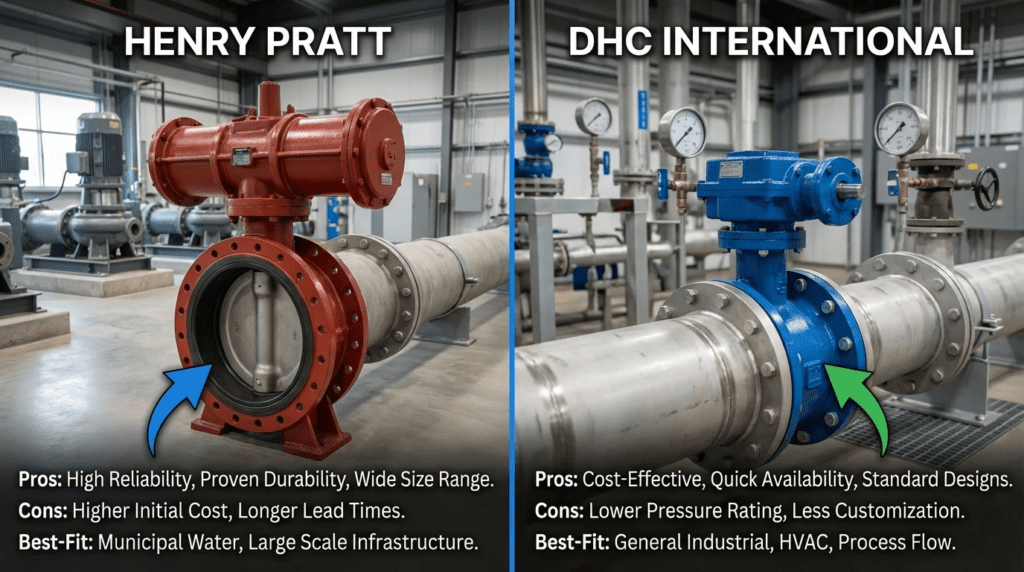
When evaluating market leaders and reliable options, engineers often encounter a choice between established domestic giants and agile international manufacturers. Specifically, comparing Henry Pratt vs DHC International for Butterfly Valves: Pros/Cons & Best-Fit Applications reveals a critical divergence in engineering philosophy, seat design, and lifecycle cost implications. Henry Pratt, a brand synonymous with the AWWA C504 standard in North America, represents the heavy-duty, specification-driven end of the spectrum. Conversely, DHC International offers solutions that often bridge the gap between industrial versatility and cost-effective municipal compliance.
This article provides a rigorous, unbiased analysis for plant directors, utility engineers, and system designers. It moves beyond marketing brochures to examine the metallurgy, seating geometry, and hydraulic performance of these two manufacturers. By understanding the distinct engineering advantages and limitations of each, decision-makers can avoid the common trap of specifying a transmission-main valve for a chemical feed line, or vice versa, ensuring long-term reliability and operational efficiency.
How to Select / Specify Butterfly Valves
Selecting the correct butterfly valve requires a multi-dimensional analysis of the process conditions. When debating Henry Pratt vs DHC International for Butterfly Valves: Pros/Cons & Best-Fit Applications, the engineer must look past the purchase price and evaluate the valve’s ability to maintain a drop-tight seal under dynamic loading conditions over 20+ years.
Duty Conditions & Operating Envelope
The operating envelope defines the stress the valve components will endure. Engineers must explicitly define:
- Flow Profiles: Is the flow continuous or intermittent? High-velocity applications (typically >16 ft/s for liquids) can induce cavitation and vibration that damage standard resilient seats. Pratt’s heavy-duty disc designs are often favored for high-velocity isolation, whereas DHC’s streamlined discs may be preferable for lower pressure drop requirements in standard flow ranges.
- Pressure Class vs. Working Pressure: AWWA C504 classes (Class 75B, 150B, 250B) refer to the pressure rating and the flow velocity capability. A common mistake is selecting a Class 150 valve for a system with potential surge pressures exceeding 200 psi.
- Frequency of Operation: A valve cycled daily for filter backwash has vastly different wear characteristics than a transmission main isolation valve operated once every five years. High-cycle applications require robust shaft-to-disc connections and fatigue-resistant seat materials.
Materials & Compatibility
Material selection is the first line of defense against premature failure. The comparison between Pratt and DHC often comes down to the philosophy of seat construction:
- Seat Design: Pratt is renowned for the “molded-in” or vulcanized seat design (specifically in the 2FII and Monoflange lines), where the rubber is bonded directly to the body. This reduces the risk of seat washout but makes field replacement difficult or impossible. DHC often utilizes cartridge-style or boot seats in smaller diameters, and adjustable mechanical seals in larger sizes, offering different maintenance trade-offs.
- Disc Materials: Ductile iron with 316SS edges is standard. However, for industrial wastewater containing chlorides or grit, fully encapsulated discs or special alloys (like Duplex Stainless Steel) may be required.
- Shaft Metallurgy: 17-4 PH Stainless Steel or 316SS are industry standards. Engineers must verify that the shaft diameter provided meets the deflection criteria of AWWA C504 to prevent seal leakage during high-pressure shutoff.
Hydraulics & Process Performance
The valve’s impact on the system curve cannot be ignored. The flow coefficient (Cv) varies significantly between manufacturers due to disc thickness and profile.
- Head Loss: In gravity flow systems or pump suction lines, head loss is critical. Manufacturers optimize disc shapes to minimize obstruction. Engineers should compare the Cv values at 100% open for both Pratt and DHC models of the same nominal size.
- Cavitation: If the valve is used for throttling, check the cavitation index/coefficient. Butterfly valves have high pressure recovery factors, making them prone to cavitation at high pressure drops. Anti-cavitation trim is rarely standard on commodity butterfly valves; this often requires a move to high-performance or specific control valve designs.
Installation Environment & Constructability
Physical constraints often dictate the valve style:
- Face-to-Face Dimensions: While both manufacturers generally adhere to industry standards (short body vs. long body), retrofits require precise verification. Pratt’s “Groundhog” line involves specific buried service considerations that differ from standard vault-installed valves.
- Actuation Space: The actuator mounting pad and orientation must account for wall clearance. A common constructability issue arises when the actuator handwheel interferes with adjacent piping or vault walls.
- Lug vs. Wafer vs. Flanged: In municipal work, double-flanged bodies are preferred for their rigidity and ability to hold dead-end service. Wafer styles (more common in DHC’s industrial lines) rely on flange bolts for alignment and are generally discouraged for critical isolation in water mains.
Reliability, Redundancy & Failure Modes
Understanding how a valve fails is as important as knowing how it works.
- Shaft Shear: The most catastrophic failure mode. It typically occurs due to instantaneous over-torque (actuator failure or water hammer).
- Seat Debonding/Tearing: In bonded seats (Pratt), failure usually implies a complete valve replacement or factory refurbishment. In cartridge seats (DHC/others), a tear can sometimes be repaired in-situ, though success rates vary.
- MTBF (Mean Time Between Failures): For AWWA C504 valves, MTBF is generally high (20+ years). Premature failure is almost always due to improper sizing or lack of exercise.
Maintainability, Safety & Access
The “Henry Pratt vs DHC International for Butterfly Valves: Pros/Cons & Best-Fit Applications” discussion must address the operator’s reality:
- Packing Adjustment: Can the packing be adjusted under pressure? Both manufacturers typically offer adjustable chevron V-packing, but access varies by actuator mounting.
- Lockout/Tagout: Actuators must accommodate robust LOTO hardware.
- Buried Service: Valves buried underground (common in distribution) are “zero maintenance” by necessity. Pratt’s reputation is built on buried service reliability where the cost of excavation exceeds the cost of the valve 10-fold.
Lifecycle Cost Drivers
The Total Cost of Ownership (TCO) equation changes based on the application:
- CAPEX: DHC generally offers a lower initial price point for standard configurations. Pratt often commands a premium due to domestic manufacturing (AIS compliance) and brand legacy.
- OPEX: If a valve requires excavation for repair, OPEX dominates. A Pratt valve with a 40-year buried lifespan offers lower TCO than a cheaper alternative that fails in 15 years. Conversely, for an easily accessible plant air line, the lower CAPEX of a DHC valve may yield the better TCO.
Comparison Tables
The following tables provide a direct technical comparison to assist engineers in the specification process. Table 1 focuses on the technical attributes of the manufacturers, while Table 2 outlines the application suitability matrix. These are tools for rapid assessment, not absolute rules.
| Attribute | Henry Pratt Company (Mueller) | DHC International |
|---|---|---|
| Primary Focus | Municipal Water/Wastewater, Nuclear, Power Generation. Heavily specification-driven (AWWA C504). | Industrial, HVAC, Commercial, and Standard Municipal applications. Cost-effective resilience. |
| Seat Technology | E-Lok® / Vulcanized (Bonded): Rubber is bonded to the body or mechanically retained in a way that prevents washout. Excellent for high velocities. | Cartridge / Booted / Bonded: Offers variety. Strong presence in replaceable cartridge seats for smaller sizes and bonded seats for larger industrial specs. |
| Size Range | Massive range: 3″ to 162″+. Dominant in large-diameter transmission mains (>36″). | Typical range: 2″ to 48″+. Strongest presence in the 2″–24″ commodity and mid-range sector. |
| Key Strengths | “Made in USA” (AIS/BABA compliant options). Long-term installed base history. Custom engineering for complex actuation. High-tolerance E-Lok seat adjustment. | Competitive pricing. Faster lead times for standard products. Broad adaptability for general industrial use. Good availability of resilient seated wafer/lug styles. |
| Typical Limitations | Higher CAPEX and longer lead times for custom builds. Over-engineered for simple HVAC or non-critical lines. | May not meet strict “100% Domestic” requirements for all federal projects. Less customization available for massive diameter civil projects compared to Pratt. |
| Maintenance Profile | Low Frequency / High Difficulty: Designed to last decades without touching. If the seat fails, the valve usually must be pulled for factory repair. | Medium Frequency / Variable Difficulty: Cartridge seats allow for potential field replacement, but requires valve removal from line. |
| Application Scenario | Service Characteristics | Henry Pratt Fit | DHC International Fit | Selection Logic |
|---|---|---|---|---|
| Potable Water Transmission (Buried) | High reliability required; zero maintenance access; soil loads. | Best Fit | Conditional | Buried service demands the most robust seat-to-body bonding to prevent failure. Pratt’s “Groundhog” or 2FII series are industry standards here. |
| Wastewater Treatment Plant (Inside) | Moderate pressure; accessible; potential grit/solids. | Strong Fit | Strong Fit | Both perform well. If budget is constrained and the valve is accessible (e.g., aeration basins), DHC offers good value. For critical influent headers, Pratt is preferred. |
| Industrial Cooling / HVAC | Clean water; temperature variations; budget-sensitive. | Over-kill | Best Fit | DHC excels here. The heavy-duty AWWA features of a Pratt valve are unnecessary cost adders for standard HVAC loops. |
| Pump Isolation (Suction/Discharge) | Turbulence; vibration; potential water hammer. | Best Fit | Good Fit | Pratt’s rigid shaft and disc designs resist flow-induced vibration better in high-energy pump stations. |
| Chemical Feed / Corrosive | Aggressive media; requires special liners (PTFE/Teflon). | Specialty | Strong Fit | DHC and other industrial-focused brands often have broader stock of PTFE-lined or special alloy valves compared to Pratt’s municipal focus. |
Engineer & Operator Field Notes
Real-world performance often deviates from the datasheet. The following insights are gathered from commissioning logs and maintenance records regarding Henry Pratt vs DHC International for Butterfly Valves: Pros/Cons & Best-Fit Applications.
Commissioning & Acceptance Testing
The most critical moment in a valve’s life is the setup of the actuator stops.
- Open/Closed Stops: A common failure mode for DHC and Pratt valves alike is the actuator over-driving the disc into the seat. For resilient seated valves, the “closed” position is defined by the seat interference, not a hard metal stop. Actuators must be set to torque limits or position limits that respect the manufacturer’s seating torque.
- FAT (Factory Acceptance Test): For valves larger than 24 inches, engineers should require a certified FAT. This includes a hydrostatic shell test (typically 2x rated pressure) and a seat leakage test. Pratt is well-equipped for witnessed testing of massive valves; verify DHC’s testing capabilities for large orders.
- Documentation: Ensure the submittal package includes the specific torque curve for the valve as manufactured, not just a catalog average. Seating torque can vary based on rubber compound batch hardness.
Common Specification Mistakes
Engineers frequently inadvertently sole-source or exclude valid competitors through copy-paste specifications.
- Mixing Standards: Do not mix API 609 (Industrial/Refinery) and AWWA C504 (Municipal Water). They have different face-to-face dimensions and testing protocols. If you specify “API 609” for a municipal water plant, you may disqualify Pratt’s standard municipal offering or force DHC to quote a specialized industrial valve.
- “100% Domestic” Requirements: If the project is federally funded (SRF, WIFIA), strict “Build America, Buy America” (BABA) rules apply. Pratt has established supply chains for this. DHC may have compliant lines, but this must be verified explicitly during the submittal phase. Failure to verify origin can lead to rejection of installed valves.
- Actuator Sizing Safety Factors: Specifying a 2.0 safety factor on an actuator for a Pratt valve (which already has conservative torque ratings) can result in an actuator capable of shearing the valve shaft if the limit switches fail. A 1.25 to 1.5 safety factor is typically sufficient.
O&M Burden & Strategy
From an operations perspective, the “set and forget” mentality must be avoided.
- Exercise Programs: Both Pratt and DHC valves require cycling (full open to full close) at least annually. This prevents the rubber seat from taking a permanent compression set and clears tuberculation build-up on the disc edge.
- Packing Leaks: Operators prefer valves with accessible packing glands. Some compact DHC designs or older Pratt wafer valves may require actuator removal to access packing bolts. Verify accessibility in the drawing phase.
- Gearbox Maintenance: Most failures are actually gearbox failures. Whether using Rotork, Auma, or the valve manufacturer’s proprietary gear (e.g., Pratt’s MDT), check oil levels and grease fittings annually. Submerged gearboxes must be hermetically sealed; standard IP68 ratings often fail over years of submersion.
Design Details & Calculations
When performing the detailed design for Henry Pratt vs DHC International for Butterfly Valves: Pros/Cons & Best-Fit Applications, the engineer must validate the hydraulic physics.
Sizing Logic & Methodology
A butterfly valve should rarely be “line size” by default. While convenient, line-sizing often results in a valve that operates only between 0-20% open to control flow, leading to wire-drawing (erosion) of the seat.
- Determine Flow Conditions: Identify $Q_{min}$, $Q_{norm}$, and $Q_{max}$.
- Calculate Velocity: $V = Q / A$. Ensure velocity at max flow does not exceed manufacturer limits (typically 16-24 ft/s for C504 valves).
- Check Control Range (if throttling): Butterfly valves have a modified equal percentage characteristic. They are effective for control only between 20% and 70% open. If the calculated opening angle for $Q_{norm}$ is <20%, reduce the valve size (using reducers) to push the operating point into the linear range.
- Calculate Dynamic Torque ($T_d$):
$T_d = C_t times D^3 times Delta P$
Where $C_t$ is the torque coefficient (dependent on disc shape), $D$ is diameter, and $Delta P$ is pressure drop. Both Pratt and DHC provide $C_t$ values. Note that peak dynamic torque often occurs at 60-70% open, not fully closed.
Specification Checklist
To ensure a fair comparison and safe installation, include these line items:
- Proof of Design (POD) Test: Require an affidavit of compliance with AWWA C504 Section 5. The manufacturer must prove that a prototype of the same design has passed cycle testing (typically 10,000 cycles).
- Coating: Specify interior and exterior epoxy coating conforming to AWWA C550. Demand holiday testing (high voltage spark test) to ensure no pinholes in the coating, which leads to corrosion under the liner.
- Actuator Interface: Specify ISO 5211 mounting pads. This standardizes the interface, allowing you to switch actuator brands (e.g., Auma, Limitorque, Rotork) easily in the future without custom machining.
Standards & Compliance
AWWA C504 (Rubber-Seated Butterfly Valves): The bible for municipal water. Pratt designs are centered entirely around this. DHC offers C504 compliant valves, but verify the specific series.
NSF 61/372: Mandatory for all potable water contacts. Verify current certification for the specific rubber compound (EPDM/Buna-N) and coating used.
Frequently Asked Questions
What is the primary difference between Henry Pratt and DHC butterfly valves?
The primary difference lies in their market focus and design philosophy. Henry Pratt is a US-centric manufacturer specializing in custom, heavy-duty AWWA C504 valves for municipal water and power, often featuring vulcanized (bonded) seats. DHC International operates globally with a broader focus on industrial, HVAC, and standard municipal applications, often utilizing cartridge or resilient seated designs that offer cost advantages for standard duties. See the [[Manufacturer Comparison Table]] for details.
How do you select the right pressure class for a butterfly valve?
Selection is based on the maximum line pressure and the required shutoff capability. AWWA C504 defines Class 75B, 150B, and 250B. For example, Class 150B is rated for 150 psi working pressure and a line velocity of 16 ft/s. Engineers should calculate the maximum potential surge pressure (water hammer) and select a class that exceeds this value. For industrial applications, ANSI Class 150 or 300 ratings are used, which correspond to higher pressure temperature ratings (approx 285 psi for Class 150 at ambient temp).
When should I specify a bonded seat vs. a cartridge seat?
Specify a bonded (vulcanized) seat (typical of Pratt) for high-velocity, vacuum, or critical buried service applications where seat movement or washout would be catastrophic. Specify a cartridge/booted seat (common in DHC and smaller valves) for general industrial, HVAC, or chemical applications where the ability to replace the seat in the field is desirable, or where chemical compatibility requires changing seat materials frequently.
Are DHC valves compatible with AWWA C504 specifications?
Yes, DHC manufactures specific product lines that meet AWWA C504 standards. However, not all DHC valves are C504 compliant; many are designed to API or MSS standards. Engineers must explicitly verify that the submitted DHC model meets the C504 Proof of Design (POD) and leakage requirements if the project demands it.
Why do butterfly valves fail in wastewater applications?
Failures in wastewater are often caused by debris (grit, rags,struvite) accumulating in the seat area or wrapping around the disc stem. “Seat-on-body” designs are generally preferred over “seat-on-disc” for raw sewage to minimize obstruction. Additionally, struvite scale can build up on the disc, increasing the torque required to seat/unseat the valve, eventually causing the actuator to stall or the shaft to shear. Regular cycling is the best prevention.
How much does a 24-inch butterfly valve cost?
Cost varies significantly by spec. A standard 24-inch industrial wafer valve might cost between $2,500 and $4,500. A 24-inch AWWA C504 flanged valve with a manual gear operator typically ranges from $8,000 to $15,000. Adding electric actuation, specialty coatings, or domestic manufacturing requirements (Pratt) can push the cost to $20,000 – $30,000+. Always obtain current quotes as material markets fluctuate.
Conclusion
Key Takeaways for Engineers & Operators
- Specification Drives Brand: If your spec rigidly follows AWWA C504 with domestic manufacturing (AIS) requirements, Henry Pratt is the path of least resistance and highest compliance.
- Application Over Loyalty: For standard industrial lines, HVAC loops, or non-critical isolation, DHC International often provides a more cost-effective solution with faster availability.
- Seat Design Matters: Choose bonded seats (Pratt) for longevity and vacuum service. Choose cartridge seats (DHC) for reparability and chemical flexibility.
- Verify Torque: 40% of valve issues are actuator-related. Ensure the actuator is sized for the valve’s actual break-away torque, including safety factors for inactivity.
- Don’t Oversize: Avoid line-sizing control valves. Validate velocity and cavitation parameters to prevent premature seat erosion.
The decision between Henry Pratt vs DHC International for Butterfly Valves: Pros/Cons & Best-Fit Applications is not a binary choice between “good” and “bad,” but rather a strategic selection between “heavy-duty custom” and “standardized versatile.”
For municipal water transmission mains, buried service, and critical plant headers where a 30-year installed life is the baseline expectation, Henry Pratt’s conservative design philosophy and robust AWWA compliance make it the standard-bearer. The premium in CAPEX is justified by the reduction in long-term risk and excavation costs.
Conversely, for industrial wastewater treatment, auxiliary plant systems, HVAC, and projects with aggressive budget or schedule constraints, DHC International offers a compelling value proposition. Their ability to deliver resilient seated performance in standard configurations quickly allows projects to move forward without over-engineering simple isolation points.
Engineers must ultimately act as the bridge between the hydraulic requirements and the procurement budget. By analyzing the duty cycle, media characteristics, and maintenance accessibility, the choice between these two manufacturers becomes a calculated engineering decision rather than a simple price comparison.