
Val-Matic vs Proco Butterfly Valves Equipment: Comparison & Best Fit
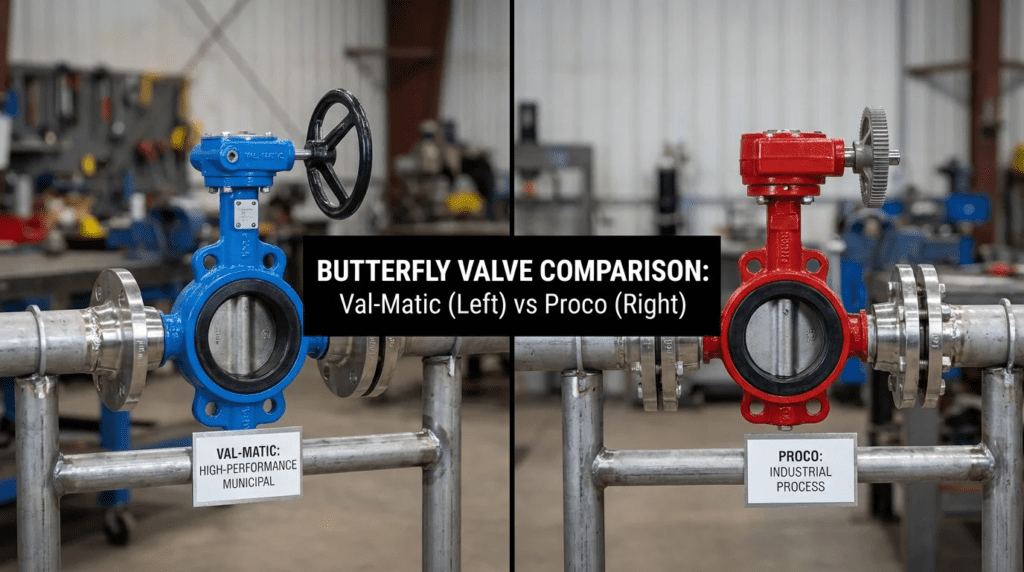
Val-Matic vs Proco Butterfly Valves: Equipment Comparison & Best Fit
Introduction
Engineers researching Val-Matic vs Proco for butterfly valve applications run into a product-line distinction that is worth establishing at the outset. Val-Matic manufactures AWWA-compliant butterfly and quarter-turn valves for municipal water and wastewater service. Proco Products manufactures rubber and PTFE expansion joints, flexible connectors, pipe penetration seals, and the ProFlex series of rubber duckbill check valves — the company describes itself as a supplier of expansion joints and check valves, and butterfly valves do not appear in that range.
That does not make the comparison useless. Proco equipment routinely shares a pump discharge line with a butterfly valve, and specifying one without accounting for the other is a common source of trouble. This article covers two things: how to choose between the butterfly valve designs actually on the market, and where Proco’s equipment fits in the same piping run.
Manufacturer positioning across the category is covered in our overview of the top OEMs for butterfly valves.
The Butterfly Valve Decision: Concentric vs Eccentric
The genuine specification choice in butterfly valves is geometric. In a concentric valve the shaft runs through the centerline of both disc and pipe, and the disc seals by interference against a rubber liner around the full perimeter. In an eccentric valve the shaft is offset, and the disc cams into the seat only in the final degrees of closure. Val-Matic’s AWWA range sits in the eccentric category; concentric resilient-seated valves are widely available from industrial valve manufacturers.
Duty Conditions
- Pressure class and shutoff: Municipal distribution typically requires Class 150B or 250B per AWWA C504. Eccentric designs built to that standard are engineered for bidirectional tight shutoff at those differentials. Concentric resilient-seated valves depend on the interference fit between disc and liner and are generally offered at lower ratings.
- Velocity: Eccentric designs generally handle higher line velocity with less vibration. Thin-disc concentric wafer valves can experience flutter or liner distortion at elevated velocity.
- Throttling versus isolation: Eccentric valves typically offer a more usable control range. Concentric resilient-seated designs are principally on/off devices.
Materials
- Body: Ductile iron to ASTM A536 is standard for municipal service. In wastewater generating hydrogen sulfide, the coating specification — typically fusion-bonded epoxy — matters more than the base metal.
- Seats: Concentric valves use a vulcanized or cartridge liner covering the full body bore, available in EPDM, Buna-N, Viton and other elastomers. Eccentric AWWA designs carry a seat on the body or disc, frequently mechanically retained and adjustable.
- Shaft: Type 304 or 316 stainless is the norm for wastewater. Verify shaft diameter meets AWWA C504 for the size to prevent deflection under load.
Hydraulics and Torque
Both types offer good flow coefficients at full open, with thin concentric discs presenting slightly less obstruction in some sizes. The differences are modest and rarely decide the selection.
Seating torque is where the geometries genuinely diverge. A concentric disc rubs against its liner through the full perimeter during the last degrees of travel, producing high seating and unseating torque that rises after long inactivity as the elastomer takes a set. An eccentric disc cams into the seat only at closure, reducing friction and torque substantially. This has direct consequences for actuator sizing and cost, particularly at larger diameters.
Installation
- Buried service: Double-flanged AWWA C504 valves with a buried service actuator are the standard. Wafer and lug bodies are generally unsuitable for direct burial — they lack the structural integrity for earth loads and settlement, and exposed through-bolting corrodes in soil.
- Space constraints: The narrow face-to-face dimension of a wafer valve is a genuine advantage in tight galleries and skid-mounted systems.
- End-of-line service: Wafer valves must not be used for dead-end service. They are held by through-bolts, and removing the downstream pipe releases the valve. Lug or double-flanged bodies are required.
Failure Modes
- Concentric: The liner is the primary failure point. Tearing, hardening or chemical swelling causes leakage or seizure, and liner life shortens considerably in high-cycle service.
- Eccentric: Seat wear is reduced by the camming action. Failures more typically involve shaft packing or actuator issues.
- Both: Blowout-proof shaft design should be specified as a safety requirement in pressurized systems.
Where Proco Equipment Fits
Proco’s products are not alternatives to a butterfly valve — they perform functions no butterfly valve performs, in the same run of pipe.
Expansion Joints
Rubber and PTFE expansion joints absorb pump vibration, accommodate thermal movement and pipe settlement, and protect pump flanges from piping stress. A rigid butterfly valve does none of this. On a typical pump discharge, the expansion joint sits immediately off the pump, ahead of the check device and the isolation valve.
Two specification points carry real consequence. Control rods must be installed and must stay installed — operators regularly mistake them for shipping hardware and remove them, after which the joint can over-extend during a surge and rupture. And the joint must be rated for surge pressure, not merely working pressure.
Duckbill Check Valves
The ProFlex series provides passive backflow prevention with no hinges, springs or moving parts. In sludge, grit, stormwater and tidal outfalls — services where a mechanical check fouls, seizes or corrodes — the elastomeric design is frequently the more reliable choice, and it requires no power or actuation.
The limits matter. A duckbill requires a cracking pressure to open and retains some head loss across the sleeve, which must be calculated in gravity and low-head systems. Sizing is based on velocity rather than flow coefficient, read from the manufacturer’s cracking pressure and head-loss curves, which are non-linear because the opening geometry changes as the bill opens.
Comparison
| Attribute | Eccentric (Val-Matic AWWA range) | Concentric (industrial resilient-seated) |
|---|---|---|
| Geometry | Shaft offset from centerline; disc cams into seat at closure | Shaft on centerline; disc interferes with liner through full perimeter |
| Governing standard | AWWA C504 | MSS SP-67, API 609 |
| Seating torque | Lower — cam action limits friction | Higher — constant interference, rises after idle periods |
| Cycle life | High; reduced seat wear | Lower in high-cycle service; liner wears |
| Body style | Typically double flanged | Typically wafer or lug |
| Buried service | Suitable with appropriate actuator | Generally unsuitable |
| Capital cost | Higher | Lower |
| Maintenance | Packing adjustment; infrequent seat work | Periodic liner replacement |
| Function required | Equipment | Rationale |
|---|---|---|
| Buried distribution isolation | Eccentric butterfly valve, double flanged | Structural integrity for earth loads; no access for repair |
| Raw sewage pump isolation | Eccentric butterfly or plug valve | Solids handling without tearing a liner |
| Process air and HVAC | Concentric wafer butterfly valve | Low pressure, clean media, space-constrained |
| Chemical feed skids | Concentric butterfly valve, elastomer matched to chemistry | Liner material options in a compact footprint |
| Backflow prevention in sludge or stormwater | Proco ProFlex duckbill check valve | No mechanism to foul; passive, non-slam closure |
| Pump vibration and pipe stress isolation | Proco expansion joint | No valve performs this function; protects pump and flanges |
| Lockout isolation ahead of a check device | Butterfly or ball valve | A duckbill cannot provide positive isolation |
Engineer & Operator Field Notes
Commissioning
For AWWA valves in critical service, require certified hydrostatic shell and seat test reports and verify proof-of-design data exists for the specific model and size.
During site acceptance, actuator stops are the focus. On concentric valves, over-travel forces the disc into the liner hard enough to deform it, while under-travel leaves it leaking. On eccentric valves, ensure the disc is fully seated without over-torquing, since the camming action provides the seal and additional force only damages the elastomer.
On Proco equipment, verify control rod installation on expansion joints and check flange bolt torque. Over-torquing crushes the elastomer flange bead and compromises the seal before the plant starts up.
Copy-pasted specifications routinely omit this. If a wafer valve is installed where downstream dismantling will occur, the result is a safety hazard — wafer valves are held by through-bolts and fall out when the downstream pipe is removed. Lug or double-flanged bodies are mandatory for end-of-line service.
- Actuator undersizing: Concentric valves require substantially higher torque to break the seal after sitting idle. Sizing on dynamic torque while ignoring breakaway torque produces valves that stall during routine exercising.
- Velocity limits: Ignoring velocity limits allows disc flutter in wafer valves, which fatigues the stem over time.
- Duckbill placement: Install with a straight pipe run upstream, typically three to five diameters. Turbulent flow directly off a pump causes the bill to flutter and fatigue prematurely.
Operations
Butterfly valves: Both geometries require regular full cycling — annually at minimum — to prevent scale buildup and confirm actuator function. On concentric valves, watch for weeping between liner and body, which indicates liner failure. For spares, hold liners and discs for concentric valves and packing kits for eccentric AWWA valves; seat replacement on large valves is a major event usually requiring manufacturer support.
Proco equipment: Inspect elastomers semi-annually for cracking, checking and UV damage. Check flange bolt torque annually, as elastomers relax over time. These units are not repairable — the spare is a full replacement unit.
Troubleshooting
- Leakage past seat: On a concentric valve this generally means the liner is torn or hardened. On an eccentric valve, check the closed position limit stop first.
- Shaft leakage: Tighten the packing gland evenly. Persistent leakage means damaged packing or a scored shaft.
- High torque or stalling: Check for trapped solids at the seat. On concentric valves, consider chemical swelling of the liner.
- Duckbill not sealing: Elastomer fatigue and loss of memory. These are consumable items; plan replacement rather than repair.
Design Details
Sizing Butterfly Valves
- Flow coefficient: Determine required Cv at maximum flow within an acceptable pressure drop, typically one to three psi for isolation duty.
- Velocity: V = (0.4085 × Q) / d², with Q in gpm and d in inches. Keep below 16 ft/s for standard municipal service.
- Cavitation: For throttling duty, calculate the cavitation index and compare against the manufacturer’s limit. Below it, specify different trim or a different valve type.
Sizing Duckbill Check Valves
These are sized on velocity rather than Cv. Sufficient velocity is needed to open the valve fully and minimize head loss; excessive velocity causes vibration and abrasion. Read head loss from the manufacturer’s curves rather than calculating it as a Cv-equivalent.
Specification Checklist
- Standard: State AWWA C504, or MSS SP-67 / API 609 for industrial duty — this single line largely determines which butterfly valve design you receive
- Seat type: Specify resilient-seated concentric or rubber-seated eccentric explicitly
- Body style: Double flanged, lug or wafer
- Actuation: Manual or powered, with enclosure rating
- Testing: Require a proof-of-design affidavit
- Elastomeric equipment: Specify surge pressure rating, control rods where applicable, and NSF/ANSI 61 certified materials for potable service
Standards
- AWWA C504: Rubber-seated butterfly valves for water service
- AWWA C508: Relevant sections for check valves
- ASTM D2000: Rubber classification for elastomeric components
- NSF/ANSI 61 and 372: Mandatory for potable water contact
- ISO 5211: Part-turn actuator attachment
Frequently Asked Questions
Does Proco make butterfly valves?
Proco Products manufactures rubber and PTFE expansion joints, braided flexible connectors, pipe penetration seals, and the ProFlex series of rubber duckbill check valves. Butterfly valves do not appear in their published product range. Engineers comparing Val-Matic and Proco are generally comparing equipment that performs different functions in the same piping run rather than competing products.
What is the real butterfly valve design choice?
Concentric versus eccentric geometry. Concentric valves seal by interference between the disc and a full-bore rubber liner. Eccentric valves use an offset shaft so the disc cams into the seat only at closure. This produces markedly different torque characteristics, seat wear rates and service lives, and it determines actuator sizing.
Can a duckbill check valve replace a butterfly valve?
Only where the butterfly valve was performing backflow prevention. A duckbill offers lower maintenance and better clog resistance in that role. It cannot replace a valve needed for isolation, for stopping flow against forward pressure, or for any application requiring lockout.
Why is concentric torque higher?
The disc interferes with the liner around the full perimeter to seal, creating friction through the final degrees of closing and the initial degrees of opening. An offset design avoids that continuous contact, engaging the seat only at the moment of closure.
Why specify a butterfly valve and Proco equipment in the same run?
Because they do different jobs. A typical pump discharge includes an expansion joint to isolate vibration, a check device to prevent backflow, and an isolation valve to allow shutdown for maintenance. This is complementary specification rather than competition, and omitting any one of the three creates a problem the other two cannot solve.
Are butterfly valve body styles interchangeable?
Not necessarily. Although flange bolt patterns may match, face-to-face dimensions differ substantially — a wafer valve is narrow while a flanged AWWA valve has a much wider body. Verify piping layout dimensions before substituting.
Conclusion
KEY TAKEAWAYS
- Different product categories: Val-Matic builds butterfly and quarter-turn valves. Proco builds expansion joints and duckbill check valves. They complement rather than compete.
- The butterfly decision is geometric: Cam action versus interference fit determines torque, wear and service life.
- Match to service: Eccentric AWWA designs for main process lines, buried service and critical isolation. Concentric wafer designs for auxiliary systems, chemical feed, air and tight spaces.
- Safety boundary: Never rely on a duckbill for lockout. Pair it with a mechanical isolation valve upstream.
- Size actuators on breakaway torque, particularly for concentric valves that sit idle for extended periods.
- The standard you cite determines what you get — AWWA C504 and MSS SP-67 lead to fundamentally different valves.
The goal in specification is identifying the right mechanism for each function rather than ranking brands. Val-Matic’s eccentric AWWA valves are the benchmark for permanent municipal infrastructure where longevity and buried-service integrity are non-negotiable. Concentric resilient-seated valves are a compact, cost-efficient answer for industrial auxiliaries where access makes replacement straightforward. Proco’s expansion joints and duckbill check valves handle vibration, surge and passive backflow prevention — functions that sit alongside the isolation valve rather than replacing it.
Well-designed pump stations use all three, and the specification errors that cause real trouble come from asking one to do another’s job. Related evaluations appear in our comparisons of Mueller and Val-Matic butterfly valves, Henry Pratt and Crispin Valve, and Crispin Valve and DHC International.