
Maryland Wastewater Treatment Plants
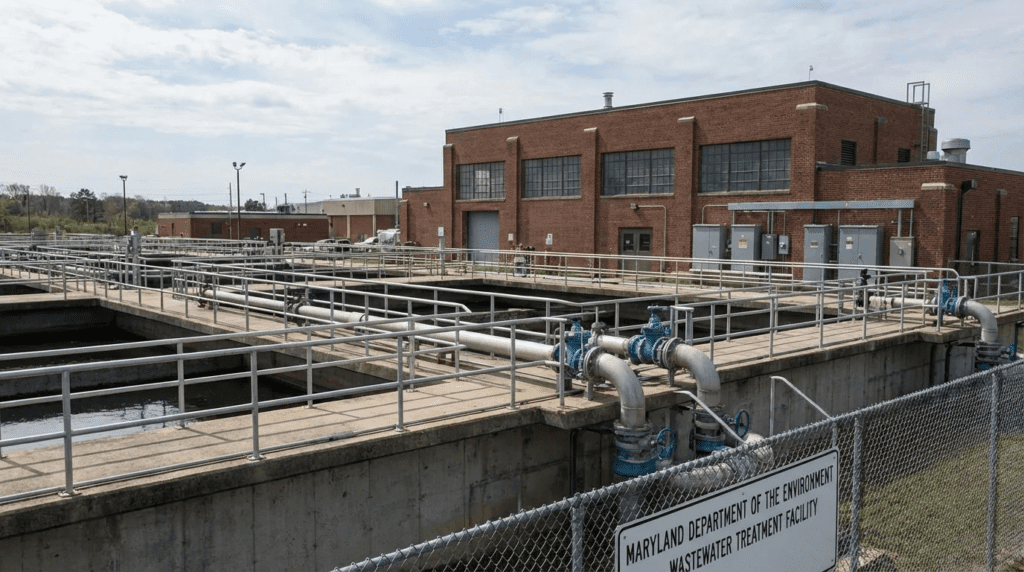
1. Introduction
Maryland’s wastewater infrastructure is defined by a single, overriding geographical feature: the Chesapeake Bay. As the largest estuary in the United States, the Bay dictates the regulatory and technological landscape for the state’s water environment. Maryland is home to approximately 320 public wastewater treatment plants (WWTPs) that treat over 650 million gallons of wastewater per day (MGD). The state is a national leader in Enhanced Nutrient Removal (ENR) technology, driven by the federally mandated Chesapeake Bay Total Maximum Daily Load (TMDL).
The sector is currently navigating a period of intense capital investment. While the “Bay Restoration Fund” (BRF) has successfully funded the upgrade of the state’s 67 largest plants to ENR standards, the focus has shifted to addressing aging linear infrastructure, managing wet weather flows, and correcting operational failures at major regional facilities. Following high-profile compliance issues in Baltimore City, the Maryland Department of the Environment (MDE) has intensified oversight, driving significant consent decree-related spending.
- Total Treatment Capacity: ~780 MGD (Design Capacity)
- Population Served: ~5.2 million (approx. 85% of state population)
- Major Regulatory Driver: Chesapeake Bay TMDL (Nitrogen/Phosphorus limits)
- Primary Funding Vehicle: Bay Restoration Fund (“Flush Tax”) & SRF
2. Recent Developments & Projects
The last 36 months have been transformative for Maryland’s wastewater sector. The most significant development was the operational crisis at the Back River and Patapsco Wastewater Treatment Plants in Baltimore City, leading to a temporary state takeover by the Maryland Environmental Service (MES) in 2022 to stabilize operations. This has catalyzed a massive influx of emergency funding and accelerated repair contracts to address solids handling and denitrification filter failures.
Simultaneously, the Washington Suburban Sanitary Commission (WSSC Water)—serving Montgomery and Prince George’s counties—has spearheaded one of the most advanced bioenergy projects in the Mid-Atlantic. The utility is transitioning from traditional biosolids disposal to advanced resource recovery using Thermal Hydrolysis Process (THP) technology.
Climate resilience is also reshaping capital improvement plans (CIPs). Facilities in Annapolis and the Eastern Shore are actively investing in flood mitigation and elevation projects to combat sea-level rise and nuisance flooding, funded partly by new federal IIJA allocations.
3. Top 20 Largest Treatment Plants in Maryland

Note: While the Blue Plains Advanced Wastewater Treatment Plant (384 MGD) serves a massive portion of Maryland’s population (Montgomery and Prince George’s counties via WSSC), the facility is physically located in Washington, D.C., and operated by DC Water. The list below ranks plants physically located within Maryland.
| Rank | Plant Name | Location | Design Capacity (MGD) | Operating Authority |
|---|---|---|---|---|
| 1 | Back River WWTP | Baltimore City | 180.0 | Baltimore City DPW |
| 2 | Patapsco WWTP | Baltimore City | 73.0 | Baltimore City DPW |
| 3 | Western Branch WWTP | Upper Marlboro | 30.0 | WSSC Water |
| 4 | Piscataway WRF | Accokeek | 30.0 | WSSC Water |
| 5 | Little Patuxent Water Reclamation Plant | Savage | 29.0 | Howard County DPW |
| 6 | Seneca WRF | Germantown | 26.0 | WSSC Water |
| 7 | Broadneck WRF | Annapolis | 21.0 | Anne Arundel County DPW |
| 8 | Sod Run WWTP | Perryman | 20.0 | Harford County |
| 9 | Parkway WWTP | Laurel | 7.5 | WSSC Water |
| 10 | Cox Creek WRF | Curtis Bay | 15.0 | Anne Arundel County DPW |
| 11 | Annapolis WRF | Annapolis | 13.0 | Annapolis City / Anne Arundel Co. |
| 12 | Hagerstown WWTP | Hagerstown | 10.8 | City of Hagerstown |
| 13 | Frederick (Gas House Pike) WWTP | Frederick | 8.0 | City of Frederick |
| 14 | Cumberland WWTP | Cumberland | 15.0 (Comb. Sewer) | City of Cumberland |
| 15 | Salisbury WWTP | Salisbury | 8.5 | City of Salisbury |
| 16 | Damascus WWTP | Damascus | 1.5 | WSSC Water |
| 17 | Maryland City WRF | Maryland City | 2.5 | Anne Arundel County DPW |
| 18 | Ballenger-McKinney WWTP | Frederick | 15.0 (Expanded) | Frederick County |
| 19 | Ocean City WWTP | Ocean City | 14.0 | Town of Ocean City |
| 20 | Cambridge WWTP | Cambridge | 8.1 | City of Cambridge |

Detailed Profiles of Top 5 Largest Plants
1. Back River Wastewater Treatment Plant
- Location: Baltimore City (Dundalk area)
- Design Capacity: 180 MGD
- Peak Wet Weather Flow: >400 MGD
- Population Served: ~1.3 million (Baltimore City & County)
- Operating Authority: Baltimore City Dept. of Public Works (DPW)
- Receiving Water: Back River (tributary to Chesapeake Bay)
Treatment Process: The plant utilizes coarse and fine screening, grit removal, primary settling, activated sludge (biological treatment), and a massive denitrification filter complex (52 deep-bed sand filters) for ENR compliance. Disinfection is achieved via chlorination/dechlorination.
Infrastructure & Upgrades: The recently completed $430 million Headworks Project (2021) installed eight massive Archimedes screw pumps to eliminate a 10-mile operational sewer backup, significantly reducing sanitary sewer overflows (SSOs). The plant is currently undergoing $50M+ in emergency repairs to its solids handling and primary settling tanks.
2. Patapsco Wastewater Treatment Plant
- Location: Baltimore City (Wagner’s Point)
- Design Capacity: 73 MGD
- Current Average Flow: ~60 MGD
- Operating Authority: Baltimore City DPW
- Receiving Water: Patapsco River
Treatment Process: Patapsco employs an oxygen-activated sludge process (Cryogenic Oxygen Generation) which allows for high-rate treatment in a smaller footprint. It utilizes denitrification filters to meet the strict 3.0 mg/L Total Nitrogen limit.
Recent Challenges: Like Back River, Patapsco has faced operational challenges regarding fats, oils, and grease (FOG) accumulation. A major rehabilitation of the oxygen generation plant and the fine screens is currently in the procurement/construction phase.
3. Western Branch Wastewater Treatment Plant
- Location: Upper Marlboro (Prince George’s County)
- Design Capacity: 30 MGD
- Population Served: ~300,000
- Operating Authority: WSSC Water
Treatment Process: This plant utilizes a high-rate activated sludge process with specific ENR modifications. It is notable for its highly automated control systems. Tertiary treatment includes deep bed sand filtration and UV disinfection (replacing chlorine gas for safety and environmental reasons).
4. Piscataway Water Resource Recovery Facility
- Location: Accokeek
- Design Capacity: 30 MGD
- Operating Authority: WSSC Water
Notable Feature: Piscataway is the site of WSSC’s regional Bio-Energy project. It receives sludge from other WSSC plants (Seneca, Damascus, Parkway) for centralized processing.
Technology: The facility recently integrated CAMBI Thermal Hydrolysis Process (THP) to pre-treat solids before anaerobic digestion, significantly increasing biogas production and producing Class A biosolids.
5. Little Patuxent Water Reclamation Plant
- Location: Savage (Howard County)
- Design Capacity: 29 MGD
- Operating Authority: Howard County DPW
Treatment Process: A sophisticated ENR facility utilizing separate stage nitrification and denitrification. The plant produces high-quality effluent discharged into the Little Patuxent River.
Infrastructure: The plant is currently executing a multi-phase Biosolids Processing Upgrade to improve dewatering efficiency and reduce hauling costs, alongside a major dryer addition.
Large Regional Plants (Rank 6-20)
Major Municipal Facilities: The Seneca WRF (26 MGD) and Sod Run WWTP (20 MGD) serve rapidly growing suburban corridors. Sod Run, serving Harford County, has been a pioneer in using sod farms for nutrient uptake in the past but now relies on full ENR mechanical treatment.
Coastal Facilities: The Ocean City WWTP (14 MGD) is unique due to its massive seasonal flow variation. It utilizes a pure oxygen activated sludge system to handle summer loads that can quadruple winter flows.
4. Plants with Approved Budgets & Expansion Projects
Maryland’s wastewater sector currently has over $1.5 billion in active capital projects. The focus has shifted from “Enhanced Nutrient Removal” (which is largely complete) to “Asset Management,” “Resiliency,” and “Resource Recovery.”
A. Major Projects Under Construction (2024-2026)
$271 Million
- Location: Accokeek, Prince George’s County
- Project Scope: Installation of CAMBI Thermal Hydrolysis Process (THP), new anaerobic digesters, and Combined Heat and Power (CHP) engines.
- Technology: THP creates Class A biosolids (fertilizer quality) and boosts methane capture.
- Contractor: PC Construction (Design-Build)
- Status: Construction substantially complete; commissioning phases ongoing through 2024.
- Impact: Will reduce biosolids volume by 50% and generate 3MW of renewable energy.
$148 Million
- Location: Curtis Bay (Anne Arundel County)
- Project Scope: Expansion of capacity to 17.5 MGD, upgrade of ENR systems, and clarification improvements.
- Funding: 30% BRF Grant, remainder County Bonds/SRF.
- Key Improvements: New Membrane Bioreactor (MBR) technology integration and grit removal upgrades.
- Timeline: Construction ongoing, completion expected 2025.
$58 Million
- Location: Baltimore City
- Project Scope: Comprehensive rehabilitation of primary clarifiers 1-8, sludge pumping stations, and odor control covers.
- Driver: Consent Decree compliance and aging infrastructure failure.
- Funding: SRF Loan and WIFIA financing.
- Status: Active construction.
B. Projects in Design/Planning Phase (2025-2027)
- Broadneck WRF Upgrade (Anne Arundel Co): A $45M project to upgrade oxidation ditches and secondary clarifiers. Currently in design with expected bid in late 2024.
- Little Patuxent Biosolids Drying Facility (Howard Co): A planned $60M+ investment to install thermal dryers to further process cake solids, reducing disposal costs.
- Frederick (Ballenger-McKinney) Expansion: Planning phases for future capacity increases to handle the rapid urbanization of Frederick County.
C. Summary Statistics of Capital Investment
- Total Active Capital Investment: ~$1.5 Billion+ (Statewide)
- Primary Project Driver (50%): Asset Renewal / Aging Infrastructure (Baltimore/WSSC)
- Secondary Driver (30%): Biosolids Management & Energy Neutrality
- Tertiary Driver (20%): Capacity expansion for suburban growth
- Top Funding Source: Maryland Water Quality Revolving Loan Fund (SRF)
5. Regulatory & Compliance Landscape
Engineers operating in Maryland must navigate one of the strictest regulatory environments in the US due to the Chesapeake Bay.
- ENR Standards: Major plants must achieve annual average effluent concentrations of 3.0 mg/L Total Nitrogen (TN) and 0.3 mg/L Total Phosphorus (TP). This is significantly lower than standard secondary treatment.
- Consent Decrees: Baltimore City is under a modified Consent Decree with the EPA and MDE to eliminate SSOs. This mandates billions in spending on collection systems and the Headworks at Back River.
- PFAS Regulations: MDE is actively sampling WWTP effluent for PFAS. While strict numerical limits for WWTP discharge are still in development, “monitoring only” permits are becoming standard for renewal cycles.
- Industrial Pretreatment: Significant focus is being placed on industrial users in the Baltimore harbor area to prevent pass-through of metals and FOG that disrupt biological nutrient removal.
6. Infrastructure Challenges & Opportunities
The “Flush Tax” Transition: For two years, the Bay Restoration Fund (fee on sewer bills) successfully funded ENR upgrades. Now, the state faces a funding gap for maintaining these complex systems. The challenge is shifting from building new reactors to funding Asset Management (pumps, SCADA, concrete rehab).
Workforce Shortage: Maryland faces a critical shortage of certified Class 5A (Wastewater) operators. The complexity of ENR plants requires higher-level operators than traditional plants, driving up salaries and creating competition between counties.
Sludge Disposal: With landfills closing and agricultural regulations tightening, disposal of biosolids is a crisis point. This creates engineering opportunities for thermal drying, pyrolysis, and incineration technologies.
7. Technology Trends in Maryland
- Denitrification Filters: Deep-bed sand filters (Tetra, Leopold) are the standard for meeting the 3.0 mg/L TN limit in MD.
- Membrane Bioreactors (MBR): Being adopted in capacity-constrained sites like Cox Creek and smaller developments in sensitive watersheds.
- Thermal Hydrolysis (THP): The WSSC Piscataway project proves THP is viable for large regional facilities.
- Peracetic Acid (PAA): Several plants are piloting PAA as a replacement for UV or Chlorine to reduce disinfection byproducts.
8. Resources for Engineers & Operators
For professionals working in the Maryland water sector, these organizations provide essential certification, training, and regulatory guidance:
- Maryland Department of the Environment (MDE): The primary regulator issuing NPDES permits and managing the SRF/Bay Restoration Fund.
- Chesapeake Water Environment Association (CWEA): The local WEF member association, hosting the annual Tri-Con conference in Ocean City.
- MAMWA (Maryland Association of Municipal Wastewater Agencies): A coalition of utility directors that lobbies on regulatory issues.
- Maryland Center for Environmental Training (MCET): Based at the College of Southern Maryland, this is the primary hub for operator training and certification exam prep.
9. Frequently Asked Questions (FAQ)
What is the largest wastewater treatment plant in Maryland?
The Back River Wastewater Treatment Plant in Baltimore City is the largest, with a design capacity of 180 MGD. (Note: The Blue Plains plant is larger but is located in Washington, D.C.).
What is the Bay Restoration Fund?
Often called the “Flush Tax,” this is a state fee collected on sewer and septic bills. It generates roughly $100 million annually dedicated to upgrading WWTPs to Enhanced Nutrient Removal (ENR) standards.
What are the nutrient limits for Maryland ENR plants?
ENR facilities are designed to meet annual average effluent limits of 3.0 mg/L Total Nitrogen and 0.3 mg/L Total Phosphorus.
Are there opportunities for contractors in Maryland?
Yes. Baltimore City alone has a multi-billion dollar CIP driven by a federal consent decree. WSSC and Anne Arundel County also have active CIPs exceeding $100M annually for wastewater projects.
Who manages operator certification in Maryland?
The Maryland Board of Waterworks and Waste Systems Operators (under MDE) manages licensing. Reciprocity is available with some states, but specific Maryland exams are often required.