
1. Introduction
North Carolina stands at a critical juncture in water infrastructure management. With one of the fastest-growing populations in the United States—driven by the rapid expansion of the Charlotte metro area and the Research Triangle (Raleigh-Durham)—the state’s wastewater treatment capacity is under significant pressure. The North Carolina Department of Environmental Quality (NC DEQ) oversees a complex network of over 200 significant publicly owned treatment works (POTWs), managing the balance between aggressive urban development and the protection of sensitive river basins like the Neuse, Cape Fear, and Catawba.
For consulting engineers and utility managers, North Carolina presents a robust market. The state is currently managing a transition from conventional treatment to advanced nutrient removal and resource recovery, driven by strict total maximum daily load (TMDL) limits and emerging contaminant regulations. Current estimates suggest the state faces a 20-year wastewater infrastructure funding gap exceeding $11 billion. However, recent influxes of federal funding via the Infrastructure Investment and Jobs Act (IIJA) and aggressive state-level grants are fueling a construction boom, focusing on capacity expansion, regionalization of services, and PFAS mitigation.
2. Recent Developments & Projects
In the last 24 months, North Carolina’s wastewater sector has shifted focus toward regionalization and advanced biosolids management. Major utilities are moving away from landfilling sludge toward thermal hydrolysis and composting to create Class A biosolids. Furthermore, the concept of “One Water” is gaining traction, particularly in the Triangle region, promoting integrated water resource management.
Key Trends and Developments:
- Greenfield Construction: Unlike many states focused solely on rehabilitation, NC is building new plants. The Stowe Regional Water Resource Recovery Facility in Charlotte represents a rare greenfield project of significant scale in the Mid-Atlantic.
- PFAS and Emerging Contaminants: Following the GenX contamination issues in the Cape Fear River, NC DEQ has implemented stricter monitoring requirements. This is driving investments in advanced membrane technologies and granular activated carbon (GAC) retrofits, not just for drinking water but increasingly for effluent polishing.
- State Funding Influx: The NC Division of Water Infrastructure has been deploying record levels of funding, including American Rescue Plan Act (ARPA) funds, specifically targeting viable utility grants to help distressed rural systems regionalize with larger, more efficient municipal systems.
- Climate Resilience: Coastal facilities are actively upgrading electrical systems and raising critical infrastructure to combat sea-level rise and increasing hurricane intensity, with significant projects in Wilmington and the Outer Banks.
3. Top 20 Largest Treatment Plants in North Carolina
The following ranking is based on permitted design capacity (MGD). These facilities represent the backbone of North Carolina’s sanitary infrastructure.

| Rank | Plant Name | City/Location | Design Capacity (MGD) | Population Served | Operating Authority |
|---|---|---|---|---|---|
| 1 | McAlpine Creek WWMF | Pineville | 64.0 MGD | ~500,000 | Charlotte Water |
| 2 | Neuse River RRF | Raleigh | 75.0 MGD* | ~580,000 | Raleigh Water |
| 3 | T.Z. Osborne WRF | Greensboro | 40.0 MGD | ~290,000 | City of Greensboro |
| 4 | Archie Elledge WWTP | Winston-Salem | 30.0 MGD | ~180,000 | Winston-Salem/Forsyth County |
| 5 | South Durham WRF | Durham | 20.0 MGD | ~140,000 | City of Durham |
| 6 | North Durham WRF | Durham | 20.0 MGD | ~130,000 | City of Durham |
| 7 | French Broad River WRF | Asheville | 40.0 MGD** | ~160,000 | MSD of Buncombe County |
| 8 | Southside WWTP | Wilmington | 16.0 MGD | ~100,000 | Cape Fear Public Utility Authority |
| 9 | Rocky River WWTP | Concord | 24.5 MGD | ~180,000 | Water & Sewer Authority of Cabarrus County |
| 10 | Rock Creek WWTP | Whitsett | 22.0 MGD | ~100,000 | City of Burlington |
| 11 | Sugar Creek WWTP | Charlotte | 20.0 MGD | ~130,000 | Charlotte Water |
| 12 | Western Wake RWRF | Apex | 18.0 MGD | ~120,000 | Town of Cary |
| 13 | Rock Creek WWTP | Fayetteville | 18.0 MGD | ~110,000 | Fayetteville PWC |
| 14 | Irwin Creek WWTP | Charlotte | 15.0 MGD | ~95,000 | Charlotte Water |
| 15 | Gastonia Long Creek WWTP | Gastonia | 16.0 MGD | ~75,000 | Two Rivers Utilities |
| 16 | High Point Eastside WWTP | High Point | 16.0 MGD | ~80,000 | City of High Point |
| 17 | Cross Creek WRF | Fayetteville | 25.0 MGD | ~150,000 | Fayetteville PWC |
| 18 | Mallard Creek WRF | Charlotte | 12.0 MGD | ~80,000 | Charlotte Water |
| 19 | Northside WWTP | Wilmington | 16.0 MGD | ~100,000 | Cape Fear Public Utility Authority |
| 20 | North Buffalo Creek | Greensboro | 16.0 MGD | ~90,000 | City of Greensboro |

*Neuse River is currently expanding to 75 MGD. **French Broad River MSD capacity reflects peak flow handling capabilities.
Detailed Profiles of the Top 5 Largest Plants
1. McAlpine Creek Wastewater Management Facility
- Location: Pineville, Mecklenburg County, NC
- Design Capacity: 64.0 MGD
- Operating Authority: Charlotte Water
- Receiving Water: McAlpine Creek (Catawba River Basin)
- Treatment Process: Advanced secondary treatment utilizing biological nutrient removal (BNR), secondary clarification, filtration, and UV disinfection.
- Infrastructure: Features anaerobic digesters and a Combined Heat and Power (CHP) system. It is the central solids handling facility for all of Charlotte Water’s plants.
- Recent Upgrades: Currently undergoing a massive biosolids program upgrade to improve thermal hydrolysis capabilities and energy recovery.
- Compliance: Maintains strict Total Phosphorus and Total Nitrogen limits due to downstream impacts on South Carolina waterways.
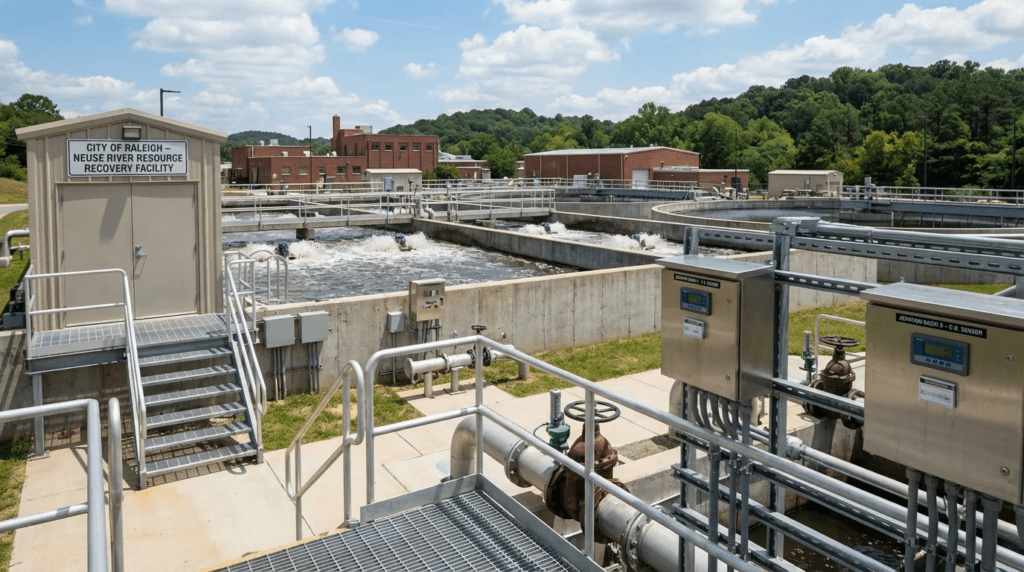
2. Neuse River Resource Recovery Facility
- Location: Raleigh, Wake County, NC
- Design Capacity: 75.0 MGD (Permitted)
- Operating Authority: Raleigh Water
- Receiving Water: Neuse River
- Treatment Process: Preliminary screening, primary clarification, biological nutrient removal (BNR) via activated sludge, deep bed filters, and UV disinfection.
- Infrastructure: Home to the “Bioenergy Recovery Project,” turning sludge into biogas for fleet fuel and power generation.
- Notable Features: The facility is a model for environmental stewardship, maintaining some of the strictest nitrogen limits in the Southeast to protect the Neuse Estuary.
3. T.Z. Osborne Water Reclamation Facility
- Location: Greensboro, Guilford County, NC
- Design Capacity: 40.0 MGD
- Operating Authority: City of Greensboro
- Receiving Water: South Buffalo Creek
- Treatment Process: Five-stage Bardenpho process for advanced nutrient removal, tertiary filtration, and UV disinfection.
- Infrastructure: Utilizes fluid bed incineration for solids handling.
- Recent Upgrades: Recently completed upgrades to the aeration basins and blower systems to improve energy efficiency.
4. Archie Elledge Wastewater Treatment Plant
- Location: Winston-Salem, Forsyth County, NC
- Design Capacity: 30.0 MGD
- Operating Authority: Winston-Salem/Forsyth County Utilities
- Receiving Water: Salem Creek (Yadkin River Basin)
- Treatment Process: Advanced biological treatment with nitrification/denitrification.
- Notable Features: The facility is known for its robust industrial pretreatment program, handling waste from major manufacturing hubs in the region.
5. South Durham Water Reclamation Facility
- Location: Durham, Durham County, NC
- Design Capacity: 20.0 MGD
- Operating Authority: City of Durham
- Receiving Water: New Hope Creek (Jordan Lake Watershed)
- Treatment Process: Enhanced biological phosphorus removal (EBPR) and denitrification filters.
- Compliance: Operates under extremely tight nutrient regulations to protect Jordan Lake, a major drinking water reservoir.
Other Significant Facilities (Rank 6-20)
Regional Hubs: The French Broad River WRF in Asheville (Rank 7) serves a massive topographic area in the mountains, utilizing gravity flow to minimize pumping costs. The Western Wake RWRF (Rank 12) is a modern facility serving Cary and Apex, utilizing highly advanced ozone and membrane technologies to ensure water quality in the Cape Fear basin.
4. Plants with Approved Budgets & Expansion Projects
North Carolina is currently witnessing a capital improvement boom. Below are the major projects currently funded and moving forward.
A. Major Projects Under Construction (2024-2026)
Stowe Regional Water Resource Recovery Facility (New Construction)
- Location: Charlotte/Belmont (Gaston County)
- Project Scope: Construction of a brand new 15 MGD facility (expandable to 25 MGD) to serve Charlotte and Mount Holly.
- Total Budget: ~$390 Million
- Funding: Revenue Bonds and Low-interest State Loans
- Timeline: Construction began 2023; Completion expected 2026/2027.
- Key Contractors: Design-Build by Garney Construction and Crowder Construction JV.
- Technology: Will utilize advanced membrane bioreactors (MBR) and biological nutrient removal to discharge high-quality effluent into Long Creek.
- Drivers: Diversion of flow from aging plants and supporting rapid growth in western Mecklenburg County.
Neuse River Bioenergy Recovery Project
- Location: Raleigh
- Project Scope: Installation of thermal hydrolysis process (THP), new digesters, and gas cleaning equipment to convert biosolids into renewable natural gas (RNG).
- Total Budget: ~$150 Million
- Funding: Revenue Bonds and SRF Loans
- Expected Benefits: Reduces biosolids volume by 50% and generates revenue through RNG credits.
- Current Status: Construction nearing final phases (75%+ complete).
B. Projects in Design/Planning Phase (2025-2027)
T.Z. Osborne WRF Process Improvements
- Location: Greensboro
- Estimated Budget: $40 Million
- Scope: Rehabilitation of secondary clarifiers and replacement of aging aeration equipment.
- Status: Engineering design phase.
South Durham WRF Reliability Improvements
- Location: Durham
- Estimated Budget: $65 Million
- Scope: Electrical distribution upgrades, new headworks screening, and solids handling redundancy.
- Anticipated Start: Late 2025.
Summary Statistics
- Total Active Capital Investment: $2.1 Billion (approximate across top 20 utilities)
- Primary Project Drivers: Regional Growth (45%), Regulatory Compliance/Nutrients (30%), Asset Renewal (25%).
- Dominant Technology Trend: Transition to Thermal Hydrolysis for solids and MBR for liquid treatment in sensitive watersheds.
5. Regulatory & Compliance Landscape
NC DEQ Division of Water Resources enforces NPDES permits with a specific focus on nutrient sensitivity. The state is divided into several river basins, with the Neuse and Tar-Pamlico basins subject to strict nutrient trading programs.
Emerging Regulations:
- PFAS/GenX: Following the Chemours contamination events, NC is leading the nation in testing requirements. While federal MCLs for drinking water are set, wastewater discharge limits for PFAS are currently being drafted and litigated, pushing plants toward advanced source control and effluent monitoring.
- 1,4-Dioxane: Several municipalities in the Cape Fear basin are under consent orders or enhanced monitoring plans to reduce 1,4-Dioxane discharge from industrial contributors.
- Nutrient Rules: The Jordan Lake Rules impose stringent nitrogen and phosphorus limits on upstream dischargers (Durham, Greensboro, Burlington) to prevent algal blooms in the reservoir.
6. Infrastructure Challenges & Opportunities
Challenges:
- Workforce Shortage: Like the national trend, NC faces a “Silver Tsunami” of retiring licensed operators. Rural plants struggle to attract Grade IV certified operators.
- Inflow and Infiltration (I&I): Older sanitary sewer systems in cities like Winston-Salem and older parts of Charlotte face significant I&I issues, leading to wet weather overflows.
Opportunities:
- Energy Optimization: There is a massive market for energy service companies (ESCOs) to upgrade blowers, pumps, and aeration controls.
- Digital Twins: Large utilities (Raleigh, Charlotte) are investing in digital twin technology for asset management and predictive maintenance.
7. Technology Trends in North Carolina
Because so many NC plants discharge into drinking water reservoirs or sensitive estuaries, the technology baseline is higher than the national average.
- Thermal Hydrolysis (THP): Cambi and similar systems are becoming the standard for large-scale biosolids handling (Raleigh, Charlotte).
- Membrane Bioreactors (MBR): Being deployed in satellite water reclamation plants to facilitate water reuse for irrigation and industrial cooling (e.g., Cary, UNC Chapel Hill).
- UV Disinfection: Almost universal conversion from chlorine gas to UV to reduce disinfection byproducts.
- Nutrient Recovery: Struvite recovery technologies are being explored at plants with high biological phosphorus removal rates.
9. Resources for Engineers & Operators
- NC One Water (formerly NC AWWA-WEA) – The primary association for water professionals in the state.
- NC DEQ Division of Water Infrastructure – Information on SRF loans, grants, and funding cycles.
- NC Waterworks Operators Association (NCWOA) – Training and certification resources.
- NC Board of Examiners for Engineers and Surveyors – Licensure requirements.
10. FAQ Section
How many wastewater treatment plants are in North Carolina?
North Carolina has over 200 major municipal wastewater treatment facilities, along with hundreds of smaller package plants and private systems.
What is the largest wastewater treatment plant in North Carolina?
The McAlpine Creek Wastewater Management Facility in Charlotte is the largest, with a design capacity of 64 MGD.
What are the operator certification requirements in NC?
Operators must be certified by the NC Water Pollution Control System Operators Certification Commission (WPCSOCC). Levels range from Grade I (simplest) to Grade IV (most complex biological systems).
How is North Carolina funding wastewater projects?
Funding comes primarily through the State Revolving Fund (SRF), administered by the Division of Water Infrastructure, supplemented significantly by federal IIJA grants and local revenue bonds.
Are there restrictions on wastewater discharge in NC?
Yes, particularly regarding nutrients. The Neuse River, Tar-Pamlico, and Jordan Lake watersheds have some of the strictest Nitrogen and Phosphorus limits in the Southeast US.