
Rotary Lobe Lifecycle Cost: CAPEX vs OPEX and Energy Payback
Introduction
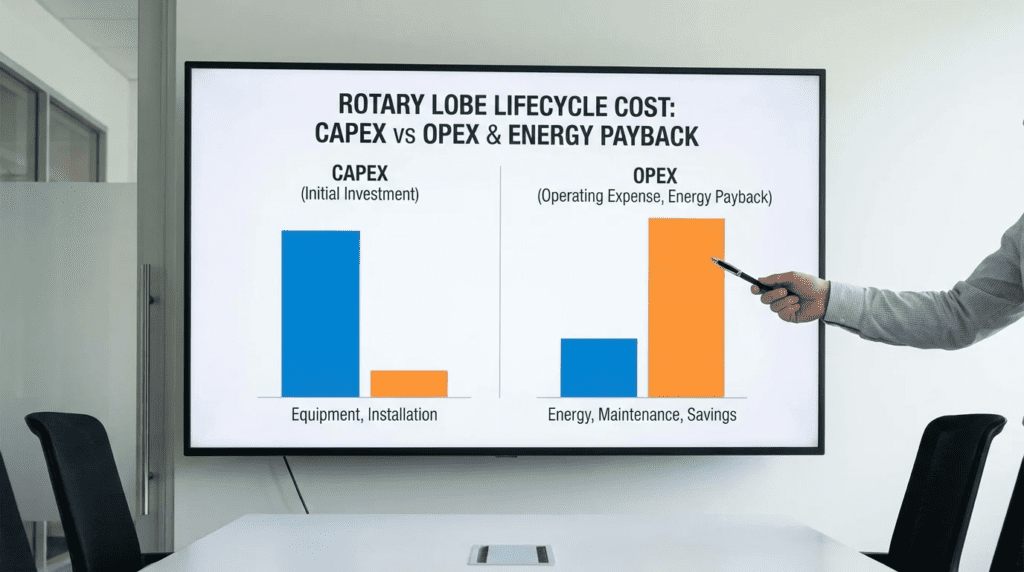
One of the most persistent friction points in wastewater treatment plant design is the misalignment between initial procurement budgets and long-term operating realities. Engineers frequently encounter scenarios where a positive displacement pump is required for high-solids or viscous sludge applications, yet the specification process defaults to the lowest bidder. This approach often ignores the Rotary Lobe Lifecycle Cost: CAPEX vs OPEX and Energy Payback analysis, leading to installations that bleed budgets through frequent spare parts consumption, excessive downtime, and inefficient energy usage.
Rotary lobe pumps have become a staple in municipal and industrial wastewater facilities, particularly for applications such as thickened waste activated sludge (TWAS), digested sludge recirculation, centrifuge feed, and truck loading. Unlike centrifugal pumps, which rely on kinetic energy, rotary lobe pumps utilize positive displacement principles to move fluid in discrete volumes. This fundamental difference creates a unique operating environment where efficiency is less dependent on the Best Efficiency Point (BEP) and more dependent on slip, viscosity, and internal tolerances.
However, the decision to specify a rotary lobe pump over a progressive cavity (PC) pump or a plunger pump should not be based on hydraulic fit alone. The consequences of poor selection in this category are severe: premature lobe wear from abrasives, shaft deflection leading to seal failure, and energy inefficiencies caused by internal slip. This article aims to equip consulting engineers and plant directors with the data-driven framework necessary to evaluate the Total Cost of Ownership (TCO) accurately. We will move beyond the catalog curves to examine the real-world engineering economics of these systems.
How to Select / Specify
Proper specification is the first line of defense against ballooning operational costs. When evaluating Rotary Lobe Lifecycle Cost: CAPEX vs OPEX and Energy Payback, the engineer must look beyond flow and head. The specification must explicitly address the interaction between the fluid rheology and the pump’s mechanical clearances.
Duty Conditions & Operating Envelope
The operating envelope for rotary lobe pumps is defined by the relationship between viscosity, speed (RPM), and pressure. Unlike centrifugal pumps, where head variation significantly impacts flow, rotary lobe flow is theoretically proportional to speed. However, slip—the backflow of fluid through internal clearances—reduces volumetric efficiency.
- Viscosity Impact: As viscosity increases, slip decreases, improving volumetric efficiency. Engineers must specify the full range of expected viscosities (e.g., 2% to 6% solids). A pump sized for 6% solids may run inefficiently or cavitate if the process temporarily drops to <1% solids (water-like).
- Pressure Limitations: Rotary lobes are typically limited to 150-175 PSI (10-12 bar), though high-pressure models exist. If the application requires overcoming high friction losses in long force mains, confirm the shaft deflection calculations at maximum pressure.
- Speed Considerations: To minimize wear in abrasive sludge applications, specifications should limit rotational speed. A common rule of thumb for abrasive municipal sludge is to keep speeds below 250-300 RPM. Higher speeds reduce CAPEX (smaller pump) but drastically increase OPEX (exponential wear rates).
Materials & Compatibility
Material selection is the primary driver of the “Maintenance” component in the lifecycle cost equation. The interaction between the lobe material and the liner/wear plate determines the Mean Time Between Failures (MTBF).

- Lobe Materials: NBR (Nitrile) is standard for general wastewater. EPDM is required for high temperatures or specific chemical presence. FKM (Viton) is used for harsh industrial chemicals. However, for abrasive applications, standard elastomers may degrade quickly.
- Hardened Options: Engineers should consider specifying steel core lobes with hardened surfaces or all-metal lobes for extreme abrasion, provided the housing is equally protected.
- Housing Protection: Replaceable wear plates (axial and radial) are mandatory for lifecycle cost control. Specifications should require that housing segments can be replaced without replacing the entire pump casing. Ideally, these plates should have a Brinell hardness rating exceeding that of the expected grit/particulate.
Hydraulics & Process Performance
The hydraulic efficiency of a rotary lobe pump is a composite of mechanical efficiency and volumetric efficiency. When calculating the Rotary Lobe Lifecycle Cost: CAPEX vs OPEX and Energy Payback, energy consumption is calculated based on the brake horsepower (BHP) required at the shaft.
Unlike progressive cavity pumps, rotary lobes can run dry for short periods if properly configured (e.g., with flushed seals or oil-quench), but sustained dry running will destroy elastomer lobes due to heat buildup. The specification must include NPSHa (Net Positive Suction Head available) calculations. Rotary lobe pumps generally have poorer suction lift capabilities than PC pumps. If NPSHa is low, the pump may cavitate, causing pitting on the lobes and reducing their lifespan by 50% or more.
Installation Environment & Constructability
One of the strongest arguments for rotary lobe pumps is their compact footprint. They typically occupy 40-60% less floor space than an equivalent progressive cavity pump.
- Retrofit Advantage: In existing lift stations or galleries where space is at a premium, this reduced footprint can eliminate the need for civil structural modifications, significantly lowering CAPEX.
- Piping Configuration: Rotary lobes are reversible. This allows for versatile piping arrangements, such as using a single pump for both loading and unloading trucks, or clearing a clogged line by reversing flow.
Reliability, Redundancy & Failure Modes
Understanding failure modes is critical for accurate O&M budgeting. The most common failure mode is abrasive wear on the lobe tips and the wear plates. As wear increases, the gap widens, slip increases, and the pump must run faster to maintain flow. This creates a feedback loop: faster speeds cause faster wear.
Controls & Automation Interfaces
To maximize energy payback, integration with SCADA is essential. The control system should monitor:
- Torque: Sudden torque spikes often indicate a blockage or a large object (rag ball) entering the chamber.
- Temperature: Temperature sensors on the lobe housing can detect dry running conditions almost immediately.
- Vibration: While less critical than in centrifugal pumps, vibration monitoring can detect bearing fatigue or severe cavitation.
Maintainability, Safety & Access
The “Maintenance-in-Place” (MIP) capability is the defining feature of modern rotary lobe pumps and a massive factor in OPEX reduction. Specifications should require that:
- The front cover can be removed without special tooling.
- Lobes can be accessed and replaced without decoupling the drive line or removing piping.
- Seals are cartridge-style and accessible from the front (wet end) rather than requiring gearbox disassembly.
Lifecycle Cost Drivers
The Rotary Lobe Lifecycle Cost: CAPEX vs OPEX and Energy Payback calculation involves three main variables:
- Acquisition Cost (CAPEX): Rotary lobes are often 20-30% more expensive than lower-tier technologies initially but comparable to high-end PC pumps.
- Energy Cost (OPEX): While rotary lobes are generally efficient (70-85%), slip impacts this. If the pump is undersized and runs fast, energy costs spike.
- Parts & Labor (OPEX): This is where rotary lobes win. Changing a stator/rotor on a PC pump can take two operators 4-8 hours and require hoisting gear. Changing lobes on a rotary lobe pump typically takes one operator less than 1 hour.
Comparison Tables
The following tables provide a direct comparison to assist engineers in selecting the correct pumping technology. Table 1 focuses on the technological differences and their impact on lifecycle costs, while Table 2 outlines the application suitability matrix.
Table 1: Technology Comparison – Lifecycle Cost Implications
| Technology | Hydraulic Efficiency (Typical) | Footprint Impact | Maintenance Complexity (Labor Hours) | Wear Part Cost Profile | Best-Fit Application |
|---|---|---|---|---|---|
| Rotary Lobe | 75% – 85% | Compact (Low) | Low (MIP, <1 hr to change lobes) | Moderate (Lobes, Wear Plates, Seals) | Thickened sludge, scum, high-solids, space-constrained areas |
| Progressive Cavity (PC) | 60% – 75% | Large (High length) | High (Requires dismantling, 4-8 hrs) | High (Rotor and heavy Stator) | Shear-sensitive polymers, dewatered sludge cake, high-pressure dosing |
| Double Disc | 50% – 65% | Moderate | Moderate (Trunnions/Discs) | Low to Moderate | Grit, screenings, rags, heavy abrasion |
| Centrifugal (Recessed Impeller) | 30% – 50% | Moderate | Moderate (Clearances, Seal) | Low (Impeller/Volute) | Dilute sludge (<2%), lift stations, raw influent |
Table 2: Application Fit & ROI Matrix
| Application Scenario | Solids Content | Pressure Requirement | Rotary Lobe Suitability | Lifecycle Cost Justification |
|---|---|---|---|---|
| Waste Activated Sludge (WAS) Transfer | 0.5% – 1.5% | Low (<30 PSI) | Moderate | High slip due to low viscosity may increase energy cost. Centrifugal may be cheaper unless space is limited. |
| Thickened Sludge (TWAS) Feed | 4% – 8% | Medium (30-80 PSI) | Excellent | Viscosity seals the lobes (low slip). High efficiency + easy maintenance yields fastest payback. |
| Dewatered Cake Conveyance | 18% – 30% | High (>150 PSI) | Poor | Pressure requirements often exceed lobe limits. PC pump with open hopper is superior. |
| Tanker Truck Loading | Variable | Low | Excellent | High flow capacity in small footprint. Reversibility allows line clearing. Fast maintenance minimizes truck wait times. |
| Membrane Scour / Permeate | Low | Variable suction | Good | Requires careful NPSH calc. Reversible flow useful for backpulsing membranes. |
Engineer & Operator Field Notes
Real-world performance often diverges from theoretical curves. The following notes are compiled from field experiences regarding Rotary Lobe Lifecycle Cost: CAPEX vs OPEX and Energy Payback optimizations.
Commissioning & Acceptance Testing
The Factory Acceptance Test (FAT) is standard, but the Site Acceptance Test (SAT) is where long-term reliability is established.
- Verification of Clearances: During SAT, verify the timing of the lobes. Incorrect timing gear adjustment can cause lobes to clash, destroying the pump in minutes.
- Relief Valve Settings: Because this is a positive displacement pump, a discharge blockage will cause pressure to rise until something breaks. Verify that the pressure relief valve (PRV) or rupture disk is set no higher than 10% above the pump’s maximum rated pressure, not the system design pressure.
- NPSH Testing: Conduct a vacuum gauge test on the suction side during full flow. If the vacuum reading exceeds the manufacturer’s limit (typically 15-20 inHg), cavitation is occurring, which will void energy payback calculations.
Common Specification Mistakes
One of the most expensive errors is specifying rotary lobes for fluids that are too thin (like water or polymer solution) without accounting for slip.
- The Water Test Trap: Contractors often test pumps with clean water. Rotary lobes have massive slip with water. The pump may appear to underperform (low flow) during the water test but perform perfectly on sludge. Specifications must define testing media or allow for “slip correction factors” during water testing.
- Oversizing Particles: While rotary lobes can pass solids, they are not grinders. Specifying a 3-inch sphere passage for a pump with a 4-inch port is risky. Hard solids can jam between the lobe and housing, causing shaft deflection.
O&M Burden & Strategy
To realize the low OPEX promised by rotary lobe manufacturers, the maintenance strategy must shift from “run-to-failure” to “restore-efficiency.”
- Intervals: Inspect lobe tips and wear plates every 2,000 hours. Measure the clearance. If the gap has doubled, efficiency has likely dropped by 10-15%.
- Spare Parts: Critical spares include one set of lobes, one set of wear plates, and a complete seal kit. Unlike PC pumps, you rarely need to stock a shaft or gearbox components.
- Labor Estimates: Budget 2 man-hours for a complete wet-end rebuild (lobes + seals + wear plates). Compare this to 12+ man-hours for a PC pump rotor/stator change.
Troubleshooting Guide
Symptom: Low Flow
Root Cause: Excessive wear on lobes/plates or viscosity is lower than designed.
Check: Check VFD speed vs. flow meter. If the pump is running at 100% speed but delivering 50% flow, the slip is excessive. Replace wear parts.
Symptom: Knocking Noise
Root Cause: Cavitation or timing gear misalignment.
Check: Check suction gauge. If suction pressure is adequate, check the gearbox timing. Lobes may be touching.
Design Details / Calculations
Accurate sizing is the mathematical foundation of the Rotary Lobe Lifecycle Cost: CAPEX vs OPEX and Energy Payback analysis.
Sizing Logic & Methodology
Sizing a rotary lobe pump requires calculating the Total Dynamic Head (TDH) and correcting for Slip.
- Calculate Theoretical Displacement: Determine the volume displaced per revolution ($V_{rev}$).
- Calculate Theoretical Flow ($Q_{theo}$): $$Q_{theo} = V_{rev} times RPM$$
- Calculate Slip ($Q_{slip}$): Slip is a function of viscosity ($mu$), differential pressure ($Delta P$), and internal clearance ($C$).
$$Q_{slip} propto frac{Delta P times C^3}{mu}$$
Note: As viscosity increases, slip decreases. - Calculate Actual Flow ($Q_{actual}$): $$Q_{actual} = Q_{theo} – Q_{slip}$$
- Determine Power ($BHP$):
$$BHP = frac{Q_{actual} times Delta P}{1714 times eta_{mech}} + text{Viscous Power Loss}$$
Specification Checklist
To ensure the selected equipment meets LCC targets, the specification should mandate:
- Maximum Shaft Deflection: Shall not exceed 0.002 inches at the seal face at full rated pressure.
- Wear Plate Hardness: Minimum 450 Brinell for grit applications.
- Run-Dry Protection: Temperature sensors or power monitoring relays integrated into the control panel.
- Performance Guarantee: Manufacturer must guarantee flow rate at the specified viscosity and pressure, not just water performance.
Standards & Compliance
- HI 3.1-3.5: Hydraulic Institute Standards for Rotary Pumps (essential for testing procedures).
- API 676: While primarily for oil/gas, referencing API 676 regarding seal chambers and bearing life (L10 > 50,000 hours) ensures a robust, heavy-duty build for critical municipal infrastructure.
- ISO 9001: Ensure the manufacturing facility is ISO certified for quality control consistency.
FAQ Section
What is the typical energy payback period for a rotary lobe pump compared to a centrifugal pump?
In sludge applications (3-6% solids), a rotary lobe pump typically demonstrates an energy payback period of 2 to 4 years compared to a recessed impeller centrifugal pump. While the centrifugal pump may have a lower purchase price, its hydraulic efficiency in sludge often drops below 40%, whereas a rotary lobe maintains 70-80% efficiency. The higher the viscosity, the faster the payback.
How does “Rotary Lobe Lifecycle Cost: CAPEX vs OPEX and Energy Payback” compare to progressive cavity pumps?
Rotary lobe pumps usually have a slightly higher or comparable CAPEX to quality progressive cavity (PC) pumps. However, the OPEX advantage lies in maintenance labor. Replacing lobes takes 60-90 minutes (Maintenance-in-Place), whereas replacing a PC stator often requires significant downtime, rigging, and 4-8 hours of labor. Over a 20-year lifecycle, the rotary lobe often yields a 15-20% lower TCO in suitable applications.
Can rotary lobe pumps run dry?
Generally, no. Standard elastomer lobes rely on the pumped fluid for lubrication and cooling. Running dry causes rapid heat buildup, expanding the rubber lobes until they seize against the housing. However, pumps equipped with flushed mechanical seals or oil-quench systems can tolerate short periods (minutes) of dry running. Protection logic in the VFD is highly recommended.
Why is slip such a critical factor in sizing rotary lobe pumps?
Slip is the fluid that leaks back from the discharge to the suction side through the internal clearances. If slip is not calculated correctly, the pump will not meet flow requirements, necessitating higher RPMs. Higher RPMs lead to exponentially faster wear (abrasion is proportional to velocity cubed) and higher energy consumption, destroying the lifecycle cost assumptions.
What is the maximum particle size a rotary lobe pump can handle?
Rotary lobe pumps can pass solids, typically up to 2-3 inches (50-75mm) depending on the pump size. However, passing a solid and pumping it reliably are different. The maximum solid size should generally be restricted to 1/3 of the port size to prevent bridging. For applications with high rag content, consider inline grinders or dual-shaft grinders upstream.
How often should rotary lobe wear plates be replaced?
In typical municipal thickened sludge applications, wear plates usually last between 2 to 5 years. However, in grit-heavy primary sludge, this can drop to 12-18 months. Using hardened steel wear plates rather than standard stainless steel can double or triple this lifespan, significantly improving the OPEX profile.
Conclusion
Key Takeaways for Engineers
- Don’t Overspeed: Keep speeds under 300 RPM for abrasive sludge to maximize wear life.
- Viscosity Matters: Efficiency improves with viscosity; ensure calculations reflect the actual fluid rheology, not water.
- Prioritize MIP: Specify “Maintenance-in-Place” features to reduce labor costs by up to 80% per event.
- Protect the Pump: Mandatory dry-run protection and over-pressure relief are non-negotiable.
- LCC Analysis: High-efficiency rotary lobes justify higher CAPEX through energy savings and reduced maintenance labor within 3-5 years.
The selection of positive displacement pumps for water and wastewater applications requires a disciplined approach to engineering economics. When evaluating Rotary Lobe Lifecycle Cost: CAPEX vs OPEX and Energy Payback, the data clearly supports the technology for applications involving viscous, solids-laden fluids where space is constrained and maintenance ease is paramount.
While the initial capital expenditure may be higher than centrifugal alternatives and comparable to progressive cavity pumps, the operational savings driven by hydraulic efficiency and the Maintenance-in-Place design offer a compelling return on investment. Engineers should focus their specifications on material hardness, low-speed operation, and robust control integration to fully realize these benefits. By shifting the decision framework from “lowest bid” to “lowest lifecycle cost,” utilities can secure reliable, efficient performance for decades to come.