Rotork vs Val-Matic Cone Valves Equipment: Comparison & Best Fit
Rotork vs Val-Matic Cone Valves Equipment: Comparison & Best Fit
Introduction
In municipal water transmission and large-scale wastewater pumping, the cone valve remains a premier choice for pump control and isolation service. Engineers specifying these assets face a complex intersection of mechanical hydraulics and automation controls, and a point of confusion routinely arises around the interface between valve body and actuation system. This article addresses the Rotork vs Val-Matic Cone Valves Equipment: Comparison & Best Fit, a topic requiring precise distinction between the valve manufacturer and the actuation technology provider.
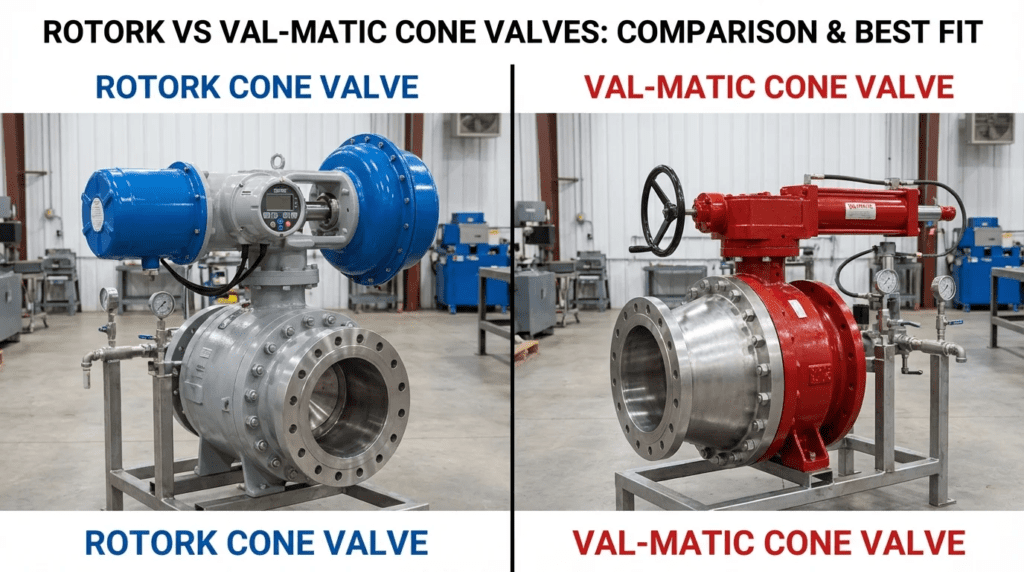
That distinction is the whole basis of the comparison. Val-Matic manufactures heavy-duty AWWA quarter-turn valve bodies and mechanisms, commonly supplied with hydraulic cylinder actuation. Rotork manufactures actuators — electric, pneumatic and hydraulic — along with gearboxes and control systems that automate valves built by others. They are not competing valve suppliers, and an engineer treating them as such will specify the wrong thing.
Cone valves are deployed in raw water intake stations, high-head lift stations and treated water transmission mains where flow modulation and surge control are paramount. The lift-turn-reseat mechanism provides a clear waterway with negligible head loss when open and tight seating when closed. The reliability of that operation depends entirely on the pairing of the iron and the muscle.
The practical decision is between a bundled solution from the valve manufacturer — Val-Matic with their hydraulic cylinder and power unit — or a custom specification pairing the valve body with Rotork electric or fluid power automation. Comparable evaluations appear in our analysis of AVK and Bray cone valve equipment.
How to Select / Specify
Duty Conditions & Operating Envelope
- Pressure class and transients: Specification must account not just for static pressure but for maximum surge pressure during a rapid closure event. The transient analysis defines the duty, not the static rating.
- Pump control logic: Where the valve serves as a pump check, it must synchronize with startup and shutdown, requiring precise timing. Rotork electric actuators allow programmable speed curves. Hydraulic cylinders offer variable speed through flow control valves but lack digital profiling without additional instrumentation.
- Throttling: Cone valves can throttle. Where continuous modulation is required, the actuator must be rated for modulating duty — Rotork’s CVA or modulating-class IQ range, for example — and seat materials must resist cavitation damage at the operating angles.
Materials & Compatibility
- Valve body: Typically ASTM A536 ductile iron, with epoxy coatings specified against the service conditions.
- Seating surfaces: Stainless or high-alloy seats are critical. The lift mechanism protects them from abrasion during rotation, but chemical compatibility with the fluid — chloride content in wastewater being the usual driver — determines alloy choice.
- Actuator environment: A key differentiator. Rotork actuators are available in explosion-proof and submersible-rated enclosures. When specifying a hydraulic system, the power unit must sit in a non-hazardous area or be specially rated, which constrains facility layout.
Hydraulics & Process Performance
- Head loss: A cone valve’s discharge coefficient approaches that of a straight pipe section, minimizing pumping energy over the lifecycle. This is the main reason the type persists despite its cost.
- Cavitation index: Verify at the specific operating points where the valve throttles. Combining the valve manufacturer’s cavitation data with Rotork position feedback lets the SCADA system avoid valve angles known to induce cavitation — a genuine advantage of intelligent actuation over simple limit switches.
Installation Environment & Constructability
- Val-Matic hydraulic system: Requires the valve, a hydraulic cylinder, hydraulic piping and a separate power unit skid. This consumes floor space and requires coordination between mechanical and electrical trades.
- Rotork electric solution: Mounts directly to the valve head, eliminating the power unit skid and hydraulic piping. This significantly reduces installation footprint and removes the risk of hydraulic fluid leaks.
In rehabilitation projects with limited space, replacing an aging hydraulic cylinder system with a direct-mount Rotork electric actuator recovers floor space and eliminates the maintenance burden of deteriorating hydraulic lines. Verify electrical capacity supports the inrush current needed to unseat a large valve before committing.
Reliability, Redundancy & Failure Modes
Failure in a cone valve application can produce catastrophic water hammer or station flooding. This section frequently determines the answer on its own.
- Fail-safe logic: Val-Matic hydraulic systems use accumulators to provide fail-close energy on power loss. Rotork electric actuators require a battery backup pack or spring-return module — straightforward on smaller valves but difficult at the torques large cone valves demand. Rotork fluid power actuators offer fail-safe capability comparable to the hydraulic solution, and the Skilmatic electro-hydraulic range combines electric intelligence with stored hydraulic energy.
- Manual override: Rotork actuators typically feature a declutchable handwheel. Hydraulic cylinders require a manual hand pump at the power unit to stroke the valve during an outage.
Controls & Automation Interfaces
This is the strongest differentiator in the Rotork vs Val-Matic Cone Valves Equipment analysis.
- Intelligent asset management: Rotork’s IQ range offers onboard data logging, torque profiling and vibration monitoring, functioning as an edge diagnostic tool that reveals increasing valve stiffness — indicating seat or bearing issues — before failure occurs.
- Standard hydraulic controls: Traditional panels rely on limit switches and solenoids. Robust, but they provide no predictive information unless heavily instrumented with additional transducers.
Lifecycle Cost Drivers
- Capital: A comprehensive hydraulic package — valve, cylinder and power unit — is often more expensive initially than a valve plus electric actuator, owing to the power unit and field piping.
- Operating: Hydraulic systems require oil changes, filter replacement and seal maintenance. Electric actuators are largely sealed and need minimal lubrication, producing lower long-term maintenance labor.
Comparison Tables
Table 1 breaks down the actuation interface method, the primary decision point when comparing Rotork technologies applied to Val-Matic valves. Table 2 provides an application fit matrix.
| Feature / Attribute | Val-Matic Integrated Hydraulic System | Rotork Intelligent Electric Actuation | Rotork Fluid Power Actuation |
|---|---|---|---|
| Primary mechanism | Hydraulic cylinder powered by remote power unit skid | Electric motor driving a gearbox mechanism | Pneumatic or hydraulic cylinder with localized controls |
| Space requirements | High: floor space for power unit and piping runs | Low: compact unit mounts directly on valve | Medium: cylinder on valve, potential accumulation tanks |
| Fail-safe capability | Excellent, via hydraulic accumulators | Limited; requires battery backup or spring return | Excellent, via spring return or accumulators |
| Control and data | Limit switches, analog control, limited diagnostics | Superior: data logging, torque curves, predictive maintenance | Standard; can be enhanced with smart positioners |
| Surge control timing | Adjustable via flow control valves, manually set | Programmable speed profiles; non-linear timing possible | Adjustable via flow controls; fast acting |
| Maintenance profile | Hydraulic fluid changes, seal checks, hose inspections | Minimal; verify battery and seals; non-intrusive setup | Seal maintenance; gas and fluid checks |
| Application Scenario | Preferred Configuration | Engineering Rationale |
|---|---|---|
| Remote pump station (unmanned) | Cone valve + Rotork intelligent electric | Remote diagnostics allow troubleshooting without a site visit; no hydraulic fluid to leak unattended |
| Critical surge protection (total power loss) | Cone valve + Val-Matic hydraulic, or Rotork fluid power | Stored accumulator energy closes the valve even when electricity is entirely lost |
| High-frequency modulation | Cone valve + Rotork process control actuator | Actuators rated for high duty cycles provide precise positioning without the heat buildup of hydraulics in constant motion |
| Hazardous classified location | Cone valve + Rotork explosion-proof electric | Simplifies compliance versus siting a power unit in a safe zone or specifying rated motors and solenoids |
| Station with multiple large valves | Cone valves + central hydraulic power unit | One power unit serving several valves improves the economics of the hydraulic approach |
Engineer & Operator Field Notes
Commissioning & Acceptance Testing
The interaction between valve mechanism and actuator is the critical path during commissioning.
- The lift-turn sequence: Cone valves must lift axially to unseat before rotating. Verify the actuator logic or mechanical linkage strictly enforces this. An actuator attempting rotation before the lift completes produces torque spikes that trip the unit or damage the seat.
- Closing time verification: For pump check applications, the fast-closure portion of the stroke prevents reverse flow slam. Use a stopwatch or SCADA trend to verify actual closing time against the surge analysis rather than trusting the setpoint.
- Torque switch settings: On Rotork units, ensure the open torque bypass accounts for break-out torque, which is highest at the very start of the opening cycle owing to differential pressure and seating friction.
Common Specification Mistakes
Engineers often size the actuator on running torque. Cone valves become sticky after months of inactivity. An actuator safety factor of 1.5 to 2.0 over the seating and unseating torque is mandatory, not optional.
- Underestimating cable runs: For Rotork electric actuators, voltage drop across long runs in sprawling water plants reduces motor torque output. Size power cabling for startup inrush current, not steady-state draw.
- Ambiguous interface responsibility: Who provides the mounting bracket and coupling? Buying a Val-Matic valve and a Rotork actuator separately leaves this interface falling through the cracks. Best practice is requiring the valve manufacturer to mount and torque-test the actuator at the factory, making one party responsible.
O&M Burden & Strategy
- Val-Matic hydraulic systems: Operators are generally familiar with hydraulics, but they are messy and fitting leaks develop over time. The accumulator charge must be verified quarterly to confirm fail-safe readiness — an unverified accumulator is not a fail-safe.
- Rotork electric systems: Generally set and forget. However, backup batteries for display and position sensing have finite life and must appear in the preventive maintenance schedule. Neglected, the actuator loses position data during a blackout and may lose fail-safe capability.
- Exercise schedule: Regardless of actuator, cone valves must be fully cycled at least quarterly to prevent tuberculation or sediment jamming the lift mechanism.
Design Details / Calculations
Sizing Logic & Methodology
- Determine flow velocity: Cone valves are often sized below the main line to reduce cost — a 36-inch valve on a 42-inch line, for example. Keep velocity through the valve port within the manufacturer’s stated limit to avoid excessive vibration and head loss.
- Calculate unbalanced pressure: The actuator must overcome full differential pressure across the valve plus seating load. Obtain seating and unseating torque figures from the valve manufacturer rather than estimating from area and pressure alone.
- Actuator sizing safety factor: 1.5 for clean water; 2.0 for wastewater and raw water, accounting for debris and grit accumulation in the seating area.
Specification Checklist
- Compliance: AWWA C507 covers ball valves in the relevant size range. Cone valves are frequently specified to manufacturer standards, so define testing and acceptance requirements explicitly rather than assuming a standard covers them.
- Actuator testing: Require a factory torque test graph showing actuator output throughout the entire stroke.
- Coatings: For wastewater, specify a high-solids epoxy lining with a defined dry film thickness for both valve body and actuator exterior.
- Integration: Specify the communication protocol clearly. Rotork actuators require specific option cards to interface with plant SCADA.
- Fail-safe: State the required behavior on power loss and the means of achieving it.
Frequently Asked Questions
What is the primary difference between Rotork and Val-Matic in this context?
Val-Matic manufactures the heavy-duty valve body and mechanism. Rotork manufactures actuators — electric, pneumatic and hydraulic — that automate the valve. The comparison is between a Val-Matic complete system, meaning valve plus their hydraulic cylinder, and a custom system pairing the Val-Matic valve with a Rotork electric actuator.
Why choose a Rotork electric actuator over a standard hydraulic cylinder?
To eliminate hydraulic fluid, reducing environmental risk and maintenance burden; to gain diagnostic data through torque monitoring and asset management; and to simplify installation by removing the separate power unit skid and interconnecting piping. The trade-off is fail-safe capability, which requires additional provision.
Can Rotork actuators handle the lift-turn-reseat mechanism?
Yes, but it requires a specialized gearbox or interface. The actuator drives a mechanical gearbox — usually supplied by the valve maker or a third party — that converts rotary motion into the lift-turn-reseat motion the cone valve requires. Responsibility for that interface should be assigned explicitly in the procurement documents.
What is the typical lifecycle of a valve body versus an actuator?
A properly maintained cone valve body is a long-life asset, outlasting its actuation by a wide margin. Actuators have shorter lives — electronic components in an electric unit or seals in a hydraulic cylinder typically require major refurbishment or replacement well before the valve does. Plan for actuator replacement as a normal event rather than a failure.
How does the cost compare between hydraulic and electric actuation?
For a single valve, an electric actuator is often cheaper on installed cost because it eliminates the hydraulic power unit and interconnecting piping. Where a station has multiple valves, a single central power unit driving several valves can become cost-competitive. Run the comparison for your actual valve count rather than per valve.
Are there SCADA integration benefits to the Rotork approach?
Yes. Intelligent actuators provide rich data over fieldbus — current torque, vibration, partial stroke test results. Standard hydraulic systems usually provide only discrete open and closed signals unless analog transmitters are added to the specification at additional cost.
Conclusion
Key Takeaways
- Define the boundary: Val-Matic provides the valve body. The comparison is between Val-Matic’s native hydraulic actuation and Rotork’s intelligent electric or fluid power actuation.
- Use electric for intelligence: Unmanned stations, SCADA-heavy environments, and locations where hydraulic fluid is a liability.
- Use hydraulic for fail-safe power: Where fail-safe closure during total power loss is a critical safety requirement and battery dependence is unacceptable.
- Verify the interface: The mechanical linkage between actuator and lift-turn mechanism is the most common failure point. Require factory mounting and testing.
- Lifecycle math: Electric actuators reduce installation footprint, but confirm the electrical infrastructure supports the inrush current required to unseat these valves.
Selecting the right equipment in the Rotork vs Val-Matic Cone Valves Equipment: Comparison & Best Fit analysis balances failure mode requirements against maintenance philosophy. Val-Matic delivers a robust, time-tested hydraulic package excelling in raw power and mechanical simplicity. Rotork brings diagnostics and simplified infrastructure to the same valve body.
For modern automated facilities emphasizing predictive maintenance and reduced environmental risk, pairing a high-quality cone valve body with a Rotork intelligent electric actuator is increasingly common. For critical transmission mains requiring absolute fail-safe closure without battery reliance, the traditional hydraulic solution — or a Rotork electro-hydraulic unit combining both approaches — remains the sound engineering choice. Weigh these factors against the hydraulic transient analysis of your specific system to dictate the final specification.