
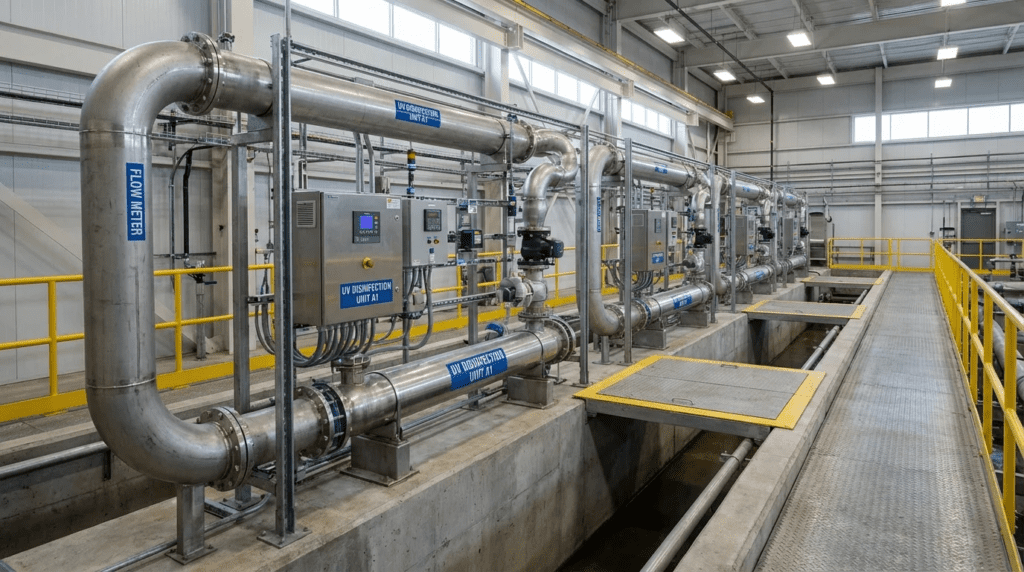
UV Disinfection System Manufacturers for Water and Wastewater: A Selection Guide
Introduction
UV disinfection is now standard practice rather than an alternative technology, but a persistent misconception remains: that UV systems are plug-and-play appliances. They are not. An improperly specified UV system becomes a plant’s largest energy consumer and its most labour-intensive maintenance burden, and the failure usually traces back to design assumptions about water quality that did not survive contact with reality.
The stakes are the same whether retrofitting a chlorine contact basin or designing a cryptosporidium barrier: UV is instantaneous and leaves no residual, so there is no buffer for a momentary lapse in performance. A system delivering insufficient dose is failing at that moment, with nothing downstream to compensate.
Process fundamentals are covered in our guide to UV disinfection in wastewater.
How to Select and Specify
Duty Conditions
- Flow rates: Define minimum daily flow — where heat dissipation becomes an issue — average daily flow as the energy efficiency design point, and peak wet weather flow as the hydraulic limit.
- UV transmittance: The single most critical design parameter. A drop of ten percentage points in UVT can roughly double the lamp count required for the same dose. Request long-term UVT data; grab samples are misleading.
- Suspended solids: In wastewater, solids shield pathogens from UV light. High TSS requires conservative sizing or reactor designs that promote turbulence and exposure.
- Dose basis: Distinguish clearly between end-of-lamp-life dose and fresh lamp dose. Specifications must reference bioassay-validated reduction equivalent dose under NWRI or USEPA UVDGM protocols, not theoretical calculation.
Materials
- Reactor construction: 316L stainless steel is standard for channels and vessels. In saline or high-TDS service, polyethylene or polypropylene channels avoid chloride stress corrosion cracking, which will eventually destroy stainless in those environments.
- Wiper components: Wiper rings and bushings are wear items. Specify materials compatible with the actual wastewater chemistry to prevent swelling or embrittlement.
- Quartz sleeves: Sleeve material affects transmission characteristics. Sleeves that block wavelengths below roughly 240 nm are typically specified in wastewater to avoid converting nitrate to nitrite.
Hydraulics
- Head loss: UV banks add head loss, and the system’s head loss curve must be matched against the plant’s hydraulic profile. Getting this wrong submerges upstream clarifier weirs.
- Velocity profile: Reactor velocity must fall within the validated range. Too slow and solids settle; too fast and short-circuiting delivers insufficient dose to part of the flow.
- Level control: Open channel systems need reliable level control to keep lamps submerged, usually through downstream weirs or motorised gates linked to flow.
Reliability and Redundancy
- Bank redundancy: N+1 is the standard approach — the system meets peak flow with one bank out of service for cleaning or failure.
- Ballast reliability: Electronic ballasts are the most common failure point. Specify a minimum mean time between failures and require active cooling provisions.
- Power quality: UV systems are sensitive to voltage sags. Uninterruptible supply for control panels is worthwhile where grid quality is poor.
Maintainability
- Automatic cleaning: For wastewater this is effectively mandatory. Manual cleaning is an unrealistic expectation for municipal staffing levels, and a specification assuming it will produce a fouled system within a year.
- Lamp replacement access: Evaluate whether lamps can be changed with the bank in place or whether the module must be lifted. Verify crane coverage and overhead clearance before selecting a configuration.
- Safety: UV exposure damages skin and eyes. Decking must be light-tight and interlocks must extinguish lamps immediately when a module is lifted or a hatch opened.
The Manufacturer Landscape
The table below maps established suppliers and their technology approaches. It is not a ranking. Validation data for the specific reactor at your hydraulic conditions matters far more than market position, and any performance claim should be verified against the validation report rather than the brochure.
| Supplier | Technology focus | Typical applications | Engineering considerations |
|---|---|---|---|
| Trojan Technologies | Low-pressure high-output and amalgam open channel systems | Municipal wastewater, reuse, large drinking water | Very large installed base simplifies operator familiarity; extensive validation library for retrofits; largely proprietary components |
| Xylem (Wedeco) | Low-pressure and medium-pressure; emphasis on energy efficiency | Municipal wastewater, UV-based advanced oxidation | Vertical lamp configurations suit deep narrow channels; confirm ballast location and access |
| Xylem (Wallace & Tiernan) | Closed vessel systems following the Evoqua acquisition | Drinking water, recreational water | Strong validation history for protozoan barriers; confirm parts support post-acquisition |
| Veolia Water Technologies (Ozonia) | Medium-pressure and low-pressure systems | Drinking water, industrial, compact plants | Suits footprint-constrained sites needing high intensity; medium-pressure lamps run hot and demand rigorous scale management |
| Calgon Carbon | Medium-pressure and advanced oxidation systems | Potable water, taste and odour control, contaminant destruction | Often specified where very high doses are needed for chemical contaminants; substantial power draw requires electrical room HVAC design |
| Aquafine (Trojan Technologies group) | Low-pressure and amalgam closed vessel | Industrial process water, smaller municipal | High configurability for pipe sizes; skid-mounted solutions common; simpler controls suited to industrial operators |
| Atlantium | Hydro-optic reactors using total internal reflection | Industrial, food and beverage, pharmaceutical | Quartz tube design promotes uniform dose with integrated UVT monitoring; modular approach for larger flows |
| UltraAqua | Polypropylene and polyethylene channel systems | Aquaculture, saline wastewater, corrosive environments | Best fit where high chloride content would pit stainless steel; observe temperature limits of the plastic |
| Enaqua | Non-contact designs where water flows through UV-transparent tubes | Wastewater with high fouling potential | Avoids quartz fouling and wipers entirely; air-cooled lamps and bulkier tube bundles; transmission through tube material differs from quartz |
| Glasco UV | Open architecture systems using non-proprietary components | Small to mid-sized municipal wastewater | Lower consumable costs through generic lamps and ballasts; confirm validation coverage matches your permit requirements |
| Application | Typical technology | Key constraint | Cost profile |
|---|---|---|---|
| Large municipal wastewater or reuse | Low-pressure high-output, open channel | Footprint and head loss | Higher capital, lower operating cost |
| Space-constrained retrofit | Medium pressure, closed vessel or channel | High energy density and room heat load | Lower capital, higher operating cost |
| Small community plant | Low-pressure closed vessel or simple vertical systems | Simplicity; avoid complex proprietary controls | Lower capital, moderate operating cost |
| Corrosive or saline service | Polypropylene or HDPE open channel | Chloride compatibility and temperature limits | Moderate capital, low operating cost |
| Potable water pathogen barrier | Validated medium-pressure or low-pressure systems | Strict validation limits; sensor drift is critical | Higher capital, moderate operating cost |
Field Notes
Commissioning
- Factory acceptance: Focus on control panel logic. Simulate every alarm condition — low UVT, lamp failure, high temperature, wiper fault — before shipment, and verify the PLC code matches the control narrative exactly.
- Site acceptance: Profile the hydraulics. Verify head loss against calculation at peak flow and check for dead zones or uneven velocity distribution using velocity meters.
- Performance verification: Full bioassay testing is expensive. Many engineers accept the manufacturer’s validated dose curve provided installation hydraulics match the validated configuration, including inlet and outlet conditions. That proviso is not a formality — a validated reactor installed with different approach conditions is not a validated installation.
Specification Mistakes
- Optimistic UVT: Designing around average UVT when the plant drops substantially during storm events guarantees permit violations at exactly the wrong moment. Design for realistic worst case.
- Ignoring end of lamp life: Sizing must apply an aging factor to fresh lamp intensity. A system sized on fresh lamp output is undersized before its first year ends.
- Inadequate upstream screening: UV systems are not screens. Hair, plastics and algae snag on lamps and wipers and jam mechanisms. Fine screening upstream is practically mandatory for trouble-free operation.
Operations
- Wiper maintenance: Automatic wipers are not set-and-forget. Wiper rings wear and need periodic replacement. When they fail, sleeves foul, intensity drops, the control system ramps power to compensate, and energy is wasted until someone notices.
- Chemical cleaning: Systems using acid cleaning need handling protocols and regular inspection of tubing and reservoirs. Acid leaking into a cable tray destroys wiring insulation.
- Sensor calibration: The reference sensor is the system’s eye. If it drifts, calculated dose is wrong and nothing else will reveal it. Regular comparison against a calibrated handheld reference is a critical task.
Troubleshooting
Low intensity alarm with new lamps: Fouled sleeves from wiper failure, a fouled sensor window, a genuine low UVT event, or ballast output failure. Clean the sensor first — if intensity jumps, that was the cause. If not, inspect sleeves, then measure UVT independently with a benchtop meter.
Wiper fault or jam: Debris in the mechanism, warped carriage, or motor torque limit reached. Inspect visually and do not force the wiper. Reverse the motor manually where possible and check carriage alignment on the rails.
Design Details
Dose Calculation
Dose (mJ/cm²) = Intensity (mW/cm²) × Time (s)
In a real reactor, time is a residence time distribution and intensity varies through the reactor volume, which is precisely why bioassay validation exists rather than relying on this calculation alone.
Sizing Sequence
- Identify the target pathogen and required log inactivation
- Establish design UVT from historical data, using a conservative percentile rather than the average
- Apply aging and fouling factors appropriate to the lamp type and cleaning mechanism
- Use validated curves to determine banks and lamps required at peak flow and design UVT
Specification Checklist
- Performance: State the validated dose required at defined peak flow and UVT
- Validation standard: Reference the NWRI guidelines or USEPA UVDGM explicitly
- Spare parts: Specify percentages for lamps, ballasts and wiper seals
- Warranty: Specify non-prorated lamp warranty hours — prorated warranties transfer risk back to the owner
- Harmonics: Require variable output ballasts to comply with IEEE 519 at the point of common coupling
Standards
- NWRI guidelines: The reference for wastewater reuse and secondary effluent validation in North America
- USEPA UV Disinfection Guidance Manual: The standard for drinking water applications targeting protozoa
- UL 508A: Industrial control panels
Frequently Asked Questions
What is the difference between low-pressure and medium-pressure UV?
Low-pressure high-output lamps emit essentially at a single germicidal wavelength, convert electricity to UV output efficiently, run cooler and last considerably longer. Medium-pressure lamps emit across a broad spectrum at much higher intensity but with lower electrical efficiency and shorter life, and they run extremely hot. Medium pressure suits constrained footprints and applications requiring destruction of chemical contaminants; low pressure suits most continuous wastewater duty on operating cost grounds.
How should design UVT be selected?
Not from the annual average. Analyse at least twelve months of data and select a conservative percentile, so the system performs during poor water quality events rather than only on good days. Overestimating UVT produces a system that cannot meet permit limits precisely when water quality deteriorates — which is when disinfection matters most.
Why does bioassay validation matter?
Theoretical dose calculations cannot model hydraulic turbulence, shadowing and lamp aging in a real reactor. Bioassay validation tests the physical reactor with a surrogate organism to demonstrate the log reduction actually achieved under defined flow and UVT conditions. It is the empirical proof that the system delivers what is claimed.
What maintenance do wiper systems require?
Automatic wiping reduces labour substantially but is not maintenance-free. Wiper rings need periodic replacement or they scratch sleeves or stop cleaning effectively. Drive mechanisms need lubrication and tension checks. Where chemical cleaning is used, reservoirs need refilling and tubing needs inspection. Neglected wipers lead to rapid fouling and persistent alarms.
What drives UV system cost?
Flow and water quality dominate, and installation — channels, electrical work, structures — frequently approaches or exceeds equipment cost. Over twenty years, lamp replacement and power consumption typically exceed the initial capital outlay, which is why energy efficiency deserves more weight in selection than the purchase price.
What is dose pacing?
A control strategy where the PLC adjusts lamp intensity based on real-time flow and UVT, calculating the power actually needed to achieve target dose rather than running at full output continuously. It reduces energy consumption significantly and extends lamp life.
Conclusion
Key Takeaways
- UVT drives sizing. A modest drop in design UVT can double the required equipment. Measure it properly over time.
- Validation matters. Accept only systems validated to NWRI or UVDGM protocols for your actual hydraulic operating range.
- Hydraulics first. Confirm head loss does not flood upstream weirs or clarifiers.
- Automatic cleaning still needs maintenance. Specify robust wipers suited to the waste stream and budget for consumables.
- Run the lifecycle numbers. Medium-pressure energy cost can dwarf capital savings across twenty years.
Selecting a UV supplier is a matter of matching a validated reactor to the facility’s hydraulic profile, biological targets and operational capability. For municipal work the choice usually falls between low-pressure efficiency for continuous duty and medium-pressure compactness for constrained retrofits, with specialist suppliers addressing specific problems such as corrosive water or high fouling potential.
Define the operating envelope first — minimum realistic UVT and peak flow — then evaluate which manufacturer offers a validated reactor covering that envelope at the lowest lifecycle cost. Specific system configurations are examined further in our review of the Pentair BioShield UV disinfection system.