
Selection Guide: How to Specify Metering Pumps for Municipal Lift Stations
Introduction
Municipal engineers frequently underestimate the complexity of chemical injection at remote lift stations. While the primary sewage pumps receive the bulk of the design attention, the auxiliary chemical feed systems are often the critical defense against the wastewater industry’s most pervasive enemies: hydrogen sulfide ($H_2S$) corrosion, noxious odors, and Fat, Oil, and Grease (FOG) accumulation. A poorly specified metering pump in a remote lift station leads to vapor-locked lines, untreated sewage entering the force main, and accelerated degradation of concrete infrastructure—potentially costing utilities millions in premature rehabilitation costs.
This article serves as a comprehensive Selection Guide: How to Specify Metering Pumps for Municipal Lift Stations. Unlike treatment plant applications where operators are present daily, lift station equipment must operate autonomously in harsh, uncontrolled environments. The chemical feed systems here are typically tasked with dosing Calcium Nitrate, Sodium Hypochlorite, Ferric salts, or proprietary biological additives into the wet well or force main. These applications demand a distinct set of engineering criteria compared to standard process dosing.
The consequences of poor selection include frequent site visits for re-priming, loss of chemical containment, and failure to meet environmental compliance regarding odor control. This guide will help engineers, directors, and operators navigate the specific hydraulic, material, and control challenges inherent to lift station chemical metering, ensuring long-term reliability and accurate dosage control.
How to Select / Specify
Developing a robust specification requires analyzing the intersection of chemical properties, hydraulic constraints, and the unique operating rhythm of a sewage lift station. This section outlines the critical criteria for the Selection Guide: How to Specify Metering Pumps for Municipal Lift Stations.
Duty Conditions & Operating Envelope
The operating envelope for a lift station metering pump is defined by the diurnal flow curve of the wastewater collection system. Unlike constant-process applications, lift station flows can vary largely from peak morning usage to near-zero flow in the middle of the night.
- Turndown Ratio: Because wastewater flow is highly variable, the metering pump must possess a high turndown ratio (typically 100:1 or greater) to accurately dose chemicals during low-flow periods without losing prime. A pump that cannot turn down sufficiently will overdose chemicals at night, wasting operational budget.
- Intermittent vs. Continuous: Engineers must determine if the chemical feed should be continuous (dosing the wet well to prevent septicity) or intermittent (locked to the run-status of the main sewage pumps for force main injection).
- Pressure Transients: If injecting directly into a force main, the metering pump must overcome the line pressure. However, it must also be robust enough to withstand pressure spikes (water hammer) caused by the start/stop cycles of the main sewage pumps, necessitating robust check valves or isolation strategies.
Materials & Compatibility
The chemical selected dictates the material construction of the pump’s “wet end.” Mismatching materials is a leading cause of early failure.
- Sodium Hypochlorite: Requires venting capabilities due to off-gassing. Wetted parts should be PVC, PVDF, or specialized elastomers. Avoid stainless steel in direct contact.
- Calcium Nitrate / Bioxide: generally compatible with standard materials but can crystallize if allowed to stagnate.
- Ferric Chloride: Highly corrosive and abrasive. Requires robust plastic head construction (PVDF/PTFE) and abrasive-resistant check valves.
- FOG/Biological Additives: Often viscous. Tubing or diaphragm materials must be selected to prevent swelling or degradation from organic solvents sometimes present in proprietary blends.
Hydraulics & Process Performance
Lift station applications often involve suction lift scenarios, where the chemical storage (tote or tank) is at grade level, and the pump may be mounted on top of the tank or a nearby skid.
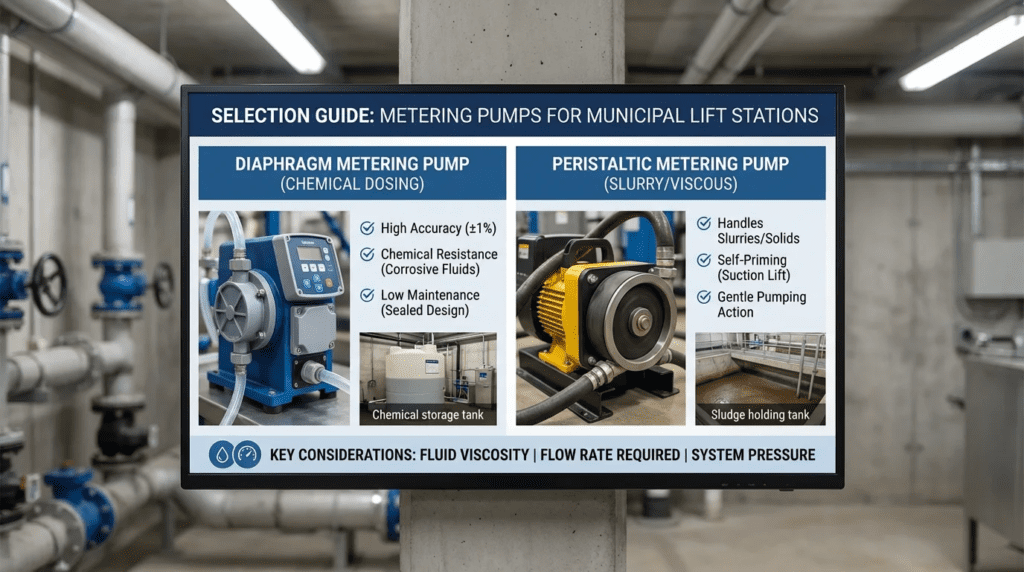
- Suction Lift: If the pump is located above the chemical tank, it must be self-priming. Peristaltic pumps are superior here, capable of pulling 25+ feet of suction lift, whereas diaphragm pumps may struggle if the prime is lost.
- Viscosity Handling: In cold weather, the viscosity of certain chemicals increases. The specification must account for the fluid’s behavior at the lowest expected ambient temperature.
- Off-Gassing Fluids: Fluids like hypochlorite release gas bubbles when pressure drops or temperature rises. In standard diaphragm pumps, this gas can accumulate in the head, causing “vapor lock” where the diaphragm moves but pumps nothing. High-velocity flushing or peristaltic designs are required to mitigate this.
Installation Environment & Constructability
Lift stations are frequently located in residential neighborhoods, roadside easements, or low-lying areas. Space is at a premium.
- Space Constraints: Retrofit projects often require fitting chemical feed systems into existing valve vaults or small control buildings. Skid-mounted systems with a small footprint are preferred.
- Outdoor Ratings: If not housed in a building, the pump and controller must be NEMA 4X (IP66) rated to withstand rain, snow, and direct sun. UV resistance is critical for plastic enclosures.
- Security: Chemical tanks and pumps at unmanned stations are vulnerability points. Enclosures must be lockable and tamper-resistant to prevent vandalism or accidental exposure to the public.
Reliability, Redundancy & Failure Modes
In a plant, an operator walks by daily. At a lift station, a pump may not be inspected for a week. Reliability is the primary driver of lifecycle cost.
- Run-Dry Capability: It is common for chemical totes to run empty before an operator arrives. Pumps that fail immediately upon running dry (e.g., certain mag-drive or cavity pumps) are poor choices. Peristaltic pumps can typically run dry indefinitely without damage.
- Leak Detection: Specifications should require integral leak detection systems that shut down the pump and send a SCADA alarm if a diaphragm ruptures or a tube bursts.
- Redundancy: For critical odor control sites (e.g., near high-value real estate), a duty/standby (N+1) configuration is recommended. Automatic switchover upon fault ensures continuous treatment.
Controls & Automation Interfaces
The metering pump must integrate seamlessly with the lift station’s RTU or PLC.
- Pacing Methods:
- Flow Proportional: 4-20mA signal from the station’s magnetic flow meter.
- Pump Run Status: Digital input triggers dosing only when main pumps are active.
- Timer Based: Simple programmed diurnal curve (less accurate but cheaper).
- SCADA Integration: Critical feedback points for the specification include “Pump Running,” “General Fault,” “Leak Detected,” and “Chemical Low Level.”
Maintainability, Safety & Access
Maintenance at lift stations is often performed by a single operator working out of a truck.
- Tool-Less Maintenance: Preference should be given to pumps that allow tube or diaphragm changes without special tools.
- Chemical Containment: Double-walled containment for tanks and tubing (dual-containment hose) is often required by environmental regulations to prevent spills into the environment.
- Ergonomics: Pumps should be mounted at waist height. If mounted on top of tall tanks, permanent access platforms or ladders must be specified to prevent unsafe climbing.
Lifecycle Cost Drivers
Engineers must evaluate the Total Cost of Ownership (TCO), not just the bid price.
- Consumables: Analyze the cost and frequency of replacement parts. For peristaltic pumps, the tube is the only wear part. For diaphragm pumps, check valves, seals, and diaphragms constitute the kit.
- Chemical Costs: An accurate pump saves money. A pump that overdoses by 10% due to poor turndown control can cost a utility tens of thousands of dollars in wasted chemical annually.
- Service Calls: The highest cost driver is the “truck roll.” Selecting a cheaper pump that requires weekly de-gassing or calibration is significantly more expensive than a robust pump that runs for months untouched.
Comparison Tables
The following tables provide a direct comparison of the technologies and application scenarios relevant to the Selection Guide: How to Specify Metering Pumps for Municipal Lift Stations. Use Table 1 to select the pump technology and Table 2 to determine the application fit.
| Technology | Primary Features | Best-Fit Applications | Limitations | Maintenance Profile |
|---|---|---|---|---|
| Peristaltic (Hose/Tube) | – Self-priming (high suction lift) – Can run dry – No check valves to clog – Handles off-gassing fluids perfectly |
– Sodium Hypochlorite – Viscous polymers – High-suction lift scenarios – Remote/unmanned sites |
– Limited discharge pressure (typically <125 psi) – Periodic tube replacement required |
Low/Predictable: Change tube/hose every 3-12 months. No other wetted parts to service. |
| Solenoid Diaphragm | – Low initial cost – High precision at fixed conditions – Compact footprint |
– Clean, simple chemicals – Indoor/climate-controlled stations – Flooded suction applications |
– Prone to vapor lock (off-gassing) – Check valves foul with dirty fluids – Poor suction lift capabilities |
Moderate: Requires regular cleaning of check valves. Diaphragm replacement 12-24 months. |
| Motor-Driven Diaphragm | – Higher pressure capabilities – Robust mechanical drive – Higher flow rates |
– Injection into high-pressure force mains – Large volume dosing (Master Lift Stations) |
– Higher CAPEX – Susceptible to vapor lock without auto-degassing heads – Check valve maintenance |
Moderate: Oil changes for gearbox, diaphragm kits, check valve cleaning. |
| Progressive Cavity | – Non-pulsating flow – Handles high solids/sludge |
– Polymer activation (rare in lift stations) – Extremely viscous fluids |
– Cannot run dry (instant stator failure) – Expensive repair parts – Large footprint |
High: Stator and rotor wear. Seal maintenance. strictly requires run-dry protection. |
| Application Scenario | Chemical Agent | Key Constraint | Recommended Pump Type | Critical Spec Feature |
|---|---|---|---|---|
| Odor Control (H2S) | Calcium Nitrate / Bioxide | Variable flow pacing required | Peristaltic or Motor Diaphragm | 4-20mA input for flow pacing; High turndown ratio. |
| Disinfection / Septicity | Sodium Hypochlorite (Bleach) | Gas binding (Vapor lock) | Peristaltic | Must handle gas bubbles without loss of prime. |
| FOG Control | Bacteria / Enzymes | Low flow rates; Viscous fluid | Peristaltic | Timer-based batch dosing; wide tube ID for viscosity. |
| Force Main Injection | Ferric Chloride / Iron Salts | High backpressure; Corrosive | Motor Diaphragm (Hydraulic or Mechanical) | PVDF/Teflon wetted parts; Injection quill with check valve. |
Engineer & Operator Field Notes
Beyond the catalog specifications, real-world success relies on proper implementation. The following notes are derived from field experience in commissioning and maintaining lift station chemical feeds.
Commissioning & Acceptance Testing
Commissioning a metering pump at a lift station requires verifying performance across the full flow range, not just a “bump test.”
- Draw-Down Calibration: Every installation must include a calibration column (draw-down cylinder) on the suction side. The SAT (Site Acceptance Test) must involve running the pump at 50% and 100% speed and measuring the physical volume drawn from the column over 60 seconds. Relying on the digital display alone is insufficient.
- Backpressure Verification: Simulate the worst-case force main pressure during testing to ensure the pump can inject against the main sewage pumps when they are running.
- Restoration of Auto: A common failure point is the “Auto-Reset.” Simulate a power outage. When power is restored, the pump should automatically return to its previous “Auto” state without requiring an operator to physically press “Start.”
Common Specification Mistakes
Engineers often copy-paste specifications from treatment plant projects to lift stations, leading to errors.
- Oversizing: Specifying a pump where the normal operating point is the bottom 5% of its range results in “slug dosing” rather than smooth injection. Metering pumps are most accurate between 30% and 90% of their rated capacity.
- Ignoring Suction Piping: Using soft, clear vinyl tubing on the suction side of a high-lift application can lead to the tubing collapsing under vacuum. Always specify rigid piping or reinforced braided hose for suction lines.
- Missing Injection Quills: Injecting chemical directly into a pipe wall causes corrosion at the tap. A retractable injection quill allows the chemical to be dispersed into the center of the flow stream, protecting the pipe and ensuring better mixing.
O&M Burden & Strategy
Operational strategies must align with the “remote” nature of the site.
- Tube/Diaphragm Life: For peristaltic pumps, the hose is a sacrificial part. The maintenance schedule should be based on hours run. If a pump runs 24/7, the tube may need changing quarterly. If it runs intermittently, it may last a year.
- Check Valve Hygiene: For diaphragm pumps, ball checks are the Achilles’ heel. Grit, crystallization, or trash can unseat the ball. Operators should keep spare check valve assemblies (cartridges) in the truck for quick swaps rather than trying to clean them on-site.
- Predictive Maintenance: Modern smart pumps can output “Tube Failure” or “Diaphragm Rupture” alarms. These should be mapped to the central SCADA system as high-priority alarms to prevent environmental spills.
Design Details / Calculations
Proper sizing is the foundation of the Selection Guide: How to Specify Metering Pumps for Municipal Lift Stations. The following methodology ensures the pump meets process requirements.
Sizing Logic & Methodology
To size the pump, you must calculate the required chemical feed rate in Gallons Per Hour (GPH).
Step 1: Determine the Chemical Mass Required
$$Mass (lbs/day) = Flow (MGD) times Dosage (mg/L) times 8.34$$
Note: Flow should be the Peak Hourly Flow for sizing the max capacity, and Average Daily Flow for operational estimates.
Step 2: Convert Mass to Gallons of Solution
Most chemicals are not 100% active. You must account for solution strength and specific gravity.
$$Volume (GPD) = frac{Mass (lbs/day)}{Specific Gravity times 8.34 times (% Solution/100)}$$
Step 3: Convert to Pump Output (GPH)
$$Rate (GPH) = frac{Volume (GPD)}{24 hours}$$
Design Example:
A lift station has a peak flow of 2.0 MGD. We need to dose Bioxide (Calcium Nitrate) at 3.5 gallons per 10,000 gallons of flow (a common volume-based metric for Bioxide).
- Peak Flow = 2,000,000 GPD
- Dosage Rate = 3.5 gal / 10,000 gal = 0.00035 ratio
- Required Pump Capacity = 2,000,000 * 0.00035 = 700 GPD
- 700 GPD / 24 hr = 29.17 GPH
Selection: Select a pump capable of ~40-50 GPH to ensure the operating point (29 GPH) is in the middle of the curve, allowing room for future flow increases.
Specification Checklist
When writing the Division 43 or 46 specification, ensure these items are explicitly called out:
- Turndown Ratio: Minimum 100:1 (for digital stepper motor driven pumps) or 1000:1 for high-end units.
- Wetted Materials: Explicitly state compatibility (e.g., “All wetted parts shall be compatible with 12.5% Sodium Hypochlorite”).
- Motor Enclosure: TEFC or TENV, with NEMA 4X controller housing.
- Control Inputs: 4-20mA analog input, Remote Start/Stop dry contact.
- Safety Accessories: Backpressure valve, pressure relief valve, calibration column, and pulsation dampener (if diaphragm type).
- Leak Detection: Integral float or conductivity sensor in the pump head or housing.
Standards & Compliance
- NSF/ANSI 61: If the lift station discharges upstream of a water reuse facility or if the chemical enters a potable source (rare for lift stations, but applicable to source water pumping), wetted parts must be NSF 61 certified.
- OSHA 1910: Safety guards on all rotating couplings. Chemical labeling requirements.
- NEC (NFPA 70): Electrical wiring methods, particularly if the lift station wet well is classified as a hazardous location (Class 1 Div 1 or 2). Note: Chemical pumps are usually in a safe zone, but if located inside the wet well vault, explosion-proof motors may be required.
Frequently Asked Questions
Why are peristaltic pumps often preferred over diaphragm pumps for lift stations?
Peristaltic (hose) pumps are often preferred in the Selection Guide: How to Specify Metering Pumps for Municipal Lift Stations because they are self-priming, can run dry without damage, and do not have check valves. Lift station applications often involve off-gassing chemicals (like hypochlorite) and suction lift conditions that cause diaphragm pumps to vapor lock or lose prime. The lower maintenance requirement of simply changing a hose is ideal for remote, unmanned sites.
How do I determine the correct backpressure rating for the metering pump?
The metering pump must be rated for a pressure higher than the maximum possible pressure in the receiving pipe. For force main injection, this is the force main dynamic head plus friction losses, plus a safety margin (typically 10-15%). However, you must also account for pressure spikes (water hammer) caused by the main sewage pumps starting and stopping. Installing an injection quill with an integral check valve helps isolate the metering pump from these spikes.
What is the difference between “Manual Pacing” and “Flow Pacing”?
Manual pacing involves setting the pump to run at a fixed speed (e.g., 50%) whenever it is on. This is simple but inefficient for lift stations with variable flow. Flow pacing (or flow proportional dosing) utilizes a 4-20mA signal from the lift station’s flow meter to automatically adjust the chemical pump speed to match the incoming wastewater flow. This maintains a constant chemical dosage (ppm) regardless of flow volume, preventing waste and ensuring compliance.
How often should metering pump tubing be replaced?
For peristaltic pumps in continuous lift station service, tubing typically requires replacement every 3 to 6 months, or up to 12 months for intermittent duty. Factors affecting tube life include the chemical being pumped, the system pressure, the pump speed (rpm), and ambient temperature. Most manufacturers provide life-expectancy charts based on hours of operation. It is best practice to replace tubes proactively during scheduled preventive maintenance rather than waiting for failure.
Can I install the chemical pump inside the wet well?
Generally, no. Installing chemical metering pumps inside the wet well is discouraged due to corrosion, difficult access for maintenance, and electrical classification issues (Class 1 Division 1 environments). Best practice is to locate the chemical pump and tank in a separate, ventilated enclosure or building at grade level, and run the discharge tubing down into the wet well or force main valve vault.
Conclusion
Key Takeaways for Specifying Lift Station Metering Pumps
- Prioritize Reliability: Choose pumps that can handle suction lift and run-dry conditions (e.g., peristaltic) for remote, unmanned sites.
- Check Chemical Compatibility: Ensure wetted materials (elastomers, heads, fittings) match the specific chemical (Hypo, Bioxide, Ferric) to prevent catastrophic leaks.
- Automate Dosing: Use flow pacing (4-20mA) or pump-run-status interlocks to match chemical feed to the highly variable diurnal flow curve.
- Manage Off-Gassing: For Sodium Hypochlorite, avoid standard diaphragm pumps unless equipped with auto-degassing heads; peristaltic is generally safer.
- Include Accessories: Never specify a pump without a calibration column, backpressure valve, and proper injection quill.
- Total Cost of Ownership: Factor in the labor cost of “truck rolls” to remote sites—a slightly more expensive, reliable pump pays for itself by preventing one emergency call-out.
Specifying the correct equipment using this Selection Guide: How to Specify Metering Pumps for Municipal Lift Stations is critical for the longevity of wastewater infrastructure. While the metering pump is a small fraction of the station’s total cost, its failure leads to septic conditions, odor complaints, and rapid corrosion of concrete assets.
Engineers must move beyond simple catalog flow rates and consider the holistic environment of the lift station: the intermittent flows, the remote location, the harsh weather, and the specific chemical properties. By selecting robust technologies like peristaltic pumps for difficult fluids, integrating smart control strategies, and designing for maintainability, utilities can ensure their chemical feed systems protect their infrastructure effectively for decades.