
Top 10 Gates Manufacturers for Water and Wastewater
Introduction
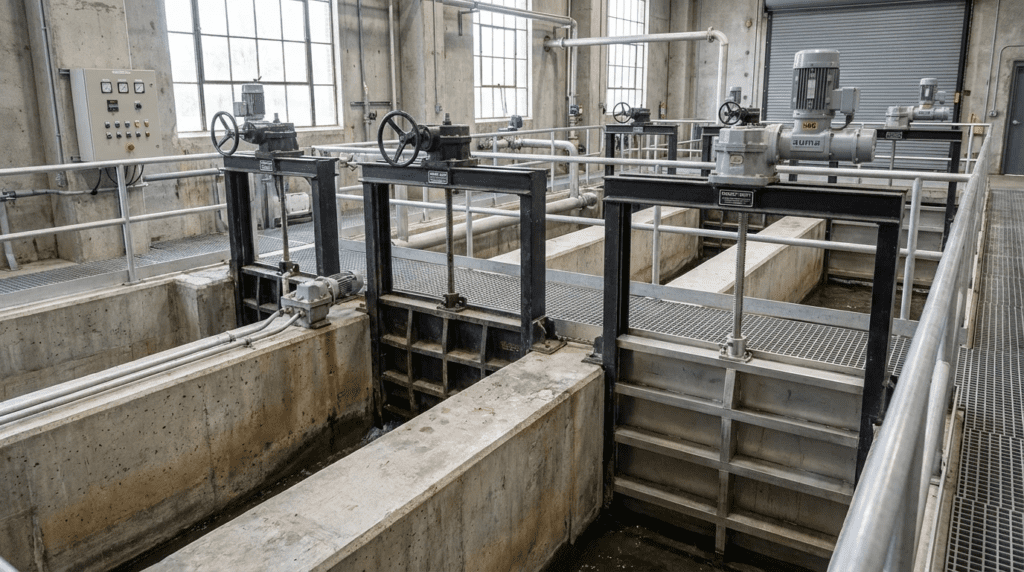
In the hierarchy of treatment plant equipment, flow control gates are often treated as static commodities rather than dynamic machinery. This is a critical error. While a pump failure may stop flow, a gate failure can result in catastrophic flooding, bypass events, regulatory fines, and process upsets that compromise the entire plant. A surprising industry statistic suggests that while gates represent less than 5% of a facility’s CAPEX, they are responsible for a disproportionate amount of corrective maintenance hours due to seal failures, stem buckling, and actuation binding, particularly in aging infrastructure.
Engineers and utility directors frequently face the challenge of distinguishing between fabricated stainless steel, cast iron, and composite solutions across a saturated market. The Top 10 Gates Manufacturers for Water and Wastewater are often specified based on legacy relationships rather than technical application fit, leading to sub-optimal performance—such as specifying a heavy cast iron gate where a lighter, tighter-sealing fabricated gate would reduce structural loads and leakage.
This technology is fundamental to headworks isolation, grit chamber control, aeration basin distribution, filtration isolation, and effluent management. It sits alongside the broader survey of top OEMs for water control gates, which covers the supplier landscape across the full gate category; this article narrows to specification logic and direct manufacturer-versus-manufacturer evaluation. It operates in environments ranging from chemically aggressive anaerobic digesters to abrasive grit slurries. Proper specification goes beyond dimensions; it requires a deep understanding of seating versus unseating heads, leakage tolerances (AWWA C560 vs. C561), and actuation mechanics. This article provides a strictly technical analysis of the Top 10 Gates Manufacturers for Water and Wastewater, guiding engineers through selection logic, lifecycle analysis, and specification best practices to ensure hydraulic integrity.
How to Select and Specify Water Control Gates
Selecting the correct gate requires a systematic evaluation of process variables. Engineers must look past the “equivalent to” clause and define specific performance parameters. The following criteria should form the backbone of any technical specification or bid evaluation.
Duty Conditions & Operating Envelope
The operating envelope dictates the mechanical design of the gate frame and disc. Engineers must explicitly define:
- Seating vs. Unseating Head: This is the most critical hydraulic parameter. Seating head pushes the gate against the seal/frame (improving the seal), while unseating head pushes the gate away from the frame. Gates rated for 20 ft of seating head may only be rated for 10 ft of unseating head. Specifying incorrect orientation is a leading cause of leakage and structural failure.
- Modulation vs. Isolation: Is the gate intended for Open/Close service (isolation) or flow throttling (modulation)? Modulating gates require robust stem nut designs and actuators rated for high duty cycles (S4/S5) to handle frequent movement without overheating or stripping threads.
- Flow Profile: High velocities (>5 fps) or turbulent flows can induce vibration in the gate leaf. Under these conditions, the deflection limits of the gate must be tighter than standard AWWA allowances (typically L/360) to prevent harmonic resonance.
Materials & Compatibility
The shift from Cast Iron (CI) to Stainless Steel (SS) dominates modern specifications, but material selection involves nuance:
- Cast Iron (ASTM A126 Class B): Historically the standard for heavy-duty sluice gates (AWWA C560). It offers excellent vibration dampening but requires painting/coating and is susceptible to graphitic corrosion in wastewater. It is heavy, requiring substantial concrete support.
- Stainless Steel (304L/316L): The standard for fabricated gates (AWWA C561). 316L is mandatory for wastewater headworks due to H2S presence. It offers a higher strength-to-weight ratio but requires careful engineering to prevent warping during welding and deflection under load.
- Aluminum: Suitable for fresh water or less corrosive environments where weight is a primary concern. Rarely recommended for raw wastewater due to galvanic corrosion issues when paired with dissimilar metals (guides, stems).
- Non-Metallic/Composite: increasingly used for smaller gates or highly corrosive industrial effluents. They offer zero corrosion but have lower modulus of elasticity and lower impact resistance.
Hydraulics & Process Performance
Leakage rates are the primary performance metric. Do not simply state “zero leakage”—it is often technically impossible or prohibitively expensive to achieve absolute zero.
- AWWA Leakage Standards:
- C560 (Cast Iron): 0.1 gpm per foot of seating perimeter.
- C561 (Fabricated SS): 0.1 gpm per foot of seating perimeter (standard), though many manufacturers can achieve 0.05 gpm or less with modern seal designs.
- Head Loss: While minor for wide-open gates, submerged orifice gates used for flow splitting must have head loss curves analyzed to ensure hydraulic profiles through the plant are maintained.
Installation Environment & Constructability
The interface between the gate and the civil structure is where most installation errors occur.
- Mounting Configuration:
- Wall Thimble: The most robust method. A cast or fabricated ring embedded in concrete. Ensures a flat, true surface for the gate.
- Anchor Bolt (Surface Mount): Requires a perfectly plumb and flat concrete wall. Use of non-shrink grout is mandatory to fill voids between the frame and wall to prevent leakage behind the frame.
- Embedded Frame: Frame guides are cast directly into the channel walls. Common in open channel construction but makes replacement difficult.
- Stem Guides: Long stems require guides to prevent buckling (Euler’s column buckling theory). The spacing is a function of the stem diameter (L/r ratio) and material stiffness.
Reliability, Redundancy & Failure Modes
Understanding failure modes helps in designing redundancy:
- Stem Thread Wear: The sacrificial component is usually the bronze lift nut. If the stem is stainless steel, the bronze nut wears first. Systems should allow nut replacement without removing the entire gate.
- Seal Degradation: Neoprene and EPDM seals degrade over time (10-15 years). Designs that allow seal replacement with the gate in place (or easily removed) reduce lifecycle downtime.
- Actuator Failure: Manual overrides (handwheels) are mandatory on electric actuators. For critical flood control, redundant power sources or portable drill-drive adapters are recommended.
Controls & Automation Interfaces
Integration with SCADA is standard for modern plants. Specifications must define:
- Position Feedback: 4-20mA signals or bus communication (Profibus/Modbus/EtherNet/IP) to report exact gate percentage open.
- Torque Protection: The actuator must sense over-torque (blockage) and stop to prevent bending the stem or damaging the gate structure.
- Partial Stroke Testing: Automated routines to move the gate slightly to ensure it hasn’t seized during long periods of inactivity.
Maintainability, Safety & Access
Operator safety is paramount. Ergonomics play a role in manual gates; maximum rim pull on a handwheel should not exceed 40 lbs. If higher force is required, a gearbox or portable actuator tool is necessary. Maintenance access requires clear space above the yoke for stem removal and safe access to lubrication points (Zerk fittings) on the lift nut.
Lifecycle Cost Drivers
The purchase price is often 30% of the lifecycle cost. Drivers include:
- Installation Labor: Thimble gates are harder to install initially but easier to seal.
- Leakage Costs: A leaking gate in a recirculation line wastes pumping energy continuously.
- Corrosion Maintenance: Coated carbon steel requires recoating; 316L SS is virtually maintenance-free regarding finish.
Comparison of Top 10 Gates Manufacturers for Water and Wastewater
The following tables provide an objective engineering comparison of the leading manufacturers often seen in North American and European specifications. This is not a ranking of “best to worst” but an analysis of application fit, historical strengths, and technology focus. Understanding these distinctions helps engineers match the vendor to the project requirements.
Table 1: Top 10 Gates Manufacturers Analysis
| Manufacturer | Primary Technology Focus | Key Strengths (Engineering) | Typical Applications | Limitations / Considerations |
|---|---|---|---|---|
| Rodney Hunt | Cast Iron Sluice & Fabricated SS | Historical benchmark for cast iron; massive installed base; robust heavy-duty designs. | Large pumping stations, flood control, deep tunnels. | Cast iron lead times can be long; heavy weight requires substantial civil support. |
| Fontaine-Aquanox | Fabricated Stainless Steel | Pioneered the SS slide gate market; patented seal designs offering high leakage performance. | Wastewater headworks, distribution channels, desalination. | Specializes in SS; less focus on heavy cast iron legacy replacements. |
| Whipps, Inc. | Fabricated Stainless Steel | High-quality fabrication; often exceed AWWA leakage standards; robust custom engineering. | Treatment plants, level control, aluminium options. | Strictly fabricated gates (no cast iron foundry products). |
| Waterman | Diverse (CI, SS, Alum, Composite) | Broadest portfolio ranging from agricultural simple gates to complex AWWA C560/C561 gates. | Rural water, irrigation districts, municipal WWTPs. | Wide range requires careful spec to ensure “Heavy Duty” line is selected for critical apps. |
| Golden Harvest | Aluminum & Stainless Steel | Strong niche in aluminum gates; flexible custom fabrication; user-friendly designs. | Water treatment, clean water channels, lighter duty wastewater. | Aluminum not suitable for high pH or abrasive grit applications. |
| Hydro Gate | Heavy Duty Cast Iron & Fabricated | Robust designs meeting strict Army Corps of Engineers specs; roller gates capabilities. | Dam safety, flood control, large intake structures. | Over-engineered for simple small-channel isolation. |
| VAG Group | Global Flow Control (Valves & Gates) | Massive global R&D; integrates gates with complex valve solutions; German engineering roots. | Large infrastructure projects requiring single-source valve/gate packages. | Global supply chain can be complex depending on project location. |
| Steel-Fab, Inc. | Large Engineered Gates | Custom crest gates, roller gates, bulkhead gates; massive structural steel capability. | Hydroelectric dams, major flood control, reservoir management. | Not typically competitive for standard small plant slide gates. |
| Muhr | Screening & Isolation | High-end German engineering; typically paired with trash rake systems; precise sealing. | Intake screens, headworks, precise level control. | Premium positioning; parts availability requires planning in some regions. |
| Ash (Technos) / Orbinox | Industrial / Knife Gates & Penstocks | Specialized in high-pressure or slurry applications; often cross-over from industrial/mining. | Industrial wastewater, sludge lines, high solids content. | Focus is often on valves/knife gates rather than channel sluice gates. |
Table 2: Application Fit Matrix
This matrix assists engineers in selecting the correct gate type before selecting the manufacturer. Different manufacturers within the “Top 10” may excel at specific types.
| Gate Type | Primary Application | Head Capacity | Sealing Efficiency | Maintenance Profile |
|---|---|---|---|---|
| Cast Iron Sluice (C560) | Deep wet wells, pump suctions, flood isolation. | High (100ft+) | Good (metal-to-metal or resilient) | Low frequency, but heavy intervention (sandblasting/coating). |
| Fabricated Slide (C561) | Channels, tanks, headworks, distribution. | Medium (20-40ft typical) | Excellent (UHMWPE/Resilient) | Low; seal replacement is easier than CI. |
| Weir Gate (Downward Opening) | Level control, scum skimming, decanting. | Low (Channel depth) | Moderate (3-sided seal) | Moderate; seal wear is higher due to modulation. |
| Flap Gate | Backflow prevention, outfalls. | Medium (Back pressure) | Moderate to Low | Very Low; passive operation. Hinges require inspection. |
| Roller Gate | Very large openings, high head (Dams/Intakes). | Very High | Good | High; requires bearing and roller maintenance. |
Head-to-Head Manufacturer Comparisons
Table 1 establishes where each supplier concentrates its engineering effort, but most procurement decisions narrow to a direct choice between two bidders that both clear the technical threshold. The comparisons below address the pairings that recur most often in North American gate specifications, plus the automation vendors that increasingly determine whether a gate integrates cleanly with plant controls.
Cast Iron Heritage Versus Aluminum Fabrication
The first recurring pairing sets a heavy-duty cast iron and fabricated specialist against an aluminum-focused fabricator, which is effectively a decision about how much structure the application actually needs. The comparison of Hydro Gate vs Golden Harvest for gates works through this trade-off in detail, covering where the heavier construction earns its weight penalty and where a lighter fabricated gate delivers equivalent service at lower installed cost.
The screening logic is reasonably clean. Applications with high unseating head, significant debris impact, dam safety or Corps of Engineers involvement, or deep submergence favour the heavy-duty approach, where structural stiffness and vibration dampening matter more than installed weight. Clean water channels, moderate head, and structures where crane access is constrained favour the lighter fabricated route. The decision inverts, however, if the water chemistry is aggressive: as noted in the materials discussion above, aluminum is vulnerable to pitting at pH extremes and to galvanic attack when paired with stainless stems, which removes it from consideration in most raw wastewater service regardless of the structural argument.
Cast Iron Heritage Versus Stainless Fabrication
The second pairing sets the same heavy-duty supplier against a stainless-only fabricator, and the question shifts from weight to corrosion strategy and sealing performance. The evaluation of Hydro Gate vs Whipps-C for gates examines this comparison, including the practical differences in lead time, leakage performance, and how each approach ages in hydrogen sulfide service.
Two factors usually decide it. Lead time is the first: foundry products carry substantially longer schedules than fabricated plate work, and on a project with a fixed commissioning date that constraint alone can settle the matter. Corrosion behaviour is the second: cast iron in wastewater is subject to graphitic corrosion and requires a coating system that will itself need renewal, while 316L stainless is effectively maintenance-free with respect to finish. Against that, cast iron retains genuine advantages in very high head service and in vibration-prone installations where the additional mass damps harmonic response that a lighter fabricated leaf would transmit.
Aluminum Versus Stainless Fabrication
The third pairing removes cast iron from the picture entirely and compares two fabrication approaches against each other. The comparison of Golden Harvest vs Whipps-C for gates covers this decision, which turns almost entirely on service environment rather than on structural capability.
Where the water is clean and the pH is near neutral, aluminum offers a genuine weight and cost advantage with no meaningful performance penalty, and it is frequently the better answer for irrigation channels, clean water distribution, and covers. Where hydrogen sulfide, chlorides, abrasive grit, or pH excursions are present, 316L stainless is the defensible specification and aluminum should not be considered on cost grounds alone. The awkward middle ground is secondary effluent and other nominally benign wastewater streams, where aluminum will often perform acceptably but carries a risk that only materialises years after the warranty expires. In that band, the conservative specification is usually correct.
Gate Automation and Monitoring Vendors
A modern gate is a controlled asset, and the actuator, position feedback, and instrumentation package frequently comes from a different supplier than the gate itself. The comparison of Badger Meter vs Emerson gates equipment addresses this layer, covering the instrumentation and automation vendors whose products sit around the gate and determine how well it integrates with plant control.
The specification points that matter here are protocol compatibility with the existing plant platform, the resolution and reliability of position feedback, and whether torque protection is genuinely integrated or bolted on. As noted in the controls discussion above, an actuator that cannot sense over-torque will buckle a stem rather than stop, and no gate manufacturer can design around that. Where flow measurement is coupled to gate position for flow splitting or level control, the accuracy of the measurement chain becomes part of the gate’s effective performance, which is why the instrumentation vendor belongs in the evaluation rather than in a separate divisional specification.
Engineer & Operator Field Notes
Real-world performance often diverges from the catalog data. The following insights are gathered from commissioning, operation, and forensic analysis of failed gate installations.
Commissioning & Acceptance Testing
Acceptance testing is the only leverage an owner has to ensure the gate meets specifications.
Factory Acceptance Tests (FAT): For large or custom gates, a shop leakage test is recommended. However, shop conditions (perfectly flat test stands) do not mimic site concrete.
Site Acceptance Tests (SAT): The standard “dry test” involves using feeler gauges to check seal contact clearances (typically < 0.004 inches). The “light test” involves shining a high-intensity light on one side of the gate; if light bleeds through the seal, water will too.
Operational Test: Run the gate through full travel 3-5 times. Monitor amperage on electric actuators to detect binding. A spike in amperage at a specific point usually indicates stem misalignment or guide rail constriction.
Common Specification Mistakes
Over-specification of Materials: Specifying Duplex 2205 Stainless Steel for standard domestic wastewater is typically unnecessary and drives up cost and lead time. 316L is sufficient for 95% of municipal applications. Duplex is reserved for high-chloride (desalination) or high-temperature industrial applications.
Ambiguous Leakage Requirements: Using phrases like “bubble tight” for large sluice gates sets unrealistic expectations. Stick to AWWA quantitative limits. If “near-zero” leakage is required for process reasons, specify a “shop hydrostatic test” and require a certificate of compliance.
O&M Burden & Strategy
Operators frequently neglect gate stems until they seize.
Lubrication: Stems should be cleaned and greased semi-annually. For submerged stems, environmentally safe grease is required.
Exercising: Gates that sit in one position (open or closed) for years will accumulate scale and debris in the guides. An automated “exercise routine” in SCADA that moves the gate 10% and back once a month can prevent seizure.
Spare Parts: Critical spares include the stem nut (bronze), seal kits (J-seals or P-seals), and actuator control boards. Do not stock stems unless they are prone to impact damage; they are custom machined and difficult to store without warping.
Troubleshooting Guide
- Symptom: Gate chatters or vibrates during throttling.
Root Cause: Gate is operating in a critical velocity zone or the V-notch/opening is creating cavitation.
Fix: Check if the gate is designed for modulation. Verify guide rail clearances are within tolerance (tighten if necessary). - Symptom: Actuator trips on torque overload when opening.
Root Cause: “Breakout torque” is higher than running torque due to sludge buildup or “stiction” of seals.
Fix: Clean guides. If persistent, check if unseating head exceeds design. Do not simply increase torque limit switches—this will buckle the stem.
Design Details and Calculations
Sizing Logic & Methodology
Sizing a gate involves more than matching the pipe or channel width.
1. Hydraulic Sizing: Calculate the area required to maintain acceptable head loss and velocity.
Velocity Rule of Thumb: Keep velocity through the gate < 5 fps to minimize head loss and wear, unless designed for flushing.
2. Actuator Force Calculation:
The force required to operate a slide gate is a function of friction and hydrostatic load.
Formula: F = (P × A × f) + W + S
Where:F = Total force to lift (lbs)P = Hydrostatic pressure (psi) at the center of the gateA = Area of the gate opening (sq. in.)f = Coefficient of friction (0.35 for bronze/SS, 0.2 for UHMWPE/SS)W = Weight of the gate slide/stem (lbs)S = Seal friction / breakaway force (lbs)
Specification Checklist
Ensure your specification document includes:
- Applicable Standard: Explicitly state AWWA C561 (Fab SS) or C560 (Cast Iron).
- Leakage Class: Define the allowable leakage rate (e.g., 0.05 gpm/ft perimeter).
- Stem Factor: Define the “slenderness ratio” (L/r) to preventing buckling (typically < 200).
- Pedestal Height: Specify the handwheel height for operator ergonomics (waist height, ~36-42 inches from grating).
- Anchor Hardware: Specify 316 SS anchors. Chemical adhesive anchors are preferred over mechanical expansion anchors for dynamic loads.
Standards & Compliance
AWWA C561 (Fabricated Stainless Steel Slide Gates): The dominant standard for modern plants. Covers design, materials, and testing for SS gates.
AWWA C560 (Cast Iron Slide Gates): The legacy standard for heavy-duty cast iron.
AWWA C562 (Fabricated Aluminum Slide Gates): Specific to aluminum construction.
AWWA C563 (Composite Slide Gates): For non-metallic gates.
NSF/ANSI 61: Required if the gate is in contact with potable water.
Frequently Asked Questions
What is the difference between a sluice gate and a slide gate?
Historically, “sluice gate” referred to heavy cast iron gates (AWWA C560) with bronze seating faces, while “slide gate” referred to lighter fabricated gates (AWWA C561). Today, the terms are often used interchangeably, but strictly speaking, sluice gates are generally cast metal designed for higher heads, while slide gates are fabricated from plate (steel, stainless, aluminum) for low to moderate heads.
When should I choose Stainless Steel over Cast Iron?
Stainless steel (316L) is generally preferred for wastewater applications due to superior corrosion resistance to hydrogen sulfide (H2S) and lighter weight, which simplifies installation. Cast iron is preferred for extremely high-head applications (deep tunnels) or where maximum vibration dampening and stiffness are required. Cast iron has a significantly longer lead time due to the casting process.
How do I calculate the operating head for a gate?
Operating head is measured from the centerline of the gate opening to the maximum water surface elevation. Engineers must distinguish between “static head” (water pressure when closed) and “differential head” (pressure difference across the gate when opening). Actuators must be sized for the maximum differential head, which generates the highest friction load.
What is the typical lifespan of a stainless steel slide gate?
A correctly specified and maintained 316L stainless steel gate can last 25-40 years. The UHMWPE seals typically require replacement every 10-15 years depending on abrasion and usage frequency. The bronze lift nut is a wear item and may need replacement every 10-20 years depending on the number of duty cycles.
Why is my gate vibrating during operation?
Vibration usually occurs when a gate is used for throttling (modulation) in a position where the flow creates harmonic resonance or cavitation. This is common if the gate is only open 10-20%. To fix this, ensure the gate guides have minimal clearance (tight tolerances), or change the control strategy to avoid holding the gate in the critical harmonic range.
Can I use an aluminum gate in wastewater?
It is generally not recommended for raw wastewater or submerged service in treatment plants. Aluminum is susceptible to pitting in high/low pH environments and galvanic corrosion when in contact with stainless steel stems or concrete reinforcing. Aluminum is best suited for fresh water channels or odor control covers, not submerged isolation in sewage.
Should the gate and its actuator come from the same manufacturer?
Not necessarily, but the interface must be specified by one party. Gate manufacturers routinely supply actuators from third-party vendors, which is fine provided the specification fixes the mounting arrangement, the torque and thrust rating relative to calculated operating force, the failure position, and the control protocol. Problems arise when the gate is specified in one division of the contract documents and the actuator in another, leaving no party accountable for the combined result. Where responsibility is split, require a single submittal covering the assembled gate and operator together.
How much does installation quality affect gate performance?
More than the equipment selection in many cases. A gate frame that is out of plumb, distorted by anchor bolt tightening after grouting, or mounted to an uneven wall will bind and leak regardless of how well it was manufactured. Forensic analysis of leaking gates frequently traces the fault to the civil interface rather than the gate itself, which is why plumbness verification before grouting and the use of non-shrink grout to fill voids behind the frame belong in the specification as inspection hold points rather than as contractor best practice.
Conclusion
Key Takeaways for Engineers
- Verify Head Orientation: Never confuse seating vs. unseating head ratings. This is the #1 cause of structural gate failure.
- Leakage Standards Matter: Cite AWWA C561 or C560 explicitly. Do not accept generic “zero leakage” marketing claims without a testing protocol.
- Lifecycle vs. First Cost: Fabricated stainless steel gates often have a higher initial material cost than coated carbon steel but eliminate the need for re-coating and offer superior sealing over time.
- Actuation Safety Factors: Size actuators with a 1.5x – 2.0x safety factor to account for aging seals and debris friction.
- Installation is Critical: A gate is only as good as the wall it is bolted to. Ensure plumb walls and proper grouting procedures are followed.
Selecting the right equipment from the Top 10 Gates Manufacturers for Water and Wastewater requires a transition from passive specification to active engineering. The market offers a wide range of solutions, from the heavy-duty legacy of Rodney Hunt’s cast iron to the precision sealing of Fontaine-Aquanox’s stainless steel. For engineers, the goal is to align the hydraulic constraints (head, flow, pressure direction) and environmental constraints (corrosion, accessibility) with the specific strengths of these manufacturers.
By focusing on the details—material grades, seal configurations, stem column strength, and rigorous acceptance testing—engineers can ensure that these critical flow control assets provide decades of reliable service. When in doubt, require detailed submittals including leakage calculations and finite element analysis (FEA) for large gates to verify structural integrity before fabrication begins.