
Top 10 DAF Systems Manufacturers for Water and Wastewater
Introduction
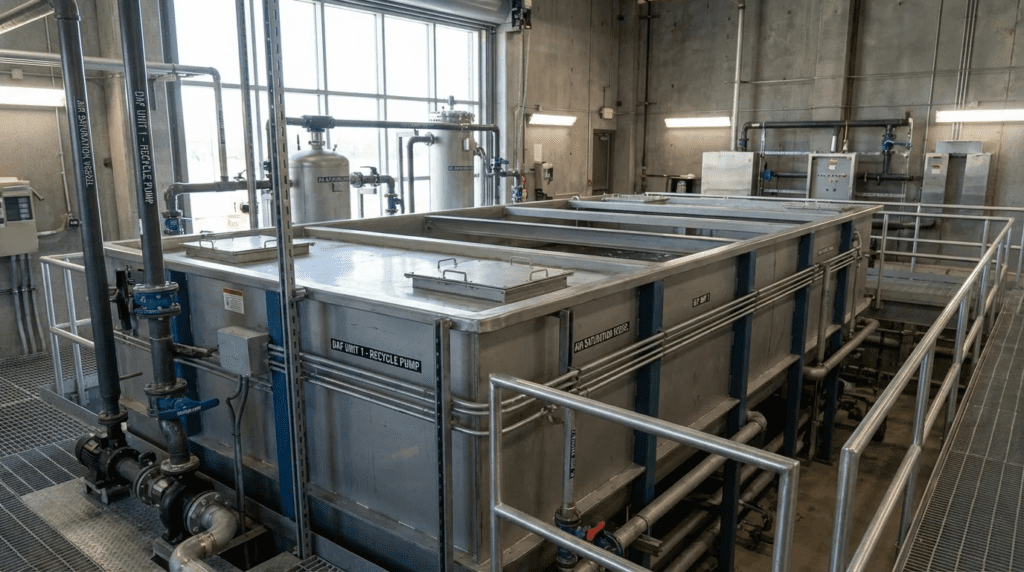
Dissolved Air Flotation (DAF) is frequently the unit process of choice when dealing with low-density solids, algae, or fats, oils, and grease (FOG)—contaminants that defy gravity settling. However, a surprising number of DAF installations fail to meet performance guarantees not because the tank is the wrong size, but because the whitewater system is improperly specified for the actual solids loading. Industry data suggests that nearly 30% of DAF operational issues stem from inadequate air-to-solids (A/S) ratios or poor hydraulic distribution, leading to short-circuiting and effluent violations.
For municipal and industrial engineers, navigating the landscape of the Top 10 DAF Systems Manufacturers for Water and Wastewater requires looking beyond glossy brochures and sales pitches. It requires a rigorous understanding of saturation mechanics, surface loading rates, and constructability.
DAF technology is pivotal in applications ranging from municipal drinking water clarification (specifically for algae and low-turbidity waters) to industrial pretreatment in food and beverage facilities, and secondary sludge thickening. The operating environments are harsh; systems must withstand corrosive headspaces, variable hydraulic loads, and aggressive cleaning chemicals. A poor specification choice can result in a system that consumes excessive power, requires constant manual nozzle cleaning, or fails to achieve the necessary sludge dryness, driving up hauling costs.
This article provides a comprehensive, unbiased engineering analysis to help you select, specify, and operate these systems. We will examine the critical design calculations, mechanical differentiators, and maintenance realities that separate robust infrastructure from high-maintenance headaches.
How to Select and Specify DAF Systems
When evaluating the Top 10 DAF Systems Manufacturers for Water and Wastewater, the engineer must move from general process flow diagrams to detailed mechanical and hydraulic specifications. The “black box” approach—simply specifying a flow rate and influent/effluent parameters—often leads to vendor proposals that are difficult to compare apples-to-apples. The following criteria define the engineering operating envelope.
Duty Conditions & Operating Envelope
Defining the duty condition goes beyond average daily flow (ADF). DAF systems are highly sensitive to hydraulic surges and solids loading spikes.
- Hydraulic Loading Rate (HLR): Unlike sedimentation basins, DAFs can often handle higher loading rates. However, specifying a rate that is too aggressive (>4-5 gpm/ft² without lamella plates) can shear fragile floc.
- Solids Loading: The most critical parameter is the mass loading (lbs/hr/ft²). Manufacturers must size the whitewater system based on the peak solids load, not the hydraulic flow.
- Temperature Variance: Water viscosity changes with temperature (cold water is more viscous), affecting the rise velocity of air bubbles and solids. Specifications must account for the minimum winter water temperature to ensure the rise rate is sufficient.
- FOG vs. TSS: If FOG is the primary contaminant (industrial), the float layer will be more cohesive but potentially more corrosive (fatty acids). If TSS/grit is present, a bottom auger/scraper is mandatory, not optional.
Materials & Compatibility
Material selection drives the CAPEX significantly but determines the lifespan of the asset.
- Stainless Steel (304 vs. 316): For municipal drinking water, 304SS is often sufficient. However, for wastewater with high chlorides or industrial applications with low pH excursions, 316L SS is the minimum engineering standard to prevent pitting corrosion.
- Non-Metallic Options: Some manufacturers offer polypropylene (PP) or HDPE tanks. These offer excellent chemical resistance for high-salinity or aggressive industrial wastewater (e.g., pickling lines) but have structural limitations and temperature ceilings (typically <140°F).
- Concrete Basins: For large municipal plants (>10 MGD), concrete basins with retrofitted internal mechanisms are standard. The specification here focuses on the embedments, grout execution, and liner protection.
Hydraulics & Process Performance
The core performance of any manufacturer in the Top 10 DAF Systems Manufacturers for Water and Wastewater list depends on their hydraulic efficiency.
- Effective Surface Area: Be wary of “projected” surface area calculations that include dead zones. Specification should demand effective separation area.
- Cross-Flow vs. Counter-Current: Different manufacturers utilize different flow patterns. Cross-flow (water flows one end to other) is standard. Counter-current allows for potentially lower footprints but requires careful baffling to prevent short-circuiting.
- Lamella Plates: Inclined plates increase effective surface area, allowing for smaller footprints. However, they are prone to fouling in high-FOG or sticky-sludge applications. Engineers must evaluate if the O&M burden of cleaning plates outweighs the space savings.
Installation Environment & Constructability
Physical constraints often dictate the winning design.
- Footprint: Rectangular units fit well in buildings; circular units often require outdoor installation or large square bays.
- Headroom: DAF units with surface scrapers and top-mounted drives require significant vertical clearance for maintenance (pulling shafts or chains).
- Shipping splits: For large steel tank units, verify if the unit ships fully assembled or requires field welding/flanging. Field welding stainless steel requires strict QC/QA (passivation) often missing in general contractor scopes.
Reliability, Redundancy & Failure Modes
The “Achilles heel” of a DAF is the recycle pressurization system.
- Saturation Pumps: Multistage centrifugal pumps are standard. Single-stage pumps usually require a separate air saturation vessel (compressor + tank). The failure mode here is often cavitation if the air is introduced improperly to the pump suction.
- Nozzles/Valves: The pressure release mechanism generates the whitewater. These nozzles can clog. Specifications should require “non-clog” designs or mechanisms that allow for cleaning without draining the tank.
- Chain & Flight: For rectangular tanks, plastic chains stretch over time. Redundancy strategies should include a full shelf spare of chain links and drive sprockets.
Controls & Automation Interfaces
Modern DAFs should not run in isolation.
- Recycle Flow Control: The system should automatically adjust recycle flow based on influent turbidity or flow pacing to maintain the target Air-to-Solids ratio.
- Sludge Blanket Monitoring: Automated sludge depth meters can trigger the scraper mechanism, preventing the float from becoming too thick (anaerobic) or too thin (wet sludge).
- SCADA: Essential hardwired interlocks include High Level (prevent overflow) and Low Pressure (prevent pump damage).
Maintainability, Safety & Access
- Walkways: Specifications must mandate OSHA-compliant walkways/handrails for accessing the drive motor and skimming beach.
- Venting: DAF tanks release significant air. In enclosed buildings, this can lead to humidity issues or entrapment of volatile organic compounds (VOCs) stripped from the water. Proper HVAC integration is critical.
- Bottom Sludge Removal: Never assume a DAF removes 100% of solids as float. Heavier solids will settle. A functional bottom scraper or hopper system is necessary to prevent septic conditions at the tank floor.
Lifecycle Cost Drivers
While CAPEX is the initial hurdle, OPEX is the long-term reality.
- Chemical Usage: DAF relies heavily on coagulation/flocculation. A system with poor hydraulics will require higher polymer doses to compensate, drastically increasing annual operating costs.
- Energy: The recycle pump consumes the most energy. Systems that can operate effective saturation at lower pressures (e.g., 60 psi vs. 90 psi) will yield savings.
- Sludge Hauling: A DAF that produces 4% solids vs. 2% solids cuts hauling volume in half. This performance metric should be a guaranteed parameter.
Comparison Tables
The following tables provide an engineering-level comparison of market approaches. Table 1 outlines the manufacturers often cited in specifications, highlighting their technological focus rather than marketing claims. Table 2 helps engineers select the right DAF configuration for their specific application.
Table 1: Top 10 DAF Manufacturers & Engineering Profiles
| Manufacturer | Primary Tech Strength | Typical Applications | Engineering Considerations | Maintenance Profile |
|---|---|---|---|---|
| Evoqua (Xylem) | High-rate flotation, Folded flow designs | Municipal Potable, Large Industrial | Often utilizes V-Fold technology to reduce footprint. High hydraulic loading capability. | Standard mechanical maintenance; check proprietary nozzle availability. |
| Veolia (Kruger) | Large-scale integration, Proprietary nozzle tech | Large Municipal Wastewater, Desalination Pretreatment | Solutions often integrated into massive civil works. High engineering support depth. | Low frequency, but parts may have long lead times due to proprietary nature. |
| KWI | Circular DAFs, “Zero Velocity” principle | Pulp & Paper, Water Reuse, Municipal | Excellent for high flow rates in a single unit. The moving carriage design minimizes turbulence. | Rotating carriage requires specialized maintenance of electrical slip rings/joints. |
| WesTech | Custom Municipal, Concrete Basin Mechanisms | Municipal Clarification, Thickening | Strong focus on robust, slow-moving heavy equipment for 20+ year life. Custom engineered. | Very low; designed for heavy duty cycles. Standard industrial components. |
| Nijhuis Saur | Modular/Containerized, Plate Pack Systems | Food & Bev, Oil & Gas, Industrial | High focus on plate pack technology to maximize separation in tight footprints. | Plate packs require regular cleaning cycles to prevent fouling. |
| World Water Works | Polypropylene tanks, Regenerative Turbine Pumps | High Salinity, MBBR Separation, Industrial | Ideal for corrosive environments where steel fails. Uses specialized multiphase pumps (Ideal DAF). | Plastic welding repairs require specialized skill sets. Pump tolerances are tight. |
| FRC (JCI) | Industrial Pretreatment, Skid Systems | Meat Processing, Dairy, General Industry | Robust recycle pressurization. Often utilize pipe flocculators for chemical mixing. | Designed for operator accessibility; parts generally off-the-shelf. |
| Ecologix | Integrated Tube Settlers, Compact Systems | Small/Medium Industrial, Primary Treatment | Combines settling and flotation effectively. Cost-effective for smaller flows. | Tube settlers are prone to clogging if screening upstream is poor. |
| DAF Corporation | Standard Rectangular Designs, Retrofits | General Wastewater, Clarification | Focus on tried-and-true rectangular geometry. Good for retrofitting existing basins. | Chain and flight maintenance is the primary activity. |
| Aqua-Aerobic | Integrated Systems, Cloth Media filters | Municipal Tertiary, Algae Removal | Often paired with downstream filtration. Focus on high-quality effluent. | Integrated controls require higher operator skill level. |
Table 2: Application Fit Matrix – Selecting the Right DAF Type
| Application Scenario | Recommended Geometry | Plate Packs? | Bottom Scraper? | Key Constraint |
|---|---|---|---|---|
| High TSS / Sludge Thickening | Rectangular | No (Risk of clogging) | Mandatory (Heavy solids) | Requires high torque scraper drives. |
| Algae Removal / Low Turbidity | Circular or Rectangular | Yes (Enhances separation) | Optional (Minimal settling) | Hydraulic Loading Rate dominates design. |
| Industrial FOG (Food/Bev) | Rectangular | Ideally No (Cleaning difficulty) | Mandatory (Grit/Bone) | Chemical compatibility (Fatty acids). |
| Large Scale (>10 MGD) | Circular or Concrete Rectangular | Yes (To reduce concrete vol) | Mandatory | Civil construction costs vs. Mechanical costs. |
Engineer & Operator Field Notes
Field experience often contradicts ideal design assumptions. The following notes are compiled from commissioning reports, troubleshooting logs, and long-term operational feedback on DAF systems.
Commissioning & Acceptance Testing
Acceptance testing for a DAF system is more complex than standard hydraulic testing.
- Clean Water Testing: Before introducing wastewater, run the system on potable water. This is the only time you can clearly visualize the “whitewater” pattern. You are looking for a milky, consistent cloud that fills the contact zone. Large bubbles (clear water visible) indicate nozzle failure or poor saturation.
- Rise Rate Verification: Verify the rise rate by taking a grab sample from the reaction zone in a graduated cylinder. Measure the time it takes for the interface to separate. If lab rise rate differs significantly from tank performance, investigate hydraulic short-circuiting.
- Sludge Dryness Test: Performance guarantees often specify a float solid percentage (e.g., >3%). This must be verified over a continuous 24-hour period, not a grab sample, as float characteristics change with diurnal flow.
If the water surface in the contact zone looks like “boiling water” (large bubbles breaking the surface), your saturation efficiency is compromised. A healthy DAF contact zone should look like a dense, white foam or milk. Large bubbles disrupt the float blanket and re-entrain solids.
Common Specification Mistakes
- Ignoring the “Beach”: The beach is the inclined ramp where sludge is scraped off. Specifying a beach that is too short allows water to drain back into the float, reducing solids concentration. Specifying one that is too long increases friction load on the scraper.
- Undersized Air Compressors: Engineers often size compressors for average duty. DAF compressors should be sized to recharge the saturation vessel quickly after a cycle dump. Undersized compressors lead to “low pressure” alarms and system trips during high demand.
- Missing Sample Ports: You cannot troubleshoot a DAF without sample ports at: Influent, Flocculation Tank, Recycle Line (pressurized), and Subnatant (effluent).
O&M Burden & Strategy
Operational reality for Top 10 DAF Systems Manufacturers for Water and Wastewater equipment revolves around the whitewater system and the scraper.
- Recycle Pumps: These operate at high pressures (60-90 psi). Seals are the primary wear item. A mechanical seal failure here causes a significant leak.
- Chain Tensioning: On rectangular units, plastic chains elongate. Operators must check tension monthly. Loose chains can jump the sprocket (derail), requiring the tank to be drained and confined-space entry for repair.
- Nozzle Cleaning: Even “non-clog” nozzles foul eventually. Exercise the declumping levers (if equipped) weekly. If fixed nozzles are used, schedule a quarterly shutdown to pressure wash them.
Troubleshooting Guide
- Problem: Carryover (Solids in Effluent)
Possible Cause: Recycle rate too low (insufficient air), hydraulic overload, or “old sludge” (sludge blanket too deep, sloughing off under the baffle).
Action: Increase recycle rate, check A/S ratio, or increase scraper speed. - Problem: Wet Sludge (Low % Solids)
Possible Cause: Scraper moving too fast, water level too high (flooding the beach).
Action: Lower the weir level or slow down the scraper drive (VFD). - Problem: Cavitating Recycle Pump
Possible Cause: Air binding in the pump volute.
Action: Check the air injection point. Ensure there is sufficient backpressure on the discharge side.
Design Details and Calculations
Proper engineering requires validating manufacturer claims with independent calculations.
Sizing Logic & Methodology
The fundamental parameter is the Air-to-Solids (A/S) Ratio. This ratio determines the mass of air required to lift a mass of solids.
- Typical A/S Ratios:
- Algae/Light Solids: 0.005 – 0.015 lb air / lb solids
- Wastewater Sludge Thickening: 0.02 – 0.04 lb air / lb solids
- Industrial (FOG): 0.03 – 0.05 lb air / lb solids
- Recycle Rate (R): Typically 10% to 50% of the influent flow (Q). Higher solids loading requires higher recycle rates.
The Air Dissolution Formula:
The amount of air available is calculated using Henry’s Law, modified for system efficiency.
A = C × f × (P/14.7 – 1) × R
Where:
- A: Air available (lbs/min)
- C: Solubility of air in water at given temp (approx. 24 mg/L at 20°C)
- f: System efficiency factor (typically 0.5 to 0.8 depending on manufacturer)
- P: Saturation Pressure (psia)
- R: Recycle Flow (gpm)
Specification Checklist
Ensure these items appear in Division 46 (Mechanical) or Division 11 (Equipment):
- Saturation Vessel: Must be ASME Section VIII stamped (if >15 psi and certain volume).
- Static Mixers/Flocculators: Define the retention time (G-value) required upstream. DAFs do not work without chemical conditioning.
- Scraper Drives: Specify Class II or Class III service factors for gear reducers. Torque monitoring for overload protection is mandatory.
- Materials: Explicitly state “All wetted parts shall be 316SS” if required. Don’t leave it as “manufacturer standard.”
Standards & Compliance
- AWWA: While specific DAF standards are limited, general equipment standards apply.
- NFPA 820: Check fire protection requirements. If the DAF treats wastewater with volatile compounds or is enclosed, explosion-proof motors (Class 1 Div 1/2) may be required.
- OSHA: Guarding for exposed chains and shafts is critical.
Frequently Asked Questions
What is the difference between DAF and Cavitation Air Flotation (CAF)?
DAF dissolves air into water under high pressure (60+ psi) and releases it to form microscopic bubbles (30-50 microns). CAF uses a mechanical aerator to whip air into the water directly. CAF produces larger bubbles and is generally less efficient for fine solids or high-purity effluent requirements, but it consumes less energy and has a simpler mechanical design. DAF is preferred for strict discharge limits.
How do you calculate the required recycle flow rate?
The recycle flow rate is derived from the target Air-to-Solids (A/S) ratio. Once you know the influent solids load (lbs/hr) and the A/S ratio required for your specific sludge type, you calculate the mass of air needed. You then determine how much water (recycle stream) is required to carry that dissolved air at a specific pressure (usually 70-90 psi) and temperature. Typical recycle rates range from 15% to 50% of influent flow.
Why is my DAF float sinking?
Float sinks for three primary reasons: 1) Insufficient air (low A/S ratio) means the bubble-particle aggregate isn’t buoyant enough. 2) Ideally, the float should be removed continuously; if it sits too long, bubbles coalesce or pop, and solids settle. 3) Rain or heavy sprays on outdoor units can mechanically knock the float down. Check your recycle pump performance and scraper timer settings.
Does a DAF system replace a secondary clarifier?
In some applications, yes. DAF is increasingly used as a “secondary clarifier” for light biological flocs, such as in MBBR (Moving Bed Biofilm Reactor) processes where solids are light and hard to settle. It allows for higher solids loading rates than gravity clarifiers, reducing the civil footprint. However, it requires more energy (pumping) than gravity settling.
What is the typical lifecycle of a DAF chain and flight system?
In non-corrosive municipal applications, non-metallic chain and flight systems typically last 10-15 years. However, wear shoes and rails usually require replacement every 5-7 years. In high-grit environments or industrial applications with abrasive solids, chain life can be reduced to 3-5 years. Proper tensioning significantly extends lifecycle.
Top 10 DAF Systems Manufacturers for Water and Wastewater: Which is best for small flows?
For small flows (< 0.5 MGD) or skid-mounted needs, manufacturers like FRC, Nijhuis, and Ecologix often provide "plug-and-play" containerized units. These are more cost-effective than the custom civil designs provided by WesTech or Veolia, which generally favor larger municipal footprints.
Conclusion
KEY TAKEAWAYS
- Sizing is Mass-Based: Never size a DAF solely on hydraulic flow (gpm). You must design for the peak solids loading (lbs/hr).
- Chemistry is King: The best DAF mechanic will fail if upstream coagulation and flocculation are poor. Ensure proper flash mix and floc time.
- Whitewater Reliability: The recycle pump and nozzle system are the most critical mechanical components. Specify redundancy here.
- Material Selection: Use 316SS for industrial or high-chloride applications. Concrete is best for large-scale municipal longevity.
- A/S Ratio: Insist on seeing the Air-to-Solids calculation in the submittal. Ensure it covers your worst-case temperature and loading.
Selecting the right partner from the Top 10 DAF Systems Manufacturers for Water and Wastewater requires a balanced assessment of process capability, mechanical robustness, and long-term support. While the fundamental physics of Stokes’ Law (or rather, its inverse for flotation) applies to all, the execution varies wildly.
For engineers, the decision framework should prioritize the specific sludge characteristics and the facility’s maintenance culture. High-rate, plate-pack systems offer incredible footprint savings but demand rigorous cleaning regimes. Open, circular, or rectangular tanks offer forgiveness and operational simplicity but demand significant real estate.
By focusing on the critical interface of hydraulics (whitewater generation) and mechanics (sludge removal), engineers can specify systems that provide reliable compliance for decades, rather than becoming a bottleneck in the treatment train.