
Top OEMs for Diaphragm Pumps (AODD) in Water & Wastewater Applications
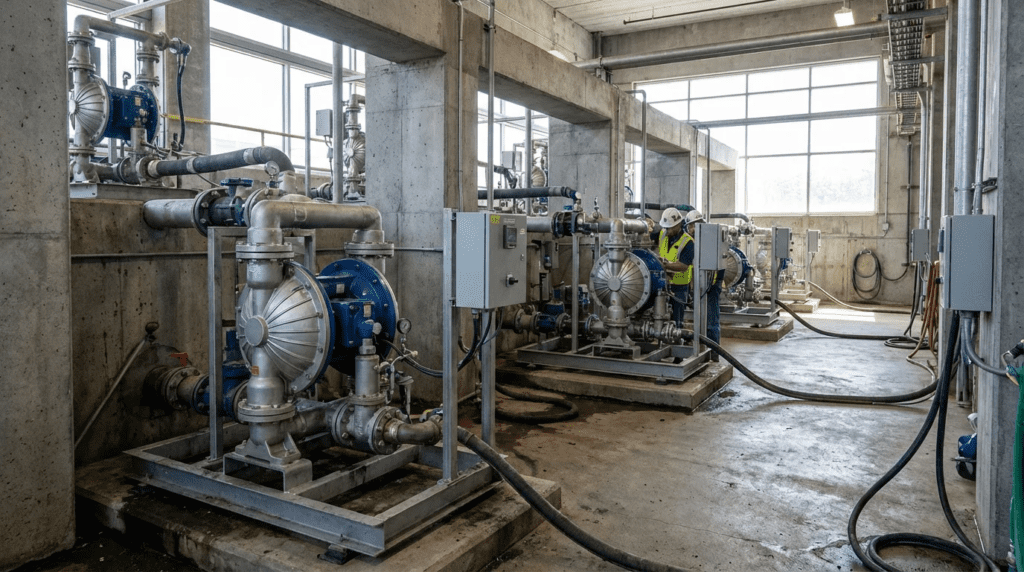
Introduction: The Role of AODD Pumps in Water & Wastewater Infrastructure
In the complex hydraulic architecture of municipal and industrial water and wastewater treatment plants, centrifugal pumps often command the most attention due to their volume handling capabilities. However, Air-Operated Double Diaphragm (AODD) pumps serve as the critical auxiliary workhorses that enable the precise handling of chemicals, sludge, and variable waste streams. Unlike rotodynamic pumps, AODD pumps are positive displacement units that utilize compressed air as a power source, offering unique advantages in scenarios where electricity is unavailable, explosive environments exist, or fluid characteristics vary wildly.
For the consulting engineer and plant operator, the AODD pump addresses specific hydraulic challenges: self-priming from dry starts, the ability to run dry without damage, and the capacity to handle shear-sensitive fluids or slurries with high solids content without degrading the media. In a typical wastewater treatment plant (WWTP), these pumps are ubiquitous in headworks for grit removal, in chemical metering rooms for the transfer of sodium hypochlorite, lime slurry, and polymers, and in dewatering buildings for feeding filter presses.
However, the specification of AODD pumps is frequently oversimplified. Because they are often viewed as “commodity” items or utility pumps, they are frequently misapplied, leading to excessive energy costs (compressed air is expensive to generate), premature diaphragm failure, and freezing of air distribution systems.
Within the broader family of wastewater pumps, the AODD occupies a position defined by tolerance rather than efficiency. It will do things no centrifugal machine will survive, and it will consume far more energy per gallon while doing them. Every specification decision that follows is a trade against that basic exchange.
Selecting the correct Original Equipment Manufacturer (OEM) extends beyond purchase price. It involves evaluating the efficiency of the Air Distribution System (ADS), the ease of maintenance (bolt-through vs. clamp band designs), the quality of diaphragm bonding, and the availability of specific elastomers required for aggressive water treatment chemicals. This article provides an engineer-level analysis of the top OEMs in the AODD sector, Wilden, ARO, Graco, Yamada, Sandpiper, and Almatec, focusing on their technical merits, architectural differences, and suitability for specific water and wastewater applications.
How to Select AODD Pumps: Engineering Criteria
When specifying an AODD pump for municipal or industrial water applications, reliance on flow rate alone is insufficient. The following criteria must be evaluated to ensure process reliability and lifecycle economy.
1. Hydraulic Performance and Air Consumption
AODD pumps operate on a simple ratio: air pressure in equals fluid pressure out (roughly 1:1). However, the volume of air required (Standard Cubic Feet per Minute, SCFM) to achieve a specific flow rate varies significantly between manufacturers.
- Air Efficiency: Engineers must calculate the cost of compressed air. Some OEMs utilize advanced air valve technologies to reduce “blow-by” (wasted air at the end of a stroke) and optimize air usage. A pump that consumes 20% less air can save thousands of dollars annually in compressor energy costs.
- Flow Curves: Unlike centrifugal pumps, AODD performance curves are linear. However, viscosity significantly impacts these curves. Engineers must apply correction factors for fluids like polymer or thickened sludge to ensure the pump is not undersized.
Reading these curves correctly requires setting aside centrifugal habits. An AODD curve is a family of lines, one per inlet air pressure, plotted with discharge pressure against flow and overlaid with SCFM consumption contours. There is no best efficiency point in the rotodynamic sense, no runout, and no shutoff head: the pump simply stalls when discharge pressure equals inlet air pressure and holds there indefinitely without harm. Operators coming from centrifugal equipment benefit from working through diaphragm pump curve reading specifically, because the selection point is chosen against air consumption and cycle rate rather than against an efficiency island.
2. Solids Handling and Internal Geometry
The internal valve type dictates the pump’s ability to pass solids.
- Ball Valves: The industry standard for general fluids. Gravity seats the ball to prevent backflow. While reliable, they can be obstructed by large, stringy solids.
- Flap Valves: Essential for wastewater applications involving large solids (up to line size) or stringy materials. Flap valves hinge open to allow unrestricted flow, making them ideal for raw sewage, sludge, or sump applications where debris is common.
- Clearance: Manufacturers specify a “maximum solids diameter.” Specifying a pump operating near its maximum solids tolerance usually results in frequent clogging; a safety factor of 1.5x to 2x the expected solid size is recommended.
3. Materials of Construction and Chemical Compatibility
In W/WW, chemical attack is a primary failure mode.
- Wetted Housing:
- Aluminum/Cast Iron: Standard for sludge, neutral wastewater, and utility sumps.
- Stainless Steel (316): Required for corrosive environments and some sludge applications.
- Polypropylene/PVDF: Mandatory for corrosive chemical dosing (acids, caustics, ferric chloride).
- Diaphragms and Balls (Elastomers):
- Buna-N/Neoprene: Good for general purpose and oils, but poor chemical resistance.
- Santoprene/Hytrel (Thermoplastic Elastomers): Excellent flex life and abrasion resistance; standard for sludge.
- PTFE (Teflon): Universal chemical resistance but poor mechanical flex life. Usually backed with a rubber diaphragm. Mandatory for aggressive oxidizers like sodium hypochlorite.
4. Air Distribution System (ADS) Reliability
The ADS is the engine of the pump. Common failure modes in W/WW applications include:
- Stalling: Occurs when the air valve centers in a neutral position, stopping the pump. Modern “unbalanced” valve designs have largely eliminated this, but it remains a consideration for low-pressure start-ups.
- Icing: As compressed air expands in the pump, it cools rapidly (adiabatic cooling). If the supply air has high moisture content, ice can form in the muffler, restricting exhaust and stalling the pump. Engineers should look for ADS designs that minimize expansion turbulence or divert cold exhaust away from sensitive components.
5. Maintenance Architecture: Bolted vs. Clamped
- Clamped Design: Utilizes band clamps to secure the fluid chambers. Advantages: Fast disassembly without tools. Disadvantages: Prone to leakage under high pressure or if misalignment occurs; clamps can loosen over time due to vibration.
- Bolted Design: Utilizes bolts through the fluid chambers. Advantages: Superior sealing pressure, safer for hazardous chemicals, higher pressure tolerance. Disadvantages: Slower disassembly. For most permanent municipal installations, bolted designs are preferred for safety and leak prevention.
Subcategory Overview
Beyond the OEM comparison, the diaphragm pump topic divides into a handful of practical areas a utility encounters at different stages of the asset’s life. Each has its own dedicated coverage within this pillar.
Manufacturer Evaluation
Choosing between suppliers on a specific duty is covered in more depth under top diaphragm pump manufacturers, which works through head-to-head comparisons rather than a single roundup. Useful vendor comparisons in this category always anchor to the fluid rather than to general capability, because the AODD market segments sharply by duty: a supplier that leads in line-sized solids handling has no particular claim on high-purity chemical containment, and the reverse holds equally. The criteria that recur across any pairing are air consumption at the actual duty point, valve type and solids clearance, available elastomer and housing combinations for the specific chemical, bolted versus clamped chamber architecture, and whether wet end kits are stocked locally, since diaphragms and balls are consumables rather than capital spares.
Commissioning and Acceptance
An AODD arrives as a simple-looking device and is frequently put into service without any formal startup procedure, which is how avoidable problems get built in on day one. Working through a structured diaphragm pump commissioning sequence covers the checks that matter: verifying supply air pressure and quality at the pump rather than at the header, confirming the regulator and filter are sized for peak SCFM draw, recording baseline cycle rate and air consumption at the design duty, checking that the muffler discharges where icing and noise will not create a problem, and confirming the pump primes and holds against the actual static lift. The baseline cycle rate in particular is worth capturing, since a rising cycle count at constant output is the earliest available indicator of a leaking check valve or a failing diaphragm.
Comparison Table: AODD OEMs in Water & Wastewater
The following table analyzes the specified OEMs based on their typical configurations found in water and wastewater facilities. Note that “Best-Fit” refers to where the brand is most frequently successful, not an exclusive limitation.
| OEM | Core Technology / Strengths | Primary W/WW Applications | Maintenance & Lifecycle Notes | Limitations |
|---|---|---|---|---|
| Wilden (PSG/Dover) |
Pro-Flo SHIFT ADS: Reduces air consumption significantly. Original Inventor: Extensive install base. Wide range of clamped and bolted options. |
General sludge transfer, lime slurry, filter press feed, utility sumps. | Massive aftermarket support. Clamped versions allow quick clean-out for non-hazardous sludge. SHIFT valve reduces compressor load. | Clamped versions less suitable for high-pressure or hazardous chemical dosing compared to bolted equivalents. |
| Sandpiper (Warren Rupp) |
Flap Valve Technology: Industry leader in solids handling and line-sized solids clearance. Signature Series: Heavy-duty bolted construction. |
Thickened sludge, raw sewage, sump with debris, mine dewatering (abrasives). | Top-ported designs allow air to escape (preventing air locking). Externally serviceable air distribution system. | Can be physically heavier than competitors in comparable sizes due to heavy-duty casting focus. |
| ARO (Ingersoll Rand) |
Unbalanced Air Valve: Patented design prevents stalling. EXP Series: High efficiency and automation readiness (electronic interface). |
Chemical dosing (polymers, coagulants), automated batching systems, filter press feed. | “Simul-Shift” valve technology provides a reliable start signal to prevent stalling. Fewer parts in the air motor compared to some legacy designs. | Standard industrial models may require specific specification adjustments for abrasive municipal sludge compared to dedicated slurry pumps. |
| Graco (Husky Series) |
Over-Molded Diaphragms: Eliminates the center hole/bolt, removing a primary leak path. Rugged Construction: Known for durability in harsh environments. |
Lime slurry, ferric chloride, polymer transfer, abrasive fluids. | Over-molded diaphragms last significantly longer and are easier to clean (no crevices for bacteria/sludge buildup). Very robust air valve. | Initial capital cost can be higher for premium over-molded configurations, though lifecycle cost is often lower. |
| Yamada | Unified Air Valve: Simple, non-lubricated, stall-free mechanism with very few parts. Outside-In Maintenance: Air valve accessible without opening fluid chambers. |
Chemical metering, general utility, confined space applications (high reliability required). | Proof-of-position pilot valves are mechanically linked, ensuring positive shifting. High reliability in continuous duty. | Market penetration in US municipal specs is sometimes lower than domestic brands, though technical quality is equivalent or superior. |
| Almatec (PSG/Dover) |
Solid Block Plastic Construction: Machined (not molded) PE/PTFE. Diffusion Bonding: Zero metal wetted parts options. High Containment: Ring-tightening structure. |
Sodium hypochlorite, hydrofluosilicic acid, high-purity water, extremely hazardous chemical transfer. | Designed for “zero leakage.” While maintenance is infrequent, parts are expensive. Best for critical chemical safety where leaks are unacceptable. | Cost prohibitive for general sludge/water applications. Overkill for non-hazardous fluids. |
Detailed Analysis of Top OEMs
The following section details the specific engineering attributes of the mandatory OEMs for the Diaphragm Pump category.
Wilden (PSG/Dover)
As the originator of the AODD pump, Wilden commands a significant share of the municipal market. Their portfolio is bifurcated into the “Original” series (clamped) and the “Advanced” series (bolted).
Engineering Focus: Wilden’s recent innovation focus has been on energy efficiency via the Pro-Flo SHIFT Air Distribution System (ADS). This mechanical spool valve restricts air flow into the pump at the end of each stroke, where the diaphragm is fully extended and doing minimal work, thereby preventing over-filling of the air chamber. For large municipal plants running dozens of 3-inch pumps, this reduction in SCFM consumption translates to reduced compressor sizing and energy savings.
Application Fit: Wilden is a “generalist” powerhouse. They are frequently specified for lime slurry transfer, scum transfer, and general utility. Their clamped design is preferred by maintenance teams who need to frequently clear blockages from the pump without tools, provided the fluid is not hazardous.
ARO (Ingersoll Rand)
ARO pumps are distinguished by their focus on the air motor technology and automation integration. The “Exp” (Expert) series is their flagship industrial line.
Engineering Focus: ARO utilizes an unbalanced air valve design. In many competitor pumps, if the air supply is cut while the valve is centered, the pump stalls and requires a manual reset (kick) to restart. The unbalanced valve ensures the spool always shifts to a driving position, guaranteeing restart reliability, which is critical for remote unmanned lift stations or intermittent chemical dosing. Additionally, ARO offers electronic interface capabilities (solenoid control) allowing the AODD to be integrated into SCADA systems for precise batching, bridging the gap between simple transfer and metering pumps.
Application Fit: ARO is strongly suited for chemical metering and injection where reliability of start/stop cycles is paramount. They are also prevalent in filter press feed applications where the pump must stall under pressure against a closed head and restart immediately when pressure drops.
Graco
Graco’s “Husky” series is synonymous with durability. While they have a massive presence in painting and finishing, their process pumps are engineered with specific features for the water/wastewater market.
Engineering Focus: The standout feature for Graco is the over-molded diaphragm. Traditional diaphragms have a center hole where the shaft attaches, secured by inner and outer plates. This interface is a common leak path and a trap for abrasive sludge. Graco’s over-molded design encloses the metal plate within the elastomer (PTFE or Santoprene) on the fluid side. This creates a smooth, continuous face that eliminates leak paths and prevents solids from packing behind the plate. This significantly extends diaphragm life in abrasive lime and sludge applications.
Application Fit: Graco is an excellent specification for abrasive slurry applications (lime, carbon slurry) and chemically aggressive fluids where diaphragm integrity is the primary concern. The bolted, rugged construction makes them ideal for rough handling in public works environments.
Yamada
Yamada represents Japanese engineering philosophy: simplicity and reliability. Their pumps are designed with fewer parts and a focus on “install and forget” operation.
Engineering Focus: Yamada utilizes a unified, accessible air valve. A key differentiator is their pilot valve mechanism. While some manufacturers rely on air signals to shift the main valve (which can be unreliable with dirty air), Yamada uses a mechanical linkage to physically push the pilot valve, ensuring a positive shift every time. Their “Ink” and general industrial series pumps utilize a patented air valve that never requires lubrication, preventing the contamination of the exhaust air and reducing maintenance.
Application Fit: Yamada is often found in OEM skids (polymer blending units, skid-mounted treatment systems) due to their high reliability and compact footprint. They are excellent for chemical transfer applications where maintenance access is difficult, as the pump requires less frequent intervention.
Sandpiper (Warren Rupp)
Sandpiper is perhaps the most “wastewater-centric” of the major AODD brands, particularly known for their Heavy Duty Flap Valve (HDF) and Ball Valve designs.
Engineering Focus: Sandpiper addresses the two biggest complaints in wastewater pumping: solids handling and air locking. Their HDF pumps utilize flap check valves rather than ball valves. This allows line-sized solids (e.g., a 2-inch solid in a 2-inch pump) to pass without clogging. Furthermore, many Sandpiper models feature “top-ported” discharge and “bottom-ported” suction. This vertical flow path allows entrained gas (common in decomposing sludge or sodium hypochlorite) to escape naturally through the discharge rather than accumulating in the chamber and air-binding the pump.
Application Fit: Sandpiper is the premier choice for raw sewage, thick sludge, and clarifier underflow where solids are unpredictable. If a facility struggles with AODDs clogging on rags or large debris, switching to a Sandpiper HDF is often the corrective engineering solution.
Almatec (PSG/Dover)
Almatec occupies the high-end, high-purity niche of the market. While they are part of the same parent company as Wilden (PSG), their technology is fundamentally different.
Engineering Focus: Almatec pumps (E-Series) are not molded; they are machined from solid blocks of high-density polyethylene (PE) or PTFE. The housing is tightened against a ring to provide massive containment force. They utilize a unique diaphragm design with integrated metal cores that are diffusion-bonded, ensuring no metal ever touches the fluid. They also feature a PERSWING air control system that requires no dead center and provides low noise levels.
Application Fit: Almatec is rarely used for general sludge due to cost. However, they are the “best available technology” for handling extremely dangerous or high-value chemicals in water treatment, such as concentrated hydrofluosilicic acid (fluoridation), high-concentration sodium hypochlorite, or acids used in odor control scrubbers. The solid-block design offers higher safety factors against environmental stress cracking than injection-molded plastic pumps.
Application Fit Guidance
To assist engineers in matching the OEM to the process node, the following hierarchy is suggested based on field performance and design strengths.
1. Sludge Handling & Dewatering Feed
Primary Choice: Sandpiper (HDF Series) or Wilden (Bolted Metal).
Reasoning: Sludge contains unpredictable solids. Sandpiper’s flap valves offer the best clearance. Wilden’s Pro-Flo Shift helps manage the high air consumption associated with the continuous duty of filter press filling.
2. Chemical Dosing (Acids, Caustics)
Primary Choice: Almatec or ARO/Graco (Plastic/Bolted).
Reasoning: For dangerous chemicals, leakage is not an option. Almatec’s solid block design is superior for safety. For standard chemicals, ARO and Graco offer excellent chemical compatibility with bolted plastic housings that resist creep better than clamped designs.
Alternatives worth screening: Where the duty is genuinely metering rather than transfer, the AODD is not automatically the right machine. Peristaltic hose pumps are the other seal-less option and hold their accuracy against varying discharge pressure without the pulsation an AODD produces, which matters on a dosing line feeding a flow-paced controller. The AODD wins on solids tolerance, dry running, and cost per gallon at higher flows; the peristaltic wins on dosing accuracy and on chemicals where even a diaphragm rupture is unacceptable, since the fluid never leaves the hose.
3. Lime Slurry & Abrasives
Primary Choice: Graco (Over-molded) or Wilden (Bravura/Stallion).
Reasoning: Lime is highly abrasive. Graco’s over-molded diaphragms prevent lime from packing around the outer piston plate, which is the leading cause of diaphragm abrasion and failure in lime applications.
4. General Utility & Sump
Primary Choice: Wilden (Clamped) or Yamada.
Reasoning: Cost-effectiveness and ease of cleanout. Utility sumps often pick up trash; a clamped Wilden can be opened, cleared, and reclamped in minutes by an operator. Yamada offers high reliability for sumps that are neglected for long periods.
Engineer & Operator Considerations
Selecting the OEM is only the first step. The successful integration of an AODD pump into a water treatment facility requires attention to the system environment.
Maintenance Access and Piping
A common design error is hard-piping AODD pumps without flexibility. AODD pumps vibrate. Engineers must specify flexible connectors (braided hose or expansion joints) on both suction and discharge to isolate vibration from rigid plant piping. Failure to do so will result in stress fractures at the pump manifolds or piping leaks. Furthermore, sufficient clearance must be left behind the pump to remove the air valve spool without unbolting the pump from the floor.
Suction Conditions and Pump Placement
An AODD is self-priming and tolerates suction lift that would require a foot valve and priming system on a centrifugal machine, which is exactly why it gets installed in awkward locations. That tolerance is not unlimited. Achievable lift falls as fluid viscosity and specific gravity rise, and a pump lifting thickened sludge will not reach anything close to its water-rated figure. Suction line size should match or exceed the pump port, runs should be kept short and direct, and the pump should sit as close to the fluid as the layout allows. Where the pump draws from a pit or tank, the considerations covered under diaphragm pump wet well design apply to the intake arrangement, though it is worth noting that a flooded suction is always preferable to a lift where the civil layout permits it, and that an AODD drawing air briefly will simply keep cycling rather than losing prime or damaging itself.
Pro Tip: Fit a simple cycle counter on any critical AODD and trend it against output. Every other symptom on these pumps is ambiguous, but cycle rate is not: at constant flow and discharge pressure, a rising cycle count means the pump is moving less fluid per stroke, which means a check valve is passing or a diaphragm is beginning to fail. It is the earliest and cheapest condition indicator available on the machine, and almost nobody installs one.
Pulsation Dampening
By nature, reciprocating pumps produce pulsating flow. In chemical metering applications, this “slug” flow can cause poor mixing or inconsistent dosing readings. Active pulsation dampeners (manufactured by the pump OEMs like Wilden and Graco, or third parties like Blacoh) should be specified for any chemical dosing line. These devices smooth the flow to near-steady state, protecting downstream instrumentation.
Air Quality and Supply
The “fuel” for these pumps is compressed air. Water/wastewater plants often have “wet” or “dirty” air systems. While modern AODD air valves are tolerant, they are not immune. Moisture in the air line causes icing in the muffler, leading to stalling. Particulates can score the air valve spool. Engineers should specify Point-of-Use (POU) filter/regulators (FRLs) at every pump drop. This protects the investment and allows operators to control pump speed (flow) by adjusting air pressure.
Common Mistake: Throttling the discharge valve to control flow. On a centrifugal pump this rides the curve back and costs some energy. On an AODD it does nothing useful at all: the pump simply works harder against the restriction, consumes the same or more air per gallon, and runs its diaphragms at higher differential stress. Flow on an AODD is controlled at the air regulator, not at the discharge. A plant with throttled AODD discharge valves is paying for compressed air it is deliberately destroying.
Lifecycle Cost: Spares Strategy
Plant managers should standardize on one or two OEMs to minimize spare parts inventory. AODD wet ends (diaphragms, balls, seats) are consumables. Stocking kits for Wilden, ARO, and Sandpiper simultaneously is inefficient. If the plant has a high population of sludge pumps, standardize on the brand best suited for sludge (e.g., Sandpiper) and use their chemical pump equivalents for dosing to maintain parts commonality where possible, or deliberately split the plant into “Sludge Pumps” (Brand A) and “Chemical Pumps” (Brand B).
Standardization only pays off if it is paired with a defined replacement interval rather than run-to-failure. A structured diaphragm pump maintenance program sets wet end kit intervals by service and duty cycle, ties the right kit part number to each work order, and sizes the shelf stock to the number of pumps in each service class. The economic argument is straightforward: a planned diaphragm change is an hour of work, while a ruptured diaphragm on a chemical pump releases the process fluid into the air chamber and out the muffler, which on sodium hypochlorite or ferric chloride duty turns a consumable replacement into a spill response.
Troubleshooting in Service
A pump that will not start usually has a stalled air valve, and the diagnostic is whether a brief increase in air pressure kicks it over; if it does, the valve design or the supply pressure is marginal rather than the pump being faulty. A pump that runs but delivers no flow is generally air-bound or has lost suction, and on ball valve designs the usual cause is a ball that has not reseated. Frost on the muffler with a slowing pump is icing from wet supply air, not a mechanical fault. Fluid appearing in the exhaust air is a ruptured diaphragm and requires immediate shutdown, particularly on chemical service. A pump that cycles rapidly with low output has a passing check valve, and comparing the cycle rate to the commissioning baseline confirms it in seconds.
Design Details & Standards
The Real Cost of Compressed Air
The article’s premise that compressed air is expensive deserves arithmetic. Take a 2-inch AODD moving 100 gpm and consuming roughly 50 SCFM. Generating compressed air at plant pressure takes on the order of 4.5 SCFM per horsepower with a reasonably efficient rotary screw compressor, so 50 SCFM requires about 11 hp, or roughly 8.3 kW at the compressor.
Run continuously, that is approximately 73,000 kWh per year, or about $7,300 at ten cents per kilowatt-hour, for a single 2-inch pump. The 20 percent air reduction that an efficient air distribution system can deliver is therefore worth around $1,450 per year on that one pump, and roughly $17,000 across a plant running a dozen of them.
Now the comparison that puts it in perspective. The hydraulic work being done is 100 gpm at, say, 40 ft of total head, which is 100 × 40 ÷ 3,960 = approximately 1.0 hp, or 0.75 kW. Against 8.3 kW drawn at the compressor, wire-to-water efficiency is on the order of 9 percent. That is not a defect; it is the price of the AODD’s tolerance for dry running, solids, and hazardous fluids. But it is why these pumps belong on duties that need those properties, and why a continuous-duty transfer application that a centrifugal pump could handle should not be given to an AODD.
Sizing Against Cycle Rate
Diaphragm life is governed by flex cycles, not by hours. A pump selected to run near its maximum stroke rate will reach its diaphragm replacement interval far sooner than one sized to loaf, even though both move the same fluid. The practical rule is to select a pump one size larger than the duty demands and run it at reduced air pressure, which lowers cycle rate, lowers air consumption per gallon, and extends wet end life simultaneously. This is the opposite of centrifugal practice, where oversizing pushes the pump away from its best efficiency point and costs energy.
Applicable Standards
Air-operated diaphragm pumps are addressed by ANSI/HI 10.1-10.5, Air-Operated Pumps for Nomenclature, Definitions, Application, and Operation, currently in its 2021 edition, which covers air-operated diaphragm and bellows pumps but not air-operated piston or plunger pumps. Performance and acceptance testing is covered separately by ANSI/HI 10.6, Air-Operated Pump Tests. Wetted materials in potable water and drinking water chemical service should carry NSF/ANSI/CAN 61 certification, and pumps installed in classified areas require the applicable explosion protection listing. Chemical compatibility of housings, diaphragms, balls, and seats should be confirmed against the manufacturer’s published resistance data for the specific concentration and temperature, not against a generic material chart.
Specification Checklist
- Fluid identified by name, concentration, temperature, specific gravity, and viscosity.
- Solids content characterized: maximum particle size, stringiness, and abrasiveness.
- Valve type selected: ball for general fluids, flap where line-sized or stringy solids are present.
- Solids clearance specified at 1.5x to 2x the expected maximum particle size.
- Duty point stated with flow, discharge pressure, and suction condition (flooded or lift).
- Air consumption at the duty point stated in SCFM, with the compressor load evaluated.
- Pump sized to run below maximum cycle rate, with the selection point identified on the curve.
- Housing material selected against the chemical: metal, polypropylene, PVDF, or solid-block.
- Diaphragm, ball, and seat elastomers specified against published resistance data.
- Chamber architecture specified: bolted for hazardous or high-pressure service, clamped only where fluid is benign and frequent cleanout is expected.
- Point-of-use filter, regulator, and lubricator (as required) specified at each air drop.
- Muffler discharge routed away from walkways and freeze-sensitive equipment.
- Flexible connectors on suction and discharge; pulsation dampener on any dosing line.
- Diaphragm rupture detection or exhaust containment specified on hazardous chemical duty.
- Cycle counter or stroke totalizer on critical pumps, with a commissioning baseline recorded.
- Wet end kit part numbers identified and replacement interval set by service class.
Frequently Asked Questions
Can an AODD pump run dry?
Yes, indefinitely and without damage, which is one of the main reasons it gets specified. There is no seal to burn up and no impeller to cavitate. The pump simply cycles on air until fluid returns. This makes AODDs the natural choice for sump duty, tank emptying, and any application where the supply is intermittent or the operator cannot be relied on to shut it down.
How do you control flow on an AODD?
At the air regulator, by adjusting supply pressure, and if needed by restricting the air line. Never by throttling the discharge. A restricted discharge does not reduce air consumption meaningfully; it just raises the differential across the diaphragms and wastes the air the pump is still drawing. The regulator is the control device, which is why a point-of-use filter/regulator belongs at every pump drop rather than only at the header.
Why is my pump icing up?
Moisture in the supply air. Compressed air cools sharply as it expands through the pump, and any water vapor it carries condenses and then freezes in the exhaust path, restricting the muffler until the pump slows or stalls. The fix is upstream: dry the plant air, add a point-of-use filter, or in persistent cases pipe the exhaust away so the icing has somewhere to go. It is not a pump fault and no amount of pump maintenance will resolve it.
Ball valves or flap valves?
Ball valves for general fluids, chemicals, and anything reasonably clean; they seal better and are the default for a reason. Flap valves where the fluid carries large or stringy solids, since a flap hinges fully clear and will pass a solid close to line size that would jam against a ball seat. Raw sewage, thickened sludge, and debris-laden sumps are flap valve duty. Choosing ball valves for those services is the single most common cause of AODD clogging complaints.
How long should diaphragms last?
It depends on cycle count rather than calendar time, on the elastomer, and on whether the fluid is abrasive. The practical lever is selection: a pump sized one size up and run at lower air pressure cycles less for the same output and will substantially outlast an identical pump run near its maximum stroke rate. Track cycles rather than hours, and set the replacement interval by service class rather than running every pump to failure.
Why are AODD pumps so inefficient?
Because compressed air is an expensive way to move energy. Generating it, distributing it, and expanding it through the pump loses most of the input, so wire-to-water efficiency on a typical duty lands somewhere around ten percent against perhaps sixty to seventy-five percent for a well-selected centrifugal pump. That trade buys dry running, solids tolerance, self-priming, deadheading without harm, and no electricity at the pump. Where those properties are needed, the pump is worth its air; where they are not, it is the wrong machine.
What happens when a diaphragm ruptures?
Process fluid crosses into the air chamber and is discharged through the exhaust muffler. On water or benign sludge this is a mess. On sodium hypochlorite, ferric chloride, or acid duty it is a chemical release into the room. This is why hazardous chemical installations should specify diaphragm rupture detection or piped exhaust containment, and why planned diaphragm replacement is cheaper than run-to-failure on those services specifically.
Conclusion
Key Takeaways
- The AODD trades efficiency for tolerance — around ten percent wire-to-water against sixty or more for a centrifugal, bought in exchange for dry running, solids handling, self-priming, and safe deadheading.
- Control flow at the air regulator, never at the discharge — throttling the discharge wastes the air the pump is still drawing and raises diaphragm stress for nothing.
- Valve type decides solids performance — flap valves pass line-sized and stringy solids, ball valves do not, and this single choice resolves most AODD clogging complaints.
- Oversize deliberately and run slow — diaphragm life is governed by flex cycles, so a larger pump at lower air pressure costs less air per gallon and lasts longer, the opposite of centrifugal practice.
- Compressed air is a real operating cost — a single 2-inch pump on continuous duty can consume on the order of $7,000 a year in compressor energy, which is what makes air distribution system efficiency worth specifying.
- Cycle rate is the condition indicator — a rising cycle count at constant output means a passing check valve or a failing diaphragm, and a counter with a commissioning baseline catches it early.
- Match the OEM to the fluid — the comparison above is a fit exercise, and the right answer for raw sewage differs entirely from the right answer for concentrated hypochlorite.
The Air-Operated Double Diaphragm pump is a versatile, indispensable component of water and wastewater infrastructure. It handles the jobs that centrifugal pumps cannot: self-priming, running dry, and moving viscous, abrasive sludges and aggressive chemicals without complaint.
However, the “commodity” mindset must be discarded. For critical sludge handling, the flap-valve technology of Sandpiper offers distinct advantages. For aggressive chemical containment, the solid-block architecture of Almatec provides unparalleled safety. For energy efficiency in large banks of pumps, Wilden’s Pro-Flo SHIFT technology offers measurable ROI. Graco’s over-molded diaphragms solve abrasion issues in lime systems, while ARO and Yamada offer high-reliability valve technologies for automation and remote duty.
Engineers and operators must evaluate the fluid properties, the cost of air, and the maintenance capabilities of the facility staff. By matching the specific strengths of these top OEMs to the application requirements, utilities can ensure reliable operation, reduced maintenance interventions, and lower total cost of ownership.