
Top OEMs for Disinfection Systems
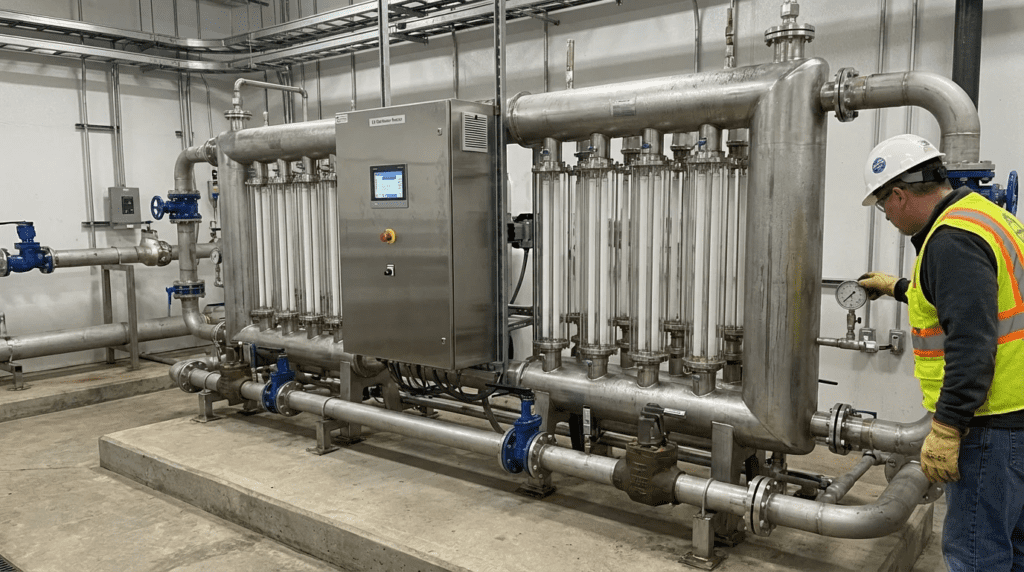
1. Introduction to Disinfection Systems in Water and Wastewater Treatment
Disinfection remains the most critical unit process in the protection of public health within municipal and industrial water cycles. In potable water treatment, disinfection serves as the primary barrier against waterborne pathogens, ensuring the inactivation of bacteria, viruses, and protozoa before distribution. In wastewater treatment, disinfection is the final treatment step required to meet National Pollutant Discharge Elimination System (NPDES) permit limits, protecting receiving water bodies and downstream users from microbial contamination.
The engineering landscape for disinfection has evolved significantly from the dominance of elemental chlorine gas. While chlorine remains a staple, the industry has diversified into ultraviolet (UV) irradiation, on-site sodium hypochlorite generation (OSHG), ozone oxidation, and chlorine dioxide systems. This diversification is driven by stringent regulatory requirements regarding disinfection by-products (DBPs), safety concerns surrounding hazardous gas storage, and the need for higher log-inactivation credits for resistant pathogens like Cryptosporidium and Giardia.
For municipal consulting engineers and utility decision-makers, selecting the appropriate disinfection technology—and the specific Original Equipment Manufacturer (OEM)—is a complex exercise in balancing hydraulic constraints, water chemistry, lifecycle costs, and operational safety. The equipment typically involves not just the dosing or irradiation hardware but a comprehensive system of controls, monitoring instrumentation, safety scrubbers (for gas), and chemical handling infrastructure.
OEM selection in this category is rarely about finding a generic commodity product. The efficacy of a disinfection system is heavily dependent on the manufacturer’s ability to model reactor hydraulics, validate performance under varying water quality conditions (such as fluctuating UV transmittance or high turbidity), and integrate seamlessly with plant SCADA systems. A poorly selected system can lead to permit violations, excessive chemical consumption, dangerous safety incidents, or catastrophic equipment failure due to material incompatibility.
This article provides a detailed technical analysis of the top OEMs in the disinfection sector. It focuses on the engineering specifications, operational realities, and long-term reliability of systems provided by the industry’s established manufacturers.
2. How to Select Disinfection Process Equipment
The selection of disinfection equipment requires a multi-dimensional engineering analysis. Unlike passive equipment, disinfection systems are dynamic and react chemically or physically with the process stream. Engineers must evaluate the following critical parameters to ensure specification compliance and operational success.
Process Function and Performance Requirements
The fundamental basis of design is the required level of pathogen inactivation, typically expressed as log removal values (LRV).
- Chemical Disinfection (Chlorine/Hypochlorite): Sizing depends on the "CT" value—the product of residual concentration (C) and contact time (T). Engineers must calculate the required basin volume and baffling factor to prevent short-circuiting. The chemical feed equipment must be sized to handle peak demand while maintaining accuracy at minimum flows (high turndown ratio).
- UV Disinfection: Performance is dictated by UV dose (mJ/cm²). Selection requires accurate data on peak flow, UV Transmittance (UVT) of the water, and Total Suspended Solids (TSS). In wastewater, low UVT or high TSS shields pathogens from light, requiring higher intensity or more lamps.
- Ozone: As a strong oxidant, ozone system sizing depends on ozone demand and decay rates. The equipment must generate sufficient ozone concentration to achieve the required CT while managing off-gas destruction.
Hydraulic and Process Loading Considerations
Disinfection systems are the bottleneck of many treatment plants. They must pass Peak Wet Weather Flows (PWWF) without hydraulic backup or flooding.
- Headloss: UV reactors, particularly closed-vessel and tightly spaced open-channel banks, induce headloss. Engineers must verify that the hydraulic profile allows for this loss without submerging upstream weirs.
- Mixing Energy: For chemical disinfection, rapid initial mixing is crucial. The equipment selection (e.g., induction mixers, static mixers, or diffusion operational strategies) must ensure chemicals are dispersed within seconds to maximize efficiency and minimize chemical usage.
- Flow Pacing: Feed pumps and control valves must react instantly to flow changes. Systems requiring long lag times for ramp-up (like some ozone generators or warmed-up UV lamps) require flow equalization or complex control logic.
Materials of Construction
Disinfection chemicals are aggressively corrosive. OEM selection heavily depends on the quality of materials used.
- Chlorine/Hypochlorite: Wetted parts must be compatible with low pH (gas) or high pH (hypo). Titanium, Hastelloy C-276, PVDF, and specific grades of PVC/CPVC are standard. Engineers must scrutinize the quality of diaphragms and seals in metering pumps.
- UV Systems: Stainless steel (316L or higher duplex alloys) is required for channels and vessels to resist corrosion, particularly in wastewater with high chlorides. The quartz sleeves protecting lamps must be of high purity to maximize transmittance.
Integration with Upstream and Downstream Processes
Disinfection cannot be designed in a vacuum.
- Upstream: Incomplete clarification or filtration increases turbidity, interfering with UV effectiveness and increasing chlorine demand. High organic loads lead to DBP formation (Trihalomethanes and Haloacetic Acids) when using chlorine.
- Downstream: Dechlorination is often required for wastewater discharge. The disinfection system needs to be paired with a sulfur dioxide or bisulfite feed system, controlled via compound loop logic based on residual analyzers.
Footprint and Layout Constraints
- Retrofits: converting gas chlorine systems to OSHG or UV often presents space challenges. OSHG requires significant footprint for brine tanks, softeners, hydrogen dilution blowers, and generation skids. UV retrofits in existing chlorine contact basins require precise concrete work to create lamp channels.
- Greenfield: Layouts should prioritize safety (segregation of incompatible chemicals) and maintenance access (pull-space for UV banks or pump maintenance).
Energy Efficiency and Operating Cost
- UV: Electricity is the primary OpEx driver. Low-Pressure High-Output (LPHO) lamps generally offer better electrical efficiency than Medium-Pressure (MP) lamps but require more lamps (larger footprint).
- OSHG: Costs are driven by salt, water, and power. Electrolyzer efficiency (lb of chlorine per lb of salt/kWh) is a key differentiator between OEMs.
- Bulk Chemical: Costs fluctuate with market supply chain volatility.
Operations and Maintenance Impacts
- UV: Regular tasks include lamp replacement (annual), quartz sleeve cleaning (chemical/mechanical wiping), and ballast replacement. Automated wiping systems are a critical specification point to reduce manual labor.
- Chemical Feed: Diaphragm pumps require regular rebuilds. Peristaltic pumps require tube replacements. Gas systems require rigorous leak testing and ejector maintenance.
- OSHG: Acid cleaning of electrolytic cells to remove scaling is a major maintenance activity. OEMs with self-cleaning (reverse polarity) cells reduce this burden significantly.
Lifecycle Cost Considerations
Engineers must perform a 20-year Present Worth Analysis. A low-bid system often carries high long-term costs due to:
- Proprietary spare parts (lamps, ballasts, cell coatings).
- High energy consumption.
- Premature material failure necessitating replacement.
- Chemical costs.
3. Comparison Table
The following table compares the locked list of Top OEMs for Disinfection Systems. Engineers should use this to identify which manufacturer aligns best with their specific project constraints, whether that be a high-flow municipal wastewater plant requiring UV, or a potable water facility retrofitting to on-site hypochlorite generation. The "Limitations" column highlights areas where specific engineering attention is required during the design phase.
| OEM Name | Typical Applications | Engineering Strengths | Limitations | Maintenance Considerations |
|---|---|---|---|---|
| Trojan Technologies | Municipal Wastewater UV, Potable Water UV (Giardia/Crypto), Water Reuse, Industrial Process Water. | Market leader in UV innovation; extensive validation (NWRI/UVDGM); highly efficient ActiClean wiping systems; advanced lamp technologies (Solo Lamp). | High capital cost; proprietary lamps and ballasts limit third-party sourcing; hydraulic profile requirements can be stringent. | Requires regular lamp/sleeve replacement and wiper seal maintenance. Ballast cooling systems need monitoring. |
| De Nora | Gas Chlorination, Chlorine Dioxide, OSHG, Ozone, Filtration/Disinfection integration. | Legacy brand (Capital Controls) reliability; comprehensive portfolio covering almost all disinfection modalities; strong expertise in electrochlorination and gas feed. | Complex portfolio can require navigating multiple product divisions; OSHG systems require rigorous brine and temperature management. | Gas feeders require regular diaphragm/spring checks. OSHG cells may require acid washing if water hardness is not managed. |
| Evoqua | Gas Chlorination (V-Notch), UV Disinfection, OSHG (OSEC), Aquatic/Industrial Disinfection. | Home of the Wallace & Tiernan brand; extremely precise gas metering technology; robust OSEC systems for on-site generation; broad service network. | Integration of legacy brands can sometimes complicate parts procurement; proprietary controls often required for maximum functionality. | Injector cleaning and vacuum regulator maintenance are critical for gas systems. UV systems require standard sleeve cleaning and lamp changes. |
| ClorTec | On-Site Sodium Hypochlorite Generation (OSHG) for Municipal Water/Wastewater. | Specialized focus on OSHG; simple, robust tank-based designs; high-efficiency electrolyzers; excellent hydrogen safety venting designs. | Scope is limited primarily to OSHG (not a generalist in UV or Ozone); footprint for salt storage and generation tanks is significant. | Electrolytic cells are the primary wear item (expensive to replace). Softener maintenance is critical to prevent cell scaling. |
| Macaulay Controls Company | Chemical Feed Systems, Instrumentation, Control Panels, System Integration. | Strong capability in custom-engineered skids; excellent integration of pumps, analyzers, and SCADA; flexibility to use best-in-class components. | Primarily a solution provider/integrator rather than a raw component manufacturer for things like UV lamps; dependent on component lead times. | Maintenance depends on specific components selected (pumps, valves). Calibration of analytical instrumentation is the primary operational task. |
4. Top OEM Manufacturers
This section details the specific capabilities, technologies, and engineering approaches of the five locked OEMs for Disinfection Systems.
Trojan Technologies
Trojan Technologies is widely recognized as the preeminent manufacturer of Ultraviolet (UV) disinfection systems globally. Their engineering focus is almost exclusively on UV applications, ranging from small modular wastewater plants to massive municipal drinking water facilities.
Engineering & Technology:
Trojan’s systems are distinguished by their validation rigor. They extensively use Computational Fluid Dynamics (CFD) to optimize reactor geometry, ensuring that water receives a uniform dose of UV light. Their proprietary "Solo Lamp" technology pairs the high electrical efficiency of low-pressure lamps with the high power output of medium-pressure lamps, reducing the total lamp count required for large-scale installations.
- Wastewater Solutions: The TrojanUV3000Plus and TrojanUVSigna are industry standards. The Signa system significantly reduces the number of lamps and banks required, which lowers maintenance labor and headloss.
- Drinking Water: The TrojanUVSwift and TrojanUVTorrent are designed for high-flow log-inactivation of Cryptosporidium and Giardia. These are closed-vessel reactors designed to handle high pressure and integrate into existing pipe galleries.
Operational Focus:
Trojan places a heavy emphasis on automated maintenance. Their ActiClean system uses a combination of mechanical wiping and chemical cleaning (Gel) to keep quartz sleeves free of fouling (algae, minerals), which is critical for maintaining disinfection effectiveness without manual intervention. Engineers should note that Trojan systems are tightly integrated packages; the ballasts, lamps, sensors, and control logic are proprietary, ensuring performance but locking the utility into the OEM for lifecycle support.
De Nora
De Nora is a multinational powerhouse in electrochemistry and water treatment technologies. In the context of disinfection, they are perhaps best known for acquiring the Capital Controls brand, the original pioneer of all-vacuum gas chlorination.
Engineering & Technology:
De Nora’s portfolio is vast, covering three primary pillars of disinfection:
- Gas Feed: Capital Controls gas chlorinators are ubiquitous in the industry. They are favored for their durability, safety (vacuum operation), and linear feed control. Their vacuum regulators and ejectors are specified for their robust materials (solid silver inlet valves, Hastelloy springs) that resist the extreme corrosivity of wet chlorine gas.
- On-Site Generation (OSHG): De Nora manufactures electrochlorination systems (ClorTec and chemically-coupled variations) that generate sodium hypochlorite from brine. Their proprietary electrode coatings (DSA – Dimensionally Stable Anodes) are a core engineering strength, offering longevity and energy efficiency.
- Filtration/Disinfection: Through the DE NORA TETRA brand, they offer deep bed filters that can also serve as contactors for denitrification and disinfection processes.
Operational Focus:
De Nora systems are designed for heavy industrial and municipal duty. Their gas feed systems are often modular, allowing for easy expansion. For OSHG, they emphasize safety features such as positive hydrogen dilution and venting to prevent explosive atmospheres in generator rooms.
Evoqua
Evoqua (now part of Xylem, but retained as a distinct brand entity in specifications) holds one of the most significant heritages in water disinfection: Wallace & Tiernan. This legacy makes them a dominant player in gas chlorination and chemical feed.
Engineering & Technology:
- Gas Chlorination: The Wallace & Tiernan V-Notch technology is the benchmark for gas metering accuracy. The V10k and V2000 systems provide extremely precise chemical dosing, which is critical for minimizing chemical waste and avoiding overdose violations.
- OSEC Systems: Evoqua’s On-Site Electrochlorination (OSEC) systems are direct competitors in the OSHG market. They are engineered for skid-mounted "plug-and-play" installation, reducing on-site mechanical contractor work.
- UV Systems: Evoqua also offers a range of UV systems (Barrier and ETS ranges) suitable for aquatics, industrial, and municipal wastewater. Their UV designs often focus on compact footprints for tight equipment rooms.
Operational Focus:
Evoqua prioritizes control loop integration. Their analyzers and controllers (such as the SFC series) are designed to work seamlessly with their feed equipment, providing flow-proportional or residual-trim control capabilities out of the box. This single-source responsibility for dosing and monitoring is a key advantage for operators.
ClorTec
ClorTec is a specialized brand specifically associated with On-Site Sodium Hypochlorite Generation (OSHG). While organizationally linked to De Nora, ClorTec is frequently specified as a standalone product line due to its specific reputation in the OSHG sector.
Engineering & Technology:
ClorTec systems are engineered around the electrochemistry of brine electrolysis. The core unit process involves passing a DC current through a solution of salt and water to produce 0.8% sodium hypochlorite. This concentration is non-hazardous (below the threshold for many hazmat regulations) and does not degrade as quickly as bulk commercial hypochlorite (12.5%).
- Electrolyzers: ClorTec electrolyzers utilize a bipolar design that optimizes the conversion efficiency of salt to chlorine.
- Thermal Management: The electrolytic process generates heat. ClorTec systems include specific engineering controls to manage solution temperature, ensuring consistent product strength and protecting the cell coatings.
- Safety: Hydrogen gas is a byproduct of electrolysis. ClorTec engineering specifications invariably include redundant blower systems and dilution air monitoring to ensure hydrogen concentration remains well below the Lower Explosive Limit (LEL).
Operational Focus:
The primary appeal of ClorTec is the elimination of hazardous gas delivery and storage. For operators, the focus shifts from handling dangerous chemicals to managing salt supply and maintaining softeners (as hardness is the enemy of electrolytic cells).
Macaulay Controls Company
Macaulay Controls Company functions differently from the manufacturers of raw UV lamps or electrolyzers. They are a premier provider of engineered chemical feed, instrumentation, and control solutions. In the disinfection category, they are the "brains and muscle" behind the delivery of the disinfectant.
Engineering & Technology:
Macaulay specializes in custom-fabricated chemical feed skids. When a consulting engineer specifies a disinfection system involving sodium hypochlorite, aqueous ammonia (for chloramines), or bisulfite, the physical pumps, piping, valves, and calibration columns need to be integrated into a functional system.
- Skid Fabrication: They engineer skids using chemical-resistant thermoplastics (polypropylene, PVC) with integral containment.
- Pump Integration: They integrate varied pump technologies (peristaltic, diaphragm) from top component manufacturers, ensuring the pump curve matches the system hydraulic pressure and flow requirements.
- Control Logic: Their strength lies in the local control panels (LCP). They engineer the logic for complex dosing strategies, such as compound loop control (feed forward + feedback trim), which is essential for maintaining stable chlorine residuals in distribution systems with variable demand.
Operational Focus:
For engineers and operators, Macaulay represents a "complete solution" approach. Instead of buying a pump from one vendor and a tank from another, Macaulay delivers a tested, skid-mounted unit ready for pipe and power termination. This reduces installation risk and commissioning time.
5. Application Fit Guidance
Selecting the right OEM and technology requires matching the equipment’s strengths to the specific sector and facility constraints.
Municipal Water (Potable)
- Primary Disinfection: Trojan (specifically the Swift/Torrent lines) is often the choice for plants needing Cryptosporidium inactivation where chlorine is ineffective. Evoqua (Wallace & Tiernan) and De Nora (Capital Controls) are the standards for gas chlorination in large conventional plants due to the low cost of gas at scale.
- Residual Maintenance: ClorTec and Evoqua (OSEC) are heavily favored for booster stations and plants moving away from gas due to safety zones (residential encroachment). The 0.8% hypo is stable and safe.
- Instrumentation: Macaulay Controls is ideal for engineering the precise trim-dosing skids required at booster stations to maintain residuals without over-dosing.
Municipal Wastewater
- Effluent Disinfection: Trojan dominates this space with open-channel UV systems (Signa, 3000Plus). The elimination of DBPs and the avoidance of dechlorination chemicals make UV the preferred technology for most new wastewater permits.
- Combined Sewer Overflow (CSO): De Nora and Evoqua high-rate disinfection systems (often utilizing chlorine dioxide or high-dose chlorine) are used here because UV transmission in CSO events is often too low for effective irradiation.
Industrial Wastewater
- Process Water: Industrial streams often vary wildly in pH and temperature. De Nora and Evoqua ozone systems are strong fits here for their ability to oxidize complex organics and disinfect simultaneously.
- Cooling Water: Macaulay Controls skids utilizing biocides are common for cooling tower applications where precise, shock-dosing is required to prevent legionella and bio-fouling.
Small vs. Large Facilities
- Large: Large facilities prioritize OpEx (chemical/power cost) over CapEx. Gas Chlorine (Evoqua/De Nora) and large-scale UV (Trojan) provide the best economy of scale.
- Small: Small rural water systems benefit from ClorTec or Evoqua OSEC units. While the capital cost is higher than a simple bleach pump, it eliminates the logistics of bulk chemical delivery to remote sites—operators only need to transport bags of salt.
Retrofit vs. Greenfield
- Retrofit: Trojan excels in retrofitting existing chlorine contact channels with UV modules. Their engineering teams are adept at modeling hydraulic modifications to fit lamps into existing concrete.
- Greenfield: New plants offer the flexibility to design safe gas storage rooms, keeping De Nora and Evoqua gas systems as viable, low-OpEx options.
6. Engineer & Operator Considerations
Beyond the catalog specifications, the reality of living with disinfection equipment dictates the success of the installation.
Installation and Commissioning
- Piping Layouts: For chemical feed (Macaulay, Evoqua), engineers must minimize suction lift and long discharge runs to prevent off-gassing and vapor lock, particularly with sodium hypochlorite.
- UV Hydraulics: For Trojan systems, the upstream weir design is critical. If the water level fluctuates too much, lamps may be exposed (overheating) or the dose may be insufficient (short-circuiting).
- OSHG Ventilation: For ClorTec and Evoqua OSEC, the hydrogen vent piping must be sloped upward without traps. Any dips in the line can collect condensate, blocking the flow and forcing hydrogen back into the tank—a major explosion hazard.
Maintenance Access
- Clearance: Engineers must verify "pull space." A UV bank might be 6 feet long, but it requires another 6-8 feet of clearance to remove the module from the channel. Similarly, tube-pulling space for heat exchangers (in ozone systems) or cell removal space for OSHG is mandatory.
- Redundancy: Disinfection is a critical control point. Systems must be designed as N+1. If a gas feeder requires service, a standby unit must automatically switch over. This requires complex vacuum plumbing logic that OEMs like De Nora and Evoqua specialize in.
Spare Parts Availability
- Proprietary Lock-in: UV lamps and ballasts are typically proprietary. Trojan’s Solo lamps cannot be bought at a hardware store. Utilities must budget for significant inventory holding costs.
- Generic Components: Systems integrated by Macaulay Controls often use best-in-class pumps (e.g., Watson-Marlow, Grundfos) where parts might be available through local distribution, offering more flexibility.
Operational Lessons Learned
- Hardness Matters: In OSHG applications, if the water supply is hard, softeners are non-negotiable. Operators frequently underestimate salt quality; dirty salt clogs brine tanks and shortens cell life.
- Temperature Sensitivity: UV ballasts generate heat. If the electrical room is not adequately air-conditioned, ballasts will fail prematurely.
- Chemical Degradation: Bulk hypochlorite degrades rapidly in heat. On-site generation (ClorTec) mitigates this, but only if the storage tanks are turned over regularly.
Long-term Reliability Risks
- Corrosion: Even with good ventilation, chlorine gas and hypo fumes are pervasive. All electrical conduits and panels in disinfection rooms should be PVC-coated or NEMA 4X fiberglass/stainless to prevent catastrophic corrosion of control electronics.
- Obsolescence: Control boards for UV systems and OSHG rectifiers evolve. Ten years post-installation, replacement boards may not fit legacy cabinets, necessitating expensive system-wide upgrades.
7. Conclusion
The selection of a disinfection system OEM is a pivotal decision that impacts a facility’s compliance, safety profile, and operating budget for decades.
For applications requiring high-intensity UV irradiation, particularly in wastewater reclamation and stringent potable water pathogen reduction, Trojan Technologies remains the standard-bearer for validation and advanced lamp technology.
For facilities prioritizing the robust, time-tested reliability of gas chlorination or the versatility of a broad chemical feed portfolio, Evoqua (Wallace & Tiernan) and De Nora (Capital Controls) offer unmatched legacy expertise and equipment durability.
Utilities seeking to eliminate hazardous chemical transport through On-Site Generation will find dedicated expertise in ClorTec and strong competitive options in Evoqua’s OSEC lines.
Finally, for projects requiring bespoke integration of pumps, instrumentation, and control logic into a unified chemical feed package, Macaulay Controls Company provides the necessary engineering bridge between componentry and operational reality.
Engineers must move beyond simple capital cost comparisons and evaluate the total lifecycle implications—including safety, maintenance labor, and consumable costs—to specify the system that best serves the public interest and the operator’s daily reality.