
Top OEMs for Tanks & Covers
Introduction
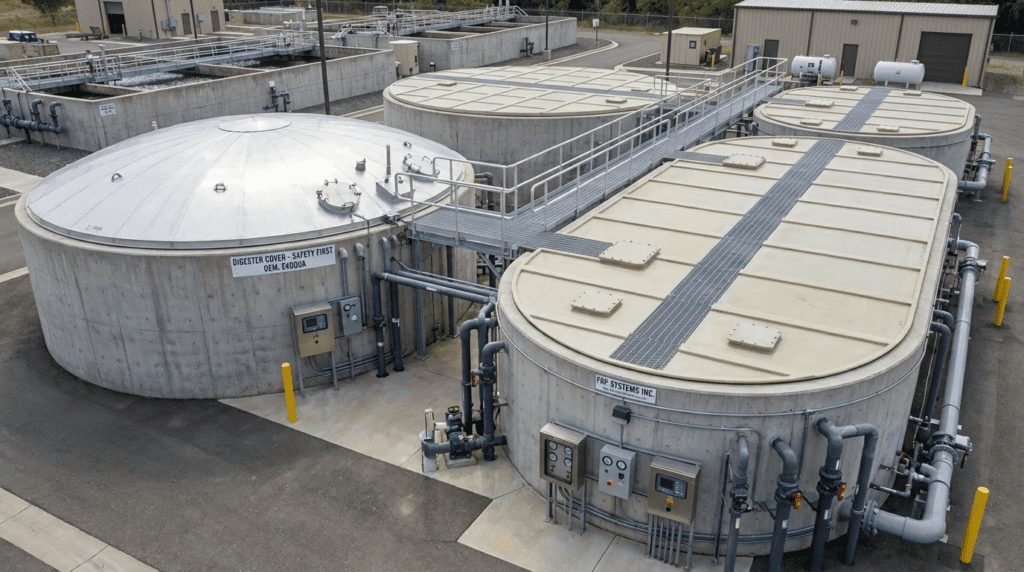
In municipal and industrial water and wastewater treatment infrastructure, the integrity of containment vessels and the reliability of protective covers are foundational to process safety, regulatory compliance, and environmental stewardship. Tanks and covers serve a dual purpose: they facilitate the secure storage of hazardous chemicals and process fluids while mitigating environmental risks such as odor dispersion, algae growth, and atmospheric contamination. For consulting engineers and plant operators, the selection of Original Equipment Manufacturers (OEMs) in this category is not merely a procurement decision but a critical engineering specification that defines the facility’s lifecycle costs and operational risk profile.
The scope of this equipment category encompasses a diverse range of engineering solutions, from high-density cross-linked polyethylene chemical storage vessels to structural aluminum covers for massive aeration basins, and specialized hydropneumatic surge vessels. Each application presents unique challenges. Chemical feed systems handling aggressive oxidizers like sodium hypochlorite or sulfuric acid require materials that resist embrittlement and stress cracking over decades of use. Conversely, covers for wastewater clarifiers and channels must withstand constant exposure to corrosive hydrogen sulfide (H2S) gas while maintaining structural integrity for personnel access.
Regulatory context heavily influences design requirements. EPA regulations regarding secondary containment, OSHA standards for walking surfaces and confined space entry, and local environmental codes regarding odor control all converge on the specification of tanks and covers. An improperly specified tank material can lead to catastrophic leaks, environmental fines, and emergency shutdowns. Similarly, inadequate cover systems can result in severe corrosion of structural elements, presenting safety hazards to maintenance staff and failing to contain nuisance odors that trigger community complaints.
This article provides a detailed engineering analysis of the top OEMs specializing in tanks, covers, and associated hydraulic vessels. It focuses on the technical distinctives, material science, and application fit for Poly Processing, Assmann Corporation, Pulsco, Hallsten, and NEFCO Systems. The objective is to equip engineers and decision-makers with the technical data required to write defensible specifications and select equipment that ensures long-term process reliability.
How to Select Tanks, Covers, and Hydraulic Vessels
The selection process for tanks and covers involves distinct engineering criteria depending on whether the primary function is chemical storage, process covering, or hydraulic surge control. However, common denominators across all sub-categories include material compatibility, structural mechanics, and maintainability.
Chemical Storage Tank Selection
For chemical storage applications, particularly involving thermoplastics, the engineering focus centers on resin properties and structural design.
- Resin Architecture: The choice between Linear Polyethylene (LPE) and Cross-Linked Polyethylene (XLPE) is critical. XLPE provides superior resistance to environmental stress cracking and higher tensile strength, making it the preferred choice for aggressive chemicals. Engineers must evaluate the specific gravity rating of the tank; standard ratings often range from 1.5 to 1.9 or higher depending on the fluid density.
- Oxidation Resistance: Chemicals like sodium hypochlorite degrade polyethylene over time through oxidation. Selection must account for antioxidant additive packages in the resin that extend the tank’s service life.
- Outlet Design: Traditional sidewall fittings are stress concentration points prone to leaks. Integral molding, where the flange is cast as part of the tank monolith, eliminates mechanical joints below the liquid level, significantly reducing leak risk.
- Containment Strategy: Double-wall systems (tank-in-a-tank) are often required for hazardous chemicals to meet passive spill containment regulations without the need for concrete bunds.
Structural and Odor Control Cover Selection
When specifying covers for process tanks, channels, or basins, the interaction between structural load and corrosion resistance is paramount.
- Material Selection: Aluminum and Fiberglass Reinforced Plastic (FRP) are the standards. Aluminum (typically 6061-T6 alloy) offers excellent strength-to-weight ratios and UV resistance but requires careful isolation from dissimilar metals to prevent galvanic corrosion. FRP offers superior corrosion resistance in high-H2S environments but requires UV inhibitors to prevent fiber blooming.
- Load Ratings: Engineers must define live load requirements based on access needs. A non-traffic odor cover may only need to withstand snow loads and wind uplift, whereas a cover intended for operator access requires a 50 psf to 100 psf rating with appropriate deflection limits (e.g., L/240 or L/360).
- Span Capabilities: For large basins, the ability of the cover system to span significant distances without intermediate supports reduces the complexity of internal structures and simplifies sludge removal mechanisms.
- Gas Tightness: For odor control, the sealing mechanism between panels and at the tank perimeter is critical. Gasket materials (EPDM, Neoprene) must be compatible with the headspace gases.
Surge and Process Vessel Selection
For pressurized applications dealing with hydraulic transients, the “tank” becomes a dynamic component of the pumping system.
- Energy Dissipation: Selection involves calculating the required gas volume to absorb pressure surges (water hammer) caused by pump trips or valve closures.
- Bladder vs. Air-Over-Water: Bladder tanks prevent the gas charge from dissolving into the fluid, reducing maintenance (re-charging). Air-over-water vessels require compressor systems but are suitable for larger volumes.
- Code Compliance: These vessels almost always require ASME Section VIII, Division 1 certification for unfired pressure vessels.
Comparison Table
The following table categorizes the designated OEMs based on their primary engineering discipline within the broad “Tanks & Covers” sector. Engineers should use this to quickly identify which manufacturer is relevant to the specific sub-system (e.g., chemical storage vs. structural decking vs. hydraulic protection) under consideration.
| OEM Name | Primary Discipline | Typical Applications | Key Technical Strengths | Engineering Limitations |
|---|---|---|---|---|
| Poly Processing | Chemical Storage Tanks | Bulk chemical storage (Hypo, Alum, Caustic), Day tanks | Cross-linked PE (XLPE) technology; Integrally Molded Flanged Outlets (IMFO); Oxidation Resistant (OR-1000) system. | Not suitable for high-pressure or high-temperature (>150°F) applications; size limited by rotational molding constraints. |
| Assmann Corporation | Chemical Storage Tanks | Industrial and municipal chemical feed, double-wall containment | Uniform wall thickness; large capacity double-wall tanks; customized fitting placement during molding. | Linear PE focus may require specific evaluation for high stress-crack applications compared to XLPE. |
| Hallsten | Structural Aluminum Covers | Clarifiers, Aeration Basins, UV Channels, Odor Control | High-strength aluminum extrusion; interlocking slat design; modularity; spans large distances without supports. | Aluminum requires isolation in extremely high pH environments or where galvanic potential is high. |
| NEFCO Systems | Process Internals & FRP Covers | Launder covers, Density Current Baffles, Weir Plates | Specialized focus on clarifying tank hydraulics (baffles); corrosion-resistant FRP components; inhibits algae growth. | Primary focus is process enhancement/covering specific zones (launders) rather than bulk storage vessels. |
| Pulsco | Surge & Pulsation Vessels | Pump stations, Force mains, Hydraulic protection | Gas-liquid interface engineering; hydropneumatic surge control; pulsation dampening for positive displacement pumps. | Specialized pressure vessels only; not a provider of atmospheric storage tanks or structural covers. |
Top OEMs / System Integrators
Poly Processing
Poly Processing is a dominant figure in the manufacturing of high-density cross-linked polyethylene (XLPE) chemical storage tanks. Their engineering philosophy centers on the molecular superiority of XLPE over linear polyethylene (LPE) for storing hazardous chemicals. In the municipal sector, they are frequently the basis of design for sodium hypochlorite, sulfuric acid, and hydrochloric acid storage.
Technical Differentiators:
- Cross-Linked Polyethylene (XLPE): Unlike linear polyethylene, where molecular chains are separate, Poly Processing utilizes a cross-linking process that bonds the polymer chains together. This creates a material with significantly higher environmental stress crack resistance (ESCR). For engineers, this translates to a tank that is much less likely to fail catastrophically under the stress of heavy chemical loads and cyclical filling.
- IMFO® (Integrally Molded Flanged Outlet): One of the most common failure points in plastic tanks is the metallic insert or bulkhead fitting used for the drain. Poly Processing developed the IMFO system, where the drainage flange is molded as a seamless part of the tank at the lowest point of the sidewall/bottom knuckle. This design allows for full drainage (critical for sludge removal and tank cleaning) without the stress concentrations associated with mechanical fittings. It also places the flange below the liquid level while maintaining a homogenous tank structure.
- OR-1000 System: Addressing the issue of oxidation in bleach applications, Poly Processing engineers an antioxidant barrier system. The OR-1000 is an inner surface layer engineered specifically to resist the oxidizing effects of sodium hypochlorite, extending the tank’s useful life by delaying the onset of resin embrittlement.
Lifecycle Considerations: Poly Processing tanks are generally considered to have a finite life in oxidative service (typically 10-20 years depending on conditions), but their initial cost is lower than fiberglass or exotic alloys. The transparent nature of natural polyethylene also allows operators to visually verify liquid levels without external gauges, reducing leak paths.
Assmann Corporation
Assmann Corporation specializes in rotational molding of polyethylene storage tanks and containers, serving both municipal water treatment and industrial wastewater sectors. They are particularly noted for their rigorous manufacturing controls and the ability to produce large-scale double-wall tank systems.
Technical Differentiators:
- Uniform Wall Thickness: Assmann emphasizes a molding process that ensures uniform wall thickness throughout the vessel, including the corners and transition zones. Variations in wall thickness can lead to stress risers; Assmann’s process control aims to eliminate these weak points.
- Double-Wall Tanks: For facilities where concrete secondary containment bunds are not feasible or cost-prohibitive, Assmann offers a robust line of double-wall tanks. The outer tank provides greater than 110% containment of the inner tank volume. The engineering design often includes interstitial leak detection ports, allowing for the integration of electronic leak sensors that tie back to the plant SCADA system.
- Customization Flexibility: Assmann’s tooling and manufacturing process allow for significant flexibility in the placement of fittings, manways, and accessories. Engineers can specify nozzle locations that align precisely with piping isometric drawings, reducing the need for complex field piping adjustments.
Lifecycle Considerations: Assmann tanks are designed for chemical resistance and durability. Their use of high-grade resins ensures compatibility with a broad spectrum of water treatment chemicals. Maintenance is generally low, primarily involving periodic inspection of gaskets and containment spaces.
Pulsco
While often categorized under “tanks” due to the pressure vessel nature of their equipment, Pulsco occupies a specialized niche in hydraulic transient control. They engineer hydropneumatic surge tanks and pulsation dampeners that protect piping networks and pumps from destructive pressure waves.
Technical Differentiators:
- Hydropneumatic Surge Control: Pulsco designs vessels that utilize a gas cushion (typically air or nitrogen) to absorb the kinetic energy of a moving fluid column when a pump trips or a valve slams shut. These vessels prevent column separation and the subsequent high-pressure return wave (water hammer) that can rupture pipes or crack pump casings.
- Pulse Dampening: In applications utilizing positive displacement pumps (e.g., metering pumps for chemical feed), flow is pulsatile. Pulsco manufactures dampeners—small specialized tanks—that smooth out these hydraulic pulses, ensuring a linear flow rate and protecting downstream instrumentation (like flow meters) from damage and erratic readings.
- Gas-Liquid Interface Management: A key aspect of Pulsco’s engineering is the management of the interface between the gas charge and the liquid. Whether through bladder designs (which physically separate the media) or air-over-water designs (which may require compressor support), their vessels are sized and configured to maintain the correct pre-charge pressure for the specific hydraulic profile of the system.
Lifecycle Considerations: The primary maintenance item for Pulsco vessels is the integrity of the bladder (if equipped) and the maintenance of the pre-charge pressure. Correctly specified, these vessels prevent catastrophic failure of the entire piping network.
Hallsten
Hallsten is a premier manufacturer of structural aluminum covering systems. Their designs are ubiquitous in municipal wastewater treatment plants, covering clarifiers, trickling filters, and aeration basins to contain odors and provide operator access.
Technical Differentiators:
- Interlocking Aluminum Planks: The core of the Hallsten system is a proprietary extruded aluminum deck slat. These slats interlock to form a continuous, rigid surface. The extrusion geometry is engineered to maximize stiffness, allowing the covers to span significant distances (often 20-30 feet or more) without the need for intermediate beams or trusses.
- Modularity and Access: Unlike rigid FRP domes, Hallsten covers are modular. Individual planks or sections can be removed to access the tank internals. This is critical for maintenance operations such as pump removal or mixer service. The system can be designed with integrated hatches and access ports that sit flush with the deck.
- Odor Control: While the deck is structural, it is also designed for containment. The interlocking joints and perimeter seals are engineered to minimize the escape of H2S and other volatile organic compounds (VOCs). This aids significantly in navigating air quality permitting and neighborhood relations.
Lifecycle Considerations: Aluminum forms a natural oxide layer that protects it from corrosion in many environments. However, in high-pH environments or where direct contact with concrete occurs, protective coatings or isolation gaskets are required. A Hallsten deck typically offers a very long service life with minimal maintenance compared to coated steel.
NEFCO Systems
NEFCO Systems focuses on the optimization of clarifier performance and the containment of specific tank zones. They are best known for their engineered Fiberglass Reinforced Plastic (FRP) products that modify tank hydraulics and cover effluent channels.
Technical Differentiators:
- Density Current Baffles: NEFCO designs and manufactures Stamford Baffles and other density current baffling systems. These internal tank structures prevent short-circuiting in clarifiers, forcing flow paths that optimize solids settling. The engineering involves precise hydraulic calculations to determine baffle placement and depth.
- Launder Covers: One of NEFCO’s primary contributions to the “cover” category is the launder cover system. These covers shield the effluent troughs (launders) of clarifiers. By blocking sunlight, they prevent algae growth, which is a significant maintenance headache and a source of suspended solids in the effluent. They also contain odors emanating from the weir drop.
- FRP Material Advantages: NEFCO utilizes high-quality FRP laminates that are impervious to the corrosive attack of wastewater gases. The materials are lightweight, reducing the dead load on the clarifier walls or mechanism supports.
Lifecycle Considerations: NEFCO’s FRP components are virtually maintenance-free regarding corrosion. The primary operational benefit is the reduction in manual cleaning hours required for algae removal in launders, offering a tangible return on investment for plant operators.
Application Fit Guidance
Selecting the correct OEM requires matching the vendor’s specialized capabilities with the specific facility application.
Municipal Water Treatment
In potable water treatment, chemical purity and NSF/ANSI 61 compliance are drivers.
- Chemical Feed: Poly Processing and Assmann are the standard choices for storing fluorosilicic acid, sodium hypochlorite, and alum. The IMFO design from Poly Processing is particularly valued for cleaning out sludge from alum tanks.
- Hydraulic Protection: Pulsco vessels are critical in high-service pump stations to prevent surge damage to distribution mains.
Municipal Wastewater Treatment
Wastewater applications prioritize corrosion resistance against H2S and odor containment.
- Odor Control & Access: Hallsten is the preferred choice for covering large aeration basins or channels where operators need to walk on the cover to access equipment. The aluminum construction resists the moist, corrosive atmosphere better than galvanized steel.
- Clarifier Optimization: NEFCO Systems is the go-to for clarifier upgrades. Installing their density current baffles improves settling capacity, potentially delaying the need for plant expansion. Their launder covers are essential for plants struggling with algae in effluent troughs.
- Chemical Storage: Poly Processing is widely used for storing odor control chemicals (like Bioxide or caustic soda) and disinfection chemicals.
Industrial Wastewater
Industrial applications often involve higher temperatures or specific chemical cocktails.
- Acid/Base Storage: Both Poly Processing and Assmann provide robust solutions for pH neutralization systems. Engineers must verify temperature ratings, as polyethylene has distinct thermal limits (typically max 100°F – 150°F depending on resin and design).
- Containment: Assmann’s large double-wall tanks are ideal for industrial sites with limited space for concrete containment dykes.
Engineer & Operator Considerations
Beyond selection, the long-term success of these installations depends on proper integration and maintenance strategies.
Installation and Commissioning
- Tank Pads: Plastic tanks (Poly/Assmann) require fully supported, monolithic flat bottoms. They cannot be placed on grillage or uneven concrete. Engineers must specify concrete pads that are level and free of debris to prevent bottom stress failure.
- Flexible Connections: Polyethylene tanks expand and contract with temperature and hydrostatic load. Rigid piping hard-piped to the tank sidewall is a leading cause of cracking. Engineers must specify flexible expansion joints or hoses at all tank nozzles to isolate line stress.
- Dissimilar Metals: When installing Hallsten aluminum covers on concrete tanks, isolation materials (like neoprene or EPDM gaskets) must be used to prevent the aluminum from reacting with the alkaline concrete. Additionally, stainless steel anchors should be isolated from the aluminum to prevent galvanic corrosion.
Maintenance and Access
- Cleaning Access: For chemical tanks, the location of the manway is critical. It should be accessible from a platform or ladder. The IMFO design (Poly Processing) significantly reduces the confined space entry requirements for cleaning, as the tank drains completely.
- Bladder Maintenance: For Pulsco vessels, operators must establish a routine to check the pre-charge pressure. A loss of pre-charge renders the surge tank ineffective.
- Cover Removal: Hallsten covers are modular, but they can be heavy. Operators should be trained on the proper sequence of removal to ensure safety. Design engineers should incorporate lifting lugs or davit crane sockets if frequent removal is anticipated.
Lifecycle and Material Degradation
- UV Exposure: While modern resins and aluminum alloys are UV stabilized, long-term exposure can cause surface chalking in FRP and polyethylene. This is usually cosmetic but should be monitored. Painting polyethylene tanks is difficult due to low surface energy; insulation or shelters are better options for extreme sun exposure.
- Chemical Embrittlement: Engineers should plan for the replacement of sodium hypochlorite tanks every 10-15 years. It is a proactive maintenance measure to prevent sudden failure due to oxidative embrittlement.
Conclusion
The “Tanks & Covers” category encompasses a vital set of infrastructure components that protect the process, the environment, and the personnel at water and wastewater facilities. Selecting the right OEM requires a granular understanding of the application’s physics and chemistry. For aggressive chemical storage, the cross-linked polyethylene technology of Poly Processing and the precision molding of Assmann Corporation provide the industry standard for safety and containment. For structural covering needs, Hallsten’s aluminum systems offer a balance of strength and corrosion resistance, while NEFCO Systems specializes in the hydraulic optimization of process tanks through internal baffles and launder covers. Finally, Pulsco remains the authority on protecting these systems from hydraulic transients through engineered surge vessels.
By strictly adhering to these established OEMs and understanding their specific engineering strengths, consulting engineers can specify systems that minimize lifecycle costs, ensure regulatory compliance, and provide reliable service for decades.