
Varec Biogas (Ovivo) vs Smith & Loveless for Digestion
Introduction
One of the most persistent operational headaches in municipal wastewater treatment is the gradual loss of anaerobic digester capacity to inadequate mixing and poor gas handling. Engineers routinely find digesters that have surrendered a substantial share of their active volume to grit accumulation and scum blankets, necessitating dangerous and expensive cleanouts. The decision on which technology to specify for digester rehabilitation or new construction is critical, often reducing to a choice between gas injection mixing and hydraulic or mechanical pumping systems.
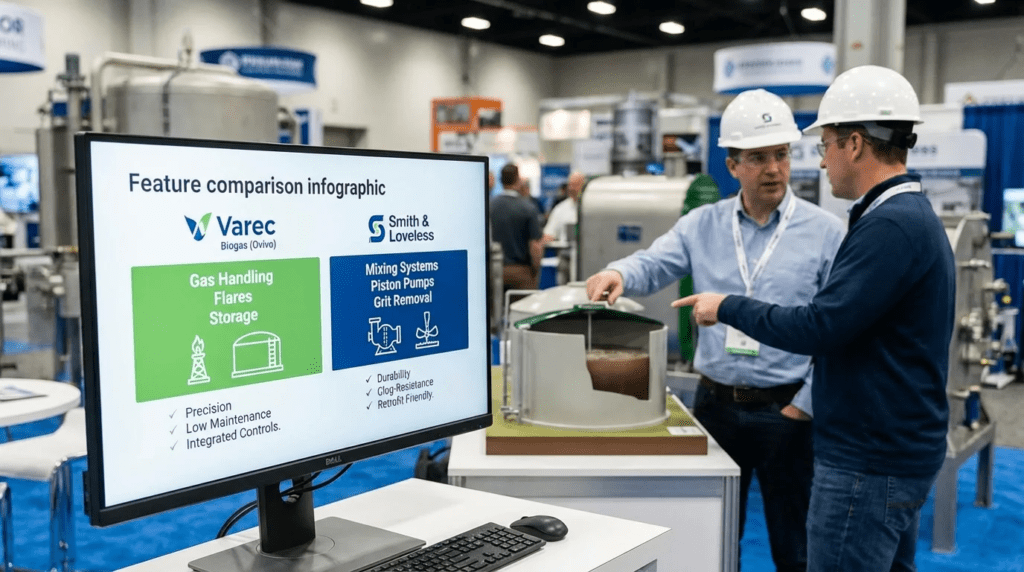
When evaluating established suppliers in this space, the comparison of Varec Biogas (Ovivo) vs Smith & Loveless for Digestion represents a decision between two distinct philosophies: unconfined gas mixing combined with comprehensive gas safety equipment (Varec, under Ovivo) versus external hydraulic recirculation built around robust non-clog pumping (Smith & Loveless). One important clarification before going further: Varec’s own product identity is digester gas safety equipment — pressure/vacuum relief valves, flame arresters, sediment traps, and waste gas burners. Gas mixing is supplied within the broader Ovivo digestion portfolio. Smith & Loveless, similarly, is a pump and package equipment manufacturer whose role in a hydraulic mixing loop is the pumps, not a packaged mixing system. Reading the comparison as “one vendor’s mixing system versus another’s” misstates what each firm actually sells.
This article provides a technical analysis for consulting engineers and utility directors. It moves beyond brochure claims to examine the hydraulic principles, maintenance realities, and lifecycle costs associated with these systems, and sits within the wider survey of digester manufacturers that engineers consult when assembling a bid list. Whether you are retrofitting a 50-year-old fixed-cover digester or designing a high-rate egg-shaped reactor, understanding the specific application fit will prevent costly change orders and long-term operational deficiencies.
How to Select and Specify
Comparing Varec (now under the Ovivo umbrella) and Smith & Loveless requires a bifurcated approach. Varec is the long-standing standard for gas safety equipment. Smith & Loveless is known for pumping systems and hydraulic handling. The specification choice is therefore between gas mixing and hydraulic mixing as technologies, plus a separate decision about whether a single-source vendor is required for the entire digestion complex.
Duty Conditions & Operating Envelope
The primary driver for selection is the digester’s physical geometry and the characteristics of the sludge.
- Solids Concentration: Hydraulic mixing systems generally maintain efficiency up to 5-6% total solids. Above this threshold, friction losses in external piping increase sharply, requiring significantly higher horsepower. Gas mixing systems can handle somewhat higher viscosities but depend on the compressor’s ability to overcome hydrostatic pressure and sludge rheology.
- Tank Geometry:
- Cylindrical/Pancake: Both systems work, but floor scour becomes critical. Hydraulic nozzles must be aimed precisely to create a toroidal flow pattern.
- Egg-Shaped: Often favor draft tube or vertical gas injection to use the natural convection of the shape.
- Gas Production Rates: For gas mixing, the available biogas is the mixing medium. In startup scenarios where gas production is low, the system must operate on an alternative gas or follow a specialized startup protocol. Hydraulic systems are independent of gas production.
Materials & Compatibility
Corrosion is the defining failure mode in anaerobic digestion headspaces.
- Gas Phase (H2S): Components exposed to biogas must resist hydrogen sulfide corrosion. Varec gas safety equipment typically specifies low-copper aluminum, 316SS, or castings designed for sour gas service. In-tank gas lances are usually 316SS.
- Liquid Phase (Abrasion): Hydraulic systems pass sludge through pumps and piping. Impeller material hardness is critical if the plant has poor headworks grit removal. Hardened iron or high-chrome alloys are necessary to prevent rapid wear of pump volutes.
- Struvite Potential: This is a major differentiator.
- Gas Mixing: Struvite (magnesium ammonium phosphate) tends to precipitate on gas lances and bubbler tubes, especially at the gas/liquid interface. This can plug orifices, requiring the tank to be taken offline for cleaning.
- Hydraulic Mixing: Struvite forms in pipelines and pump volutes. Lined pipe or periodic acid cleaning loops are common specification requirements to maintain capacity in the recirculation piping.
Hydraulics & Process Performance
When analyzing Varec Biogas (Ovivo) vs Smith & Loveless for Digestion, the definition of “mixing” differs.
Gas Mixing: Relies on the buoyancy of gas bubbles to create vertical lift. The specification should focus on SCFM per 1,000 ft³ of volume. It creates zonal mixing, which is generally effective for volatile solids reduction but can struggle with heavy grit suspension on the tank floor if floor coverage is inadequate.
Hydraulic Mixing: Relies on momentum transfer from a nozzle. The specification logic is horsepower per 1,000 ft³ or turnover time. Non-clog pumps, wet-well mounted or dry pit, draw sludge and re-inject it. This provides positive, verifiable movement of fluid but introduces ragging risks at the pump suction.
Installation Environment & Constructability
Space constraints often dictate the winner in retrofit applications.
- Compressor Room vs. Pump Room: Gas mixing requires a compressor building, but the piping running to the tank is small-diameter gas line. Hydraulic systems require large-diameter sludge piping (8″-12″+) and space for pumps. In tight galleries, routing 12″ ductile iron is significantly harder than 2″ stainless gas line.
- Tank Penetrations: Gas systems typically enter through the cover, floating or fixed. Hydraulic systems may require core-drilling the tank walls for suction and discharge nozzles, which can be structurally risky in older prestressed concrete tanks.
Reliability, Redundancy & Failure Modes
- Redundancy: Specifications should require N+1 compressors for gas systems or N+1 pumps for hydraulic systems.
- Ragging: Sludge pumps, while robust, are susceptible to ragging if screening is poor. Chopper pumps or specific impeller geometries must be specified. Gas mixing has no moving parts in the liquid, making it immune to ragging, though the compressors require maintenance.
Maintainability, Safety & Access
- Gas Safety Integration: Varec provides a cover-to-flare safety approach. Their pressure/vacuum relief valves and flame arresters are standard specifications. Sourcing the gas train from one supplier simplifies the safety review of the whole system.
- Maintenance Access: Smith & Loveless emphasizes external maintenance access that keeps operators out of the tank. Gas systems also keep operators out during normal operation, but internal maintenance such as bubbler cleaning is a major confined space event.
Lifecycle Cost Drivers
- Energy Efficiency: Gas mixing historically consumes less power than hydraulic mixing for the same active volume, since overcoming hydrostatic head with gas buoyancy is often more efficient than pumping viscous sludge against friction losses.
- OPEX: Hydraulic systems have higher wear parts costs (seals, impellers, wear rings). Gas systems have lower parts costs but potentially higher labor costs if lances foul.
The Mixing System Cannot Fix the Grit Problem
Every digester mixing comparison eventually turns into a grit argument, and the argument is usually being had in the wrong place. Grit that reaches the digester will accumulate, because the digester is a quiescent vessel with a long retention time and grit is denser than the sludge around it. A mixing system can keep some of it in suspension and move some of it toward a withdrawal point. It cannot remove it, and no mixing technology on the market changes that.
The practical consequence is that grit accumulation is a headworks problem presenting itself downstream. A plant losing volume to grit at an unusual rate should look at the grit removal system’s actual capture efficiency across the particle size distribution it receives — particularly the fine fraction below about 150 microns, which many older vortex and aerated units pass almost entirely and which is a large share of what settles in a digester. Specifying a more aggressive mixing system to compensate is buying horsepower to stir sand.
Where the mixing choice genuinely matters is in what happens to the grit that does get in. Hydraulic systems with floor-directed nozzles can sweep material toward the sludge withdrawal point, so it leaves the tank with the drawdown rather than building a cone. Gas systems create zonal circulation with quiescent areas between the discharge points, and grit collects there. If the plant’s grit removal is known to be marginal and cannot be upgraded in the same project, that is a legitimate argument for the hydraulic option — not because it removes grit, but because it keeps the accumulation moving toward an exit.
The second practical consequence is a design one: put a real cleanout plan in the documents. Access hatches sized for equipment, a sludge withdrawal point at the low spot, and a documented drawdown procedure cost little at design and are the difference between a two-week cleanout and a two-month one.
Comparison Tables
The following tables break down the technical differences between the two mixing approaches. Table 1 focuses on the mixing methodology, which is the primary point of divergence. Table 2 outlines the typical application fit for varying plant constraints.
| Feature | Gas Mixing (Varec gas train / Ovivo portfolio) | Hydraulic Mixing (Smith & Loveless pumps) |
|---|---|---|
| Primary Energy Source | Rotary vane or liquid ring compressors (gas compression) | Centrifugal pumps (kinetic energy) |
| Mechanism | Bubble rise creates vertical draft and turnover; lances or floor-mounted diffusers. | Directional nozzles inject high-velocity sludge to create toroidal rotation. |
| Internal Moving Parts | None (passive lances and pipes only). | None inside tank (nozzles only); pumps are external. |
| Scum Suppression | Moderate; gas bubbles break surface tension, but may not re-entrain thick grease caps effectively without surface-directed designs. | High; nozzles can be aimed specifically at the surface to break and re-entrain scum blankets. |
| Grit Suspension | Variable; depends on floor coverage density. Dead zones between lances are common. | Good; floor scour velocity can sweep grit toward the withdrawal point. Neither system removes grit. |
| Sensitivity to Ragging | Negligible. | Moderate; pump impellers can foul without upstream grinding or chopping. |
| Maintenance Profile | Compressor maintenance (accessible). Internal lances susceptible to struvite plugging, requiring draining. | Pump maintenance (seals, bearings, impellers). External access allows repair without draining tank. |
| Power Consumption | Typically lower, in the range of 0.2 HP/1,000 ft³ equivalent. | Typically higher, in the range of 0.3 HP/1,000 ft³. |
| Scenario | Gas Mixing Fit | Hydraulic Mixing (Smith & Loveless) Fit |
|---|---|---|
| Existing Tank with Fixed Cover | Strong: Can often retrofit gas lances through existing cover penetrations. | Weak: Difficult to install new large-bore suction and discharge piping without major structural work. |
| High Rag Content Sludge | Excellent: No ragging potential in the mixing mechanism. | Moderate: Requires chopper pumps or inline grinders, increasing CAPEX and OPEX. |
| High Struvite Potential | Poor/Caution: Gas injection points are prime spots for crystallization. | Neutral: Lined pipe can mitigate, and chemical cleaning loops are easier to implement. |
| Single-Source Responsibility | Strong: If one vendor is wanted for cover, mixing, and gas safety train. | Partial: Covers the mixing and pumping scope; the gas safety train comes from a separate supplier. |
| Operator Skill Level | Requires knowledge of gas compressors and low-pressure gas safety. | Standard mechanical pump maintenance, familiar to most WWTP operators. |
Engineer & Operator Field Notes
Real-world experience often diverges from the theoretical curves provided in submittals. The following sections detail practical insights from field deployments.
Commissioning & Acceptance Testing
Verifying mixing performance is notoriously difficult once the tank is filled.
- Lithium Tracer Testing: This is the standard method for both technologies. A pulse of lithium chloride is injected, and the concentration is monitored at the withdrawal point.
- Success Criteria: Look for active volume above 90%. If the tracer indicates only 60-70% active volume, there are significant dead zones or short-circuiting.
- Gas System Specifics: Verify that the compressor discharge pressure matches the hydrostatic head calculation. If pressure is lower than calculated, a lance may be broken near the surface.
- Hydraulic System Specifics: Verify nozzle velocity. Use a portable Doppler flow meter on the exterior piping to confirm flow rates match the pump curve.
- Temperature Profiling: Install temperature probes at multiple depths. A well-mixed digester should not vary more than 1°F to 2°F throughout the vertical profile. Stratification indicates mixing failure.
Common Specification Mistakes
- Undersizing Compressors: Engineers often size compressors on steady-state gas production. Sequenced or burst injection modes require higher instantaneous flow rates. Ensure the VFD and motor are sized for the peak sequencing load, not just the average.
- Ignoring Pipe Friction: Sludge at 5% solids behaves as a non-Newtonian fluid. Using water friction curves for recirculation piping results in undersized pumps that cannot achieve the required nozzle velocity. A safety factor of 1.5 to 2.0 on friction head is prudent.
- Mismatched Pressure/Vacuum Relief: When specifying gas mixing, ensure the tank’s pressure/vacuum relief valve is sized to handle the maximum instantaneous gas addition from the mixing system plus the peak biological gas production. Failing to account for the mixing gas input can over-pressurize the tank.
O&M Burden & Strategy
- Hydraulic (Smith & Loveless): The primary burden is mechanical seals and wear rings. In grit-heavy environments, volute thickness checks should be performed annually using ultrasonic testing. Wet-well mounted designs afford good ergonomic access, but expect to change seals every 2-3 years.
- Gas (Varec / Ovivo): The compressor is the heart of the system. Rotary vane compressors require vane replacement and rigorous oil changes. The hidden burden is the condensate traps in the gas lines. These must be drained daily or automated; otherwise, liquid blocks the gas flow, stopping mixing in that zone.
Design Details & Calculations
When engineering the system, relying solely on vendor recommendations can be risky. Use these design parameters to validate the proposals.
Sizing Logic: Mixing Energy
Regardless of the technology chosen, the system must meet minimum energy inputs.
1. Hydraulic Mixing
The standard benchmark is horsepower per unit volume.
- Standard: 0.2 to 0.3 HP per 1,000 ft³ of active volume.
- Velocity Gradient (G): Target G-values between 50 and 80 per second.
- Turnover Time: The total tank volume should theoretically pass through the mixing system every 20 to 30 minutes.
- Calculation: Required flow equals active volume divided by turnover time. Ensure nozzle exit velocity exceeds 20 ft/s to promote momentum transfer.
2. Gas Mixing
The benchmark is gas flow per unit volume.
- Standard: 4.5 to 6.0 SCFM per 1,000 ft³ of active volume for unconfined mixing.
- Floor Coverage: Crucial for unconfined gas systems. Ensure gas lances or floor diffusers are spaced to influence the entire floor area. A typical radius of influence for a single discharge point is 5-8 feet.
Specification Checklist
Include these specific line items in your Division 43 or 46 specifications:
- Performance Guarantee: Vendor must guarantee above 90% active volume as verified by lithium tracer test.
- Vibration Analysis: Require factory vibration testing for recirculation pumps at the design operating point on sludge duty, not just water.
- Hazardous Area Compliance: All in-tank components and gas handling equipment must meet NFPA 820 requirements for the classified area.
- Material Certifications: 316L stainless steel for all wetted gas piping; hardened iron for hydraulic pump impellers.
- Cleanout Provisions: Access hatch sizing, low-point withdrawal, and a documented drawdown procedure.
Frequently Asked Questions
What is the main difference between Varec Biogas and Smith & Loveless in digestion?
Their product scopes barely overlap. Varec Biogas (Ovivo) supplies the gas safety train — pressure/vacuum relief valves, flame arresters, sediment traps, waste gas burners — with gas mixing available through the wider Ovivo portfolio. Smith & Loveless supplies the pumps that make hydraulic mixing and recirculation work. The real comparison is between gas mixing and hydraulic mixing as technologies, not between two competing packages.
Which system is better for scum suppression?
Generally, hydraulic mixing with dedicated scum nozzles is superior for physically breaking up heavy scum blankets. The high-velocity liquid jet can break and re-entrain grease caps. Unconfined gas mixing disrupts the surface, but can allow scum to accumulate between bubble zones unless specifically designed with draft tubes or surface-directed discharge.
Can I use Varec gas safety equipment with Smith & Loveless mixing?
Yes, and this is the most common configuration in practice. Engineers routinely specify Smith & Loveless for the sludge mixing and recirculation pumps and Varec (Ovivo) for the cover safety equipment, waste gas burners, and flame arresters. Because the two firms sell different things, this is not a compromise — it is the normal arrangement.
How does maintenance differ between the two systems?
Gas system maintenance is focused on the compressor room and condensate management in gas lines. In-tank maintenance is rare but difficult, requiring the tank to be drained. Hydraulic maintenance is focused on the pumps. While pump maintenance is more frequent, it is performed externally without interrupting the digestion process, which many operators prefer.
What is the typical lifecycle cost difference?
Gas mixing systems typically have lower energy costs but may have higher long-term costs associated with cleaning in-tank components if struvite is present. Hydraulic systems generally have higher energy costs and higher wear-part costs, but offer greater operational continuity and easier access.
How do I select between gas and hydraulic mixing for a retrofit?
If the existing tank has good structural integrity but limited access for large piping, gas mixing is often easier to retrofit because gas lines are small. If the tank has a history of grit accumulation, hydraulic mixing with floor-scouring nozzles keeps material moving toward the withdrawal point, provided the large core drills required for suction and discharge piping are structurally acceptable.
Where do the gas safety comparisons fit relative to this one?
The mixing decision and the gas train decision are separate procurements. Once the mixing technology is settled, the safety equipment comparison is between the specialist suppliers in that field — worked through in Varec Biogas (Ovivo) vs Shand & Jurs and Smith & Loveless vs Shand & Jurs — while the broader supplier landscape is surveyed in the review of digestion system OEMs.
Conclusion
Key Takeaways
- Scope Split: Varec = gas safety train (mixing via the wider Ovivo portfolio). Smith & Loveless = pumps for hydraulic mixing and recirculation. They are not substitutes for one another.
- Maintenance Trade-off: Gas mixing requires less daily maintenance but poses confined space risks for lance repairs. Hydraulic mixing offers external, operator-safe maintenance but requires more frequent seal and wear part attention.
- Energy: Gas mixing is generally more energy-efficient (around 0.2 HP/1,000 ft³) compared to hydraulic mixing (around 0.3 HP/1,000 ft³).
- Struvite: Avoid gas mixing if the sludge has high struvite potential unless acid cleaning provisions are included.
- Grit is Upstream: No mixing system removes grit. Fix it at the headworks; choose hydraulic mixing if you cannot, because it keeps accumulation moving toward an exit.
- Hybrid Specs: It is standard practice to combine these vendors — pumps from one, gas safety train from the other.
When deciding between Varec Biogas (Ovivo) vs Smith & Loveless for Digestion, the engineer is choosing between two mixing philosophies: the buoyancy-driven efficiency of gas or the kinetic robustness of hydraulics. There is no single correct choice for every plant. High-rate digesters with heavy grease loads may benefit from the shear forces of hydraulic nozzles. Large diameter tanks where energy efficiency is paramount may favor the zonal mixing of gas injection.
The most successful designs result from a rigorous analysis of the specific sludge rheology and the facility’s maintenance culture. If the operations team prefers external mechanical work over compressor maintenance, the hydraulic solution wins. If the facility is energy-sensitive and has clean sludge, gas mixing offers a lower lifecycle cost. Ultimately, the specification must detail the performance criteria—turnover time, active volume, and serviceability—rather than copying a vendor’s standard boilerplate.