
Top OEMs for Screening Equipment
1. INTRODUCTION
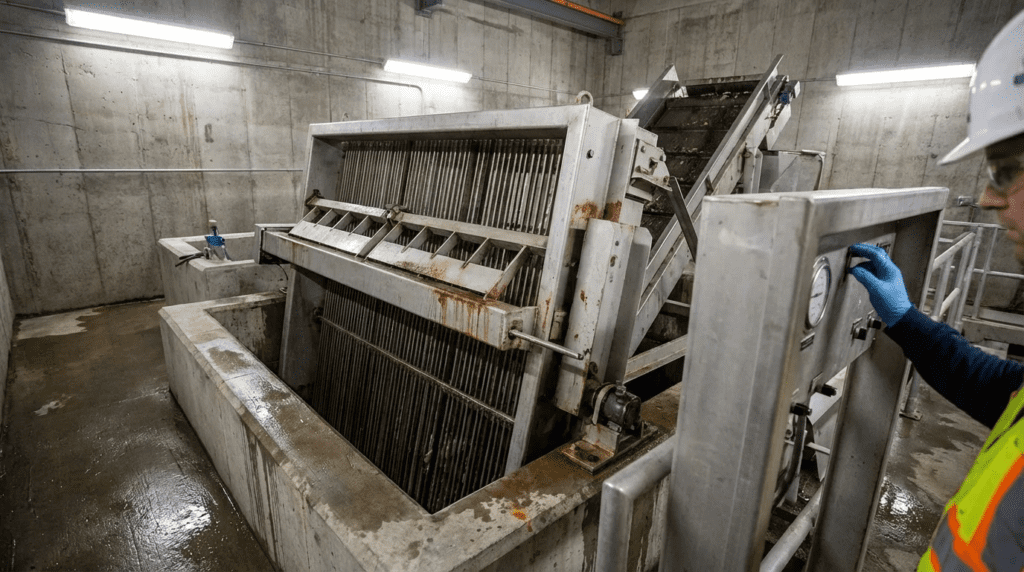
Screening equipment constitutes the first unit operation in the preliminary treatment phase of municipal and industrial wastewater treatment plants (WWTPs). Positioned at the headworks, these systems are critical for the physical removal of gross solids, rags, plastics, and inorganic debris from the influent stream. The primary engineering objective of screening is the protection of downstream mechanical equipment—such as raw sewage pumps, comminutors, pipelines, and aeration diffusers—from clogging, abrasion, and catastrophic mechanical failure. Furthermore, modern biological nutrient removal (BNR) processes and Membrane Bioreactor (MBR) facilities impose stricter requirements on screening performance to prevent the accumulation of inert solids in bioreactors and the fouling of membrane cassettes.
The operating environment for screening equipment is among the most aggressive in the water sector. These units are subjected to variable hydraulic loading, including peak wet weather flows (PWWF) that can carry heavy grit loads and large debris. The atmosphere is typically corrosive, characterized by high humidity and the presence of hydrogen sulfide (H2S), necessitating robust material specifications and explosion-proof electrical classifications (Class 1, Division 1 or 2).
From a regulatory and compliance standpoint, the efficiency of screening impacts the total solids load processed by the facility and the quality of the biosolids produced. Inadequate screening can lead to the “ragging” of pumps and mixers, resulting in increased energy consumption, frequent maintenance interventions, and potential permit violations due to sanitary sewer overflows (SSOs) caused by headworks flow restrictions.
OEM selection in this category is rarely about finding a generic commodity; it involves selecting a technology partner capable of addressing specific hydraulic profiles, channel geometries, and debris characteristics. The difference between a well-specified screen and a mismatched unit is often measured in years of operational uptime versus weekly operator intervention.
2. HOW TO SELECT THIS PROCESS EQUIPMENT
Selecting screening equipment requires a multidimensional engineering analysis that goes beyond simple flow capacity. Engineers must balance capture efficiency (Screenings Capture Ratio – SCR) with headloss constraints and maintenance accessibility. The following criteria define the specification process.
Process Function and Performance Requirements
Screens are generally categorized by the size of the openings: Coarse (6mm to 150mm), Fine (1mm to 6mm), and Micro (<1mm).
- Coarse Screens: Typically used as primary protection for raw sewage pumps. Bar racks (trash racks) are standard here. The goal is to remove large objects (timber, rocks, large rags) that could damage impellers.
- Fine Screens: The industry standard for headworks. Technologies include step screens, perforated plates, and drum screens. For conventional activated sludge plants, 6mm openings are common. For MBR plants, 2mm or 3mm perforated plates are mandatory to protect membranes from hair and fibrous material.
- Capture Efficiency: Engineers must evaluate the Screenings Capture Ratio (SCR). Perforated plates generally offer higher SCR than bar screens for the same opening size because they prevent “stapling” (long thin objects passing through) better than unidirectional bars.
Hydraulic and Process Loading Considerations
Hydraulic calculations are paramount. The screen creates a physical restriction in the channel, inducing headloss.
- Headloss Management: Specifications must define the maximum allowable headloss at Peak Wet Weather Flow (PWWF) with a specific blinding factor (often 30% to 50% blinded). If the headloss exceeds the channel depth capabilities, it can cause upstream flooding or surcharging of the collection system.
- Approach Velocity: To prevent grit deposition in the channel, approach velocity should typically be maintained above 0.4 m/s (1.25 ft/s). However, velocity through the screen face should not exceed 0.9 m/s to 1.2 m/s (3-4 ft/s) to prevent forcing solids through the openings and to limit headloss.
- Flow Variations: The equipment must handle the turn-down ratio between minimum night flows and storm events without bypassing untreated flow.
Materials of Construction
Given the H2S-rich environment, material selection determines the structural longevity of the asset.
- Stainless Steel: AISI 304L is the baseline standard. However, for coastal areas or headworks with high septic conditions, AISI 316L is strongly recommended due to its resistance to pitting and crevice corrosion.
- Duplex Stainless Steel: For extreme industrial applications or high-chloride environments, Duplex 2205 provides superior strength and corrosion resistance.
- Non-Metallic Components: Wear strips, brushes, and spacer gears often utilize HDPE or UHMWPE. These must be UV stabilized if exposed to sunlight and chemically resistant to common cleaning agents.
Integration with Upstream and Downstream Processes
A screen does not operate in isolation. It is the first step in a “screenings handling system” which includes transport, washing, and compaction.
- Screenings Conveyance: The discharge height of the screen must align with the intake of the washer/compactor or conveyor. Screw conveyors or sluice troughs are common.
- Washer/Compactors: To reduce disposal costs and odors, screenings should be washed (to return organics to the flow) and compacted (to increase dry solids content). High-performing systems can achieve over 40% dry solids.
- Controls Integration: The screen operation is typically triggered by a differential level sensor (upstream vs. downstream water level) or a timer. Integration with SCADA for high-level alarms and fail-over logic is critical.
Operations and Maintenance Impacts
The most frequent failure modes in screening involve drive systems and submerged bearings.
- Submerged Bearings: Engineers should prioritize “bottomless” designs or designs where no bearings or sprockets are submerged in the wastewater. Submerged components are difficult to inspect and prone to fouling by grit and hair.
- Cleaning Mechanisms: Screens can be self-cleaning (e.g., rotary drums with spray bars) or mechanically cleaned (rakes). Spray water consumption is a key O&M cost; using plant non-potable water (NPW) is preferred over potable water.
- Operator Safety: Enclosures should be provided to contain aerosols and odors. Access hatches must be large enough for safe removal of jams but interlocked to prevent operation while open.
3. COMPARISON TABLE
The following table contrasts the five mandated OEMs for screening equipment. Engineers should utilize this data to align specific project constraints—such as channel width, MBR requirements, or retrofit limitations—with the manufacturer’s core technical competencies. This is a high-level differentiation based on equipment architecture and historical application data.
| OEM Name | Typical Applications | Engineering Strengths | Limitations | Best-Fit Scenarios | Maintenance Considerations |
|---|---|---|---|---|---|
| JWC Environmental | Headworks, Pump Stations, Prisons/Institutions, Sludge Screening. | Pioneers of dual-shaft grinding technology (Muffin Monster). Strong portfolio of combined screening/grinding systems. High torque capabilities. | Grinders reduce particle size but do not remove solids from the flow (unless paired with a screen). Reconstituted solids can re-weave downstream. | Pump protection in lift stations; applications requiring aggressive size reduction (grinding) alongside screening; constrained footprints. | Cutter cartridge replacement is a specialized maintenance task. Drum screens require spray water for cleaning. |
| Parkson Corporation | Municipal Headworks, Industrial Pre-treatment, Membrane Protection. | Aqua Guard® filter screen is an industry standard for stepped screening. Exceptional capture rates due to filter element design. Robust chain systems. | Mechanically complex chain-and-sprocket assemblies. High capital cost for premium models. | Large municipal headworks requiring fine screening (6mm or less); retrofits into existing channels; high-capture requirements. | Chain tensioning and brush replacement are routine. Inspecting links for wear is critical to prevent tracking issues. |
| Lakeside Equipment | Small to Large Municipal Plants, Septage Receiving, Industrial. | Raptor® series integrates screening, washing, and compacting in a single unit. Efficient cylindrical/rotary designs. 35-degree installation saves space. | Rotary basket designs can be sensitive to heavy grease loads if spray wash is insufficient. | Complete headworks systems (screen + grit); installations requiring integrated washing/compacting; MBR pre-screening. | Spray nozzles require regular checking. Brush wear on rotating drums needs monitoring. |
| Vulcan Industries | Coarse and Fine Screening, Large Pumping Stations, Stormwater. | Heavy-duty custom fabrication. Strong focus on mechanical bar screens and stair screens. capable of handling very large hydraulic loads. | Less focus on ultra-fine membrane protection compared to perforated plate specialists. | Severe duty applications; large channel widths; stormwater intakes; coarse screening requirements. | Mechanical bar screens have moving parts (rakes) that require lubrication and alignment checks. robust but traditional maintenance profile. |
| Hendrick Screen | Water Intakes, Passive Screening, Fish Diversion, Industrial Process. | Specialists in wedge wire and profile wire technology. High precision manufacturing of screen surfaces. Passive intake screens (no moving parts). | Primarily a screen surface/component specialist; fewer “full system” mechanical wastewater headworks installations compared to others. | Surface water intakes; passive screening needs; industrial dewatering surfaces; applications requiring precise slot openings (wedge wire). | Passive screens rely on airburst systems for cleaning (low mechanical maintenance). Wedge wire is durable but difficult to repair if dented. |
4. TOP OEM MANUFACTURERS
The following section details the specific engineering capabilities and product lines of the top OEMs designated for Screening Equipment. The focus is on technical differentiation, drive mechanisms, and screening philosophies.
JWC Environmental
JWC Environmental is arguably most famous for the “Muffin Monster” grinder, a technology that revolutionized solids size reduction in wastewater. However, in the context of screening, JWC leverages this heritage to offer hybrid and standalone screening solutions. Their engineering philosophy often centers on the “grind and screen” or “capture and wash” approach.
Technical Highlights:
JWC’s screening portfolio includes the Monster Separation Systems. A notable technology is the Bandscreen Monster®, which utilizes UHMWPE perforated panels attached to a drive chain. This design eliminates the “carryover” problem often seen in bar screens, as the panels form a continuous barrier. For finer applications, the Finescreen Monster® utilizes continuous stainless steel bands to achieve high capture rates essential for MBR protection.
Engineering Considerations:
JWC equipment is frequently specified in retrofit applications where space is tight. Their “Screenings Washer Monster” is a heavy-duty compactor that can be paired with their screens to produce a very dry cake, reducing hauling costs. Engineers should note that JWC systems are particularly robust in institutional settings (prisons, hospitals) where the debris load is non-standard and heavy.
Parkson Corporation
Parkson Corporation has established itself as a dominant force in the North American headworks market, primarily through the Aqua Guard® screen. The Aqua Guard is a continuous, self-cleaning moving media screen that utilizes a filter element system rather than simple bars or perforated plates.
Technical Highlights:
The core of the Parkson design is the interlocking filter elements. These elements form a grid that captures solids much smaller than the nominal slot size due to the matting effect of the screenings themselves. The screen utilizes a two-stage cleaning process: the elements flex as they go over the head shaft to release solids, followed by a rotating brush. This design allows for high hydraulic throughput with relatively low headloss.
Engineering Considerations:
Parkson offers the Aqua Guard in various configurations (Standard, High Flow, Ultra). For deep channels, high-strength frames are available. Engineers often specify Parkson when “capture ratio” is the primary driver, as the stepped element design prevents long, fibrous materials from orienting themselves to pass through the screen. Parkson also manufactures the Hycor® line of rotoscreens, which are internally fed drum screens suitable for industrial and scum screening applications.
Lakeside Equipment
Lakeside Equipment Corporation is renowned for its focus on complete headworks engineering. Their Raptor® line of screens is distinct for integrating screening, washing, conveying, and compacting into a single, cohesive mechanical unit. This “all-in-one” approach simplifies the layout for engineers and reduces the number of drive motors required.
Technical Highlights:
The Raptor® Fine Screen features a rotating cylindrical basket angled typically at 35 degrees. As wastewater flows into the basket, solids are captured inside. A rotating rake and spray bar system cleans the basket, transporting solids up a central screw conveyor. The screw conveyor has an integrated compaction zone at the top discharge.
Engineering Considerations:
The cylindrical design provides a large surface area relative to the channel width, helping to minimize headloss. The Lakeside design is particularly effective for removing grease and floating solids that can plague flat screens. For MBR applications, the Raptor® Micro Strainer uses a similar rotary drum architecture but with a specific capture basket designed for 1mm to 3mm separation.
Vulcan Industries
Vulcan Industries operates with a philosophy of heavy-duty, custom mechanical fabrication. While they offer standard models, their strength lies in adapting screening technologies to difficult or non-standard civil works. They are a “metal-first” manufacturer, emphasizing structural rigidity and longevity.
Technical Highlights:
Vulcan’s portfolio is broad, covering the Mensura (measuring) Bar Screen, which is a reciprocating rake screen. The design is simple, robust, and utilizes a “back-cleaning” mechanism where the rakes engage the bars from behind (or front, depending on model) to lift debris. They also manufacture the Stair Screen, a step-type screen ideal for fine screening in channels.
Engineering Considerations:
Vulcan screens are often favored in large municipal pump stations and storm intakes where the debris load can be massive and unpredictable (tires, logs, heavy rag balls). Their mechanical bar screens are designed to stall without damage or to utilize slip clutches, protecting the drivetrain. Maintenance is generally straightforward due to the open, accessible design of the mechanical components.
Hendrick Screen
Hendrick Screen occupies a unique niche in this list. While the other OEMs are primarily known for mechanical wastewater screens (moving parts), Hendrick is a global leader in the manufacture of the screening surface itself, specifically wedge wire and profile wire. However, they also supply complete intake screen systems.
Technical Highlights:
The proprietary “Profile Bar” and wedge wire construction offers non-clogging characteristics for static and passive screening. Hendrick’s intake screens are often used in raw water abstraction, utilizing an airburst system to clear debris from the screen surface without removing the screen from the water. In wastewater, they provide run-down screens (static) and components for mechanical screens.
Engineering Considerations:
Hendrick is the go-to specification for passive water intakes where protecting aquatic life (low intake velocity) and minimizing moving parts underwater are the goals. In industrial wastewater, their static sieve bend screens are highly effective for primary separation without energy consumption (gravity feed).
5. APPLICATION FIT GUIDANCE
Correctly matching the OEM and technology to the application is the primary responsibility of the design engineer.
Municipal Wastewater (Headworks)
For standard Activated Sludge plants, Parkson and Lakeside are dominant. The Parkson Aqua Guard is often preferred for large, deep channels in major metropolitan plants due to its heavy-duty chain construction. Lakeside’s Raptor is an excellent fit for medium-sized plants where footprint is constrained, as the integrated compactor removes the need for separate screenings handling equipment.
Membrane Bioreactor (MBR) Protection
MBR plants require screening to < 3mm, preferably with perforated plates to capture hair. JWC Environmental (Finescreen Monster) and Lakeside (Micro Strainer) and Parkson (Aqua Guard Ultra) offer specific models for this. The “stapling” effect of bar screens makes them unsuitable for MBR protection; perforated plate or mesh designs are mandatory.
Coarse Screening & Stormwater
For large trash racks, lift station protection, and combined sewer overflow (CSO) screening, Vulcan Industries excels. Their mechanical bar screens are designed to handle the brute force of large debris flows. JWC grinders are also applicable here to protect pumps from ragging, though they do not remove the load.
Water Intake & Passive Screening
For raw water intakes from rivers or lakes, Hendrick Screen is the primary choice among this group. Their passive wedge wire screens ensure compliance with environmental regulations regarding fish impingement and entrainment, relying on airburst systems rather than mechanical rakes.
6. ENGINEER & OPERATOR CONSIDERATIONS
Beyond the catalog specifications, the reality of installing and running screening equipment dictates long-term satisfaction.
Installation and Commissioning
Channel Tolerances: Civil construction of concrete channels is rarely perfect. Screens, however, are precision machines. Engineers must specify side-wall seals (neoprene or brushes) that can accommodate ±1 inch of civil variance to prevent flow bypass.
Retrofits: When retrofitting a screen into an existing channel, the “drop-in” capability is key. Lakeside’s cylindrical design often fits easily into varying channel widths. Parkson frames are rigid and may require channel modification if the civil work is out of square.
Maintenance Access
The “Bottom Bearings” Issue: Operators universally despise submerged bottom bearings. When they fail, the channel must be dewatered, creating a confined space entry hazard. Where possible, select designs that pivot out of the channel (like some Vulcan or Lakeside models) or designs that utilize a bottom track without a bearing (like the Parkson Aqua Guard, which uses a ceramic or plastic bushing guide rather than a load-bearing shaft).
Odor Control
Screening rooms are odor hotspots. Enclosed screens (like the Lakeside Raptor or fully enclosed Parkson units) significantly reduce fugitive odors compared to open bar screens. Engineers should specify localized odor control extraction ports directly on the screen housing.
Solids Handling
The screen is only as good as the conveyance system taking the trash away. If the compactor jams, the screen backs up. Engineers should prioritize OEMs that supply the screen and the compactor as an integrated package to avoid “finger-pointing” between vendors when interface issues arise.
7. CONCLUSION
The selection of screening equipment is a critical engineering decision that dictates the maintenance intensity of the entire headworks facility. While the fundamental physics of screening remain constant, the execution varies significantly among the top OEMs.
Parkson offers the gold standard in stepped-screen capture efficiency, ideal for stringent downstream protection. Lakeside provides highly integrated, footprint-efficient rotary solutions perfect for modern, compact plants. JWC Environmental bridges the gap between grinding and screening, solving difficult solids problems in lift stations and headworks. Vulcan Industries provides the heavy mechanical muscle for coarse and large-flow applications, while Hendrick Screen dominates the precision wedge wire and passive intake market.
Engineers must move beyond “lowest bid” mentalities for headworks equipment. Specifying a screen based on Lifecycle Cost (LCC)—accounting for wash water usage, preventive maintenance labor, and capture efficiency benefits to downstream aeration—will invariably lead to a more resilient and operator-friendly treatment facility.