
Val-Matic vs Proco Butterfly Valves Equipment: Comparison & Best Fit
Introduction
In the design of municipal water treatment plants and industrial wastewater facilities, the butterfly valve is often treated as a commodity item. This assumption—that “a valve is just a valve”—is a primary driver of unexpected operational expenditure (OPEX) and premature system failure. Engineers frequently encounter scenarios where a valve specified for general isolation fails to seal after only a few years of service, or where actuation torque requirements were drastically underestimated, leading to actuator stall during critical shut-down events. The selection process is rarely about finding a “better” brand in isolation, but rather matching the mechanical design of the valve to the hydraulic rigor of the application.
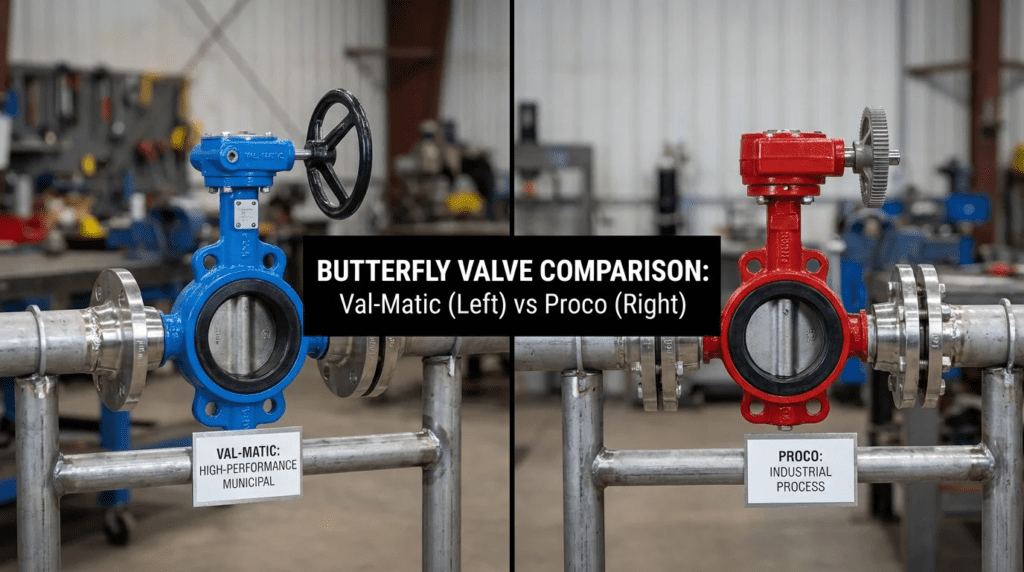
This article provides a technical analysis of Val-Matic vs Proco Butterfly Valves Equipment: Comparison & Best Fit. These two manufacturers represent distinct engineering philosophies within the fluid control sector. Val-Matic is widely recognized for its heavy-duty, AWWA C504-compliant eccentric plug and butterfly valves tailored for municipal distribution and treatment. Proco Products, while globally dominant in expansion joints and check valves, offers a line of resilient-seated, concentric butterfly valves often utilized in industrial piping, HVAC, and auxiliary plant systems. Understanding the divergence in their design—specifically the difference between concentric (rubber-lined) and eccentric (offset) seating mechanisms—is critical for specifying engineers.
Poor selection between these equipment classes can lead to two extremes: over-specification, which bloats capital budgets unnecessarily, or under-specification, which results in leakage, shaft seizing, and non-compliance with municipal standards. This guide aims to equip engineers, directors, and maintenance supervisors with the data necessary to navigate the Val-Matic vs Proco Butterfly Valves Equipment: Comparison & Best Fit landscape effectively.
How to Select / Specify
Selecting the correct butterfly valve requires a granular analysis of the process fluid, the physical installation constraints, and the required longevity of the seal. The following criteria provide a framework for evaluating options.
Duty Conditions & Operating Envelope
The primary differentiator when analyzing Val-Matic vs Proco Butterfly Valves Equipment: Comparison & Best Fit is the intended duty cycle.
- Pressure Class and Shut-off: Municipal distribution typically requires Class 150B or 250B ratings per AWWA C504. Val-Matic’s eccentric designs are engineered to hold bubble-tight capability at these differential pressures bidirectionally. Proco’s concentric designs are generally rated for 150-200 psi but rely on an interference fit between the disc and the rubber liner.
- Flow Velocity and Cavitation: Engineers must calculate the maximum line velocity. Eccentric valves (typical of Val-Matic) generally handle higher velocities (up to 16-20 ft/s) with less vibration compared to concentric wafer-style valves (typical of Proco), which may experience liner flutter or distortion at high velocities.
- Throttling vs. Isolation: If the valve is intended for flow control (throttling), the valve’s characteristic curve is vital. Eccentric valves often provide a more linear control range than concentric valves, which are primarily designed for On/Off service.
Materials & Compatibility
Material selection dictates the lifespan of the valve in corrosive wastewater environments.
- Body Construction: Val-Matic typically utilizes Ductile Iron (ASTM A536) flanges as standard for municipal strength. Proco and similar industrial providers often offer Cast Iron or Ductile Iron wafer bodies. In wastewater applications producing hydrogen sulfide (H2S), the coating specification (typically fusion-bonded epoxy) is critical for both brands.
- Seat Materials: Proco’s resilient seated valves often feature a vulcanized or cartridge-style seat (EPDM, Buna-N, Viton) that lines the entire body. Val-Matic’s AWWA designs usually feature a seat on the body (or disc) that is adjustable or mechanically retained.
- Shaft Material: High-strength stainless steel (Type 304 or 316) is mandatory for wastewater. Engineers should verify that the shaft diameter meets AWWA C504 standards for the specific valve size to prevent deflection under load.
Hydraulics & Process Performance
The hydraulic profile of the valve impacts pump head requirements and energy efficiency.
- Head Loss (K-factor): Butterfly valves generally have low head loss, but disc geometry matters. Eccentric discs generally present a slightly different flow profile than thin concentric discs. However, at full open, both offer high flow coefficients ($C_v$).
- Seating Torque: Concentric valves (Proco style) rely on the disc rubbing against the liner for the full 360 degrees to seal. This creates high seating/unseating torque, which can increase after long periods of inactivity (“set”). Eccentric valves (Val-Matic style) cam into the seat, reducing friction and torque requirements, which may lower actuator costs.
Installation Environment & Constructability
Constructability is often where the “Best Fit” decision is made.
- Buried Service: For buried service, AWWA C504 flanged ends with a specific actuator extension are standard. Val-Matic valves are designed for the structural stresses of earth loads and pipe settling. Proco wafer/lug valves are rarely suitable for direct burial due to the lack of flanged structural integrity and exposed bolting.
- Space Constraints: In tight pump galleries or skid-mounted industrial systems, the narrow face-to-face dimension of a Proco wafer valve is advantageous compared to the wider body of a double-flanged Val-Matic unit.
- End-of-Line Service: If a valve must be used for dead-end service (e.g., equipment isolation for maintenance), a Lug-style valve (available from both, but common in Proco’s line) or a Flanged valve (Val-Matic) is required. Wafer valves cannot be used for dead-end service.
Reliability, Redundancy & Failure Modes
Engineers must consider how the valve fails.
- Seat Failure: In concentric valves, the rubber liner is the primary failure point. If it tears or swells, the valve may leak or seize. In eccentric valves, seat wear is minimized due to the camming action, extending Mean Time Between Failures (MTBF).
- Shaft Blowout Protection: Both manufacturers should offer blowout-proof shaft designs, a critical safety feature in pressurized systems.
Controls & Automation Interfaces
Integration with SCADA systems depends largely on the actuator, but the valve interface (ISO 5211 mounting) determines compatibility.
- Modulating Duty: For valves connected to PID loops (e.g., flow pacing), the hysteresis caused by the friction in concentric rubber seats can make fine control difficult. Eccentric valves generally offer smoother mechanical movement for precise positioning.
Maintainability, Safety & Access
Operational reality often diverges from design intent.
- Seat Replacement: Proco-style cartridge seats can often be replaced by removing the valve from the line and pressing in a new liner. Val-Matic AWWA valves typically have adjustable or replaceable seats that may require different procedures, sometimes performable without full disassembly depending on the model.
- Packing Adjustment: Ideally, the packing should be adjustable without removing the actuator. Self-adjusting V-type packing is preferred for inaccessible areas.
Lifecycle Cost Drivers
The total cost of ownership (TCO) analysis is the final arbiter in the Val-Matic vs Proco Butterfly Valves Equipment: Comparison & Best Fit.
- CAPEX: Proco (and similar industrial wafer valves) will almost always have a lower initial purchase price than a Val-Matic AWWA C504 flanged valve.
- OPEX: If a valve requires replacement every 3-5 years due to liner degradation (common in harsh industrial service), the labor and downtime costs rapidly eclipse the initial savings. For 20+ year asset life in municipal infrastructure, the heavier-duty design often yields a lower TCO.
Comparison Tables
The following tables provide a direct side-by-side analysis to assist engineers in selecting the appropriate equipment class. Table 1 compares the manufacturers’ typical product positioning, while Table 2 outlines the application fit based on common scenarios found in water and wastewater plants.
| Manufacturer / Type | Primary Design Standard & Technology | Primary Strengths | Limitations / Considerations | Typical Maintenance |
|---|---|---|---|---|
| Val-Matic (AWWA C504 Focus) |
Eccentric / Double Offset Disc is offset from the shaft centerline. Seat contact occurs only at closure. Meets AWWA C504. |
|
|
Low (Packing adjustment; rare seat replacement). |
| Proco Products (Industrial/Resilient Focus) |
Concentric / Rubber Lined Disc rotates on centerline within a rubber liner/cartridge. Meets MSS SP-67 / API 609. |
|
|
Medium (Liner replacement required periodically). |
| Application Scenario | Best Fit Technology | Why? (Engineering Rationale) | Relative Cost Impact |
|---|---|---|---|
| Buried Distribution / Isolation | Val-Matic (AWWA Flanged) | Requires structural integrity of flanges and robust shaft to handle ground shifting and lack of access. | High Initial / Low Long-term |
| In-Plant Process Air / HVAC | Proco (Wafer/Lug) | Low pressure, clean media, and space constraints favor the compact wafer design. | Low Initial / Low Long-term |
| Chemical Feed Systems (Skid) | Proco (Resilient Seated) | Variety of elastomer options (Viton/FKM) allows for specific chemical compatibility in a small footprint. | Low Initial |
| Raw Sewage Pump Isolation | Val-Matic (Eccentric Plug/BFV) | Solids handling capability and ability to cut through debris without tearing a rubber liner is critical. | High Initial / Critical Reliability |
| Auxiliary Water Systems | Proco (Wafer) | General service water (non-critical) where replacement access is easy. | Lowest Cost Solution |
Engineer & Operator Field Notes
Beyond the catalog specifications, real-world performance is dictated by installation quality and maintenance discipline. The following notes are compiled from field experiences regarding Val-Matic vs Proco Butterfly Valves Equipment: Comparison & Best Fit.
Commissioning & Acceptance Testing
Factory Acceptance Tests (FAT): For Val-Matic valves intended for critical service, engineers should require a certified hydrostatic shell and seat test report per AWWA C504. Verify the proof-of-design test data is available for the specific model size.
Site Acceptance Tests (SAT): During startup, verify the actuator stops. A common issue with concentric valves (Proco style) is over-travel, which forces the disc into the liner too hard, causing deformation, or under-travel, resulting in leakage. For eccentric valves, ensure the disc is fully seated but not over-torqued, as the cam action provides the seal.
Common Specification Mistakes
Engineers often copy-paste specs. If you specify a wafer valve (typical of Proco industrial lines) for a location requiring downstream dismantling, you create a safety hazard. Wafer valves are held by through-bolts; if you remove the downstream pipe, the valve falls out. Lug-style or double-flanged bodies are mandatory for end-of-line service.
- Undersizing Actuators: Concentric valves (Proco type) require significantly higher torque to “break” the seal after sitting idle. Engineers often size actuators based on dynamic torque, ignoring the “breakaway” torque, leading to stuck valves during monthly exercise routines.
- Velocity Limits: Ignoring velocity limits in the spec can lead to disc flutter in wafer valves, which eventually fatigues the stem.
O&M Burden & Strategy
Maintenance Intervals: AWWA-style valves (Val-Matic) generally require annual exercising (full open/close) to prevent scale buildup and verify actuator function. Packing bolts should be checked for tightness. Concentric resilient valves (Proco) require similar exercising, but operators should monitor for “weeping” between the liner and body, which indicates liner failure.
Spare Parts: For Proco-style valves, keeping spare liner cartridges and discs is standard practice. For Val-Matic valves, the primary spare parts are packing kits. Seat replacement on large AWWA valves is a major maintenance event, often requiring manufacturer field service support.
Troubleshooting Guide
- Leakage Past Seat: In a concentric valve, this usually means the rubber is torn or hardened. In an eccentric valve, it may indicate the closed position limit stop needs adjustment.
- Shaft Leakage: Tighten packing gland. If leakage persists, the V-packing is damaged or the shaft is scored.
- High Torque / Stalling: Check for solids trapped in the seat. For concentric valves, the liner may have swollen due to chemical incompatibility.
Design Details / Calculations
Correct sizing ensures the valve operates within its efficiency range without inducing cavitation or choke flow.
Sizing Logic & Methodology
Do not simply match the valve size to the line size. While common, this can lead to poor control authority if the valve is used for throttling.
- Calculate Flow Coefficient ($C_v$): Determine the required $C_v$ at maximum flow with a permissible pressure drop (usually 1-3 psi for isolation).
- Check Velocity: $$V = frac{0.4085 times Q}{d^2}$$ where $Q$ is flow in GPM and $d$ is diameter in inches. Ensure $V < 16$ ft/s for standard municipal service to minimize cavitation risk.
- Cavitation Index: For throttling applications, calculate the cavitation index ($sigma$). If $sigma$ falls below the manufacturer’s critical cavitation limit, specify anti-cavitation trim or choose a different valve type.
Specification Checklist
To ensure a fair comparison in a bid environment involving Val-Matic vs Proco Butterfly Valves Equipment: Comparison & Best Fit, the specification must be explicit:
- Applicable Standard: Must state “AWWA C504” (favors Val-Matic) or “MSS SP-67 / API 609” (allows Proco/Industrial).
- Seat Type: Specify “Resilient seated concentric” or “Rubber-seated eccentric”.
- Body Style: Explicitly state “Double Flanged,” “Lug,” or “Wafer.”
- Actuation: Define manual (handwheel/chainwheel) or electric/pneumatic, including enclosure ratings (NEMA 4X/6P).
- Testing: Require “Proof of Design” (POD) affidavit.
Standards & Compliance
AWWA C504: The gold standard for Rubber-Seated Butterfly Valves in water service. It governs body thickness, shaft diameter, and testing cycles. Val-Matic Series 2000 is built to this.
NSF 61/372: Mandatory for any valve in contact with potable water (Lead-Free requirements).
ISO 5211: The standard for part-turn actuator attachments, ensuring compatibility between the valve and the automation unit.
FAQ Section
What is the primary difference between Val-Matic and Proco butterfly valves?
The primary difference lies in the design philosophy and intended application. Val-Matic specializes in eccentric (offset) butterfly valves designed to meet AWWA C504 standards for heavy-duty municipal water and wastewater service. These feature flanged bodies and high-cycle seating mechanisms. Proco Products typically supplies concentric (resilient seated) butterfly valves (wafer or lug style) designed for industrial, HVAC, and auxiliary piping systems, offering a more compact and cost-effective solution for general isolation.
Can I use a Proco wafer valve for buried service?
Generally, no. Wafer and lug-style valves lack the structural body integrity of a double-flanged valve required to withstand earth loads and pipe settling stresses found in buried service. Furthermore, the exposed bolting on wafer valves is susceptible to corrosion in soil environments. For buried service, a double-flanged AWWA C504 valve (like Val-Matic) with a dedicated buried service actuator is the standard engineering recommendation.
Why is the torque requirement higher for concentric valves?
In a concentric valve (common to Proco’s industrial line), the disc interferes with the rubber liner for the entire seating perimeter to create a seal. This creates constant friction during the final degrees of closing and the initial degrees of opening. In an eccentric valve (Val-Matic), the offset shaft causes the disc to cam into the seat only at the very moment of closure, significantly reducing friction and operating torque.
When should I specify a double-offset valve over a rubber-lined valve?
Specify a double-offset (eccentric) valve when the application involves high frequency of operation, high flow velocities (>12 ft/s), critical isolation requirements (where leakage is unacceptable), or difficult maintenance access. The eccentric design reduces seat wear, extending the valve’s lifecycle. Rubber-lined concentric valves are best fit for clean water, air, or chemical feed applications where space is limited and capital cost is a primary constraint.
How do maintenance costs compare between the two?
Proco-style resilient seated valves are often considered “throw-away” items in smaller sizes (< 6 inches) because the replacement cost is low. In larger sizes, the liner can be replaced, but it requires removing the valve from the line. Val-Matic AWWA valves have a higher upfront cost but lower long-term maintenance costs due to the adjustable packing and durable seating mechanisms that do not rely on interference friction, often lasting 20+ years with minimal intervention.
Are these valves interchangeable in a piping system?
Not necessarily. While they may fit the same pipe flange bolt pattern (ANSI Class 125/150), the face-to-face dimensions often differ. A wafer valve is very narrow, whereas a flanged AWWA valve has a wider body (Short Body or Long Body per AWWA C504). Engineers must verify piping layout dimensions before swapping one type for the other.
Conclusion
KEY TAKEAWAYS
- Application Rules: Use Val-Matic (AWWA C504) for main process lines, buried service, and critical isolation. Use Proco (Wafer/Lug) for auxiliary systems, chemical feed, air, and tight spaces.
- Cost vs. Value: Val-Matic represents higher CAPEX but lower OPEX and longer MTBF. Proco offers low CAPEX and compact installation for general service.
- Design Difference: Understand the difference between Eccentric (cam-action, low torque) and Concentric (interference fit, higher torque).
- Installation Safety: Never use a wafer valve for dead-end service unless strictly rated for it; lug or flanged bodies are safer.
- Actuation: Ensure actuators are sized for “breakaway” torque, particularly for concentric rubber-lined valves that sit idle for long periods.
In the evaluation of Val-Matic vs Proco Butterfly Valves Equipment: Comparison & Best Fit, the engineer’s goal is not to declare a superior brand, but to identify the superior mechanism for the specific hydraulic reality. Val-Matic stands as the benchmark for permanent, heavy-duty municipal infrastructure where longevity and adherence to AWWA C504 are non-negotiable. Proco provides a versatile, compact, and cost-efficient solution for industrial auxiliaries, chemical handling, and space-constrained environments.
Successful specification requires moving beyond brand loyalty and analyzing the physics of the seal: the cam-action of the eccentric valve versus the interference fit of the concentric valve. By aligning the valve design with the criticality of the service line, engineers can optimize both the capital budget and the future operational reliability of the plant.