
Badger Meter vs Emerson Gates Equipment: Comparison & Best Fit
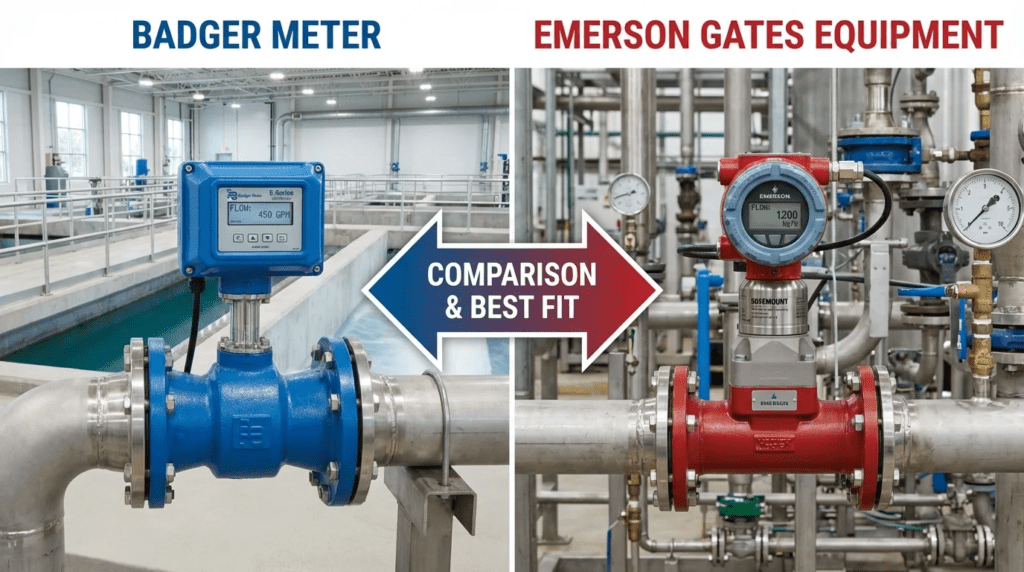
Badger Meter vs Emerson Gates Equipment: Comparison & Best Fit
Introduction
A scope correction belongs at the very top of this comparison, because the pairing as written does not describe a real procurement decision. Neither Badger Meter nor Emerson manufactures water control gates. Slide gates, sluice gates, weir gates, stop logs and the associated frames and guides come from gate manufacturers — Hydro Gate, Waterman, Fontaine, Rodney Hunt, Whipps and Golden Harvest among them. Badger Meter makes flow measurement equipment. Emerson makes process instrumentation, control valves and actuators.
There is still a genuine engineering decision buried in a Badger Meter vs Emerson Gates Equipment: Comparison & Best Fit query, and it has two parts. The first is flow measurement around gated structures — knowing what is actually passing through a gate, which is instrumentation work. The second is gate actuation, where Emerson does compete directly through its Bettis actuator line, commonly specified to operate gates supplied by the manufacturers named above. Badger Meter has no product in the actuation space.
This article covers both threads honestly. It compares utility-grade flow measurement against industrial process instrumentation for gated and open-channel applications, and it addresses actuator selection where the gate itself comes from a separate supplier. Broader gate supplier positioning is covered in our overview of the top gates manufacturers for water and wastewater.
The cost of getting measurement wrong is real. Non-revenue water sits in the range of ten to thirty percent for many utilities, frequently traced to aging or improperly specified metering that loses accuracy at low flow. In industrial wastewater, process upsets often stem from instrumentation that cannot handle aggressive chemistry or high solids. Metering is not a monolithic category, and the operating philosophy behind a meter designed for a residential subdivision differs sharply from one designed for a chemical dosing skid.
How to Select and Specify
Selecting between utility-grade metering and industrial process instrumentation requires a rigorous assessment of application constraints. The criteria below break down the decision.
Duty Conditions & Operating Envelope
The primary driver is the flow profile. Municipal distribution shows wide diurnal variation — high flows at peak demand, very low flows overnight. Industrial processes more often run at steady state or controlled batch intervals. Gated structures add a further wrinkle: flow through a partially open gate is neither full-pipe nor free-surface in a predictable way, which constrains measurement technology choice.
- Turndown ratio: Evaluate the required turndown. Utility-focused electromagnetic and ultrasonic meters excel at revenue capture at very low velocities, which matters for billing accuracy. Industrial units may prioritize high-end accuracy at process velocities but require careful checking of low-flow cutoff points.
- Pressure and temperature: Both manufacturers offer standard flange ratings. Emerson equipment is often the default for extreme thermal cycling or high-pressure gas applications through vortex or Coriolis technology. For standard water and wastewater temperatures both platforms are sufficient and the decision moves to cost-effectiveness.
- Flow disturbances: Consider piping geometry. Where straight pipe runs are limited, selecting a meter with flow conditioning or reduced-run certification becomes mandatory. Immediately downstream of a gate this is almost always the situation.
Materials & Compatibility
- Liners: For potable water, NSF/ANSI 61 certification is non-negotiable. For aggressive industrial wastewater or chemical dosing service, PFA, PTFE or ceramic liners resist permeation and blistering better than standard options.
- Electrodes: Standard 316L stainless is often insufficient for coagulants. Specify Hastelloy, titanium or tantalum where media pH is extreme or chlorides are present.
- Abrasion: For sludge and slurry service, soft rubber or polyurethane liners withstand abrasion better than rigid PTFE, which can crack under impact from solids.
Hydraulics & Process Performance
- Full bore against reduced bore: Full-bore magnetic meters present effectively zero head loss, behaving like a straight pipe. Coriolis mass flow meters provide exceptional data density — mass, density, temperature — but induce meaningful pressure drop from the flow tube geometry.
- Vacuum conditions: In siphon lines or pump suction applications, negative pressure can collapse certain liners if not bonded to the spool piece. Specifications must explicitly state vacuum service rating where this risk exists.
Gate Actuation: Where Emerson Genuinely Competes
This is the part of the comparison with a real bid list. Gates supplied by a gate manufacturer are frequently actuated by electric or pneumatic actuators from a separate supplier, and Emerson’s Bettis line appears regularly in these specifications alongside Rotork, AUMA and Limitorque.
- Thrust and torque: Gate actuators must be sized on stem thrust including seating and unseating loads, not just running torque. Under-sizing here is the most common actuation failure.
- Duty cycle: Modulating service demands a different actuator class than open-close service. Verify the rated starts per hour against the intended control strategy.
- Enclosure and submergence: Actuators on submerged or occasionally flooded gates need appropriate ingress protection and, in some installations, full submersible rating.
- Position feedback: Gate position feedback to SCADA is what makes flow estimation through a gate possible at all. Specify the resolution and the failure behavior of the position transmitter explicitly.
Installation Environment & Constructability
- Submergence: In municipal meter vaults, flooding is a matter of when rather than if. Utility-focused potting techniques for remote transmitters are evolved for damp, submerged environments. Industrial meters often ship rated for splash protection and require optional upgrades for full submergence.
- Hazardous areas: Where the installation sits in a digestion complex or classified headworks, equipment must carry appropriate explosion-proof or intrinsic safety certification. Emerson generally offers a broader range of hazardous area approvals as standard across its product lines.
Reliability & Failure Modes
- Drift and coating: In wastewater, grease and conductive coatings on electrodes cause signal drift. Advanced diagnostics from either manufacturer can detect coating before measurement fails outright.
- Weak link: Electronic components fail before flow tubes. For critical billing or regulatory discharge points, specifying a separate battery backup or redundant signal path is sound practice.
Controls & Automation
- Municipal connectivity: Badger Meter leads in integration with cellular endpoints and automated meter reading systems. The focus is encoded output protocols compatible with billing software.
- Process automation: Emerson equipment is native to complex automation, using HART, fieldbus and industrial Ethernet protocols. Where the plant runs a distributed control system, native integration provides diagnostic data — device health, temperature, signal noise — that simple pulse or analog outputs cannot convey.
Lifecycle Cost Drivers
- Initial cost: Utility-grade metering generally carries a lower price point suited to high-volume deployment. Process-grade equipment carries a premium for accuracy, diagnostics and exotic materials.
- Revenue recovery: For a main billing meter, a modest accuracy improvement can justify a more expensive meter within months.
- Verification costs: Meters requiring removal for recalibration incur substantial labor and bypass pumping costs. In-situ verification reduces this significantly.
Comparison Tables
| Criteria | Badger Meter (municipal and utility focus) | Emerson (industrial and process focus) |
|---|---|---|
| Water control gates | None. Not a gate manufacturer. | None. Not a gate manufacturer. |
| Gate actuation | No product in this space. | Yes — Bettis actuators, competing with Rotork, AUMA and Limitorque on gate and valve actuation |
| Primary flow technology | Electromagnetic, ultrasonic, mechanical | Coriolis, electromagnetic, vortex, thermal mass |
| Data integration | Strongest in automated meter reading — cellular and radio endpoints for billing | Strongest in plant control systems — HART, fieldbus, wireless mesh |
| Diagnostic capability | Focused on billing integrity, empty pipe detection and battery life | Process diagnostics: electrode coating, entrained gas, density shifts |
| Ruggedness | Optimized for vaults, pits and submergence | Optimized for vibration, heat and classified hazardous areas |
| Best fit | Water distribution, residential metering, effluent discharge, billing | Chemical dosing, sludge density, gas measurement, complex industrial waste, gate and valve actuation |
| Application | Primary Constraint | Recommended Path | Reasoning |
|---|---|---|---|
| Slide or sluice gate supply | Structural, sealing, corrosion | Gate manufacturer | Hydro Gate, Waterman, Fontaine, Rodney Hunt, Whipps, Golden Harvest. Neither company in this comparison supplies gates. |
| Gate actuation and position control | Stem thrust, duty cycle, submergence | Emerson Bettis or equivalent | Size on seating and unseating thrust. Specify position feedback resolution and failure behavior. |
| Raw water intake flow | Large diameter, low head loss required | Badger Meter electromagnetic | Cost-effective at large line sizes with minimal pressure drop and sufficient accuracy for intake monitoring. |
| Chemical dosing | Pulsating flow, low volume, chemical aggression | Emerson electromagnetic or Coriolis | Requires high chemical resistance and the ability to handle pulsating flow from metering pumps. |
| Sludge lines | High solids, abrasion, coating potential | Either, with high-noise signal processing | Signal processing must distinguish flow signal from solid impact noise. |
| District metering area | Low flow leak detection, no power available | Badger Meter battery mag or ultrasonic | Battery life and low-flow sensitivity are paramount for finding distribution leaks. |
| Digester gas monitoring | Wet gas, low pressure, variable composition | Emerson thermal mass or vortex | Standard mag meters cannot measure gas. Thermal mass suits methane service. |
Engineer & Operator Field Notes
Commissioning & Acceptance Testing
- Zero verification: Before the system goes live, perform a proper zero verification. The pipe must be full of fluid at zero velocity. Zeroing an empty pipe sets an erroneous baseline and ruins low-flow accuracy.
- Grounding is non-negotiable: For electromagnetic meters, the large majority of instability issues stem from poor grounding. In plastic or lined pipe, grounding rings or a grounding electrode are mandatory to reference the fluid potential to the meter body. Without this, the meter reads stray electrical noise as flow.
- Actuator stroke test: For gate actuators, verify full travel under load, not just unloaded bench travel. Confirm limit switch and torque switch settings and record the seating thrust actually observed.
- Soak time: For meters with hard rubber or certain synthetic liners, allow a soak period before final calibration checks. The liner can absorb moisture and shift dimensions slightly, affecting the calibration factor.
Common Specification Mistakes
Engineers often specify a 10-inch meter because the pipe is 10 inches. If that pipe flows at 1 ft/s average velocity, the meter operates in its least accurate range. Reducing the meter to 8 or 6 inches raises velocity into a measurable range, using concentric reducers to manage the transition.
- Ignoring conductivity: Electromagnetic meters require a minimum fluid conductivity. Specifying one for deionized water or ultrapure condensate results in total failure.
- Cable length limits: When separating transmitter from sensor, respect the manufacturer’s cable limits. Exceeding them without specialized pre-amplifiers produces signal attenuation and susceptibility to drive noise.
- Actuator sized on running torque only: Gate actuators must be sized on seating and unseating thrust. Running torque is the easy part of the duty cycle and the wrong basis for selection.
O&M Burden & Strategy
- Verification intervals: Modern meters from both manufacturers offer electronic verification. Schedule it annually. It generates a pass/fail report for regulatory purposes without removing the meter.
- Electrode cleaning: In wastewater, struvite or grease coats electrodes. Enable electrode cleaning functions where supported, or schedule manual cleaning during shutdowns.
- Desiccant packs: For electronics in humid vaults, check desiccant packs inside the transmitter housing during annual inspection. Saturated desiccant leads to board corrosion.
- Actuator exercise: Gates that sit in one position for months seize. Exercise actuators on a schedule regardless of process need.
Troubleshooting
Reading jumps or the signal is erratic. Likely air entrainment or electrical noise. Check whether the pump is cavitating, or whether a chemical injection point sits immediately upstream causing conductivity spikes. Verify grounding integrity.
Meter reads flow when pumps are off. Likely convection currents, a leaking check valve, or improper grounding picking up ground loops. Use low flow cutoff settings to mask near-zero noise, but investigate the hydraulic cause first.
Design Details and Calculations
Sizing Methodology
Proper sizing focuses on fluid velocity, not pipe diameter. The goal is to keep normal operating flow within the flat part of the accuracy curve.
- Determine flow range: Identify minimum day demand and peak hour demand.
- Calculate velocity: Velocity equals flow divided by cross-sectional area.
- Target velocity: Ideal operational range falls between roughly 2 and 15 ft/s. Maximum intermittent velocity should account for liner abrasion risk. Minimum accurate velocity depends on the manufacturer’s stated turndown.
- Pressure drop check: If reducing meter size, calculate permanent pressure loss to confirm it does not affect hydraulic grade lines or pump energy costs significantly.
Specification Checklist
- Fluid media: Detailed composition, temperature range and abrasive characteristics
- Accuracy class: Define the required accuracy explicitly rather than accepting a marketing figure
- Flange rating: State the pressure class
- Power supply: Line voltage, low-voltage DC, or battery and solar
- Output requirements: Analog, pulse, industrial digital protocol, or encoder
- Certifications: NSF/ANSI 61 for potable service, hazardous location rating where applicable, ingress rating for submergence
- For actuators: Stem thrust including seating and unseating, duty cycle, enclosure rating, position feedback type and failure behavior
Standards
- AWWA M6: Manual of practice for water meters
- AWWA C700 series: Standards for cold water meters
- AWWA C560 / C561: Cast iron and fabricated stainless slide gates, for the gate itself
- NEC (NFPA 70): Electrical installation, particularly hazardous location requirements
Frequently Asked Questions
Do Badger Meter or Emerson manufacture water control gates?
No. Neither company supplies slide gates, sluice gates, weir gates or stop logs. That equipment comes from gate manufacturers including Hydro Gate, Waterman, Fontaine, Rodney Hunt, Whipps and Golden Harvest. Engineers writing a gate specification should be working from those bid lists. Emerson does compete in gate actuation through its Bettis line, and both companies compete in the flow measurement that tells you what is passing through a gated structure. Those are the two real decisions inside this comparison.
What are the main differences between the two portfolios?
Intended application environment. Badger Meter equipment is optimized for municipal water and wastewater distribution, focusing on cost-efficiency, battery operation and automated meter reading connectivity. Emerson equipment is engineered for industrial process control, offering higher temperature and pressure ratings, broader chemical resistance, actuation products, and deep integration with plant automation systems.
When should I specify a Coriolis meter over an electromagnetic meter?
Specify Coriolis when you need direct mass flow measurement, when the fluid is non-conductive, or when density and temperature are critical variables. Coriolis meters are also insensitive to flow profile disturbance. Use electromagnetic meters for conductive water and wastewater where cost and low pressure drop are priorities.
How does straight run affect meter selection near a gate?
Traditional electromagnetic meters require several pipe diameters of straight run upstream and downstream. Flow leaving a partially open gate is highly disturbed, so if space is limited you must select a meter approved for reduced-run installation with built-in flow conditioning, or choose a technology insensitive to flow profile. Ignoring straight run requirements is a leading cause of measurement error in gated structures.
What is the typical lifecycle of a mag meter in wastewater?
A quality mag meter typically lasts well over a decade in wastewater service. Transmitter electronics may need replacement sooner due to component aging or surge damage. Flow tube lifespan depends on liner resistance to abrasion and chemical attack — in highly abrasive sludge lines, liner failure comes considerably earlier if the liner was not properly specified.
Why is grounding so important for flow meters?
Electromagnetic flow meters measure a small voltage induced by conductive fluid moving through a magnetic field. If the fluid is not properly referenced to the meter body, stray currents in the pipe overwhelm that signal, causing readings to jump or drift. In plastic or lined pipe, grounding rings create the necessary electrical connection.
Can Badger Meter equipment communicate with industrial SCADA?
Yes. While Badger Meter is best known for utility metering protocols, its industrial and higher-end municipal lines offer analog, Modbus and other industrial protocols. For native integration into complex distributed control environments, Emerson equipment provides richer diagnostic data over its native protocols without third-party converters.
Conclusion
Key Takeaways
- Neither makes gates: Water control gates come from dedicated gate manufacturers. This comparison covers flow measurement and, for Emerson, actuation.
- Emerson competes on actuation: The Bettis line is a genuine contender for gate actuation, sized on seating and unseating thrust rather than running torque.
- Define the zone: Badger Meter for distribution, billing and municipal networks. Emerson for complex plant processes, chemical dosing and industrial service.
- Connectivity matters: Badger Meter leads for automated meter reading; Emerson is the standard for plant automation and high-speed control.
- Size correctly: Never size a meter solely by pipe diameter. Size for the velocity range.
- Don’t forget grounding: In non-metallic piping, grounding rings are critical to mag meter function rather than optional.
The useful version of this comparison is not a contest between two gate suppliers, because neither company is one. It is a matter of matching the tool to the task across two separate procurements: the gate and its actuator, and the instrumentation that tells you what the gate is passing.
For a distribution network, the Badger Meter portfolio offers the revenue-focused, connectivity-rich features utilities need. For a complex industrial facility, a chemical injection skid, or gate actuation on a large hydraulic structure, Emerson’s process instrumentation and actuator lines offer the material resilience and diagnostic depth to prevent process upsets. Related evaluations of actual gate manufacturers appear in our comparisons of Hydro Gate and Golden Harvest, Hydro Gate and Whipps, and Golden Harvest and Whipps.