
Hydro Gate vs Whipps – C for Gates: Pros/Cons & Best-Fit Applications
Introduction
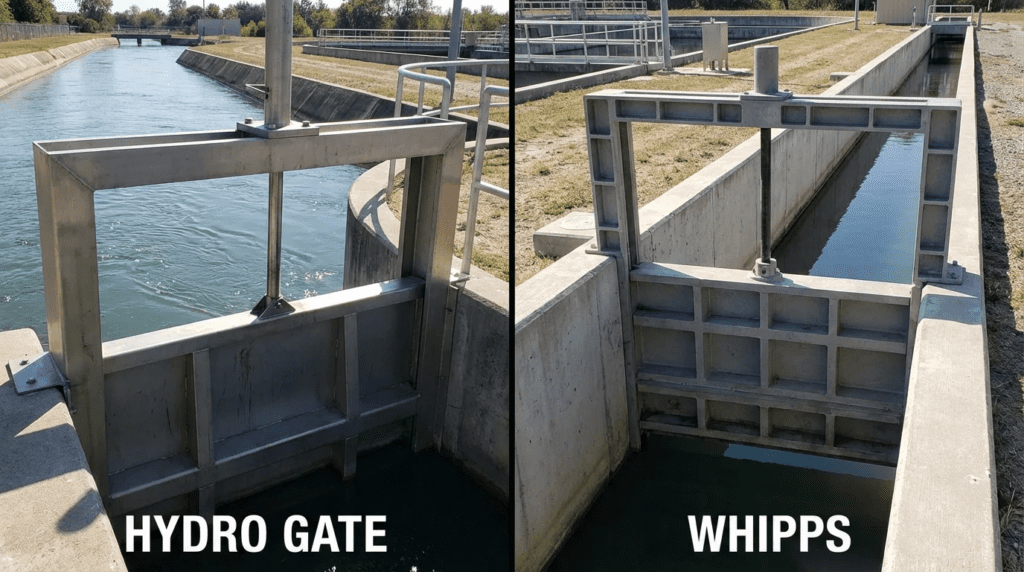
One of the most persistent debates in municipal water and wastewater plant design centers on the selection of isolation and flow control gates. For decades, engineers have weighed traditional heavy-duty cast iron sluice gates against modern fabricated stainless steel slide gates. This decision often crystallizes into a comparison of two established manufacturers. Hydro Gate is frequently the archetype for AWWA C560 cast iron gates, while Whipps is a standard-bearer for AWWA C561 fabricated stainless steel gates.
The stakes are higher than many realize. A significant number of treatment plant retrofits fail to account for the fundamental structural and interface differences between these technologies. Specifying a cast iron gate where a fabricated gate would serve increases structural loads and installation costs substantially. Conversely, applying a light-duty fabricated gate in a high-head, severe-vibration application can lead to seal failure and jamming within a few years of operation.
These gates are the critical control points in headworks, aeration basins, clarifier isolation, and disinfection channels. A failure here is not just a maintenance nuisance; it often requires a plant shutdown or bypass pumping to rectify. This article moves beyond marketing literature to provide a rigorous technical analysis.
A note on the title and one correction to the technical content. The published title contains the string “Whipps – C,” where the trailing suffix is an internal content-classification artifact rather than part of the company name. The company is Whipps, Inc., and the suffix should be removed from the title and URL.
More substantively, the earlier version stated that fabricated stainless gates under AWWA C561 carry a tighter allowable leakage rate than cast iron gates under C560. That is incorrect: both standards specify the same baseline allowance, expressed per foot of seating perimeter. Fabricated gates with resilient seals can often be specified to perform substantially tighter than the baseline, and frequently do — but that is a specified enhancement the engineer must call for and test, not something the standard delivers automatically. The distinction matters because a specification that assumes the tighter number is inherent will not produce it.
This guide sits within our coverage of water control gate manufacturers. See also our comparisons of Hydro Gate and Golden Harvest and Golden Harvest and Whipps. Those two pages plus this one form the three pairwise combinations of the same three manufacturers; a single three-way comparison would serve readers better, and the set is a consolidation candidate.
How to Select / Specify
Proper specification requires understanding the engineering divergence between cast iron construction and fabricated metal construction. The selection process must follow a hierarchy of constraints, starting with duty conditions and moving through to constructability.
Duty Conditions & Operating Envelope
- Head Pressure: Cast iron gates generally excel in high-head applications due to the rigidity of the casting and the mass of the gate, which resists deflection. Fabricated gates have evolved significantly, but at extreme heads the reinforcement required for a stainless steel plate can make the gate cost-prohibitive or geometrically bulky.
- Modulating vs. Isolation: For strictly open and close service, both technologies are viable. For modulating service, the gate must withstand vibration and cavitation. The damping properties of cast iron absorb vibration better than fabricated steel structures, which may require specialized reinforcement to prevent resonance during throttling.
- Flow Direction: Identify whether the gate faces seating head or unseating head. Cast iron gates with bronze wedges are robust in unseating conditions. Fabricated gates use low-friction polymer slides and resilient seals that can handle unseating head, but the deflection limits of the frame must be calculated to ensure the seal remains compressed.
Materials & Compatibility
- Cast Iron (ASTM A126 Class B): The standard for heavy-duty gates. It offers excellent compressive strength but is susceptible to graphitic corrosion in aggressive environments. In wastewater headworks with high hydrogen sulfide, cast iron requires robust epoxy coating. If the coating is compromised, corrosion accelerates.
- Stainless Steel (304L/316L): The hallmark of fabricated gates. 316L is the standard for wastewater due to chloride and sulfide resistance. It requires no coating, eliminating a major maintenance failure point. Engineers must be wary of galvanic corrosion if these gates are mounted to carbon steel thimbles without dielectric isolation.
- Seal Materials: Cast iron gates use bronze wedges and seat facings — durable, but reliant on precise machining and wedge adjustment. Fabricated gates use polymer bearing surfaces and elastomeric seals, which offer lower friction coefficients, reducing actuator size, but have lower temperature limits than bronze.
Hydraulics & Process Performance
Leakage rates are defined by AWWA standards, and this is an area where the two technologies are frequently misrepresented. AWWA C560 for cast iron and AWWA C561 for fabricated stainless specify the same baseline allowable leakage rate — expressed as gallons per minute per foot of seating perimeter. The standards do not differ on this point.
Where the technologies genuinely differ is in what each can achieve when a tighter rate is specified as an enhancement, and in how performance degrades over time. Resilient seal designs can often be specified to achieve substantially tighter performance than the baseline, and for applications such as disinfection channels where water level control is vital, that tighter seal is frequently the deciding factor. Metal-to-metal seating, by contrast, degrades more gradually and predictably rather than failing suddenly.
Installation Environment & Constructability
- Weight & Handling: Cast iron gates are heavy. A large cast iron gate may require a heavy crane and structural reinforcement of the concrete deck. A comparably sized fabricated stainless gate is substantially lighter. For retrofits in enclosed buildings with limited overhead clearance, fabricated gates are often the only viable option without major structural demolition.
- Mounting Interfaces: Cast iron gates traditionally mount to wall thimbles embedded in concrete. Fabricated gates are typically designed for anchor bolt mounting directly to the concrete wall. If replacing an existing gate on a thimble, a new cast iron gate is a direct swap. Installing a fabricated gate on an existing thimble requires a specific adapter flange, which must be carefully detailed.
Reliability, Redundancy & Failure Modes
- Cast Iron Failure: Usually gradual. Wedges wear down, leakage increases, or the stem nut strips. Catastrophic structural failure is rare unless subjected to severe water hammer.
- Fabricated Gate Failure: Can relate to seal degradation or weld fatigue if vibration analysis was not performed for modulating service. However, the modular nature of seals often allows easier field repair compared to machining bronze seats on a cast iron gate.
Controls & Automation Interfaces
The friction factor significantly impacts actuator sizing. Cast iron gates with bronze-on-bronze seating surfaces have a higher starting friction coefficient than fabricated gates using polymer slides.
Impact: A cast iron gate requires a larger, more expensive electric actuator and a heavier stem to prevent buckling. Fabricated gates are also less prone to sticking after long periods of inactivity, making them somewhat more reliable for automated emergency closure applications.
Maintainability, Safety & Access
Cast iron gates rely on wedge systems that require periodic adjustment, which often involves confined space entry to access the wedges at the bottom of the gate. Fabricated gates typically use resilient seals that compress under pressure, reducing the need for manual wedge tuning. However, if a seal tears on a fabricated gate, the gate must be dewatered for replacement, whereas minor leakage on a cast iron gate can sometimes be tolerated until the next scheduled outage.
Lifecycle Cost Drivers
- Capital: Fabricated stainless steel gates are generally more cost-effective in small to moderate sizes due to casting costs and elimination of the wall thimble.
- Installation: Fabricated gates have lower shipping and rigging costs.
- Operating: Cast iron gates require recoating on a multi-decade cycle, a significant expense. Stainless steel gates eliminate this cost.
- Longevity: A well-maintained cast iron gate can last many decades. A fabricated gate typically has a 25 to 40 year design life before major refurbishment, primarily driven by seal and weld life.
Comparison Tables
| Feature / Criteria | Cast Iron Sluice Gates | Fabricated Slide Gates |
|---|---|---|
| Primary Material | Cast iron (ASTM A126 Class B) or ductile iron | Stainless steel (304L or 316L) or aluminum |
| AWWA Standard | AWWA C560 | AWWA C561 for stainless, C562 for aluminum |
| Sealing Mechanism | Bronze wedges on bronze seats | Polymer slides with elastomeric seals |
| Baseline Allowable Leakage | Per AWWA C560 | Per AWWA C561, same baseline allowance; tighter rates available when specified |
| Weight Profile | Heavy; requires cranes and thimbles | Light to medium; easier handling |
| Corrosion Resistance | Requires epoxy coating; vulnerable if the coating is damaged | Inherently resistant when properly passivated |
| Actuation Force | Higher, due to bronze-on-bronze friction | Lower, due to polymer-on-stainless friction |
| Best-Fit Application | High head, heavy vibration, very long lifecycles | Channel isolation, submerged applications, corrosive environments |
| Application Scenario | Cast Iron Preference | Fabricated Stainless Preference | Key Decision Factor |
|---|---|---|---|
| Deep Raw Sewage Pump Station | High | Low | Ability to withstand large unseating heads and debris impact. |
| UV Disinfection Channel | Low | High | Requirement for tight seal for level control and corrosion resistance. |
| Aeration Basin Isolation | Medium | High | Ease of actuation and lower weight for installation on walkways. |
| Stormwater Outfall | High | Medium | Durability against tidal surge and heavy debris. |
| Retrofit on Existing Thimble | High | Low; requires adapter | Matching existing bolt patterns simplifies construction. |
| High Chloride Service | Low | High, in duplex stainless | Cast iron corrodes rapidly; duplex stainless fabricated gates are superior. |
Engineer & Operator Field Notes
Commissioning & Acceptance Testing
During factory or site acceptance testing, verify the leakage criteria specifically. For fabricated gates, ensure the gate is fully seated. Fabricated gates often use a wedging action at the very bottom of the stroke to compress the bottom seal. If the actuator limit switch is set too early, the gate may appear closed but will leak substantially.
Critical checkpoint: During installation, check the frame flatness. Fabricated gates are more flexible than cast iron. If the concrete wall is uneven and installers over-torque the anchor bolts, the stainless steel frame can twist, causing binding and seal failure. Use non-shrink grout behind the frame to ensure a plumb and true surface.
Common Specification Mistakes
One of the most frequent errors is copying cast iron specification language but permitting fabricated gates as an equal without adjusting the parameters.
- The Thimble Trap: Specifications often call for a wall thimble for all gates. Fabricated gates do not require thimbles, and mounting them to one adds unnecessary cost and leak paths. If allowing fabricated gates, explicitly remove the thimble requirement for that alternate.
- Stem Sizing: Specifying a stem diameter based on cast iron friction factors for a fabricated gate results in grossly oversized stems and actuators. Allow the manufacturer to size the stem based on their specific slide friction coefficients.
- Material Mismatch: Specifying 304 stainless for the gate but carbon steel for the anchor bolts creates a galvanic cell that destroys the anchors. Always match the anchor material to the gate frame material.
O&M Burden & Strategy
Lubrication: Cast iron gates with bronze lifts need frequent stem lubrication and periodic wedge lubrication where accessible. Fabricated gates with polymer guides are largely self-lubricating at the slide, but the stem nut still requires grease.
Seal Replacement: Replacing a bronze seat on a cast iron gate often requires removing the gate and machining it, a major undertaking. Replacing a resilient seal on a fabricated gate can often be done in place or by lifting the slide out of the frame with a light hoist. Maintenance supervisors should stock spare seal kits for fabricated gates but do not typically need to stock bronze wedges for cast iron gates.
Troubleshooting Guide
Symptom: Gate is binding mid-travel.
Cast iron: Check for debris lodged in the bronze wedge. Check for stem bending.
Fabricated: Check whether the frame was twisted during installation. Loosen anchor bolts slightly to see if tension releases. Check for swelling of polymer guides if the chemical composition of the water has changed.
Design Details / Calculations
Sizing Logic & Methodology
Required actuator thrust is the sum of three components: the hydrostatic load on the slide multiplied by the friction coefficient, the weight of the moving parts, and the force required to seat the gate at the end of travel.
The friction coefficient is the variable that separates the two technologies. Bronze against bronze runs roughly 0.35 to 0.40; polymer against stainless runs roughly 0.20 to 0.25. For a given gate size and head, the hydraulic load is identical, but the friction component for the cast iron gate is nearly double. That difference cascades into actuator model selection, electrical load, cabling, and backup power sizing — frequently one full actuator size.
Isolation You Cannot Verify Is Not Isolation
Gates in a treatment plant exist primarily so that a basin, channel or piece of equipment can be taken out of service. That makes their failure mode more consequential than a leakage number suggests: a gate that passes when closed does not merely waste water, it puts maintenance staff into a structure they believe is isolated.
Two design provisions address this, and neither is expensive at construction:
- Provide redundant isolation at points where staff will enter. Two gates in series, or a gate plus stop logs, allow isolation to be verified rather than assumed. For any structure that will be entered for maintenance, this should be the default rather than an upgrade.
- Provide a means to observe the dewatered side. If the only way to learn that a gate is passing is to climb down into the channel, the crew learns it at the worst possible moment.
The operational counterpart matters as much as the hardware. Gates must be exercised through full travel, not cracked open and closed. A gate left in one position for years accumulates compacted solids in the invert and corrosion on the stem threads, and the first time it is genuinely needed is the worst time to discover it will not seat over the last few percent of travel. Where a gate serves as a lockout point for confined space entry, that exercise record is a safety document, not a maintenance convenience.
Specification Checklist
- Governing Standard: Explicitly state AWWA C560 or AWWA C561. Do not mix them.
- Leakage Testing: Require a field leakage test. Shop testing alone is insufficient for critical applications.
- Material Certifications: Require mill test reports for the stainless steel to confirm the specified grade.
- Anchor Bolt Calculations: Require the manufacturer to submit calculations showing the anchor bolts can withstand the pullout force generated by the unseating head. This is critical for surface-mounted fabricated gates.
Frequently Asked Questions
What is the main difference between AWWA C560 and AWWA C561 gates?
AWWA C560 governs cast iron sluice gates, focusing on heavy metal construction, bronze sealing wedges, and wall thimble mounting. AWWA C561 governs fabricated stainless steel slide gates, focusing on welded plate construction, resilient polymer seals, and anchor bolt mounting. C560 gates are generally heavier and more robust for extreme heads, while C561 gates are lighter and more corrosion-resistant. Both standards specify the same baseline leakage allowance.
Why is cast iron often specified for heavy duty applications?
Cast iron product lines use thick sections that provide high stiffness and vibration damping. In applications with large hydraulic heads or turbulent flow, the mass of cast iron prevents deflection and resonance. Heavy-duty fabricated gates are also produced, but cast iron offers this rigidity without requiring complex external stiffeners.
Can I replace a cast iron gate with a stainless steel gate?
Yes, but it requires engineering attention. A direct swap is rarely possible without an adapter. Cast iron gates typically mount to a wall thimble with a specific bolt pattern. Fabricated gates typically mount to the wall surface. To retrofit, you must either bolt an adapter flange to the existing thimble or remove the thimble and grout the wall flat. The fabricated gate must also be designed for the exact head conditions of the previous gate.
Which gate type has a lower lifecycle cost?
For typical municipal wastewater applications at moderate channel depths, fabricated stainless steel gates often have a lower lifecycle cost. They are usually cheaper to purchase, lighter to install, and require no coating maintenance. However, for very long service lives in non-corrosive water, cast iron’s durability can eventually justify its higher upfront and maintenance costs.
Are fabricated gates leak-proof?
No slide gate is permanently zero-leakage. Fabricated gates with resilient lip seals often achieve near drip-tight performance when new, outperforming the baseline allowance. Over time, as seals wear, leakage increases, but they generally remain tighter than metal-to-metal seats.
How does the choice impact actuator sizing?
The friction coefficient of bronze on bronze is roughly double that of polymer on stainless. Consequently, selecting a fabricated gate often allows a smaller, less expensive electric actuator and a lighter stem compared to a cast iron equivalent for the same aperture and head.
Conclusion
KEY TAKEAWAYS
- Head Pressure Rule: Use cast iron for extreme heads and heavy vibration. Use fabricated stainless for channel isolation and moderate heads.
- Leakage Specs: Both AWWA C560 and C561 share the same baseline allowance. Tighter performance is a specified enhancement, achievable more readily with resilient seals.
- Installation Weight: Fabricated gates are substantially lighter, reducing installation equipment requirements and structural loads.
- Corrosion: 316L stainless eliminates the need for coating. Cast iron requires rigorous coating maintenance in sulfide environments.
- Retrofit Caution: Switching from cast to fabricated requires careful interface design between thimble and anchor bolt mounting.
This is not about declaring a single winner, but about matching the technology to the physics of the application. Cast iron sluice gates remain the heavyweights of the industry, offering rigidity and longevity in deep, high-pressure, or abusive environments. They are the durable solution for long-horizon infrastructure projects where weight and initial cost are secondary to ultimate durability.
Fabricated stainless steel gates have changed standard treatment plant design. They offer corrosion resistance, tight leakage performance, and easier handling and installation for the majority of open-channel and moderate-head applications. For modern wastewater plants focused on operational efficiency and tight process control, fabricated gates are frequently the logical engineering choice.
Engineers must evaluate their specific constraints — head, corrosion potential, access, and budget — and specify the standard that aligns with those realities. Avoiding the copy-paste specification trap is the single most effective step toward a reliable gate installation.