
Hydro Gate vs Golden Harvest for Gates: Pros/Cons & Best-Fit Applications
Introduction
For municipal and industrial engineers, the failure of a water control gate is rarely a minor operational annoyance; it is a vulnerability that can lead to flooding, regulatory non-compliance, and significant safety hazards. While pumps receive the greater share of attention in hydraulic modeling, the isolation provided by sluice and slide gates is fundamental to process integrity. A recurring decision point in facility design involves selecting the right manufacturer and technology platform.
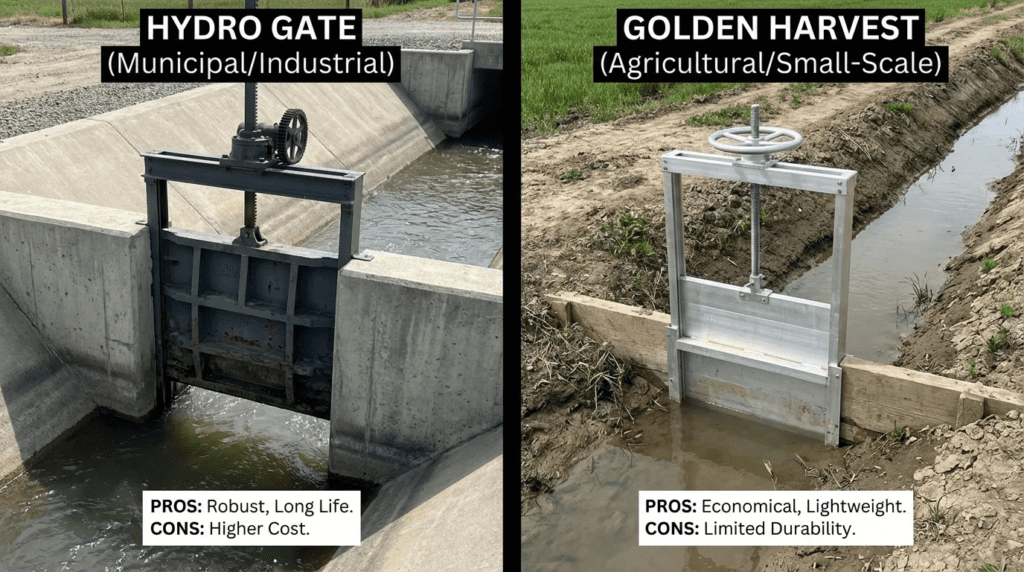
Hydro Gate and Golden Harvest represent slightly different approaches to water control. Hydro Gate is historically associated with heavy-duty cast iron sluice gates under AWWA C560, the traditional robust approach favored for deep and high-head applications. Golden Harvest, while offering a broad range, has built a substantial position in fabricated stainless steel and aluminum gates under AWWA C561 and C562, favoring modularity, leakage performance, and customization.
The choice between these manufacturers — and more importantly, the technologies they represent — is not merely about brand preference. It involves analyzing unseating head requirements, corrosion potential, actuation forces, and lifecycle maintenance costs. A poor specification that calls for a fabricated gate where a cast iron gate is required, or the reverse, can result in seal failure, structural deflection, or excessive maintenance burdens.
Before using this comparison, verify the corporate relationship between these two companies. Our research indicates that Hydro Gate and Golden Harvest may be under common ownership, with Hydro Gate having been acquired by Golden Harvest. If that is current, then this page does not compare two competing suppliers — it compares two product lines within one company, which changes both the procurement picture and the value of the comparison entirely. The earlier version described Hydro Gate as a brand of a different corporate parent, which we could not confirm. Confirm current ownership directly with the manufacturer before treating these as independent bidders on the same project.
What remains valid regardless of ownership is the underlying technology comparison — cast iron sluice gates against fabricated stainless slide gates — which is a real and frequent specification decision. The article has been framed on those terms.
Note also that this site carries three pairwise comparisons among the same three gate manufacturers. A single three-way comparison would serve readers better, and the set is a consolidation candidate.
This guide sits within our coverage of water control gate manufacturers. See also our comparisons of Hydro Gate and Whipps and Golden Harvest and Whipps.
Editorial note: a thrust calculation on this page previously published as unrendered markup and has been rewritten in plain language. A leakage claim stating that AWWA C561 allows half the leakage of C560 has been corrected — the two standards share the same baseline allowance, and tighter performance is a specified enhancement rather than a difference between the standards.
How to Select and Specify Water Control Gates
Duty Conditions & Operating Envelope
The primary driver is the relationship between the gate and the hydraulic head. Engineers must explicitly define the seating head, which pushes the gate into the frame, and the unseating head, which pushes the gate away from it.
- Seating vs. Unseating: Cast iron gates rely on machined bronze wedges and heavy mass to handle large unseating heads with minimal deflection. Fabricated gates use low-friction polymer sliding surfaces. While modern fabricated gates are robust, high unseating heads require substantial reinforcement, which affects both cost and geometry.
- Modulating vs. Isolation: If the gate is intended for throttling, it must resist vibration and cavitation. Cast iron’s damping properties are often superior in severe throttling applications, whereas fabricated gates must be analyzed for natural frequency to avoid resonance.
- Flow Direction: Is the flow unidirectional or bidirectional? Bidirectional applications such as tidal gates or equalization basins generally favor the wedging action of cast iron, or high-specification fabricated gates with active seating mechanisms.
Materials & Compatibility
- Cast Iron (ASTM A126 Class B): The traditional choice for raw sewage and heavy-duty intakes. It offers vibration damping and good corrosion resistance when properly coated. However, it is heavy and requires significant infrastructure for installation.
- Stainless Steel (304L/316L): The standard for modern treatment plants, particularly in aeration basins and disinfection channels. It offers corrosion resistance without coating maintenance. Passivation is critical to prevent surface rust.
- Aluminum (6061-T6): Used in stormwater and clean water applications for light weight and lower cost. It is generally unsuitable for aggressive wastewater or environments with significant grit, which abrades the softer metal.
- Galvanic Corrosion: Engineers must be vigilant about dissimilar metals. Pairing a stainless steel gate with a carbon steel thimble in conductive wastewater leads to rapid failure of the anodic component.
Hydraulics & Process Performance
For weir gates, the accuracy of level control is paramount. Fabricated gates allow tighter manufacturing tolerances on weir plates, making them well suited to decanters or precise level control in sequencing batch reactor basins.
Leakage is another critical hydraulic factor, and it is frequently misstated. Both AWWA C560 for cast iron and AWWA C561 for fabricated stainless specify the same baseline allowable leakage rate. The difference between the technologies is not in the standard’s allowance but in what each can achieve when a tighter rate is specified as an enhancement, and in how each degrades over time.
Installation Environment & Constructability
Constructability is a major differentiator. A large cast iron sluice gate may weigh several tons, requiring a crane, a thimble wall penetration, and a grouting procedure. A comparable fabricated stainless steel slide gate is significantly lighter and anchor-bolt mounted directly to the concrete face.
In retrofit applications where crane access is limited, the lighter weight and modularity of fabricated gates provides a decisive advantage. Conversely, for new construction of deep pump stations where the gate is embedded in the initial concrete pour, the thimble-mount design of a heavy cast iron gate ensures long-term structural integrity.
Reliability, Redundancy & Failure Modes
Cast iron gates can suffer graphitic corrosion over decades, losing structural strength while retaining shape. They can also crack under sudden shock loads. Fabricated gates are more ductile but can suffer weld fatigue or seal delamination if not properly maintained.
- Service life: Properly specified gates of either type often exceed 20 to 30 years for the gate body. The actuation system is usually the limiting factor.
- Common failure point: The stem nut. As the sacrificial wear component, usually bronze, it will strip if the gate is over-torqued or if the stem is not lubricated.
Maintainability, Safety & Access
Rising stem gates provide a visual indication of gate position, a critical safety feature. Non-rising stem gates require position indicators. Maintenance access for stem lubrication is essential. If the operating floor is well above the gate, intermediate stem guides are required to prevent column buckling. The spacing of these guides is a function of the stem slenderness ratio, which the engineer must verify against the manufacturer’s recommendation.
Lifecycle Cost Drivers
- Capital: Fabricated stainless gates are generally less expensive to purchase and install than cast iron sluice gates, primarily due to lower weight and elimination of wall thimbles.
- Operating: Cast iron gates may require periodic abrasive blasting and recoating on a multi-decade cycle, a significant expense. Stainless steel gates largely eliminate this but may require more frequent seal replacement depending on the abrasion level of the fluid.
Comparison Tables
Table 1: Technology & Manufacturer Focus Comparison
| Feature / Criteria | Hydro Gate (Traditional Strength) | Golden Harvest (Traditional Strength) | Engineering Implication |
|---|---|---|---|
| Primary Material Focus | Cast iron and ductile iron, heavy duty | Fabricated stainless steel and aluminum | Cast iron for mass and damping; stainless for corrosion resistance and light weight. |
| Applicable AWWA Standard | AWWA C560 (cast iron sluice gates) | AWWA C561 (fabricated stainless) and C562 (aluminum) | C560 implies metal-to-metal seating; C561 implies polymeric sealing. |
| Sealing Mechanism | Bronze wedges, metal-to-metal | Polymer bearing surfaces with elastomeric seals | Metal seats are durable but seal less tightly as they wear; polymer seats seal tightly but wear faster in grit. |
| Leakage Standard | Per AWWA C560 allowance | Per AWWA C561 allowance, with tighter rates achievable when specified | The two standards share a baseline allowance; tighter performance is a specified enhancement, not a default. |
| Unseating Head Capacity | Excellent, due to the wedge system | Good, requires stiffeners and reinforcement | Cast iron is preferred for extreme unseating head scenarios. |
| Installation Complexity | High; requires thimbles, grout, cranes | Moderate; anchor bolts, lighter weight | Fabricated gates reduce civil works cost and installation time. |
Table 2: Application Fit Matrix
| Application Scenario | Best-Fit Technology | Why | Key Specification Constraint |
|---|---|---|---|
| Deep Tunnel Isolation | Cast iron sluice gate | Extreme head pressures, difficult access, very long required service life. | Must specify unseating head rating equal to full tunnel depth. |
| UV Disinfection Channels | Fabricated stainless steel | Level control accuracy, no contamination, low head pressure. | Specify 316L stainless to prevent surface corrosion. |
| Headworks / Grit Chamber | Cast iron or heavy fabricated stainless | Abrasion resistance is key. Grit destroys soft seals. | If fabricated, specify flush-bottom seal to prevent a grit trap. |
| Stormwater Outfall | Fabricated aluminum or stainless | Intermittent use, large size, low pressure. | Ensure flap gates have break-open force calculations. |
| Existing Channel Retrofit | Self-contained fabricated stainless | No existing superstructure; mounts directly to channel walls. | Verify channel wall structural integrity for reaction loads. |
Engineer & Operator Field Notes
Commissioning & Acceptance Testing
- Leakage Testing: The most contentious part of commissioning. The gate must be subjected to the full design head. Engineers should specify a dry field test using feeler gauges to check seat contact before water is introduced. When testing with water, leakage should be measured using a calibrated container and stopwatch, normalized to gallons per minute per foot of seal perimeter.
- Amperage Draw: During site acceptance, record the motor amperage during full travel. Spikes often indicate binding in the guides or a bent stem. This establishes a baseline for predictive maintenance.
Do not overlook the actuator gearing. A common mistake is specifying an actuator that moves the gate too fast, causing surge, or too slow, delaying process reaction. Verify the travel speed against the total travel distance to ensure cycle times meet operational protocols.
Common Specification Mistakes
- Over-Specifying Leakage: Demanding zero leakage is not achievable. All slide gates leak to some degree. Specifying limits tighter than the AWWA standard drives up cost sharply and should be done only where the process genuinely requires it, such as a channel that must be dewatered for entry.
- Ignoring Stem Buckling: For deep channels, the unsupported length of the stem is critical. Engineers often forget to specify the location and number of intermediate stem guides, leading to stems that bow under compressive closing loads.
- Material Mismatches: Specifying 304 stainless in a coastal wastewater plant invites pitting corrosion. 316L or duplex stainless should be standard in high-chloride environments.
O&M Burden & Strategy
- Stem Lubrication: A dry stem is a leading cause of gate failure. Automated lubrication systems are recommended for critical gates.
- Exercising: Gates that remain in one position for years will freeze. A quarterly exercise program keeps the threads clean and the seals pliable.
- Seal Adjustment: Fabricated gates often have adjustable wedges or seal retainers. Operators must be trained to tighten these without over-compressing the seal, which increases friction and motor load.
Troubleshooting Guide
Symptom: Gate is binding or the motor trips on overload.
- Root cause 1: Debris lodged in the bottom seal, common in grit chambers.
- Root cause 2: Stem nut wear. As threads wear, friction increases sharply.
- Root cause 3: Frame distortion. If the concrete wall has settled or anchor bolts were over-torqued, the frame may have twisted, pinching the slide.
Design Details & Calculations
Sizing Logic & Methodology
The force required to operate a gate is the sum of several resistance components. Total stem thrust equals the friction force, plus the weight of the slide and stem, plus any hydrostatic uplift or downpull, plus the force required to wedge the gate into its seated position.
- Friction force is the hydrostatic load on the slide multiplied by the coefficient of friction between the slide and the seat. That coefficient is roughly 0.35 for bronze against bronze and roughly 0.2 for polymer against stainless steel — a difference that cascades directly into actuator size.
- Weight is the combined weight of the slide and the stem.
- Hydrostatic uplift or downpull is generated by water flowing across the bottom of the gate, and is significant in throttling service.
- Seating force is what wedges the gate into position at the end of travel.
The force required to start moving a gate is typically well above the running force. Engineers must ensure the actuator is sized for this peak starting requirement, not just the running load.
The Gate Schedule Is the Specification
Gates differ from most plant equipment in one respect that governs how they should be procured: a project rarely buys one gate, and almost never buys identical ones. A treatment plant upgrade may involve fifteen gates across headworks, aeration, clarifiers and disinfection, each with a different size, head, mounting condition and duty. The specification text is largely common to all of them; the gate schedule is where the engineering actually lives.
A gate schedule that omits any of the following produces change orders:
- Seating and unseating head stated separately for each gate. A single “design head” column invites the manufacturer to assume the easier case. Where a channel can be dewatered on one side, the unseating condition is the governing one and it must be stated.
- Invert and operating floor elevations for each gate. These determine stem length, guide count, and whether an extension stem and pedestal are required. They are also the values most often carried over incorrectly from a previous project.
- Mounting condition for each gate — new concrete, existing wall, existing thimble — because this determines whether a thimble, an adapter flange, or grouting is in scope, and whose scope it is.
- Actuation type and, where electric, the control interface required. Gates specified without stating whether position feedback is required routinely arrive without it.
- Which gates must be dewatered for service, and how. A gate that isolates the only channel serving a process cannot be taken out of service without a bypass. That constraint belongs in the design, not in the operator’s problem list.
Specification Checklist
- Opening Size: Clearly state whether this is the clear opening or the frame size.
- Design Head: Maximum seating and maximum unseating head in feet of water column.
- Invert Elevation: Critical for stem length calculations.
- Operating Floor Elevation: Determines pedestal height and stem length.
- Actuation Type: Manual, electric with voltage and phase stated, or hydraulic.
- Mounting Style: Wall mount with anchor bolts, thimble mount, or embedded.
- Leakage Class: Reference the applicable AWWA standard limits explicitly.
Standards & Compliance
- AWWA C560: Cast-iron slide gates. Covers material thickness, safety factors, and bronze seating surfaces.
- AWWA C561: Fabricated stainless steel slide gates. Focuses on structural calculations to prevent deflection that would compromise the seal.
- AWWA C562: Fabricated aluminum slide gates. Similar to C561 but addresses aluminum-specific properties.
- NSF/ANSI 61: Required for any gate in contact with potable water.
Frequently Asked Questions
How do you select between a cast iron and a fabricated stainless steel gate?
Select cast iron for applications with high unseating heads, severe vibration potential, or where very long service life without seal replacement is prioritized. Select fabricated stainless for applications requiring corrosion resistance without coating maintenance, ease of installation through lighter weight, tight leakage control, or custom geometries in non-standard channel sizes.
What is the typical lifespan of a sluice gate in wastewater service?
A properly maintained cast iron sluice gate can last several decades, and many remain in service far longer. Fabricated stainless steel gates typically have a design life of 25 to 40 years, with seal replacement required periodically depending on usage frequency and grit abrasion. The actuator usually requires overhaul or replacement well before the gate body.
Why does unseating head matter so much in this selection?
Unseating head pushes the gate away from its frame. Cast iron gates use rigid wedges and heavy frames to mechanically lock the gate against the seal, handling high unseating pressure well. Fabricated gates rely on the stiffness of the slide and frame assembly; under high unseating pressure they may deflect, causing seal separation. For high unseating head applications, cast iron or heavily reinforced fabricated gates are necessary.
How often should water control gates be maintained?
Stems should be cleaned and lubricated on a semi-annual cycle or per manufacturer recommendation. The gate should be fully cycled at least quarterly to prevent seizing. Gearboxes on electric actuators should have oil levels checked annually and changed on the manufacturer’s recommended cycle.
Can I replace an old cast iron gate with a new fabricated one?
Yes, this is a common retrofit strategy. However, the engineer must verify the anchor bolt pattern and the flatness of the existing concrete wall. Fabricated gates are more flexible than cast iron and require a flat mounting surface to seal properly. Often a layer of non-shrink grout is required between the wall and the new gate frame to establish a plumb and flush installation.
Conclusion
Key Takeaways
- Duty Defines Design: Do not default to a standard sluice gate. Analyze seating against unseating head explicitly for every gate on the schedule.
- Material Matters: Use cast iron per AWWA C560 for heavy, high-head, long-life deep infrastructure. Use fabricated stainless per AWWA C561 for lighter, corrosion-resistant, high-sealing applications.
- Installation Costs: Fabricated gates significantly reduce civil constraints and crane requirements compared to heavy cast iron.
- Maintenance Trade-off: Cast iron requires coating maintenance but has durable metal seats. Stainless requires no coating but has softer seals that wear faster in grit.
- Actuator Sizing: Verify breakaway force calculations. Undersized actuators are a leading cause of early operational failure.
This comparison ultimately serves as a proxy for the broader engineering choice between heavy-duty cast construction and modern custom fabrication. Cast iron remains the benchmark for applications where mass, vibration damping, and extreme longevity under high pressure are non-negotiable. Fabricated stainless steel offers engineers superior options for corrosion resistance, leakage control, and retrofit versatility.
For the consulting engineer or plant director, the best choice is never universal. It is found in the specific hydraulic profile of the channel, the chemical composition of the fluid, and the long-term operational capabilities of the maintenance staff.