
Henry Pratt vs Val-Matic for Check Valves: Pros/Cons & Best-Fit Applications
1. Introduction
The sound of a check valve slamming shut—resembling a sledgehammer striking the pipe—is more than a nuisance; it is an audible indicator of kinetic energy rapidly converting to pressure energy, potentially exceeding the structural limits of the piping system. For municipal and industrial engineers, the selection of check valves is the primary line of defense against hydraulic transients and reverse flow damage in pumping systems.
Treating manufacturers as interchangeable “or equal” options without analyzing the specific hydraulic nuances of their product lines is a common specification error. Different manufacturers utilize different design philosophies, particularly regarding closure mechanics, disc geometry, and head loss characteristics. Val-Matic has built a significant position in high-performance check valves focused on dynamic response and energy efficiency.
This article provides an engineer-to-engineer analysis. We move beyond catalog data to explore how specific technologies perform in real-world duty cycles, from raw sewage lift stations to high-pressure potable water distribution.
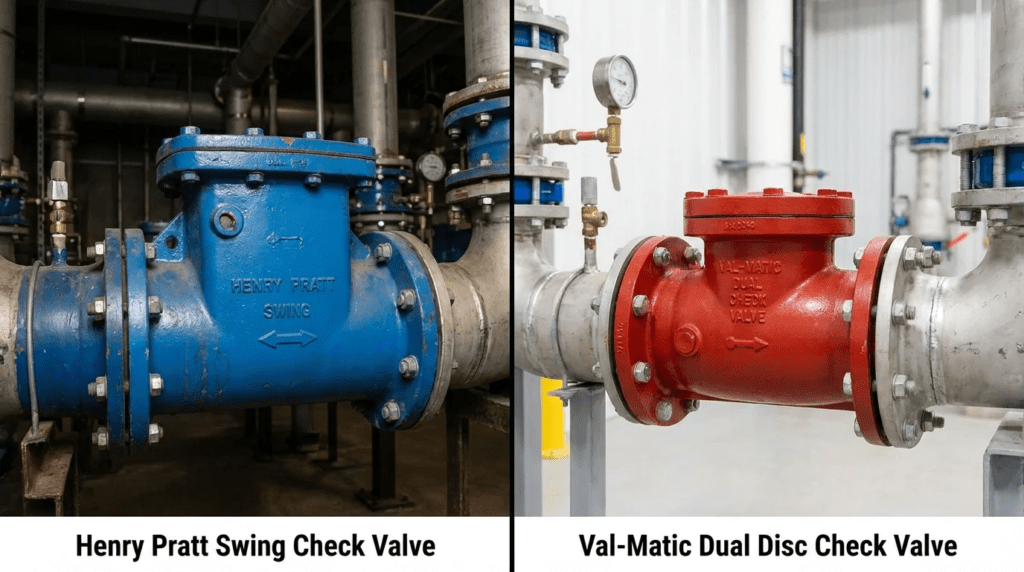
A correction to the framing this article was published under. It presented Henry Pratt and Val-Matic as the two names that dominate North American check valve specifications. That overstates one side of the pairing. Val-Matic is genuinely a check valve specialist — the Swing-Flex, Surgebuster, tilted disc and silent check lines are established, widely installed products, and the company publishes the dynamic characteristic data that surge analysis requires.
Henry Pratt, by contrast, is principally a butterfly, ball and plug valve manufacturer. Check valves are not the line the company is specified for. An engineer assembling a genuine bid list for municipal check valves would normally be comparing Val-Matic, APCO (DeZURIK), Crane, GA Industries and Mueller. Specific product claims attributed to Pratt in the earlier version of this page, including a ball check line, could not be verified and have been removed rather than left for someone to cite in a submittal review.
What survives is the comparison that matters: traditional mechanical swing check versus modern short-stroke and flexible-disc geometry, which is the real engineering decision at a pump discharge. The article has been reframed around that. See also our guide to top check valve manufacturers, and our comparisons of Crane and Henry Pratt and Rotork and Singer Valve.
2. How to Select / Specify
Effective valve selection requires moving beyond nominal pipe size and pressure class. The engineer must define the operating envelope and match the valve’s dynamic characteristics to the system’s deceleration profile.
Duty Conditions & Operating Envelope
The most critical error in check valve sizing is matching the valve size to the line size without verifying fluid velocity. Check valves rely on flow to keep the disc in the fully open, stable position.
- Flow Velocity: Check valves generally require a minimum velocity, typically 3 to 5 ft/s depending on type, to fully lift the disc. If the valve is oversized, the disc will flutter or chatter, causing premature wear on the hinge pins or the flexible hinge element.
- Reverse Velocity Requirements: The propensity for a valve to slam depends on how quickly the column of water reverses direction after pump trip. Systems with high static head and short pipe runs reverse flow almost instantly. In these scenarios, rapid-closure designs outperform traditional swing checks that have a longer stroke length.
- Frequency of Operation: For intermittent duty such as stormwater pumps, a standard AWWA C508 swing check may be cost-effective. For high-frequency cycling such as RAS pumps, wear on mechanical hinge pins becomes a liability, favoring designs with fewer moving parts.
Materials & Compatibility
- Body Construction: Ductile iron (ASTM A536) is standard and superior to gray iron for shock resistance.
- Disc and Seat Materials: Metallic seating or traditional O-ring designs perform well in clean water but require careful specification for grit handling. Molded disc designs, where steel reinforcement is fully encapsulated in EPDM or Buna-N, prevent ragging in wastewater applications because there are no exposed mechanical linkages in the flow path.
- Coatings: Fusion bonded epoxy lining and coating per AWWA C550 is standard for municipal service to prevent tuberculation and corrosion.
Hydraulics & Process Performance
Head loss translates directly to energy costs. The internal geometry of the valve determines its resistance coefficient.
- Energy Efficiency: Tilted disc check valves generally offer significantly lower head loss than conventional swing checks due to the airfoil shape of the disc floating in the stream.
- Solids Handling: In wastewater, full waterway is essential. Traditional swing checks provide a clear waterway when fully open. Flexible-disc designs also offer full flow area but rely on the memory of the elastomer rather than a counterweight to close, which can be advantageous in preventing clogging around hinge pins.
Installation Environment & Constructability
- Orientation: Most swing checks are designed for horizontal installation. Vertical installation with flow up is possible but requires specific bonnet configurations or counterweights. Globe-style silent checks are well suited to vertical turbine pump discharges but cannot handle solids.
- Space Requirements: Dual disc wafer-style check valves are compact but are generally limited to clean water. For heavy municipal valves, ensure adequate clearance for the counterweight arm and external lever, or for top-access covers.
Reliability, Redundancy & Failure Modes
- Mechanical Linkage Failure: Traditional swing checks have hinge pins, keys, and bushings. Over time these wear, leading to disc misalignment and seal failure. Heavy-duty designs allow robust service, but the maintenance requirement remains.
- Flex-Hinge Fatigue: Flexible-disc designs use a disc with no mechanical hinge. The failure mode is fatigue of the reinforced elastomer hinge. While reliable, it requires total disc replacement upon failure rather than component repair.
Maintainability, Safety & Access
- Top Entry: Valves complying with AWWA C508 provide top entry access, allowing operators to remove the disc assembly without breaking the flange connections.
- External Indicators: Swing checks with an external lever and weight or spring provide clear visual indication of valve position. Flexible-disc designs may offer an optional position indicator, but standard models have no external moving parts, making visual verification of status more difficult without the accessory.
Lifecycle Cost Drivers
- Acquisition Cost: Standard swing checks are often the lowest capital cost option in large diameters.
- Energy Cost: Tilted disc valves can save meaningful pumping cost annually due to lower head loss compared to standard swing checks.
- Maintenance Labor: Designs without packing glands or hinge pin greasing reduce labor hours in wastewater applications.
3. Comparison Tables
The following tables provide a side-by-side analysis. Table 1 contrasts design philosophies. Table 2 provides an application fit matrix to guide selection based on process constraints.
| Feature / Criteria | Traditional Swing Check | Val-Matic High-Performance Lines |
|---|---|---|
| Primary Design Philosophy | Robust, heavy-duty mechanical construction; traditional AWWA C508 compliance for large-scale infrastructure. | Hydraulic performance focus; emphasizes non-slam characteristics, energy efficiency, and innovative geometry such as tilted disc and flexible disc designs. |
| Wastewater Product | Rubber flapper swing check or ball check: reliable, traditional designs with proven longevity in grit environments. | Swing-Flex and Surgebuster: angled seat, flexible disc, short stroke length to minimize slam potential. |
| Clean Water / High Head | Tilted disc check: used in large diameter transmission mains. | Tilted disc check: low head loss with strong non-slam characteristics. |
| Slam Mitigation Strategy | Relies largely on external levers, weights, and air or oil dashpots to control closing speed. | Relies on internal disc geometry, short stroke and angled seat, to close before flow reverses. |
| Maintenance Profile | Moderate: external levers and weights allow adjustment but introduce packing glands and hinge points requiring lubrication or seal replacement. | Low: many designs eliminate mechanical hinges and packing glands entirely. |
| Typical Size Range | Strong in large diameter. | Strong across the range, particularly in high-performance specifications. |
| Application Scenario | Best Fit Type | Engineering Rationale |
|---|---|---|
| Raw Sewage Lift Station (High Solids) | Flexible disc swing check or ball check | Flexible disc designs avoid ragging on hinge pins. Ball checks are excellent for clogging resistance but have higher head loss. |
| High-Head Water Transmission (Surge Prone) | Tilted disc | Superior non-slam characteristics are critical here. The energy savings from low head loss help justify the higher capital cost. |
| Large Diameter Stormwater (Low Head) | Standard swing check | Cost-effective for large sizes. Slam is less of a concern due to low pressures. External lever assists closure against low backpressure. |
| Vertical Pump Discharge (Flow Up) | Silent (globe-style) check, clean water only | Spring-loaded silent checks close instantly when flow stops, preventing the column from reversing. |
| Budget-Constrained Municipal Retrofit | Standard swing check | Standard C508 swing checks are often the lowest capital cost option and fit standard face-to-face dimensions. |
4. Engineer & Operator Field Notes
Commissioning & Acceptance Testing
During the Site Acceptance Test, the behavior of the check valve during pump ramp-down is the critical observation point.
- The Closure Test: A properly sized non-slam valve should close quietly. If a metallic bang is heard upon pump stop, the valve is closing too slowly, allowing reverse flow to build velocity before the disc hits the seat. On valves with dashpots, this is the time to adjust the cushion control. On flexible-disc valves, slamming often indicates the valve is oversized, so the disc was not fully open, or that static head is high enough to require a tilted disc instead.
- Sealing Verification: Verify zero reverse rotation on the pump. If the pump spins backward, the check valve is passing. This is common in new installations if construction debris gets lodged in the seat.
Common Specification Mistakes
- Copy-Paste Specs: Engineers often copy a specification for a standard swing check but expect the performance of a high-dynamic tilted disc. If you need non-slam performance in a high-head system, a standard swing check with a lever and weight will likely slam unless equipped with a complex and expensive oil dashpot.
- Ignoring Pipe Orientation: Specifying a standard swing check for a vertical pipe run without explicitly calling for a vertical service configuration is a frequent error. Without a counterweight or spring set for vertical lift, the disc may not close properly, or may slam violently.
O&M Burden & Strategy
- Swing Check: Maintenance involves inspecting the stuffing box for leaks. If the valve has an external lever, the linkage must be kept clear of corrosion and debris. The hinge pin is the weak point; check for side-to-side play indicating bushing wear.
- Flexible Disc: The strategy is predictive. There are no packing glands. Operators should inspect the hinge area during annual cleanouts. If cracks appear in the rubber at the flex point, the entire disc needs replacement.
- Spare Parts: For mechanical swing checks, stock packing kits and seals. For flexible disc valves, stock a replacement disc assembly.
Troubleshooting Guide
5. Design Details / Calculations
Sizing Logic & Methodology
Do not size the check valve simply to match the pipe flange. Size the valve based on fluid velocity.
- Calculate flow velocity from flow rate and cross-sectional area.
- Check minimum velocity: flexible disc valves typically require roughly 3 to 5 ft/s to be fully open; heavier swing check discs generally need more to remain stable against the stop.
- Analyze deceleration: if the system deceleration, calculated via transient analysis software, is faster than the valve’s closing speed, slam will occur. Manufacturers publishing dynamic characteristic curves showing reverse velocity against deceleration provide the data needed for critical transmission mains.
Why the Transient Analysis Comes First
Check valve selection is the one valve decision that cannot be made from the valve catalog alone, because the governing variable lives in the system rather than in the valve. The question is not how fast the valve closes; it is whether the valve closes faster than the water column reverses.
That reversal rate is set by the pump inertia, the static head, and the length and profile of the force main. A high-head, short force main reverses almost immediately after pump trip and will slam nearly any conventional swing check. A long, low-head main decelerates slowly and will tolerate a slow-closing valve without complaint. The same valve is correct in one and wrong in the other.
The practical consequence for specification:
- Run the transient analysis before selecting the check valve type, not after the slam appears at startup. Retrofitting surge control into a station that was designed without it is far more expensive than selecting the right valve initially.
- Require the manufacturer’s dynamic characteristic data — reverse velocity at the valve against system deceleration rate. A manufacturer who cannot supply this data cannot demonstrate non-slam performance, whatever the marketing says.
- Treat a dashpot as a corrective device, not a design feature. An oil or air cushion slows the last portion of travel and quiets the noise, but the reverse flow energy still has to go somewhere. Geometry that closes before reversal is the better answer where it is available.
- Remember that surge protection may not live in the valve at all. Where the transient is severe, a surge tank, surge anticipator valve, or controlled pump ramp-down may be the correct solution, and no check valve selection will substitute for it.
Specification Checklist
- Reference Standards: AWWA C508 for swing check valves is the baseline.
- Testing: Require a hydrostatic shell test and a seat leakage test at the pressures defined by the governing standard.
- Materials: Specify ductile iron body (ASTM A536). Avoid gray cast iron for modern wastewater, as ductile iron offers better resistance to water hammer shock.
- Coating: Interior and exterior fusion bonded epoxy conforming to AWWA C550.
- Full Flow Area: Valve shall provide unrestricted flow area equal to the mating pipe size, which is critical for wastewater to prevent clogging.
The Cost of Head Loss
To justify the cost of a premium low-head-loss valve over a standard swing check, calculate the annual energy cost attributable to the valve. The inputs are the flow rate, the head loss across the valve at that flow, the specific gravity of the fluid, the cost of electricity, the annual operating hours, and the combined pump and motor efficiency. Head loss data should come from the manufacturer’s published resistance coefficient or flow coefficient at the design flow, not from a generic table.
Tilted disc valves typically exhibit substantially lower head loss than conventional swing checks. In a continuously pumping application, the payback period on that difference is often short enough to justify the capital premium on energy grounds alone.
6. FAQ Section
What is the difference between a swing check and a tilted disc check valve?
A standard swing check has a disc that pivots on a hinge pin located above the flow path. It requires significant travel distance to close, making it slower and more prone to slam in high-head systems. A tilted disc check has a pivot point located within the flow stream, creating an airfoil effect. The disc travels a much shorter distance to close, resulting in faster non-slam closure and significantly lower head loss.
When should I specify a ball check valve?
Ball check valves are well suited to wastewater applications with high grit or heavy solids content where ragging is a concern. The rotation of the ball promotes self-cleaning and even wear. They are best suited to smaller lift stations where head loss is less critical than clog resistance.
Can flexible disc check valves be installed vertically?
Yes, flexible disc check valves are generally designed to function in vertical flow-up applications. However, the engineer must verify that the static backpressure is sufficient to seal the valve tightly when the pump is off. Without mechanical springs, the hinge memory and backpressure are responsible for the seal.
Why do check valves slam?
Slam occurs when the check valve disc is still closing while the water column has already reversed direction and is rushing back toward the pump. The disc slams into the seat against the reverse flow. Tilted disc and short-stroke designs are engineered specifically for faster closure rates to prevent this. Traditional swing checks address it by adding external oil dashpots to slow the final phase of closure, which mitigates the sound but is a mechanical fix rather than a hydraulic geometry solution.
How does maintenance cost compare between designs?
Flexible disc designs typically offer lower maintenance costs because they lack packing glands, hinge pins, and weights requiring lubrication or adjustment. Traditional swing checks are robust but have more moving parts that require periodic inspection and adjustment, particularly in corrosive environments.
What is the typical lifespan of these check valves?
In municipal water and wastewater service, quality check valves are expected to last 20 to 30 years. The wear components differ: mechanical swing checks may need hinge pin and bushing replacement periodically, while flexible discs eventually require replacement of the entire disc module depending on cycle frequency.
7. Conclusion
KEY TAKEAWAYS
- Selection is about Surge, not Brand: If your transient analysis shows rapid flow reversal from high static head, prioritize valves with short stroke lengths and fast closing characteristics.
- Wastewater Handling: For raw sewage, avoid internal obstructions. Flexible disc and ball check designs are superior to standard swing checks with protruding hinge pins that catch rags.
- Energy Efficiency: Calculate the head loss. In continuous duty applications, the premium cost of a high-efficiency tilted disc valve is often recovered in energy savings.
- Sizing Matters: Never line-size a check valve without verifying minimum velocity. Oversizing leads to chatter and premature failure.
- Maintenance Philosophy: Choose a mechanical swing check if you prefer external adjustability and repairable metal components. Choose a flexible disc design if you prefer a sealed-unit approach with fewer moving parts.
The decision ultimately depends on the specific hydraulic profile of the pumping station. Traditional heavy-duty swing checks remain cost-effective for standard municipal applications and are familiar to maintenance crews.
Val-Matic and similar performance-focused manufacturers dominate applications where hydraulic performance is paramount. A focus on reducing head loss and eliminating valve slam through advanced disc geometry makes these designs the preferred choice for high-head lift stations, surge-sensitive distribution networks, and applications where energy efficiency is a weighted selection criterion. By analyzing the fluid velocity, potential for water hammer, and solids content, engineers can specify the right technology for the application.