
Proco vs Henry Pratt Air Valves Equipment: Comparison & Best Fit
Introduction
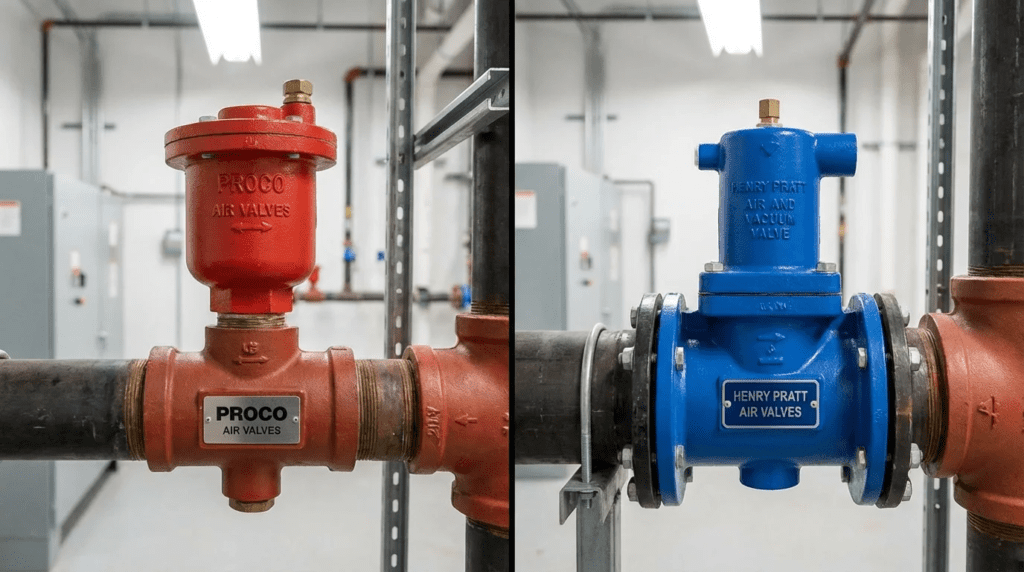
The catastrophic collapse of a pipeline due to vacuum conditions or the rupture of a force main caused by trapped air pockets remains a persistent threat in municipal water and wastewater infrastructure. Despite the critical nature of air management, air valves are often the most undervalued component in the hydraulic profile, frequently selected based on line size rather than thermodynamic and hydraulic performance. For engineers tasked with specifying these components, the choice often narrows down to established industry leaders and specialized challengers. This article provides an in-depth analysis of Proco vs Henry Pratt Air Valves Equipment: Comparison & Best Fit to aid in specification and procurement.
Air valves serve three distinct functions: venting air during filling (exhaust), admitting air during draining (vacuum break), and releasing entrained air during operation (release). While the fundamental physics remain constant, the mechanical execution differs between manufacturers. Henry Pratt (a Mueller brand) is a ubiquitous name in North American municipal water works, known for rigid adherence to AWWA C512 standards. Proco Products, while widely renowned for expansion joints and check valves, offers a line of air valves (Series 300) that present specific advantages in industrial and cost-sensitive applications.
Choosing the wrong equipment can lead to accelerated corrosion from trapped oxygen, pump inefficiency due to artificial head, or water hammer events that fatigue piping systems. This guide moves beyond the catalog data to examine the engineering realities—materials of construction, maintenance intervals, and failure modes—helping you decide which technology aligns with your specific hydraulic grade line and operational resources.
How to Select / Specify Air Valve Technologies
When evaluating Proco vs Henry Pratt Air Valves Equipment: Comparison & Best Fit, engineers must move beyond simple “pipe size matching.” The selection process requires a rigorous analysis of the hydraulic profile, the fluid matrix, and the specific mechanical design of the valve body and internals.
Duty Conditions & Operating Envelope
The primary driver for selection is the operating envelope. Engineers must calculate the Maximum Operating Pressure (MOP) and the minimum pressure during pump shutdown (transients). Both Pratt and Proco offer valves rated for standard classes (150# to 300# ANSI), but their performance at the margins differs.
- Venting Capacity (SCFM): Do not assume a 2-inch valve from Vendor A has the same SCFM discharge capacity as Vendor B. You must compare the discharge curves at specific differential pressures (usually 2-5 psi). Pratt’s designs typically focus on maximizing flow per AWWA C512 requirements for large municipal mains.
- Sealing Pressure: A critical, often overlooked parameter is the minimum sealing pressure. Some air valves require 5-10 psi to seal initially (drip tight). If the valve is located at a high point with low static head, it may leak continuously.
- Vacuum Collapse Protection: Calculate the potential vacuum volume during a column separation event. The valve must admit air fast enough to prevent the pipe from buckling. This is a function of the effective orifice area, not just the connection flange size.
Materials & Compatibility
The longevity of an air valve is dictated by its materials.
- Body Material: Municipal specifications typically demand Ductile Iron (ASTM A536) or Cast Iron (ASTM A126). Pratt’s core product line is heavily focused on these heavy-duty cast materials coated with fusion-bonded epoxy (FBE) to resist external corrosion. Proco offers similar materials but is also known for providing efficient solutions where weight or specific coatings are prioritized.
- Internal Mechanisms: The float and linkage mechanisms are the most failure-prone components. 316 Stainless Steel is the baseline recommendation for wastewater. Delrin or other polymers may be acceptable for potable water but can degrade in aggressive industrial effluents.
- Seat Material: Buna-N or EPDM are standard. However, in wastewater applications with high grease content (FOG), the seat geometry matters more than the material. A steep seat angle prevents debris accumulation.
Hydraulics & Process Performance
The valve’s interaction with the process fluid is critical.
- Wastewater Considerations: In sewage applications, “short body” air valves are prone to clogging because the mechanism is too close to the fluid line. “Long body” or extended body valves (standard in Pratt’s wastewater series) keep the sealing mechanism elevated, utilizing an air gap to prevent solids from fouling the seat.
- Anti-Slam Devices: For high-pressure pumps, the rapid expulsion of air during startup can cause the float to slam shut, creating a secondary surge. Look for “Anti-Slam” or “Throttling” devices that restrict airflow as the water column approaches the valve. Both manufacturers offer variations of this, but the mechanical robustness of the throttling disc is a key comparison point.
Installation Environment & Constructability
Physical constraints often dictate the winner in a specification battle.
- Vault Height: Air valves are typically installed at high points, often in shallow vaults. The overall height of the valve assembly (including isolation valve) is critical. Pratt’s traditional long-body wastewater valves are tall; ensure vault clearance allows for top-cover removal for maintenance.
- Flooding Risks: If the vault is prone to flooding, the air valve must be piped to a vent stack above the flood rim. This adds backpressure to the discharge; the valve sizing must account for the friction loss of the vent piping.
Reliability, Redundancy & Failure Modes
The most common failure mode for air valves is “spitting” or leakage due to debris on the seat.
- Self-Cleaning Mechanisms: Some designs incorporate a linkage that creates a mechanical advantage, ensuring the valve opens against internal pressure but also seats firmly.
- Redundancy: For critical transmission mains, it is best practice to install two air valves isolated by a manifold, or to keep a shelf spare. The standardization of flange dimensions (ANSI B16.1) usually makes swapping between Proco and Pratt physically possible, provided the height clearance exists.
Lifecycle Cost Drivers
While Proco may offer competitive upfront pricing in certain size ranges, the total cost of ownership (TCO) includes maintenance labor.
- Backwash Accessories: In wastewater, valves require regular backflushing. A valve supplied with factory-integrated backwash valves and quick disconnects saves significant operator time.
- Spare Parts Availability: Pratt, due to its massive municipal install base, has extensive parts distribution. Proco has a strong rep network, but local stock availability for specific internal kits should be verified during selection.
Comparison Tables: Proco vs Henry Pratt Air Valves Equipment: Comparison & Best Fit
The following tables provide a side-by-side engineering analysis. Table 1 focuses on the equipment attributes and manufacturer philosophy. Table 2 outlines the “Best Fit” applications to help engineers align the correct product with the specific project constraints.
| Feature / Criteria | Henry Pratt (Mueller) | Proco Products (Series 300/1900) |
|---|---|---|
| Primary Focus | Heavy Municipal Water/Wastewater, AWWA C512 Compliance. | Industrial, HVAC, and flexible piping solutions. (Stronger focus on Check Valves/Expansion Joints). |
| Design Philosophy | Robust, heavy cast bodies, traditional float/linkage mechanics designed for 20+ year municipal lifecycles. | Cost-effective, functional designs often targeting specific industrial or commercial applications. |
| Wastewater Designs | Extensive “Long Body” options specifically designed to keep mechanism free of FOG (Fats, Oils, Grease). | Available, but specification typically requires scrutiny to ensure “sewage grade” internals are selected. |
| Pressure Ratings | Full range: Class 125, 250, 300. High-pressure specialty valves available. | Standard commercial ranges; verify for high-pressure transmission main applications (>250 psi). |
| Certifications | Universal AWWA C512, NSF-61, ISO 9001. The standard spec for public works. | Verify specific model compliance with AWWA C512 if mandated by municipal code. |
| Market Perception | The “Safe Specification” for municipal consulting engineers. Premium price point. | The “Value Alternative” or “Industrial Problem Solver.” often shorter lead times. |
| Maintenance Profile | High maintainability; rebuild kits widely available. Designed for field disassembly. | Moderate maintainability; depending on model size, replacement may be more cost-effective than rebuild. |
| Application Scenario | Best Fit Equipment | Engineering Rationale |
|---|---|---|
| Municipal Potable Water Transmission | Henry Pratt | Requires strict AWWA C512 compliance and long-term asset management integration. The heavy-duty linkage withstands continuous cycling. |
| Raw Sewage Force Mains | Henry Pratt | The extended body design minimizes clogging risks. Access to standardized backwash accessories is critical for O&M. |
| Industrial Cooling Water / HVAC | Proco Products | Cost-efficiency is prioritized. Less stringent requirement for AWWA documentation. Proco’s availability often suits commercial timelines. |
| Outfall Scenarios (Passive) | Proco (Duckbill)* | *While not a mechanical air valve, Proco’s Duckbill checks are often used for air/vacuum relief in passive outfall scenarios, superior to mechanical valves in salt water. |
| Budget-Constrained Retrofits | Proco Products | When replacing existing valves on non-critical lines, Proco can offer significant CAPEX savings while meeting functional requirements. |
| High-Head Pump Stations | Henry Pratt | Robust anti-slam devices are necessary to prevent surge damage. Pratt’s engineered throttling devices are proven in these high-risk environments. |
Engineer & Operator Field Notes
Real-world performance often diverges from the datasheet. The following insights are gathered from commissioning reports, field troubleshooting, and long-term maintenance logs regarding air valve installations.
Commissioning & Acceptance Testing
Commissioning an air valve is more than just bolting it on.
- The “Burp” Test: During initial line filling, operators must verify that the valve is actually venting. Listen for the high-velocity air escape. If it goes silent too early, the float may have “blown shut” prematurely due to excessive differential pressure—a sign of undersizing or lack of a throttling device.
- Sealing Verification: Once pressurized, check for weeping. A new valve should be bone dry. Weeping suggests debris from construction (weld slag, stones) has already lodged in the seat. This is common and requires immediate flushing.
- Isolation Valve Check: Ensure the isolation valve (ball or gate) under the air valve is fully open. Partially closed valves restrict the orifice area, rendering the air valve’s vacuum protection useless.
Common Specification Mistakes
When analyzing Proco vs Henry Pratt Air Valves Equipment: Comparison & Best Fit, mistakes often occur in the “Details” section of the spec.
“The most expensive air valve is the one that is undersized for vacuum conditions, leading to a collapsed pipe.”
- Specifying by Line Size: Engineers often write “Install 2-inch Air Release Valve” simply because the pipe has a 2-inch tap. This is negligent. A 2-inch valve might be sufficient for release but woefully inadequate for vacuum relief during a catastrophic drain event.
- Ignoring Coating Specs: In wastewater vaults, H2S gas will attack standard epoxies. For Pratt or Proco valves in sewage service, specify 316SS bodies or high-build 100% solids epoxy internal and external coatings.
- Overlooking Freeze Protection: In northern climates, air valves in unheated vaults will freeze. The condensation inside the valve turns to ice, locking the float. Heat tracing or insulated covers are mandatory accessories that are often missed in the bid packages.
O&M Burden & Strategy
- Preventive Maintenance (PM): Air valves are “out of sight, out of mind.” A robust PM program requires semi-annual inspection.
- Monthly: Visual inspection for leaks.
- Quarterly (Wastewater): Backflush to remove grease cap.
- Annually: Isolate, disassemble top cover, inspect float linkage for corrosion, clean seat.
- Spare Parts Strategy: For Pratt valves, utilities often stock “rebuild kits” (seat, O-rings). For smaller Proco or commercial-grade valves, the labor cost to rebuild often exceeds the cost of a new unit; therefore, stocking complete replacement units is often the smarter strategy.
Design Details & Sizing Methodologies
Accurate sizing is the differentiator between a quiet system and one plagued by water hammer.
Sizing Logic & Methodology
Both Pratt and Proco equipment must be sized according to AWWA M51 guidelines. The physics do not change based on the brand.
1. Air Release Sizing (Operation)
The goal is to vent air coming out of the solution.
Rule of Thumb: Air entrainment is typically 2% of the flow volume at standard temperature and pressure.
Calculation: Determine flow rate (Q). Calculate 2% of Q. Select an orifice size that can vent this volume at the working pressure limit (usually 5-10 psi differential).
2. Air/Vacuum Sizing (Filling & Draining)
This is the critical safety sizing.
Filling: The valve must vent air at the same rate the pipe fills to prevent backpressure.
Draining (Vacuum): If the pump trips or a line breaks, the water column separates. The valve must admit air to replace the water.
Key Formula (Thorley or similar):
[ Q_{air} = Q_{water} ]
The valve must admit ( Q_{air} ) without exceeding a pressure drop (differential) of 5 psi (or pipe collapse pressure, whichever is lower).
Note: Standard piping can collapse at negative pressures as low as -4 to -7 psi depending on diameter and wall thickness (DR rating).
Specification Checklist
To ensure a fair comparison in a bid situation involving Proco vs Henry Pratt Air Valves Equipment: Comparison & Best Fit, include these line items:
- Compliance: Must meet AWWA C512 (latest revision).
- Test Data: Manufacturer must provide certified air flow curves (SCFM vs. Differential Pressure) for both inflow and outflow.
- Body Construction: ASTM A536 Ductile Iron or 316 Stainless Steel.
- Float: 316 Stainless Steel (No plastic floats for wastewater).
- Seat: EPDM or Buna-N, field replaceable.
- Hardware: All external bolts/nuts must be 316SS to prevent vault corrosion.
Frequently Asked Questions
What is the difference between an Air Release Valve and a Combination Air Valve?
An Air Release Valve (ARV) has a small orifice and is designed to release small pockets of entrained air while the system is pressurized and operating. A Combination Air Valve combines the functions of an Air/Vacuum valve (large orifice for filling/draining) and an Air Release valve (small orifice) into a single unit. For most municipal force mains, Combination Air Valves are the standard choice for high points.
How do Proco vs Henry Pratt Air Valves Equipment compare regarding AWWA C512 compliance?
Henry Pratt (Mueller) builds its core air valve product line specifically around AWWA C512 standards; it is their baseline. Proco Products offers compliant valves, but because they also serve broad industrial markets, not every valve in their catalog is AWWA C512 certified. Engineers must explicitly request C512 compliance when specifying Proco to ensure the submittal meets municipal standards.
Why do wastewater air valves leak?
Leakage is usually caused by debris (grit, ragging, or grease) getting stuck between the float and the seat. In low-pressure systems, there may not be enough pressure to force the seal tight. Selecting a “Sewage Grade” valve (like Pratt’s long-body series) extends the distance between the fluid and the mechanism, significantly reducing, though not eliminating, leakage risks.
When should I specify a Vacuum Breaker instead of a standard Air Valve?
A Vacuum Breaker is a specific type of Air Valve designed primarily for rapid air intake to prevent collapse. While a Combination Valve offers this feature, dedicated Vacuum Breakers are often used on large, thin-walled pipelines (like steel transmission mains) or at siphons where vacuum protection is the paramount safety concern, far outweighing air release needs.
Can I replace a Pratt Air Valve with a Proco Air Valve?
Physically, yes, provided the flange connection (ANSI Class 125/150) matches. However, you must verify the height clearance in the vault and, more importantly, the air flow capacity (SCFM). A Proco valve of the same flange size may have different internal orifice geometry. Always compare the flow curves, not just the connection size.
What is the typical lifespan of these valves?
In potable water applications, a high-quality cast iron air valve (like Pratt) can last 20-25 years, with internal maintenance every 5-7 years. In wastewater applications, the lifespan is significantly shorter due to corrosive gases (H2S) and grease; expect 10-15 years for the body, with more frequent internal rebuilds required every 3-5 years.
Conclusion
KEY TAKEAWAYS
- Application Rules: Use Henry Pratt for core municipal infrastructure, critical transmission mains, and where strict AWWA C512 compliance is non-negotiable. Consider Proco for industrial loops, non-critical retrofits, or budget-sensitive projects where flexibility is required.
- Sizing Matters: Never size based on pipe diameter alone. Calculate required SCFM for both filling and vacuum protection.
- Wastewater Reality: For sewage, always specify “Long Body” or “Extended Body” designs to prevent fouling. Short-body valves will fail rapidly.
- Maintenance: Specify isolation valves and backwash accessories. Without them, the air valve becomes a permanent liability that operators cannot service.
- Safety Factor: Ensure the valve sizing accounts for the collapse pressure of the pipe. The cost of a larger air valve is negligible compared to a collapsed main.
The choice within the Proco vs Henry Pratt Air Valves Equipment: Comparison & Best Fit debate ultimately comes down to the criticality of the asset and the specific nature of the fluid. Henry Pratt represents the traditional, heavy-duty municipal standard—a safe, robust choice for public works projects requiring 50-year design horizons and standardized MRO inventories. Proco Products offers a viable alternative, particularly in industrial sectors or applications where supply chain agility and cost-effectiveness are prioritized.
For the design engineer, the responsibility is to look beyond the brand name and focus on the performance curve. Ensure the vacuum capacity protects your pipe class, the materials withstand your fluid chemistry, and the installation allows for the inevitable maintenance these components require. By adhering to rigorous sizing methodologies (AWWA M51) and specifying appropriate accessories (anti-slam devices, backwash kits), both manufacturers can provide reliable service. However, for critical municipal force mains, the depth of Pratt’s installed base and specific wastewater engineering often tips the scale in their favor, while Proco remains a strong contender for diverse piping systems and industrial problem-solving.