
Submersible Materials Selection: Cast Iron vs Stainless vs Duplex in Wastewater
Introduction to Submersible Pump Metallurgy
One of the most persistent and costly challenges in modern wastewater management is the premature degradation of submersible pumping equipment due to shifting influent chemistry. As water conservation efforts reduce flow rates, wastewater becomes more concentrated. Simultaneously, longer retention times in force mains and collection basins accelerate septicization, leading to aggressive spikes in hydrogen sulfide (H2S) and the formation of sulfuric acid via biological activity.
Material selection sits at the intersection of two disciplines that are often handled by different people. Hydraulic sizing determines whether a pump can move the required flow at the required head; metallurgy determines how long it will continue to do so. Within the broader submersible pumps category, the operations-side questions — what fails, why, what it costs, and when to replace rather than repair — all trace back to alloy decisions made during design. An engineer who treats the material line item as a commodity choice is effectively pre-committing the utility to a maintenance budget for the next two decades.
Many utilities face a stark reality: submersible pumps specified with standard materials that once lasted 15 to 20 years are now showing signs of severe corrosion, pitting, and impeller degradation within 3 to 5 years. This drastic reduction in Mean Time Between Failures (MTBF) disrupts capital improvement plans and bloats operational maintenance budgets.
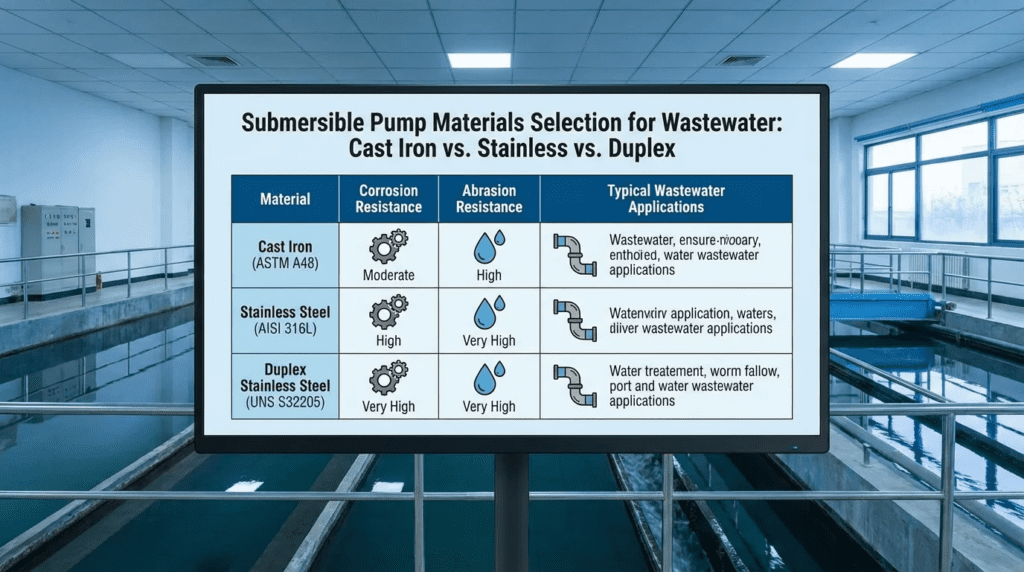
The engineering challenge lies in the Submersible Materials Selection: Cast Iron vs Stainless vs Duplex in Wastewater applications. It is no longer sufficient to default to ASTM A48 Class 30 Grey Iron for every lift station. While cast iron remains the workhorse of the industry, the specific chemical and abrasive loads of modern wastewater often demand higher-grade alloys.
This article provides a comprehensive technical analysis for engineers and plant directors. We will examine the metallurgical properties, failure modes, and selection logic required to choose between standard cast iron, austenitic stainless steel (300 series), and duplex stainless steel (CD4MCu) to ensure hydraulic integrity and optimize Total Cost of Ownership (TCO).
Submersible Pump Operations: Subcategory Overview
Metallurgy is one of four operational disciplines that determine whether a submersible installation meets its design life. The others are diagnostic practice, seal management, economic analysis, and end-of-life decision-making. Each is covered in a dedicated guide below, and each connects directly back to the material choice made at specification. A utility that upgrades alloy without also upgrading its troubleshooting protocol, seal specification, and replacement criteria will capture only a fraction of the available reliability gain.
Troubleshooting Submersible Pumps by Symptom
Field diagnosis at a lift station is almost always symptom-driven: an operator arrives to a high-level alarm, a tripped breaker, or a pump that runs but moves nothing. Structured submersible troubleshooting by symptom converts those observations into a short list of probable causes before anyone opens a confined space or calls for a crane. The discipline matters more, not less, on high-alloy pumps, because the failure signatures shift when the material changes.
A cast iron pump that gradually loses head over eighteen months is usually telling you that corrosion-erosion has opened the wear ring clearance. A duplex pump exhibiting the same curve droop is far more likely to have a mechanical problem — a partially clogged impeller, a worn coupling, or a motor operating off its design voltage — because the clearances simply do not open at the same rate. Reading the symptom against the expected degradation mode of the installed alloy is what prevents a utility from replacing a perfectly sound wet end while ignoring the actual fault. Amp draw trending, discharge pressure logging, and vibration signature comparison against the commissioning baseline all become more diagnostic once the corrosion variable is largely removed.
Seal Failures: Causes and Prevention
Mechanical seal failure remains the single most common reason a submersible pump comes out of a wet well, and it is the failure mode least affected by upgrading the volute and impeller alloy. Understanding the root causes of submersible seal failures — dry running, thermal shock, abrasive intrusion, chemical attack on the elastomer, and shaft deflection from off-curve operation — is essential to realizing the service life a duplex specification promises on paper.
The interaction between metallurgy and sealing deserves specific attention. Duplex and 316 stainless shafts run truer and resist the corrosion pitting under the seal faces that ruins iron shafts, but silicon carbide and tungsten carbide face materials are selected against the fluid, not the pump body. A pump specified with CD4MCu wetted parts and a carbon-versus-ceramic seal in a gritty septage application will still fail on schedule, because the grit is attacking the seal faces rather than the volute. Specifications should call out seal face material, elastomer compound, and the presence of a seal leakage detection probe with the same precision applied to the casting alloy — and the seal chamber oil should be sampled at every scheduled visit, since water content is the earliest available warning of a primary seal breach.
Lifecycle Cost: CAPEX vs OPEX and Energy Payback
The economic case for an alloy upgrade only holds together when it is built on a complete cost model. A rigorous submersible lifecycle cost analysis accounts for purchase price, installation, energy consumption over the evaluation period, scheduled maintenance, unscheduled repairs including crane and confined-space entry costs, and residual value or disposal at end of life. Energy typically dominates: over a twenty-year horizon a continuously duty-cycled pump will consume electricity worth several times its purchase price.
This is where material selection produces a second, less obvious benefit. Hydraulic efficiency degrades as internal clearances open, and a pump that has lost three points of efficiency is paying an energy penalty every hour it runs. Duplex and stainless castings hold their clearances and surface finish far longer than iron in aggressive service, which means the efficiency curve stays closer to the certified test curve through the middle years of service. When that retained efficiency is monetized alongside avoided replacement cycles, the CAPEX premium for a high alloy frequently pays back inside seven to ten years — well short of the asset’s design life.
Retrofit vs Replace in Aging Stations
Most utilities are not specifying greenfield stations; they are deciding what to do with a lift station built in 1985 whose pumps have been rebuilt three times. The retrofit vs replace decision for aging submersible stations weighs the cost of a wet-end rebuild or drop-in alloy upgrade against full station modernization including guide rails, discharge piping, controls, and electrical service.
Material considerations often force the decision. A drop-in duplex pump installed on 1985-vintage carbon steel guide rails creates the galvanic couple described later in this article, so the true cost of the “cheap” retrofit includes rail and bracket replacement in 316 stainless or composite. Conversely, when the existing rails and base elbow are already stainless and structurally sound, a wet-end-only upgrade can deliver most of the reliability benefit at a fraction of full-replacement cost. The practical rule used by many utilities is that when cumulative repair spending over the trailing five years exceeds roughly 60% of replacement cost, or when the station’s hydraulic duty has shifted materially from its original design point, replacement rather than retrofit is the defensible choice.
How to Select and Specify Pump Materials
Selecting the correct material for a submersible wastewater pump is a balance of chemical resistance, mechanical strength, and economic feasibility. The decision framework must move beyond initial purchase price to encompass the anticipated service life under specific hydraulic and chemical stressors.
Duty Conditions & Operating Envelope
The first step in Submersible Materials Selection: Cast Iron vs Stainless vs Duplex in Wastewater is a rigorous characterization of the fluid. Municipal wastewater is rarely just “sewage”; it is a complex, chemically active slurry.
- pH Range: Standard cast iron is generally suitable for pH ranges of 6.0 to 9.0. If the influent pH drops below 6.0—common in septic environments or industrial discharge zones—the passive oxide layer on iron dissolves, accelerating mass loss. Stainless steel (316) handles pH 4.0–10.0 effectively, while Duplex alloys can often withstand pH ranges from 2.0 to 12.0.
- Chloride Concentration: Chlorides are the nemesis of stainless steel due to pitting and crevice corrosion. While 316 stainless steel is superior to cast iron, it is susceptible to stress corrosion cracking (SCC) above 60°C (140°F) in high-chloride environments. Duplex stainless steel, with its dual-phase microstructure, offers vastly superior resistance to chloride stress cracking.
- Temperature: Corrosion reaction rates generally double for every 10°C (18°F) rise in temperature (Arrhenius equation). A pump that survives mild acidity at 15°C may fail rapidly at 40°C. Material selection must account for the maximum process temperature, particularly in industrial effluent or aerobic digester applications.
Materials & Compatibility
Understanding the metallurgy is critical for accurate specification.
Cast Iron (ASTM A48 Class 30 / ASTM A536 Ductile):
Grey cast iron is the industry baseline. It relies on a thick casting wall to tolerate a certain rate of general corrosion. Ductile iron provides better tensile strength and impact resistance but offers similar chemical resistance. It is suitable for domestic influent with low H2S and neutral pH.
Austenitic Stainless Steel (304 vs 316):
304 Stainless is rarely adequate for wastewater due to poor resistance to chlorides and sulfuric acid. 316/316L (containing 2-3% Molybdenum) is the minimum standard for “corrosion-resistant” specifications. It excels in oxidative environments but can suffer from pitting in stagnant, anaerobic zones common in lift station wet wells.
Duplex Stainless Steel (CD4MCu / ASTM A890 Grade 1B/1C):
Duplex alloys consist of a microstructure that is approximately 50% ferrite and 50% austenite. This provides twice the yield strength of 316 stainless steel and significantly higher hardness. The addition of Copper (in CD4MCu) greatly enhances resistance to sulfuric acid, making it the premier choice for septic wastewater and high-H2S environments.
PREN = %Cr + 3.3(%Mo) + 16(%N).
Standard 316 SS has a PREN of ~24. Duplex CD4MCu typically exceeds a PREN of 34, indicating vastly superior resistance to localized pitting.
Hydraulics & Process Performance
Material selection impacts hydraulic efficiency and performance curves, primarily through surface roughness and wear resistance.
- Surface Finish: Stainless steel investment castings typically have smoother hydraulic passages than sand-cast iron. This can result in a 1-3% gain in wire-to-water efficiency for stainless variants.
- Wear Ring Maintenance: In cast iron pumps, wear rings (or clearance gaps) open up over time due to corrosion-erosion, leading to internal recirculation and a drop in volumetric efficiency. Duplex stainless steel, being harder (approx. 240-260 Brinell vs. 160-190 for 316 SS), maintains tight clearances longer, preserving the original pump curve for the majority of its lifecycle.
Installation Environment & Constructability
The physical environment influences material choice beyond just fluid chemistry.
- Guide Rail Systems: A common oversight is specifying a high-grade Duplex pump but mating it to a galvanized or standard carbon steel guide rail system. This creates a galvanic cell where the rail (anode) sacrifices itself to the pump (cathode), leading to structural failure of the mounting system. Specifications must require compatible rail materials—typically 316 SS or composite—when upgrading pump metallurgy.
- Weight: While density differences are negligible, the higher strength of Duplex allows for thinner casting walls in some designs (though most manufacturers use the same molds). However, ensure lifting chains and shackles are rated for the environment; a corroded lifting chain on a pristine pump is a safety hazard.
Reliability, Redundancy & Failure Modes
Engineers must consider the dominant failure mode when selecting materials:
- General Corrosion: Uniform thinning of the material. Predictable in Cast Iron.
- Localized Pitting: Deep penetration in small areas. Common in 316 SS in high-chloride, stagnant water. Can lead to through-wall failure and motor housing flooding.
- Microbially Induced Corrosion (MIC): Bacteria (SRBs) colonize the metal surface, creating localized acidic environments. Standard stainless steels are vulnerable to MIC under deposits. Duplex alloys are significantly more resistant due to their surface chemistry.
- Abrasion-Corrosion: The synergistic effect where grit removes the passive oxide layer, and corrosion attacks the fresh metal. This cycle destroys soft metals rapidly. Duplex, with high hardness, resists this cycle best.
Lifecycle Cost Drivers
The economic argument is the crux of the Submersible Materials Selection: Cast Iron vs Stainless vs Duplex in Wastewater decision.
- CAPEX: If a Cast Iron pump costs $10,000 (Base), a 316 SS equivalent may cost $20,000–$25,000, and a Duplex unit $28,000–$35,000.
- OPEX: In an aggressive environment, a cast iron pump may require impeller replacement every 2 years and full replacement in 5. A Duplex pump may last 15+ years with only seal changes.
- Labor: The cost of pulling a pump, cleaning the wet well, and confined space entry often exceeds the cost of the pump repair itself. High-grade materials reduce the frequency of these interventions.
Material Comparison Matrices
The following tables provide a direct comparison of metallurgical properties and application suitability. These guides are intended to assist engineers in matching material grades to specific wastewater environments.
| Material Grade | ASTM Standard | Typical PREN | Hardness (Brinell) | Primary Strengths | Limitations | Relative Cost Factor |
|---|---|---|---|---|---|---|
| Grey Cast Iron | ASTM A48 Class 30 | N/A | 180 – 220 | Low cost, excellent machinability, good vibration damping. | Poor resistance to acids and H2S. Low tensile strength. Brittle. | 1.0 (Baseline) |
| Ductile Iron | ASTM A536 | N/A | 200 – 240 | High tensile strength, impact resistance, moderate cost. | Still susceptible to corrosion in acidic/high-chloride environments. | 1.1 – 1.2 |
| 316 Stainless Steel | ASTM A743 CF8M | 23 – 25 | 160 – 190 | Excellent general corrosion resistance, readily available. | Susceptible to pitting in chlorides >1000ppm. Vulnerable to abrasion (soft). | 2.0 – 2.5 |
| Duplex Stainless (CD4MCu) | ASTM A890 Gr 1B | 32 – 38 | 240 – 270 | Superior pitting resistance, high abrasion resistance, high strength. | Higher initial cost. Harder to machine during repairs. | 2.8 – 3.5 |
| Application Scenario | Key Stressors | Recommended Material | Alternative / Upgrade | Engineering Rationale |
|---|---|---|---|---|
| Standard Domestic Lift Station | Neutral pH, low grit, low H2S. | Cast/Ductile Iron | 316 SS Impeller (Hybrid) | Standard iron is sufficient for neutral pH. A stainless impeller prevents erosion at high velocities. |
| Septage Receiving Station | High H2S, acidic pH (4-6), variable solids. | Duplex (CD4MCu) | High-Chrome Iron (for grit) | Acidity attacks iron; H2S causes MIC. Duplex is required to prevent rapid volute failure. |
| Industrial Laundry / CIP Wash | High temperature (>60°C), caustic/acid swings. | 316 Stainless Steel | Duplex (if chlorides high) | 316 SS handles chemical clean-in-place (CIP) fluids well. Watch for chlorides causing stress cracking. |
| Coastal / Brine Intrusion | High chlorides (>2000 ppm), conductivity. | Duplex / Super Duplex | Titanium (Extreme cases) | 316 SS will pit rapidly in brackish water. Duplex is mandatory for saline environments. |
| Grit Chamber / Headworks | Extreme abrasion, sand impact. | High-Chrome Iron | Duplex (Hardened) | Abrasion is the primary failure mode. Hardness >500 HBN is preferred over corrosion resistance. |
Selection & Specification Framework
The matrices above identify candidate materials; the framework below resolves the choice when more than one candidate appears acceptable. Work the constraints in the order they actually bind — chemistry, then abrasion, then mechanical duty, then system compatibility, then economics — because a decision made on cost before the chemistry is settled almost always has to be revisited after the first failure.
Step 1 — Establish the Governing Chemical Stressor
Sample the influent across at least one full diurnal cycle and, where industrial contributors are present, across a full production week. The governing parameter is rarely the average; it is the excursion. A collection system that averages pH 7.2 but drops to 5.4 during a weekly discharge event will corrode iron at the rate dictated by those excursion hours. Rank the stressors — acidity, chlorides, hydrogen sulfide, temperature — and identify which single parameter eliminates the most candidate materials. That parameter governs the specification, and every subsequent step is a refinement within the surviving set.
Step 2 — Quantify Abrasion Independently of Corrosion
Abrasion and corrosion are separate design problems that happen to occur together. Measure grit loading as settleable solids rather than relying on total suspended solids, since organic TSS causes almost no wear while 200 mg/L of sand will destroy a soft alloy. Where grit dominates, hardness outranks passivity and high-chrome iron may outperform duplex despite being metallurgically inferior in every corrosion test. Where both are severe, duplex is the compromise that avoids failing badly on either axis.
Step 3 — Verify the Mechanical Duty Point
Materials that resist chemistry can still fail mechanically. Confirm the pump will operate within roughly 70% to 120% of best efficiency point across the expected wet well level range. A pump running far to the left of BEP experiences radial thrust and shaft deflection that will destroy seals regardless of casting alloy, and a pump running out toward runout will cavitate. The relationship between duty point and service life is well documented across the site’s guidance on submersible wastewater pump applications, and it should be settled before the alloy premium is committed — there is no metallurgical solution to a hydraulic sizing error.
Step 4 — Enforce System-Wide Material Compatibility
Extend the material specification to every component sharing the wetted electrolyte: guide rails, base elbow, upper bracket, lifting chain, shackles, level sensor mounts, and discharge fasteners. Mixed metals in a conductive sewage environment form galvanic cells whose corrosion rate is driven by the area ratio between anode and cathode — a small carbon steel bracket next to a large duplex pump will disappear quickly. The same logic applies to adjacent equipment sharing the basin, including mixers; utilities specifying alloy upgrades often review submersible mixers in the same basin at the same time, since a mismatched mixer shaft or propeller will corrode preferentially once the pumps are upgraded.
Step 5 — Confirm Supply and Support Before Committing
High-alloy castings are not universally available across every hydraulic size and configuration, and lead times for duplex wet-end spares commonly run 12 to 20 weeks against 2 to 4 weeks for cast iron. Before finalizing the specification, confirm which manufacturers actually pour the required grade in the required frame size, what their documented lead times are, and whether regional service support can rebuild the unit without factory return. Comparing the alloy offerings across major OEMs for submersible pumps early in design prevents writing a specification that only one vendor can meet — a situation that eliminates competitive bidding and typically adds 15% to 25% to the delivered price.
Worked Example — Alloy Payback at a Septage Receiving Station
A receiving station handles hauled septage with pH excursions to 5.2, sustained H2S in the headspace above 40 ppm, and settleable grit around 150 mg/L. Two dry-weather duty pumps run approximately 4,000 hours per year each at 25 hp.
- Cast iron baseline: $12,000 per pump. Observed service life in this duty: 4 years. Impeller replacement at year 2 costs $3,500 including labor.
- Duplex CD4MCu: $34,000 per pump. Expected service life: 16 years, seals only.
- Removal and reinstallation: $4,200 per event (crane, confined space entry, bypass pumping, two-person crew).
Over a 16-year evaluation period, the iron option requires four pump purchases ($48,000), eight impeller interventions ($28,000), and roughly twelve removal events ($50,400), totaling approximately $126,400 per pump position. The duplex option requires one purchase ($34,000), four scheduled seal services at $2,800 each ($11,200), and four removal events ($16,800), totaling approximately $62,000. The alloy premium of $22,000 returns roughly $64,000 in avoided cost — and that figure excludes the retained hydraulic efficiency, which on a 25 hp pump running 4,000 hours at $0.11/kWh is worth an additional $800 to $1,000 annually for every three points of efficiency preserved.
Step 6 — Document the Basis of Selection
Record the water quality data, the governing stressor, the rejected alternatives and why, and the lifecycle comparison in the design memorandum. This documentation does two things: it defends the alloy premium during value-engineering reviews, and it gives the next engineer — the one making the retrofit-versus-replace call in fifteen years — the baseline needed to judge whether the material performed as predicted.
Engineer & Operator Field Notes
Successful deployment of submersible pumps requires more than just correct material selection on a datasheet. Practical implementation, testing, and maintenance strategies determine the ultimate success of the project.
Commissioning & Acceptance Testing
When high-grade materials are specified, verification is essential. During the Factory Acceptance Test (FAT) or upon site delivery:
- Material Traceability: Request and review the Material Test Reports (MTRs) / Mill Certificates. Verify the heat numbers on the casting match the documentation. For Duplex pumps, ensure the specific ASTM A890 grade matches the bid (e.g., Grade 1B vs 1C).
- Passivation Check: Stainless steel requires a passive oxide layer to resist corrosion. If the pump was machined or ground during manufacturing without re-passivation (acid pickling), it may rust prematurely. Visual inspection for “free iron” contamination (orange spotting) on new pumps is critical.
- Coating Integrity: Even if a pump is cast iron, it likely has an epoxy coating. Inspect for pinholes or chips from shipping. A breach in the coating is a focused corrosion point that can undercut the remaining paint.
- Ferrite Balance Verification: For duplex castings, request the ferrite number from the foundry or verify with a ferritescope on arrival. A properly solution-annealed duplex casting holds roughly 35% to 55% ferrite; a casting outside that band has lost either the corrosion resistance or the toughness that justified the premium, and improper post-weld heat treatment on repaired castings is the usual cause.
- Baseline Performance Record: Log amp draw at each duty point, discharge pressure at rated flow, seal chamber oil condition, and a vibration signature at commissioning. Every future troubleshooting decision is a comparison against this record, and a station without one forces operators to diagnose from absolute values rather than trends.
Common Specification Mistakes
Simply writing “Stainless Steel Construction” in a bid often leads to vendors supplying 304 SS or even 400-series (ferritic) stainless to lower costs. 304 SS offers marginal improvement over cast iron in septic sewage but costs significantly more. Always specify the grade (e.g., AISI 316 or ASTM A890 CD4MCu).
Another frequent error is the “Hybrid” Mismatch. Engineers often specify a Stainless Steel impeller inside a Cast Iron volute to save money. While this improves impeller life, it creates a galvanic couple. The large cast iron volute acts as the anode and corrodes to protect the stainless impeller. In highly conductive wastewater, this can accelerate the deterioration of the volute, potentially causing catastrophic structural failure of the pump housing.
O&M Burden & Strategy
Operational strategies differ based on the material selected:
- Cast Iron: Requires frequent visual inspection of the coating system. Zinc anodes (sacrificial protection) are highly recommended and must be replaced annually or when 50% depleted.
- Duplex/Stainless: These materials are generally “install and forget” regarding corrosion, but they are sensitive to bio-fouling. The smooth surface can sometimes accumulate grease buildup differently than rough iron. Periodically cleaning the wet well remains necessary to prevent large solid agglomerations.
- Critical Spares: For Duplex pumps, lead times for replacement parts (impellers, volutes) can be significantly longer (12-20 weeks) than standard cast iron parts. Utilities utilizing Duplex pumps should maintain a robust on-site inventory of wet-end components or a complete spare pump.
Design Details and Specification Logic
Sizing Logic & Methodology
When conducting Submersible Materials Selection: Cast Iron vs Stainless vs Duplex in Wastewater, the sizing logic extends into chemical engineering. There is no simple calculation for “corrosion allowance” in pumps because hydraulic performance depends on precise geometries; you cannot simply add 3mm of thickness to an impeller vane as you would a pipe wall.
Step-by-Step Selection Approach:
- Sample Analysis: Obtain a composite sample of the wastewater. Test for pH (min/max), Chlorides (mg/L), Temperature (max), and Sand/Grit content (TSS).
- Calculate Corrosion Rate (Theoretical): If using Cast Iron in acidic conditions, reference isocorrosion charts. If the estimated rate >20 mils/year, Iron is unsuitable.
- Abrasion Factor: If TSS > 200mg/L with high sand content, hardness becomes the priority. Select material with Brinell Hardness > 200 (Duplex or Hard Iron).
- Velocity Check: High fluid velocities accelerate corrosion (Erosion-Corrosion). At impeller tip speeds > 60 ft/s, soft materials (316 SS) may erode rapidly in the presence of grit. Duplex allows for higher tip speeds without rapid degradation.
Specification Checklist
To ensure competitive bids comply with material requirements, include these specific standards in your Division 11 or Division 43 specifications:
- For 316 Stainless Steel: Components shall be cast of ASTM A743 Grade CF8M. Wetted parts shall be passivated to remove surface iron.
- For Duplex Stainless Steel: Components shall be cast of ASTM A890 Grade 1B (CD4MCuN) or Grade 5A (2205). Minimum hardness shall be 240 HBW.
- Fasteners: All external bolts and nuts shall be 316 Stainless Steel. (Avoid 304 fasteners on 316 pumps to prevent seizing/galling, or use appropriate anti-seize compounds compatible with the process).
- O-Rings/Elastomers: Ensure elastomers are compatible. Viton (FKM) is standard for high-temperature/industrial/acidic apps, while Nitrile (NBR) is standard for domestic sewage.
- Seal Configuration: Tandem mechanical seals in an oil-filled chamber, with lower seal faces of silicon carbide versus silicon carbide in abrasive service, and a moisture-detection probe wired to the control panel as a discrete alarm.
- Documentation: Certified pump performance test curve, material test reports with heat numbers, ferrite measurement for duplex castings, and a parts list with manufacturer numbers furnished before substantial completion.
- System Components: Guide rails, base elbow, upper bracket, lifting chain, and all submerged hardware shall match or exceed the corrosion resistance of the pump castings.
Standards & Compliance
No single standard governs submersible pump metallurgy for wastewater service; the specification must assemble several. Casting chemistry and mechanical properties are defined by ASTM A48 and A536 for iron, ASTM A743 for austenitic stainless, ASTM A890 for cast duplex grades, and ASTM A532 for abrasion-resistant high-chrome iron. Hydraulic performance, acceptance testing, and material class definitions follow the Hydraulic Institute standards, principally HI 1.3 for rotodynamic pumps and HI 11.6 for submersible pump testing. Motor construction and enclosure ratings are governed by NEMA MG 1 and the applicable NFPA 70 (NEC) provisions for hazardous location classification at wet well installations, and NSF/ANSI 61 applies wherever the pumped stream can reach a potable or reuse system.
- HI 1.3 (Rotodynamic Centrifugal Pumps): Defines material classes and testing procedures.
- NACE MR0175: While primarily for oil/gas sulfide stress cracking, the principles regarding hardness control in H2S environments are relevant for severe wastewater applications.
- NSF/ANSI 61: If the pump is used in reuse applications or near potable water sources, specific material certifications may be required.
Frequently Asked Questions
What is CD4MCu and why is it recommended for wastewater?
CD4MCu is a cast duplex stainless steel (ASTM A890 Grade 1B). It contains approximately 25% Chromium, 5% Nickel, 2% Molybdenum, and 3% Copper. The “Duplex” name refers to its mixed microstructure of ferrite and austenite. It is recommended for wastewater because it offers double the strength of 316 stainless steel, superior resistance to abrasion (grit), and excellent resistance to pitting and stress corrosion cracking caused by chlorides and hydrogen sulfide.
Is it worth coating a Cast Iron pump instead of upgrading to Stainless?
Applying high-performance ceramic or epoxy coatings to cast iron is a valid mid-tier strategy. A factory-applied ceramic coating can extend the life of a cast iron volute significantly. However, coatings are susceptible to impact damage from debris. Once the coating is chipped, corrosion undercuts the surrounding area, leading to failure. For critical applications where reliability is paramount, an alloy upgrade (integral material change) is superior to a surface coating.
How much more does a Duplex Stainless Steel pump cost compared to Cast Iron?
Typically, a Duplex stainless steel pump costs 2.5 to 3.5 times the price of a standard cast iron pump. However, this CAPEX premium must be weighed against lifecycle costs. If a cast iron pump fails every 4 years and a Duplex pump lasts 20 years, the Duplex option yields a significantly lower Total Cost of Ownership (TCO) when factoring in replacement labor, crane costs, and downtime.
Does 316 Stainless Steel rust in wastewater?
Yes, it can. While 316 SS is “stain-less,” it is not “stain-proof.” In stagnant wastewater with high chlorides and low oxygen (anaerobic conditions), the protective passive layer on 316 SS can break down, leading to pitting or crevice corrosion. This is why Duplex alloys, which have higher Pitting Resistance Equivalent Numbers (PREN), are preferred for high-chloride or high-H2S environments.
When should I specify Hard Iron (High Chrome) over Duplex?
You should specify High Chrome Iron (ASTM A532) when abrasion is the primary failure mode and corrosion is secondary. This is common in grit chambers, tunnel dewatering, or sand washing applications. High Chrome Iron is extremely hard (600+ Brinell) but brittle and has lower corrosion resistance than Duplex. If the application is both highly corrosive (acidic) and abrasive, Duplex is usually the safer compromise.
What is the impact of Galvanic Corrosion in lift stations?
Galvanic corrosion occurs when dissimilar metals are electrically connected in an electrolyte (wastewater). If you install a stainless steel pump on a carbon steel guide rail, the rail will corrode rapidly to protect the pump. To prevent this, specifiers must ensure the entire wetted assembly (pump, guide rails, lifting chains, brackets) utilizes compatible materials, typically upgrading all stationary components to 316 SS or composite when using SS/Duplex pumps.
Can an existing cast iron pump be upgraded to a higher alloy without replacing the station?
Often yes, provided the hydraulic duty has not changed and the mounting interface is compatible. Most manufacturers offer the same frame size in multiple alloys, so a drop-in duplex or stainless wet end can be installed on the existing base elbow if the discharge flange pattern matches. The complication is galvanic compatibility: dropping a high-alloy pump onto carbon steel or galvanized guide rails accelerates rail corrosion, so the retrofit budget must include rails, brackets, and lifting chain in 316 stainless or composite. Where the station’s electrical service, controls, or wet well geometry are also at end of life, or where cumulative repair spending has passed roughly 60% of replacement cost, full replacement usually delivers better value than a staged alloy upgrade.
Conclusion
Key Takeaways for Engineers
- Analyze the Water: Do not guess. Obtain chloride, pH, and H2S data before specifying materials.
- The 316 Limit: 316 SS is the standard upgrade but has limits. Avoid it if Chlorides >1000ppm or if high abrasion is present. Move to Duplex.
- Duplex (CD4MCu) is the Heavy Lifter: Offers the best balance of corrosion resistance and abrasion resistance for modern, septic wastewater.
- Lifecycle vs. Low Bid: A 3x initial cost for Duplex is justified if it eliminates three replacement cycles over 20 years.
- System Compatibility: Never upgrade the pump metallurgy without upgrading the guide rails and lifting chains to match.
- Separate Abrasion from Corrosion: They are distinct design problems. Measure settleable grit independently of TSS, because hardness and passivity are not the same property and the wrong one will be optimized otherwise.
- Seals Fail First: An alloy upgrade does nothing for the most common failure mode. Specify seal face material, elastomer compound, and moisture detection with the same rigor applied to the casting grade.
The landscape of Submersible Materials Selection: Cast Iron vs Stainless vs Duplex in Wastewater is shifting. As water conservation creates more concentrated, aggressive influent, the “standard” cast iron specification is increasingly becoming a liability for municipal and industrial utilities. While cast iron remains a cost-effective solution for neutral, domestic sewage, the engineering community must recognize when to step up the material specification.
For applications involving septage, industrial effluent, or coastal environments, the shift to Duplex Stainless Steel (CD4MCu) represents a prudent investment in reliability. By understanding the failure modes of pitting, MIC, and abrasion, engineers can write specifications that protect utility assets, reduce maintenance burdens, and ensure long-term hydraulic performance. The goal is not merely to buy a pump, but to secure a reliable transport process for the next two decades.