
Submersible Seal Failures: Causes
Introduction
For municipal and industrial engineers, few events are as frustrating—or as costly—as the premature loss of a critical lift station pump. While the symptom is often a grounded motor or a tripped breaker, the root cause frequently lies in the failure of the mechanical seal system. Mechanical seal issues account for a large share of unplanned submersible pump downtime, yet the specific mechanisms driving Submersible Seal Failures: Causes are often misunderstood during specification and procurement.
In water and wastewater applications, the seal is the primary barrier between the process fluid—laden with grit, rags, and corrosives—and the dry environment required by the motor stator. When that barrier is breached, the clock starts on a motor failure. Many engineers treat seals as commodity components and accept manufacturer defaults. Ignoring the specific mechanical and material requirements of the application produces repetitive failure cycles.
This article examines the causes of seal failure, prevention strategies, and specification practice. It is written for design engineers, plant superintendents, and reliability professionals who need specification-grade information, and it builds directly on the metallurgy decisions covered in submersible pump materials selection. By understanding the physics of seal operation, the impact of hydraulic selection on shaft stability, and the nuances of material science, engineers can turn generic pump specifications into reliability tools.
How to Select and Specify for Reliability
Preventing seal failure begins at the engineering desk. A robust specification does not merely ask for a “mechanical seal”; it defines the operational envelope and the material constraints necessary to survive the application.
Duty Conditions & Operating Envelope
Unlike dry-pit pumps, submersibles rely on the surrounding fluid and an oil chamber for seal cooling. Engineers must evaluate:
- Pressure Differentials: In deep lift stations or high-head applications, hydrostatic pressure on the faces changes substantially between the off and running states. Standard seals carry a stated pressure rating, but transient surge can exceed it, forcing faces open or crushing the lubricating film.
- Temperature Gradients: Industrial wastewater varies in temperature. A rapid influx of hot cleaning fluid into a cold sump produces thermal shock. Where the two face materials have different coefficients of thermal expansion, this causes face distortion and leakage.
- Solids Content & Particle Size: Specific gravity and abrasiveness dictate the face material. Grit, sand, and metal fines embed in softer face materials such as carbon, turning the seal into a lapping tool.
Materials & Compatibility
Material selection is the single most controllable variable in preventing abrasion- and chemistry-driven failure. The specification must state materials separately for the lower (process side) and upper (oil side) seals.
Face materials:
- Carbon-Graphite: Excellent self-lubricating properties and poor abrasion resistance. Unsuitable for the lower seal in raw wastewater; well suited to the upper seal running in the oil bath.
- Ceramic (alumina): Hard but brittle, with poor thermal shock resistance. Rarely specified in modern high-reliability submersibles.
- Silicon Carbide (SiC): The standard for wastewater. Extreme hardness combined with high thermal conductivity, which is what allows it to shed frictional heat and resist thermal cracking. It is brittle under mechanical impact. Grade matters: specify direct-sintered SiC, not reaction-bonded. Reaction-bonded SiC contains free silicon, which is attacked by caustics and offers lower abrasion resistance; sintered SiC is the correct choice for grit-bearing municipal wastewater and for any plant using caustic cleaning.
- Tungsten Carbide (TC): Tougher than SiC and far more resistant to mechanical shock and chipping, which makes it the choice where impact from grit and stones is the dominant risk. Its thermal conductivity is lower than SiC, so it sheds frictional heat less readily and is more vulnerable in a dry-run event.
Elastomers:
- Nitrile (NBR): Standard for municipal sewage. Good oil resistance, moderate temperature range.
- Fluoroelastomer (FKM): Required for industrial effluents containing hydrocarbons, acids, or elevated temperatures.
- EPDM: Good for hot water and ozone, incompatible with oils and greases — which makes it the wrong choice for the upper seal in an oil-filled chamber.
Hydraulics & Process Performance
Seal life is bound to pump hydraulics. A pump operating well away from its Best Efficiency Point generates significant radial force.
- Shaft Deflection: High radial loads deflect the shaft slightly on every rotation. The faces wobble, the fluid film is compromised, and the result is uneven wear or intermittent opening. Specifications should state a maximum allowable shaft deflection at the seal face under worst-case operating conditions — a value on the order of 0.002 inches, deliberately tighter than the seal’s own tolerance so that margin remains as bearings wear.
- Cavitation: Cavitation produces high-frequency shock that fractures brittle faces and fatigues springs and bellows.
Engineering Note: Specifying a pump with a broad preferred operating region is a direct defense against seal failure. Pumps forced to run at minimum flow experience temperature rise in the volute, which can vaporize the fluid film at the seal face — effectively dry running while fully submerged.
Installation Environment & Constructability
- Vibration Transmission: Poorly grouted base elbows or misaligned guide rails transmit vibration into the pump housing, destabilizing spring compression and producing face chatter.
- Cable Entry: Not the mechanical seal, but a parallel leakage path. Require separate sealing grommets and strain relief to prevent capillary wicking of water down the conductors into the motor housing.
Reliability, Redundancy & Failure Modes
- Tandem Arrangement: Two seals mounted in the same orientation. The lower seal handles process fluid; the upper runs in a clean oil buffer. This gives the upper seal a controlled environment and protects the motor if the lower seal fails. This is the standard municipal arrangement.
- Double (Back-to-Back): Requires a pressurized barrier fluid system, which complicates a submersible installation. Reserved for hazardous slurry duty.
Controls & Automation Interfaces
- Moisture Detection: Conductive probes in the oil chamber (between seals) and in the stator cavity.
- Logic: The control system must distinguish a warning — water in the oil chamber, schedule maintenance — from a fault, meaning water in the stator, trip immediately. Wiring both to a single common alarm contact discards the distinction that makes the tandem arrangement worth paying for.
Maintainability, Safety & Access
Maintenance teams should be able to replace seals without proprietary tooling where possible. Cartridge seals reduce installation error by pre-setting spring compression, though most submersible wastewater pumps use component seals because of space constraints. Require a design that allows seal replacement without a full motor rewind or cable removal.
Lifecycle Cost Drivers
Lower-cost pumps often use single seals or lower-grade faces. Capital cost is lower and lifecycle cost is higher, through frequency of pull-and-service events, stator rewinds caused by seal breaches, and energy penalties from degraded running clearances. A total cost of ownership analysis generally justifies premium face materials and a monitoring relay.
The Seal Is Usually Reporting a Problem Somewhere Else
The most consequential thing to understand about seal failure is that the seal is rarely the thing that failed first. It is the component with the least tolerance for conditions created elsewhere, so it fails first and gets blamed.
Four upstream conditions account for most of it. Hydraulic mismatch puts the pump away from BEP, which deflects the shaft, which opens the faces — a selection error surfacing as a seal problem three years later. Level control that allows the pump to snore vaporizes the film and heat-checks the faces, and no face material survives that. Ragging around the seal housing restricts heat dissipation and adds an unbalanced rotating load. Bearing wear increases runout until the faces can no longer track.
The practical consequence is that a seal replacement without a root cause investigation is a scheduled repeat. When a pump comes up for its second seal in three years, the useful questions are what the actual operating point is on the curve, where the pump stop elevation sits relative to minimum submergence, what the bearing condition and measured runout are, and whether the oil chamber has been sampled. If all four check out, then the seal specification itself is the problem — and that is the least common answer.
This also explains why the oil chamber is the most underused diagnostic in the station. The oil between the two seals is a sample of the lower seal’s condition, available without pulling anything apart, and most plants never draw one. A routine sample at annual maintenance turns a binary sensor into a trend.
Comparison Tables: Material Selection and Application Fit
| Material Combination | Abrasion Resistance | Thermal Shock Resistance | Impact / Chip Resistance | Typical Application |
|---|---|---|---|---|
| Carbon / Ceramic | Low | Low | Low | Clean water, light duty. Avoid in municipal sewage. |
| Carbon / Silicon Carbide | Moderate | High | Moderate | Upper seal, oil bath side, in municipal pumps. Good lubricity and dry-run tolerance. |
| Sintered SiC / Sintered SiC | Very high | High — high thermal conductivity sheds frictional heat | Moderate — brittle under impact | Standard lower seal in raw sewage. Specify sintered, not reaction-bonded. |
| Tungsten Carbide / Tungsten Carbide | Extreme | Moderate — lower thermal conductivity than SiC | Highest | Grit chambers, influent stations, stormwater. Best where impact rather than heat is the risk. |
Note on the two hard faces: SiC conducts heat better and therefore tolerates marginal lubrication more gracefully; TC is tougher and therefore tolerates solid impact better. Neither tolerates true dry running. Choose by which failure mode the station actually presents.
| Application | Recommended Configuration | Key Constraints | Required Monitoring | Relative Cost |
|---|---|---|---|---|
| Raw Sewage Lift Station | Tandem seals Lower: sintered SiC/SiC Upper: carbon/SiC |
Rag wrapping causing shaft vibration and restricted heat transfer. | Oil chamber moisture probe, separately alarmed. | Medium |
| Grit Chamber / Slurry | Tandem seals Lower: TC/TC Upper: carbon/TC |
High abrasion plus impact from stones. | Oil chamber probe plus stator cavity probe. | High |
| Stormwater | Tandem seals Lower: TC/TC Upper: carbon/SiC |
Intermittent operation; high dry-run risk at end of event. | Motor thermal protection is the critical element. | Medium-high |
| Effluent / Reuse Water | Single or tandem Sintered SiC/SiC |
Chemical compatibility with disinfection residuals. | Standard moisture detection. | Low-medium |
Engineer & Operator Field Notes
Commissioning & Acceptance Testing
The first minutes of a submersible pump’s life are decisive. Faces are lapped to within light bands of flatness, and improper commissioning destroys that finish immediately.
- Rotation Check: The most common cause of immediate seal failure. Bumping a pump for rotation while dry generates instantaneous heat at the faces. Without fluid for cooling, elastomers can fuse to the shaft and faces can crack from thermal shock. Only bump rotation with the pump submerged, or where the manufacturer explicitly confirms the oil chamber provides adequate temporary lubrication.
- Insulation and Sensor Testing: Record baseline insulation resistance before installation. Test the moisture sensor circuit: a healthy reading is effectively an open circuit, and a low resistance reading before installation indicates moisture already present in the oil housing or a damaged cable.
Submersible pumps ship with oil in the seal chamber, but transport can cause loss if vent plugs loosen. Verify oil level before energizing. Running with low oil leaves an air pocket at the upper seal, which overheats and destroys the motor-side barrier.
Common Specification Mistakes
- “Manufacturer’s Standard Materials”: For a pump manufacturer, standard is cost-optimized and may be carbon against ceramic. In a grit-bearing lift station that guarantees premature failure. Specify sintered silicon carbide or tungsten carbide for the lower seal by name.
- Naming “Silicon Carbide” Without the Grade: This permits reaction-bonded material where sintered is required.
- Overlooking Cable Protection: A nicked cable jacket lets water travel down the conductors into the terminal area, bypassing the seals entirely. Require heavy-duty jacketed submersible cable and stainless steel strain relief.
- Single Alarm Contact: Wiring the oil chamber probe and the stator probe to one contact removes the warning-versus-trip distinction that justifies the tandem arrangement.
O&M Burden & Strategy
- Oil Analysis: The oil in the seal chamber is a diagnostic fluid. Draw a sample at annual maintenance.
- Milky or emulsified: water intrusion past the lower seal. The seal is failing; the motor is still protected. Plan the repair.
- Clear: seal integrity good.
- Burnt odor: high heat, from dry running or bearing friction.
- Metallic glitter: face material breaking down, usually abrasion or chipping.
- Sensor Trending: Modern protection relays output the actual resistance of the leakage sensor. Trending that value in SCADA shows a developing failure well before a trip. A gradual decline indicates slow intrusion; a step change indicates a face failure.
Troubleshooting Guide
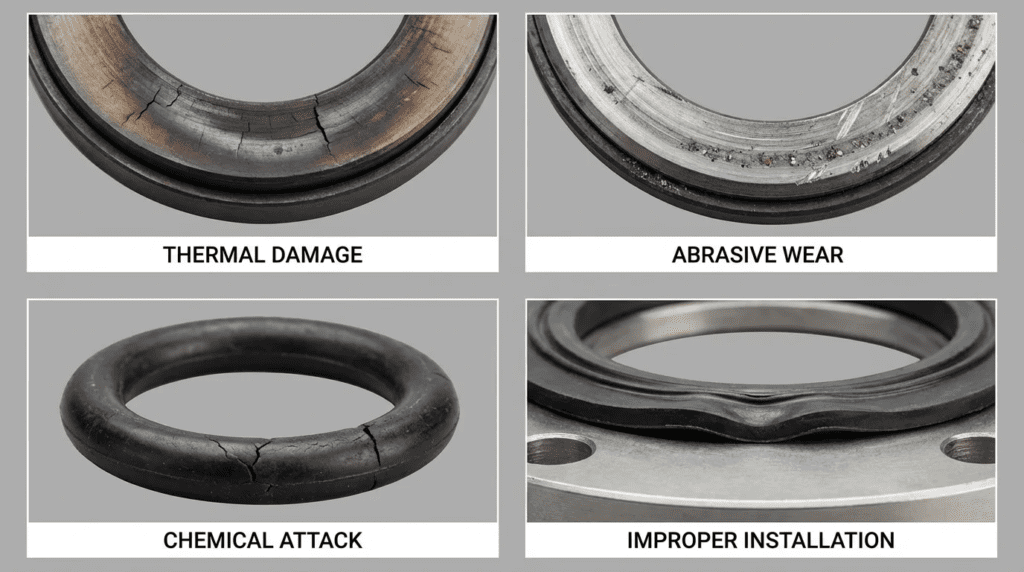
The failed parts tell the story. Do not discard the old seal during repair.
- Radial cracks across the face (heat checking). Dry running or vaporization of the fluid film. The pump was likely snoring, or the chamber oil level was low.
- Deep concentric grooves. Abrasive wear. Particles exceeded the film thickness, or the face material was too soft.
- Chipped or spalled face edges. Mechanical impact. Consider tungsten carbide if grit and stones are present.
- Uneven, elliptical wear pattern. Shaft deflection or misalignment. Check impeller balance, bearings, and the operating point on the curve before fitting a new seal.
- Elastomers swollen or blistered. Chemical incompatibility — check the process fluid and any cleaning chemicals.
Design Details and Calculation Logic
Heat Generation at the Faces
Utility engineers rarely design the seal itself, but they must verify the conditions it will operate under. The governing parameter is the PV value, the product of face pressure and sliding velocity, which represents heat generation potential.
Heat generated at the interface is proportional to the friction coefficient, the face load, the sliding velocity, and the contact area:
Q ∝ μ × Pface × Vsliding × A
In submersible service the constraint is heat removal, not generation. Unlike a dry-pit pump with an external flush line, a submersible relies on convection in the oil bath and conduction through the housing. As a practical consequence, fluids above roughly 104 °F (40 °C) may exceed the capacity of standard submersible cooling. In those cases specify high-temperature elastomers and a higher motor insulation class to tolerate the elevated ambient.
Specification Checklist
- Construction: dual mechanical seals in tandem arrangement.
- Isolation: seals separated by an oil-filled chamber.
- Lower seal: direct-sintered silicon carbide against direct-sintered silicon carbide, or tungsten carbide against tungsten carbide for grit service. State the grade.
- Upper seal: carbon against silicon carbide or tungsten carbide.
- Elastomers: named compound, verified against process fluid, chamber oil, and any cleaning chemicals.
- Metal parts: 316 stainless springs and cages. 304 is vulnerable to chloride stress corrosion cracking in some wastewaters.
- Monitoring: conductive moisture probes in both the oil chamber and the stator cavity, wired to separate alarm points.
- Runout limit: maximum allowable shaft deflection at the seal face, stated numerically.
- Cable entry: potted or compressed grommet sealing system to prevent capillary leakage.
Standards & Compliance
- ANSI/HI 11.6: submersible pump acceptance tests. Requiring testing to a defined acceptance grade verifies hydraulic performance, which indirectly confirms stable shaft operation.
- UL 1207: sewage pumps for hazardous (classified) locations. Relevant because a seal failure can admit flammable gas to the motor enclosure.
- NEMA MG-1: motor insulation classes. A higher class provides thermal margin for the seals and bearings during temporary overload or cooling loss.
Frequently Asked Questions
What is the most common cause of submersible seal failure?
Dry running or inadequate lubrication. This happens when the pump operates below minimum submergence and the fluid film between the faces vaporizes, producing heat checking. In municipal wastewater, ragging around the seal housing is the other leading contributor, because it restricts heat dissipation and adds an unbalanced load.
What is the difference between silicon carbide and tungsten carbide faces?
Silicon carbide is harder and conducts heat substantially better, so it tolerates marginal lubrication and sheds frictional heat more effectively. It is also more brittle. Tungsten carbide is tougher and far more resistant to impact and chipping, but conducts heat less well. For standard sewage, sintered SiC against sintered SiC is preferred. For grit, slurry, or applications with stones and high vibration, TC against TC resists fracture better.
How often should submersible seals be replaced?
In continuous municipal service, three to seven years is typical, though this varies widely with fluid quality and operation. Replace during any major motor overhaul, or whenever oil analysis indicates water intrusion. Many utilities replace proactively on a fixed cycle as part of refurbishment to avoid field failures.
Why do submersible pumps require dual seals?
For redundancy and warning. The lower seal is exposed to process fluid; the upper runs in clean oil. If the lower fails, the oil chamber captures the leakage and the moisture sensor alerts the operator while the upper seal continues to protect the stator. That converts a motor burnout into a scheduled repair — provided the two sensors are alarmed separately.
How does shaft deflection affect seal life?
Deflection is bending of the shaft under radial hydraulic load, which occurs when a pump runs far from BEP. Once deflection exceeds what the faces can accommodate, they open on one side, admitting fluid and abrasive particles into the gap. Correct sizing for the actual system curve is the primary defense, which is why a chronic seal problem is often a hydraulic problem.
Where does seal reliability show up in the operating budget?
In repair frequency and in the avoided cost of stator rewinds, both of which belong in the procurement comparison rather than in the maintenance budget alone. That analysis is set out under submersible lifecycle cost. The diagnostic methods for catching a developing failure are covered under submersible troubleshooting symptoms, and where repeat failures indicate the station itself has aged out, the decision framework is in retrofit versus replace for aging stations.
Conclusion
KEY TAKEAWAYS: Preventing Seal Failures
- Name the Grade: Never accept “standard” materials or unqualified “silicon carbide.” Specify direct-sintered SiC or tungsten carbide for the lower seal.
- Match Face to Failure Mode: SiC for heat and abrasion; TC for impact. Neither survives dry running.
- Redundancy with Two Alarms: Tandem seals with an oil barrier, and the oil chamber and stator probes alarmed separately.
- Hydraulics Drive Mechanics: Operating far from BEP deflects the shaft and destroys seals. Correct sizing is a reliability requirement.
- The Seal Reports Upstream Problems: A second seal in three years means the cause is hydraulic, level control, ragging, or bearings — not the seal.
- Sample the Oil: The chamber oil is a free diagnostic most plants never use.
Mitigating Submersible Seal Failures: Causes requires an approach that extends past component selection into the interplay between hydraulic forces, friction and wear, and operating discipline. For the consulting and utility engineer, the objective is to write specifications that anticipate the environment of wastewater transport rather than describing a part.
By mandating robust face materials with their grades named, verifying the hydraulic operating window to limit shaft deflection, and requiring monitoring that distinguishes a warning from a trip, engineers shift the station from reactive repair to managed reliability. The mechanical seal is the sentinel protecting the most expensive component in the lift station. Time spent specifying it properly returns more than almost any other engineering hour on the project.