
Top 10 Channel Grinder Manufacturers for Water and Wastewater
Introduction
The operational resilience of a wastewater treatment plant or lift station is often determined not by its pumps, but by the equipment protecting them. With the rise of non-dispersible wipes and textiles entering municipal collection systems, ragging has transitioned from a nuisance to a critical operational failure mode. Unscheduled maintenance due to pump clogging costs utilities substantial sums annually in labor and equipment wear. For engineers designing headworks or lift stations, selecting the right size reduction equipment is a mandatory safeguard for process continuity.
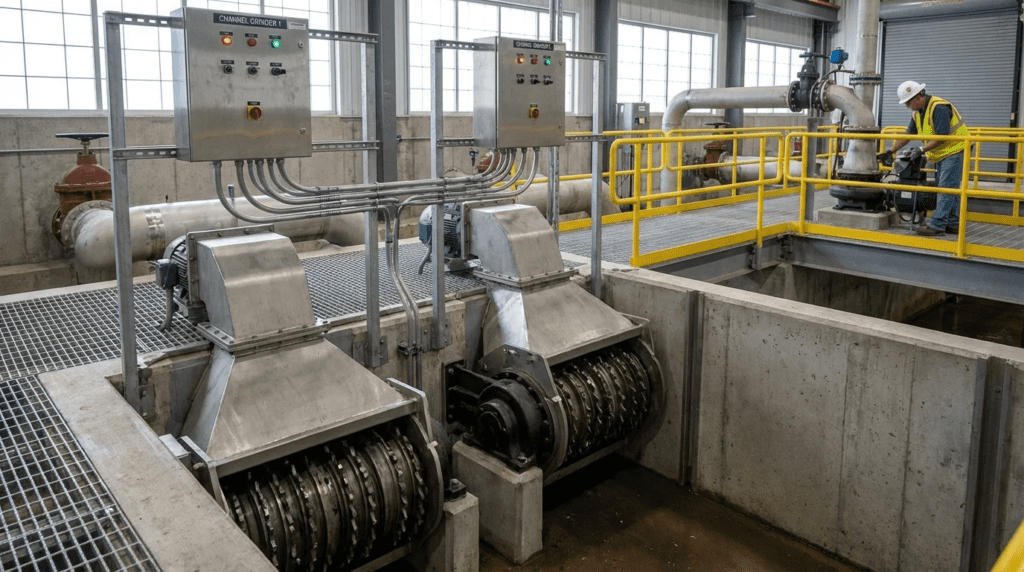
Channel grinders fit into the hydraulic profile differently from screens. Unlike bar screens that remove solids, channel grinders reduce solids to a manageable size, allowing them to pass through downstream pumps and piping without causing obstructions. These units are typically deployed in open channels at headworks, immediately upstream of pump station wet wells, or in sludge processing lines. The market is crowded with varying technologies, from twin-shaft low-speed grinders to high-speed macerators.
Evaluating channel grinder manufacturers requires looking beyond brochure claims of unstoppable torque. Engineers must analyze hydraulic throughput, head loss implications, cutter hardness, seal cartridge reliability, and the ease of in-situ maintenance. A poor specification results in either a hydraulic bottleneck that floods the upstream channel or a unit requiring frequent, expensive crane removals for jam clearing.
Three corrections to the manufacturer list as originally published.
- Sulzer and JWC Environmental were listed as separate manufacturers. They are not. Sulzer acquired JWC Environmental, and with it the Muffin Monster and Channel Monster lines, in a transaction completed in 2018; JWC operates within Sulzer’s pumps business. The earlier version even carried a published note to “check current portfolio availability” because JWC had been sold — an editorial reminder that should never have reached readers. The entries are now consolidated.
- The Eradicator is not a Landia product. That name belongs to Gorman-Rupp, which uses it for the solids management system on its self-priming pump line. Landia’s own technology is its chopper pump knife system, which is what the entry now describes.
- Grundfos grinder pumps are the SEG range, and they are grinder pumps rather than channel grinders — a different device serving a different point in the system. The entry has been corrected and re-scoped accordingly.
More broadly, this site carries three overlapping grinder roundups — one for channel grinders, one for inline grinders, and one covering both. The third subsumes the first two, and the set is a consolidation candidate.
This guide sits within our coverage of wastewater grinders. See also our guides to inline grinder manufacturers, channel grinder equipment comparisons, and wastewater grinders for efficient sewage management.
How to Select / Specify
Duty Conditions & Operating Envelope
The most common failure in grinder application is undersizing based on average flow rather than peak hydraulic events. Channel grinders are physical obstructions in the flow path; their sizing must accommodate the maximum instantaneous flow rate while accounting for the reduction in open area caused by the cutter stacks.
Engineers must define the solids loading rate. A grinder at a prison or hospital lift station faces a vastly different duty cycle than one at a residential subdivision. For high-loading applications, the torque-to-speed ratio is critical. High-torque, low-speed units generally operate at low rotational speeds, providing the shearing force necessary to shred textiles and wood without stalling. Sludge applications may require different cutter geometries designed for viscosity rather than impact.
Always design a hydraulic bypass or overflow channel around the grinder. If the grinder jams or blinds during a storm event, the head loss will spike rapidly. Without a passive overflow, you risk backing up the collection system or flooding the dry well.
Materials & Compatibility
The standard specification for cutter material is heat-treated alloy steel, typically hardened to 45-50 Rockwell C for general use, or higher for severe duty. However, harder cutters are more brittle; if the waste stream contains rocks or concrete fragments, extremely hard cutters may fracture rather than dull.
For the housing and side rails, ductile iron (ASTM A536) is the industry standard for strength and vibration dampening. In aggressive industrial wastewater or high hydrogen sulfide environments, 304 or 316 stainless steel housings may be required to prevent corrosion that could compromise the bearing journals. Shafts should be heat-treated hexagonal steel to ensure maximum torque transmission to the cutter stack without the risk of keyway failure.
Hydraulics & Process Performance
A channel grinder acts as a localized restriction. The specification must require a head loss curve from the manufacturer based on clean water and various debris loading factors. A typical twin-shaft grinder will induce a few inches of head loss at nominal flow, but this can multiply as the cutter stack blinds with debris before the cleaning cycle activates.
Engineers must verify that the upstream hydraulic grade line can accommodate this rise without triggering high-level alarms or surcharging upstream manholes. The channel velocity should remain above roughly 2 ft/s to prevent grit deposition upstream of the unit, but typically below 4 to 5 ft/s to ensure solids are captured by the cutters rather than forced past the side rails.
Installation Environment & Constructability
Retrofit applications pose significant challenges regarding channel fit. Grinders are often flange-mounted or installed in concrete channels using guide rails. The specification must detail the frame design:
- Wall-mounted frames: best for deep channels where the grinder is suspended.
- Channel frames: used where the grinder sits on the channel floor.
Constructability review must ensure sufficient overhead clearance for a hoist or crane to lift the unit for maintenance. Unlike pumps, grinders often require removal for cutter replacement. If the installation is in a Class 1, Division 1 or 2 hazardous location, typical for headworks, the motor and electrical connections must carry appropriate explosion-proof ratings.
Reliability, Redundancy & Failure Modes
The primary failure mode for channel grinders is seal failure leading to bearing contamination. The specification should mandate cartridge-style mechanical seals, preferably with tungsten carbide faces, which resist the abrasion of grit that inevitably works its way toward the shaft.
Reliability is also a function of shaft deflection. Under heavy load, the shafts will attempt to spread apart. If the shaft diameter is undersized, this deflection causes seal runout and premature failure. Specifying a maximum allowable deflection at full load is a rigorous way to ensure mechanical integrity. Redundancy strategies often involve N+1 configurations or a manual bar screen bypass to allow flow during grinder repair.
Controls & Automation Interfaces
A simple starter is insufficient. The control panel must feature a current sensing jam relay. The logic sequence is standard but critical:
- Unit detects over-current indicating a jam.
- Unit stops and reverses rotation to clear the object.
- Unit attempts forward rotation again.
- If the jam persists after a set number of attempts, the unit shuts down and triggers a SCADA alarm.
Modern specifications should request integration via Modbus or EtherNet/IP to the plant SCADA system, providing data on run hours, amp draw trends indicative of cutter wear, and seal leak status.
Maintainability, Safety & Access
Maintenance is the largest lifecycle cost driver. Traditional grinders require the entire cutter stack to be disassembled piece by piece to replace a single broken cutter. Cartridge or monolithic cutter designs allow operators to slide off a pre-assembled stack and slide on a new one, reducing rebuild time substantially.
Safety considerations include zero-speed switches and lockout/tagout points that are easily accessible. Because grinders are often located in wet wells, specifying guide rail systems that allow the unit to be pulled without entering the confined space is a mandatory safety provision.
Lifecycle Cost Drivers
While the initial capital cost of a grinder is significant, the operating cost is dominated by cutter replacement and energy. A total cost of ownership analysis should compare the cost of a full cutter stack replacement, often a substantial fraction of the unit cost, against the expected service interval. Low-speed grinders are generally energy efficient, but high-flow designs using higher horsepower motors to overcome hydraulic resistance will incur higher electrical costs over a 20-year life.
Comparison Tables
Table 1: Channel Grinder Manufacturers
| Manufacturer | Primary Technology | Key Strengths | Limitations / Considerations | Typical Maintenance Profile |
|---|---|---|---|---|
| JWC Environmental (Muffin Monster, a Sulzer company) |
Twin-Shaft Low Speed | Market leader; vast install base; cutter technologies designed to prevent rag weaving; high torque capability. | Premium pricing; replacement parts can be proprietary; varying legacy models. | Cartridge replacements available; requires pull-out for major service. |
| Franklin Miller (Taskmaster) |
Twin-Shaft / Cartridge | Cutter cartridge technology eliminates individual cutter stacking; robust frame construction. | Heavy units requiring substantial lifting capacity; specific sizing increments. | Simplified rebuilds due to cartridge design; high seal reliability. |
| Vogelsang (XRipper) |
Twin-Shaft (Monolithic) | Service-friendly design allows on-site repair without removing the unit from the channel on some models; monolithic rotors. | Monolithic rotors are expensive to replace if damaged; slightly lower torque in smaller frames. | Excellent maintainability; one-piece rotor replacement reduces downtime. |
| NOV Mono (Muncher) |
Twin-Shaft Grinder | Slow speed, high torque; differing cutter speeds clean the stack; integrated packages with Mono pumps available. | Availability of parts varies by region; product line has changed through corporate consolidation. | Standard stack rebuilds; individual cutters. |
| Netzsch (N.Mac) |
Twin-Shaft Grinder | Inline and channel versions; shock absorption systems to protect the drive train; cartridge mechanical seals. | Brand more associated with pumps than grinders in the US market; fewer sizing options than the category leaders. | Designed for ease of access; flanged housing allows quick inspection. |
| Börger (Multichopper) |
Macerator / Chopper | Maintenance-in-place design; adjustable cutter blades; effective for sludge lines. | More complex mechanism than a simple twin shaft; better suited to sludge than raw headworks flow. | Very high maintainability; wear parts accessible through the front cover. |
| Landia | Chopper Pumps / Knife Systems | Known for chopper pumps with hardened knife systems; agricultural and digester crossover experience. | Primary focus is pumps with integrated chopping rather than standalone passive channel grinders. | External knife adjustment on some models reduces need for internal rebuilds. |
| Grundfos (SEG grinder pump range) |
Submersible Grinder Pump | Integration with the Grundfos pump ecosystem; high efficiency motors; widespread distribution. | A grinder pump rather than a channel grinder; focused on smaller lift station applications rather than large municipal headworks. | Swap-out unit philosophy for smaller sizes. |
| Hydro-Dyne Engineering | Screens & Grinders | Specializes in headworks; custom fit fabrication; robust stainless steel construction. | More focused on screening and washing; grinder portfolio is narrower than the category leaders. | Designed for long-term municipal durability. |
Table 2: Application Fit Matrix
| Application Scenario | Recommended Technology | Key Constraints | Operator Impact | Relative Cost |
|---|---|---|---|---|
| Municipal Headworks (High Flow, Variable Solids) |
Large Twin-Shaft Channel Grinder | Head loss limits; requires concrete channel work; grit abrasion. | Low frequency, high effort; requires crane for jams. | High |
| Remote Lift Station (Unmanned, Ragging Prone) |
Twin-Shaft or Pump-Integrated Chopper | Power availability; connectivity for alarms; space in wet well. | Must be auto-reversing; remote monitoring essential. | Medium |
| Sludge Recirculation (Thickened Sludge, Inline) |
Inline Macerator / Single Shaft | Viscosity handling; pressure rating of flanged housing. | Easy access in dry install; regular cutter adjustments. | Medium |
| Institutional (Prisons, Hospitals) |
Heavy Duty Twin-Shaft | Must handle non-grindables such as cutlery and plastics; extreme torque required. | Frequent jams likely; requires robust reversing logic. | Medium-High |
Engineer & Operator Field Notes
Commissioning & Acceptance Testing
The critical check is the amp draw baseline. During the Site Acceptance Test, record the amperage of the motor running in free air. It should be smooth and balanced across all three phases. Any oscillation suggests a bent shaft or tight bearings.
Additionally, force a jam simulation using an appropriate test object, consulting manufacturer safety protocols first. Verify that the controller detects the spike, stops, reverses, and retries the programmed number of times. If the unit trips the overload breaker instead of reversing, the sensitivity settings on the jam relay are incorrect.
Common Specification Mistakes
Engineers often specify a channel depth but fail to specify the active cutter stack height. If the stack is shorter than the peak water level, floating debris such as grease balls and plastics will simply float over the top of the grinder, bypassing treatment entirely. Always specify a stack height that exceeds the peak hydraulic grade line, or include a baffle above the cutters.
Another frequent error is vague material specifications. Specifying “hardened steel” is insufficient. A proper specification reads: “Cutters shall be heat-treated alloy steel with a minimum surface hardness of 45-50 HRC and a core hardness of 35-40 HRC to prevent shattering under shock load.”
O&M Burden & Strategy
Operators should perform a visual inspection of the cutter stack monthly, looking for rounding of the cutter teeth. As teeth lose their edge, they stop shearing and start grabbing and wrapping rags, which increases torque load and accelerates wear.
Predictive Maintenance: Trend the motor current. A gradual increase in baseline amperage indicates that the seal faces may be dragging or the bearings are beginning to fail. Sudden drops in amperage during grinding may indicate a broken shaft or stripped keyway where the motor is spinning but the stack is stationary.
Troubleshooting Guide
- Symptom: Unit jams frequently on soft materials.
Root Cause: Worn cutter spacing or rounded teeth. When the gap between cutters increases due to face wear, rags pass between them rather than being cut.
Fix: Check cutter stack tension; likely requires cutter replacement. - Symptom: Seal leakage.
Root Cause: Seal cartridge failure, often due to wire or hair wrapping around the shaft and working under the seal lip.
Fix: Replace seal cartridge; consider installing deflector disks if not present. - Symptom: Motor overheating.
Root Cause: Jam relay set too high so the unit fights too hard, or duty cycle exceeded through too many starts and stops.
Fix: Adjust controller settings; verify voltage balance.
Design Details / Calculations
Sizing Logic & Methodology
- Determine peak flow: use the maximum instantaneous flow expected.
- Calculate clean channel velocity: target 2 to 3 ft/s.
- Apply the manufacturer restriction coefficient: every manufacturer provides a head loss curve for their specific cutter geometry.
- Calculate head loss using the relationship provided by the vendor.
Rule of thumb: allow for at least 6 to 10 inches of head loss availability in the channel profile to account for a partially blinded grinder during a storm event.
Grinder or Screen? The Question Worth Asking First
Before specifying any grinder, it is worth confirming that grinding is the right strategy at all, because the two technologies solve different problems and the industry has been moving.
A screen removes solids from the waste stream. A grinder leaves them in it, smaller. Everything a grinder cuts still arrives at the primary clarifiers, the digesters, and eventually the dewatering equipment. Shredded wipes do not disappear; they reassemble downstream, and a well-documented consequence is rag accumulation in digesters and around centrifuge scrolls that originated as material a headworks grinder passed through rather than captured.
That has shifted practice at larger plants toward fine screening with washing and compaction at the headworks, physically removing the material to a dumpster, with grinders reserved for duties where removal is impractical:
- Grinding makes sense at unmanned lift stations with no screenings handling, upstream of specific equipment needing protection, in sludge and recirculation lines where the solids must stay in the process, and at septage receiving.
- Screening usually makes more sense at a staffed headworks where screenings can be washed, compacted, and hauled — removing the load from every downstream process rather than redistributing it.
Where a grinder is chosen for a headworks, the design should account for where the ground material ends up, not simply for whether the pumps stop clogging.
Specification Checklist
- Motor: IP68 submersible rating even if installed above grade, for flood protection; inverter duty rated.
- Drive Shafts: hexagonal steel; round shafts with keys are prone to shearing in reversing applications.
- Cutters: independent cutters and spacers, or cartridge equivalent, allowing replacement.
- Controller: PLC-based or smart relay with automatic jam sensing, reversing, and alarm contacts. NEMA 4X stainless steel enclosure.
- Warranty: minimum two years on mechanical components.
Standards & Compliance
- NFPA 820: Fire Protection in Wastewater Treatment and Collection Facilities. Determines electrical area classification.
- NEC Article 500/501: Hazardous location electrical installation.
- Build America, Buy America: for US federally funded projects through the State Revolving Funds or WIFIA, verify domestic sourcing compliance at submittal review.
Frequently Asked Questions
What is the difference between a channel grinder and a macerator?
Channel grinders typically refer to twin-shaft, low-speed, high-torque units installed in open channels to shred solids in bulk flow. Macerators often refer to high-speed, single-shaft units, sometimes inline, that use a chopping blade against a cutting plate. Grinders are generally better for heavy municipal solids such as wood and clothing, while macerators are effective for sludge conditioning and homogeneous waste streams.
How do I determine the correct cutter hardness?
Cutter hardness is a tradeoff between wear resistance and impact resistance. For standard municipal sewage, 45-50 Rockwell C provides good edge retention while retaining enough ductility to absorb the shock of a rock hitting the stack. For sludge lines where grit abrasion is the only concern, harder cutters can provide longer life. Avoid extremely hard cutters in combined sewer systems where concrete or stones are common.
Can a channel grinder be installed in a hazardous location?
Yes, and they often must be. Headworks and wet wells are frequently classified as Class 1, Division 1 or 2 environments due to methane and hydrogen sulfide. The motor must carry the appropriate hazardous location rating, and intrinsically safe barriers must be used for any sensor wiring returning to a control panel located in a safe area.
How often should cutter stacks be replaced?
Cutter life in municipal wastewater varies widely with grit load, which acts like sandpaper on the cutter faces. In systems with high grit such as combined sewers, expect the shorter end of the range; in separated sanitary sewers, considerably longer. Rather than working to a calendar interval, monitor the gap between cutters and the amperage trend; once the gap widens significantly, cutting efficiency drops and replacement is due.
What happens if the grinder fails during a storm?
If a grinder fails and blinds during a storm, it acts as a dam. Without a relief path, this causes upstream flooding. Every grinder installation must include an emergency bypass channel, usually with a manual bar screen, or an overflow weir set at a specific elevation to allow flow to bypass automatically if the water level rises too high.
Are twin-shaft grinders better than single-shaft?
For open channels, twin-shaft grinders are generally superior. They use two counter-rotating shafts to grab solids and pull them into the cutter stack. Single-shaft units often rely on flow velocity to push solids into the cutter, which can be less effective at low flows or with floating debris. Twin-shaft units actively feed themselves.
Conclusion
Key Takeaways for Engineers
- Flow Sizing: Always size for peak hour flow and account for hydraulic restriction; never size solely on average daily flow.
- Technology Fit: Use twin-shaft low-speed grinders for raw sewage headworks; consider macerators for sludge applications.
- Bypass is Mandatory: Never install a channel grinder without a passive hydraulic overflow or bypass channel to prevent flooding during failure.
- Material Specs: Demand hex shafts and cartridge seals; specify cutter hardness based on the presence of rocks and grit.
- Control Logic: The controller must feature auto-reverse jam clearing logic; a simple on/off starter is insufficient.
- Maintenance Access: Ensure overhead clearance for crane access; grinders typically require removal for major service.
Selecting channel grinder equipment is a critical exercise in risk management. The goal is to protect downstream pumps and dewatering equipment from the increasingly aggressive solids found in modern wastewater streams. While JWC Environmental and Franklin Miller have set the standard for twin-shaft technology, offerings from Vogelsang and others provide valid alternatives, particularly regarding maintenance-friendly designs.
Engineers must move beyond brand loyalty and evaluate manufacturers based on the specific hydraulic profile, solids loading, and maintenance capabilities of the utility client. By focusing on robust specifications regarding torque, seal integrity, and hydraulic throughput, designers can ensure the grinder serves as a reliable line of defense rather than a maintenance bottleneck.