
Top OEMs for Electrical Control Panels in Water & Wastewater
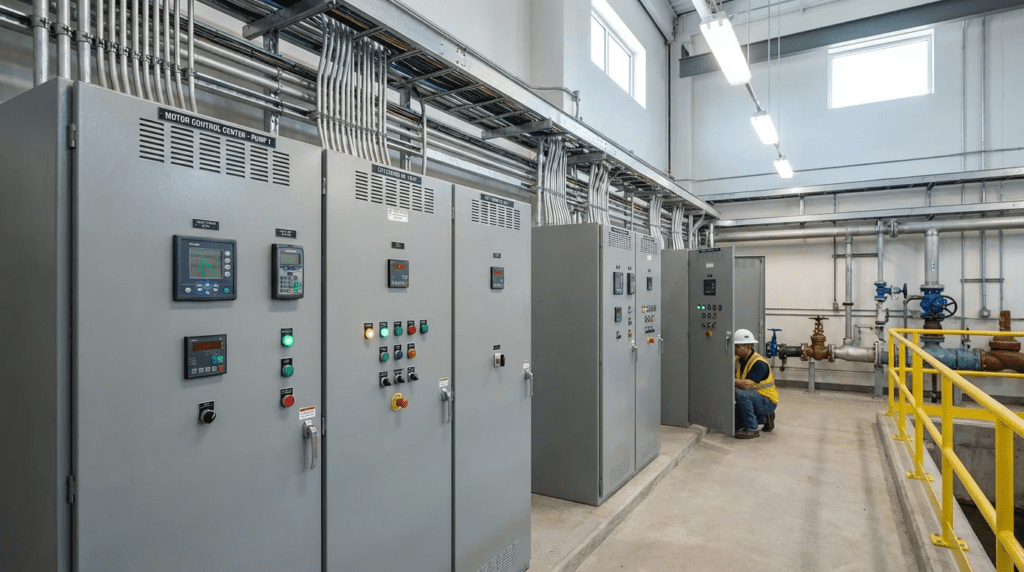
Top OEMs for Electrical Control Panels in Water & Wastewater
Introduction: The Neural Network of Water Infrastructure
In municipal and industrial water and wastewater treatment, the electrical control panel serves as the central nervous system of the facility. Pumps move the fluid and valves direct the flow, but it is the control panel — engineered and fabricated by specialized system integrators — that dictates logic, ensures safety and connects operators to mechanical assets. For consulting engineers, utility superintendents and plant managers, selecting a control panel manufacturer is not a purchasing decision but a critical infrastructure choice governing reliability and maintainability for decades.
These panels operate in punishing environments. They sit outdoors, exposed to thermal cycling, solar loading and precipitation. In wastewater service they face corrosive atmospheres containing hydrogen sulfide, requiring specialized material selection and pressurization strategies. The regulatory context is stringent: panels must comply with the National Electrical Code and adhere to UL 508A for industrial control panels, and UL 698A where hazardous classified locations are involved. The convergence of power distribution, low-voltage control logic and telemetry demands engineering rigor that separates professional integrators from general panel shops.
The distinction between a generic enclosure and a purpose-built water or wastewater control system is process knowledge. A lift station panel must account for ragging, pump alternation logic and storm event management. A potable booster station panel must prioritize pressure maintenance, water quality monitoring and flow pacing. The supplier in this context is usually a specialized integrator who designs, builds, programs and commissions the panel — bridging hardware manufacturers and the end user’s operational requirements.
This article analyzes leading integrators specializing in electrical control panels for the water sector, focusing on technical competencies, fabrication standards and application suitability. Broader supplier positioning is covered in our overview of the top system integrators for water and wastewater automation.
How to Select Control Panels and System Integrators
1. Functional Role and Complexity
Define functional scope first. Is the project a standalone duplex lift station, or a plant-wide SCADA upgrade involving multiple master controllers and distributed I/O?
Standalone control: For small pump stations, the focus is standardization and simplicity. The panel must provide reliable motor control, basic alternation logic and robust alarm notification. Integrators with standard product lines or configurable templates offer the best value and lead times here.
Complex integration: For treatment plants or distribution networks, the panel is a custom-engineered solution integrating disparate protocols, managing complex control loops for aeration or chemical dosing, and providing sophisticated operator visualization. Selection criteria shift toward engineering depth, programming standards and documentation quality.
2. Operating Conditions and Environmental Hardening
Enclosure ratings: NEMA 4X in stainless is the industry standard for corrosion resistance and washdown protection. In non-corrosive outdoor environments, NEMA 3R or 4 in painted steel may suffice. For extreme corrosion such as headworks buildings, fiberglass or polycarbonate may be specified, though these present challenges for heat dissipation and electromagnetic shielding.
Thermal management: Heat is the enemy of solid-state electronics. Integrators must perform detailed heat load calculations. Passive venting is rarely sufficient for drive panels. Active cooling — filtered fans, heat exchangers or air conditioning — must be sized correctly. In wastewater environments, introducing outside air via fans also introduces corrosive gases, so closed-loop cooling is generally preferred to maintain the enclosure rating.
Condensation control: Temperature fluctuation causes condensation and board-level failure. Quality panels include thermostatically controlled anti-condensation heaters, and their placement and sizing indicate whether the design was thought through.
3. Reliability, Redundancy and Safety
Power reliability: Uninterruptible power for the control circuit is effectively mandatory. A quality integrator sizes it to maintain monitoring and alarming for a defined period during an outage.
Backup control: Hardwired backup is an engineering philosophy decision. In the event of a controller failure, can the station operate? Quality designs include hand-off-auto switches and relay-based logic allowing manual or float-based pump operation independent of the microprocessor, ensuring basic service continuity during catastrophic controller failure.
UL standards: UL 508A is baseline. For wastewater lift stations where methane may be present, UL 698A applies, involving correct application of intrinsically safe barriers to limit energy delivered to wet well sensors and prevent ignition sources.
4. Materials, Construction and Craftsmanship
Wire management: Look for ample wire ducting with spare capacity. Wiring should be neatly routed, bundled and secured.
Labeling: Every wire, terminal block and component must carry machine-printed tags corresponding exactly to as-built schematics. Heat-shrink markers outlast adhesive flags.
Termination quality: Ferrules on stranded wire terminations are a hallmark of quality, preventing stray strands from causing shorts and ensuring a gas-tight connection at the terminal block.
Component spacing: Manufacturers specify minimum clearances for heat dissipation and arc flash prevention. Professional integrators adhere to these strictly, even when it means a larger enclosure.
5. Lifecycle Cost and Open Architecture
Open architecture: Guard against vendor lock-in. Proprietary controllers or locked code hold a municipality hostage to one vendor for maintenance and upgrades. The standard is non-proprietary hardware and open communication protocols, with unlocked source code provided at project completion.
Documentation: The deliverable is not just the panel but the documentation package — full schematics, bills of material, network architecture diagrams and operating manuals. Without these, troubleshooting becomes expensive guesswork.
Comparison Table: Leading System Integrators
The table below compares integrators by market focus, municipal sector strengths and lifecycle support considerations, distinguishing those suited to large custom integration from those optimized for standardized, replicable solutions.
| System Integrator | Core Role | Typical Applications | Strengths | Considerations | Best-Fit Scenarios |
|---|---|---|---|---|---|
| Tesco Controls | Custom system integrator and manufacturer | Large water and wastewater plants, regional SCADA, complex lift stations | Substantial manufacturing capacity; comprehensive engineering support; depth in complex controller and SCADA integration; significant Western US presence | High demand can affect lead times for smaller projects; premium positioning may affect cost on simple applications | Major plant upgrades, region-wide SCADA, complex custom logic |
| Data Flow Systems | Telemetry manufacturer and integrator | Remote monitoring, distributed lift stations, rural water districts | Specializes in telemetry and radio communications; durable utility-oriented hardware; strong backward compatibility focus | Uses proprietary hardware and software ecosystems, which may limit open-architecture flexibility relative to pure controller integrators | Utilities seeking single-source responsibility for telemetry and SCADA with long-term legacy support |
| Dorsett Technologies | SCADA and controls integrator | Municipal water distribution, wastewater collection, utility management | Turnkey approach covering hardware, software and installation; focus on SCADA interfaces and enterprise integration | Geographic strength concentrated in specific regions; proprietary elements in some turnkey solutions require evaluation | Municipalities needing a holistic solution from field device to control room for distributed assets |
| Advanced Integration & Controls | Custom systems integrator | Industrial wastewater, specialized municipal process control, hazardous locations | High technical competency in complex logic and process optimization; industrial crossover expertise; platform agnostic | Smaller scale than national manufacturers, which may limit capacity for concurrent large projects | Projects requiring highly specific non-standard control logic or challenging industrial process integration |
| Primex Controls | Pump station control manufacturer | Lift stations, booster stations, stormwater monitoring | Arc-resistant enclosure design isolating control from power compartments; cloud-based remote monitoring offering; highly standardized and configurable panel designs | Standardized product lines may be less flexible for idiosyncratic legacy plant retrofits | Municipalities standardizing lift station fleets with repeatable, safe control panels |
| Control Assemblies | Industrial control panel builder | Large-scale process automation, material handling, water treatment | Strong fabrication quality and volume capacity; solid electrical engineering background; platform agnostic | Roots in broader industrial automation mean municipal-specific nuances must be clearly specified | Large spec-driven infrastructure projects where high-volume, high-quality fabrication is the priority |
Integrator Profiles
Tesco Controls
Overview: Tesco Controls is a heavyweight in water and wastewater automation, particularly in the Western United States, functioning as both custom manufacturer and full-service integrator.
Technical capabilities: Tesco is vertically integrated, designing and manufacturing enclosures while serving as an integrator for major controller platforms. Engineering staff spans electrical power distribution through software architecture.
Application focus: Projects requiring total system responsibility — main plant control panels, power distribution centers and telemetry networks. The ability to fabricate large walk-in enclosures and integrate motor control centers with controller sections suits large treatment plants.
Engineer’s perspective: Specifying a single party for panel build, programming and commissioning reduces integration risk and eliminates the finger-pointing that occurs between separate panel shops and programmers. Documentation standards are generally high.
Data Flow Systems
Overview: Data Flow Systems occupies a niche focused on telemetry and remote monitoring. Based in the Southeast, it has a reputation for durability and backward compatibility addressing the pain points of rural and suburban utilities.
Technical capabilities: Rather than relying solely on off-the-shelf controllers, the company manufactures its own remote telemetry units and SCADA software while also integrating standard platforms. Its telemetry architecture targets the low-bandwidth, high-reliability requirements of water towers and lift stations, using a modular approach that simplifies field maintenance.
Application focus: Distributed collection and distribution systems where radio communication is the primary link, with systems optimized for data integrity over challenging terrain.
Engineer’s perspective: The decision hinges on open against single-source architecture. Proprietary solutions offer seamless integration and reliability, but must be weighed against the desire for generic hardware. The company mitigates this by supporting legacy products over long periods.
Dorsett Technologies
Overview: Dorsett Technologies provides SCADA and control solutions emphasizing enterprise integration, focused on turning raw data into actionable information for municipal managers.
Technical capabilities: The company combines panel fabrication with software capability, offering SCADA software designed to be intuitive for water operators, and end-to-end solutions from field sensor to management dashboard. Panels often feature controllers capable of autonomous operation during communication loss, ensuring process continuity.
Application focus: Municipal utility management where connected infrastructure concepts are being adopted, often integrating security, energy management and process control in a single interface.
Engineer’s perspective: Frequently selected for design-build projects or upgrades where the utility wants a turnkey transformation. Specifiers should verify that underlying hardware meets long-term non-proprietary goals where that is a project constraint.
Advanced Integration & Controls
Overview: A versatile integrator bringing rigorous engineering to control panel design. Serving multiple industries, its application of industrial best practices to water projects produces robust systems.
Technical capabilities: Platform agnostic with expertise across major automation platforms. Strength lies in custom logic development for complex biological or chemical processes, including sophisticated control loops, cascade control and intelligent instrumentation over fieldbus protocols.
Application focus: Industrial pretreatment plants and municipal plants with specialized process technologies such as membrane systems, reverse osmosis or ozone, where standard pump-up and pump-down logic is insufficient.
Engineer’s perspective: Valuable when specifying a unique process or a constrained retrofit. Known for collaborative engineering, working with the process mechanical engineer so control logic matches hydraulic reality.
Primex Controls
Overview: Primex is a significant force in standardized pump station control, having productized the control panel to balance customization against standardized reliability.
Technical capabilities: A key differentiator is the focus on operator safety through arc-resistant enclosure design isolating the low-voltage control compartment from the high-voltage power compartment, reducing arc flash exposure. The company also offers cloud-based remote monitoring providing SCADA-like visibility without heavy IT infrastructure investment.
Application focus: Lift station standardization programs. Utilities replacing aging controls across large lift station fleets turn to standardized suppliers for a repeatable solution maintenance staff can easily learn and service.
Engineer’s perspective: Specification-friendly due to widespread acceptance and certification. The safety enclosure design is a significant selling point for safety-conscious utilities. Custom work is possible, but the sweet spot is configurable standard product lines.
Control Assemblies
Overview: Control Assemblies brings decades of industrial automation experience as a high-volume, high-quality panel builder capable of large infrastructure projects with demanding specifications.
Technical capabilities: As a certified member of the Control System Integrators Association, the company adheres to recognized standards for fabrication and business practice. It offers UL 508A and UL 698A certified panels, with capacity for large batch orders at consistent quality.
Application focus: Large municipal expansion projects requiring multiple diverse panels — blower panels, filter consoles, chemical feed panels. A background in broader industrial sectors brings rigor to wire management, thermal design and electrical protection.
Engineer’s perspective: A builder’s builder. Given a solid design, execution is precise. Less about proprietary software, more about execution excellence in fabrication and standard programming.
Application Fit Guidance
Municipal Water Distribution
For wells, boosters and tanks, the primary challenge is telemetry — moving data over long distances. Data Flow Systems and Dorsett Technologies are strong contenders given their native telemetry focus. Tesco suits larger, complex distribution networks requiring high-end integration.
Municipal Wastewater Collection
Lift stations demand corrosion resistance, safety and reliability in harsh environments. Primex Controls is a strong choice for standardizing fleets due to safety-focused enclosure design and specialized pump controllers. Tesco and Data Flow Systems offer robust solutions for critical stations requiring complex bypass logic or specific telemetry integration.
Complex Treatment Plants
Inside the fence line, complexity rises steeply — sophisticated logic, motor control center integration and high-density I/O. Tesco Controls and Control Assemblies have the manufacturing capacity and engineering depth for large lineups and main plant control centers. Advanced Integration & Controls is effective for specific process areas requiring intricate custom logic.
Industrial Wastewater
Industrial clients prioritize uptime, rapid deployment and integration with existing plant-wide control systems. Advanced Integration & Controls and Control Assemblies are often better suited given cross-industry experience and ability to adapt to non-municipal specifications.
Engineer & Operator Considerations
Installation Best Practices
- Conduit entry: Never allow top-entry conduit on outdoor panels. It is the leading cause of water ingress and component failure. Conduits should enter from the bottom.
- Sun shields: For outdoor panels, a sun shield is an engineering necessity rather than a luxury. Direct solar loading raises internal temperatures well above ambient, causing nuisance tripping and shortened electronics life.
- Sealing: Expanding foam or duct seal must be used inside conduits entering the panel to prevent corrosive gases from wet wells and moisture from migrating into the enclosure.
Integration and Commissioning
- Factory acceptance testing: Mandate a witnessed test. This is not a visual check — it should involve powering the panel, simulating analog inputs, forcing outputs and verifying logic sequence before the panel leaves the shop.
- Loop checks: During commissioning, every I/O point must be loop checked from field device to operator screen. Documenting this is essential for liability and baseline performance.
Maintenance and Spare Parts
- Standardization: Push for standardization of relays, power supplies and controllers across the facility, reducing spare parts inventory value.
- Accessibility: Ensure fuses and breakers are accessible without reaching over exposed live busbars. Finger-safe terminals should be mandatory.
- Documentation pockets: A durable print pocket on the door containing laminated schematics and bill of materials pays for itself the first time someone troubleshoots at night.
Related Topics
Control panels are one layer of a broader automation stack. Readers evaluating the platforms those panels run on will find relevant material in our reviews of the top OEMs for PLC and control platforms and the top OEMs for SCADA and HMI platforms. Plant-wide supervisory system selection is covered in our guide to the top SCADA systems manufacturers.
Conclusion
The electrical control panel is where engineering design meets operational reality. It is the component operators touch daily, and the selection of a system integrator reverberates through the facility lifecycle.
The integrators covered here each offer distinct value propositions. For the consulting engineer, the task is writing specifications that enforce quality — UL standards, enclosure ratings, component grades — while selecting a partner whose competencies align with project complexity. For the owner and operator, the focus stays on maintainability, safety and open architecture.
By prioritizing engineering rigor over lowest initial bid, utilities ensure their control systems remain robust, safe and supportable for the decades these assets are expected to serve.