Siemens vs YSI CSO/Storm Equipment: Comparison & Best Fit
Siemens vs YSI CSO/Storm Equipment: Comparison & Best Fit
Introduction
Accurate monitoring of combined sewer overflows and stormwater systems under regulatory consent decrees is one of the harder instrumentation problems municipal engineers face. Equipment must survive rag-prone environments, operate reliably through rapid hydraulic changes, and produce data accurate enough to satisfy environmental agencies. A frequent decision point in specification development is the Siemens vs YSI CSO/Storm Equipment: Comparison & Best Fit analysis.
A scope note helps here. Both companies are instrumentation suppliers, not CSO equipment manufacturers. Neither makes CSO screens, storage structures, vortex separators or wet weather treatment systems. Siemens supplies process instrumentation under the SITRANS name along with automation and drives — note that Siemens exited water treatment equipment entirely when it divested Siemens Water Technologies in 2013. YSI is a Xylem brand, alongside SonTek, specializing in environmental monitoring and water quality instrumentation.
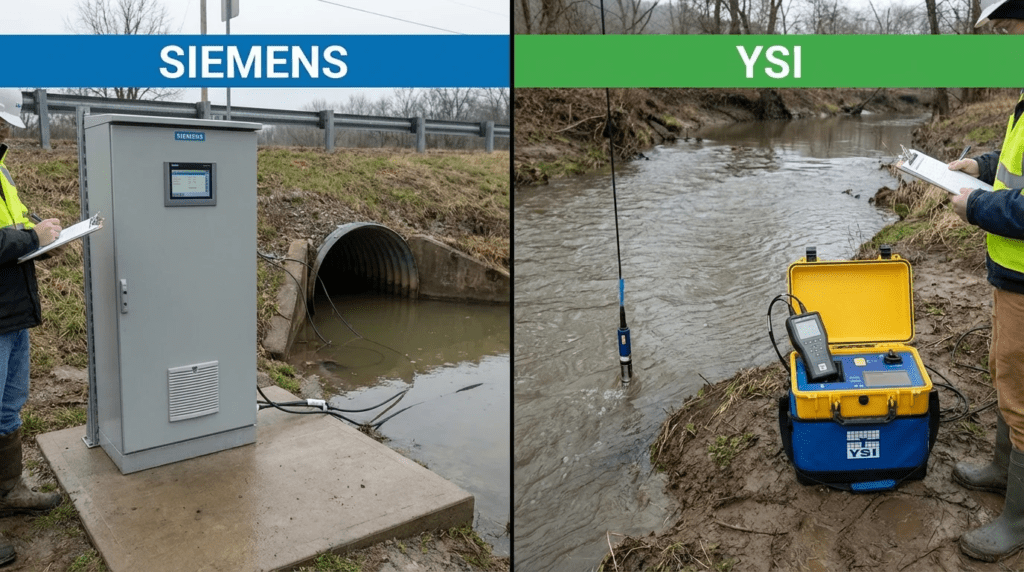
Within that scope the comparison is substantive, because it represents a genuine divergence in measurement philosophy: infrastructure-heavy permanent process control against flexible environmental monitoring and water quality profiling. These technologies are deployed at collection system nodes, overflow structures, retention basins and plant headworks. Siemens dominates in magnetic flowmeters and radar level for permanent structures; YSI is frequently the standard for open-channel velocity profiling and multi-parameter water quality sondes.
Misapplying them — placing a standard mag meter in a gravity line with insufficient surcharge, or deploying a sensitive water quality sonde without adequate anti-fouling — produces total data loss during the very storm events the system was installed to capture. The consequences include failed compliance reporting, expensive sensor replacement and unverified flow data that cannot calibrate a hydraulic model. Broader supplier positioning is covered in our overview of the top water treatment equipment manufacturers.
How to Select and Specify
Duty Conditions & Operating Envelope
Start by defining the hydraulic regime. CSOs are characterized by dry weather flow periods punctuated by violent, high-velocity storm events.
- Flow regime: Where the application involves a force main or a continuously full pipe, electromagnetic flowmeters are generally superior given their obstructionless design and high accuracy. Where the application is a gravity sewer that surcharges only occasionally, a full-bore mag meter is inappropriate unless installed in an inverted siphon, which introduces its own maintenance risks. In partially filled pipes, acoustic Doppler technology is required to calculate flow by area-velocity methods.
- Submergence: Equipment in manholes will be submerged during surcharge. Specify IP68. Both manufacturers offer submersible options, but duration and depth matter. Water quality sondes are designed for long-term submersion; industrial transmitters rated for submersion are still better located above grade with only the sensor submerged.
- Sediment and bed load: Stormwater carries heavy grit. Bottom-mounted acoustic Doppler sensors can be buried by sediment, blinding them. Non-contact radar mounted at the pipe crown is immune to bed load but cannot measure velocity, requiring a Manning’s equation assumption that becomes inaccurate under backwater conditions.
Materials & Compatibility
- Abrasion resistance: Stormwater carries sand and grit. For electromagnetic meters, specify liners that resist abrasion — neoprene or polyurethane — rather than PTFE, which is more susceptible to damage from debris in high-velocity storm flows.
- Corrosion: In combined sewers, hydrogen sulfide is a constant threat. 316L stainless is the baseline for sensor bodies and mounting hardware. In high-sulfide environments, Hastelloy electrodes in mag meters may be necessary to prevent signal noise from surface passivation.
- Biofouling: This is a critical differentiator. The YSI sonde line features active anti-fouling wipers to keep optical sensors clean through long deployments. Industrial process instrumentation typically relies on flow velocity or ultrasonic cleaning for electrodes, which is not sufficient for optical turbidity sensors in stagnant retention tanks.
Hydraulics & Process Performance
- Straight runs: Magnetic flowmeters typically require several pipe diameters upstream and downstream. In CSO structure retrofits this space is rarely available. Area-velocity sensors can function with shorter straight runs but still need a developed flow profile for high accuracy.
- Minimum velocity: Mag meters generally require velocity above roughly 1.5 to 2 ft/s to keep electrodes clean and maintain accuracy. Doppler sensors need suspended particles to scatter the signal, which makes them excellent for stormwater but potentially problematic in very clear effluent.
Installation Environment & Constructability
- Space constraints: Installing a full-bore mag meter requires cutting the pipe and potentially building a vault, a major civil expense. Strap-on or insertable sensors can be installed through existing manholes, drastically reducing civil cost.
- Power availability: Many CSO outfalls are remote. YSI systems are frequently designed for low-power, battery or solar operation with integrated data logging. Siemens industrial instrumentation generally assumes mains or substantial DC power is available, requiring electrical infrastructure upgrades at remote sites.
Reliability, Redundancy & Failure Modes
In CSO monitoring, ragging is the primary enemy.
- Non-contact against contact: Non-contact radar level is immune to ragging. Submerged pressure transducers and in-stream sensors will eventually foul.
- Sensor redundancy: A best-practice specification for critical CSOs uses a hybrid approach: non-contact level for total head measurement, paired with a submerged area-velocity sensor. If the submerged sensor fouls or is buried, the level sensor continues providing depth, allowing an estimated flow calculation.
Controls & Automation
- Protocols: Siemens equipment natively supports the major industrial protocols, making integration into a plant controller seamless. YSI equipment, with roots in environmental science, often uses SDI-12 or logging formats from that world, though standard industrial outputs are increasingly available on newer controllers.
- Data granularity: For storm events, long logging intervals are insufficient. Specify loggers capable of event-based logging, where the sample rate increases automatically once a level threshold is breached.
Lifecycle Cost Drivers
- Capital: Civil works dominate. A mag meter installation is high capital cost because of the vault and pipe modification. A manhole-mounted sensor is comparatively low capital cost.
- Operating: Maintenance dominates. Water quality sondes require regular calibration and consumable replacement. Magnetic flowmeters and radar level sensors are largely install-and-forget with much lower calibration requirements, provided they are not physically damaged.
Comparison Tables
| Manufacturer & Category | Primary Strengths | Typical Applications | Considerations | Maintenance Profile |
|---|---|---|---|---|
| Siemens SITRANS F M magnetic flowmeters | High accuracy, obstructionless, no moving parts, durable | Force mains, pump station discharge, full-pipe gravity lines and siphons | Requires full pipe; high civil cost to install; requires mains power | Low: periodic verification; electrode cleaning in sludge or grease service |
| Siemens SITRANS radar level | Non-contact and immune to grease and rags, precise, unaffected by temperature or vapor | Wet wells, manholes, tank level, open channel flow with a weir or flume | Measures level only, requiring a known hydraulic structure for flow; foam can absorb signal | Minimal: occasional cleaning of the antenna face where splashing occurs |
| YSI SonTek acoustic Doppler | Measures velocity and level together; works in partially filled pipes; handles backwater and surcharge conditions | Gravity sewers, irregular channels, culverts, streams | Susceptible to burial by sediment; requires scattering particles; ragged sensors lose data | Medium: cleaning of the sensor face; checking mounting integrity |
| YSI water quality sondes | Multi-parameter measurement; active anti-fouling wipers; smart sensor architecture | Environmental compliance, CSO impact monitoring, receiving water quality | Higher operating cost from consumables; more delicate than industrial process sensors | High: regular calibration; sensor cap replacement; wiper maintenance |
| Application | Primary Constraint | Secondary Constraint | Best Fit | Rationale |
|---|---|---|---|---|
| CSO pump station discharge | High accuracy for regulatory reporting | Pressurized pipe | Siemens mag meter | A closed pipe application demands the accuracy and robustness of a mag meter, and delivers the best lifecycle value. |
| Gravity sewer overflow in a manhole | Variable flow from open channel to surcharge | No power available, remote site | YSI Doppler with logger | Area-velocity is required for open channels, and low power consumption permits solar or battery deployment. |
| Retention tank level | Grease and floating debris | Potential hazardous gas classification | Siemens radar, appropriately rated | Non-contact radar avoids fouling from the grease cap, and suitably rated versions are available for classified areas. |
| Water quality compliance at an outfall | Turbidity and dissolved oxygen reporting required | High biofouling risk | YSI sondes | Industrial process sensors often lack the low-range sensitivity and active wiping required for environmental compliance. |
| Complex hydraulic structure | Backwater effects; reverse flow possible | Limited straight run | YSI SonTek | Acoustic Doppler is the only reliable way to measure velocity profiles and direction in complex, non-uniform flow. |
Engineer & Operator Field Notes
Commissioning & Acceptance Testing
Site acceptance must verify performance under simulated storm conditions, which is difficult during dry weather.
For radar and ultrasonic level sensors, verify the blanking distance programming. During a surcharge event, water rising into the sensor’s blanking zone causes the output to lock at the last value or fail to zero — losing data exactly when the overflow is peaking.
- Velocity profiling: For Doppler installations, verify the index velocity calibration. Velocity measured at the sensor location, often the bottom or side, is not the average velocity of the cross-section. Use a handheld profiler during commissioning to establish the relationship between the sensor reading and true mean velocity across different flow depths.
- Zero-flow stability: Mag meters must be properly grounded to the fluid. In lined pipe, grounding rings are mandatory. Without them, stray electrical noise produces phantom flow readings during dry periods, accumulating false totalized volume.
Common Specification Mistakes
- Range turndown: Specifying a mag meter for peak storm flow produces a meter oversized for daily flow. A large meter operating at the very bottom of its range becomes inaccurate and prone to fouling. Use reducers to keep velocities high, even at the cost of slight head loss.
- Cable lengths: In deep tunnel CSOs, sensor cable runs can exceed standard lengths. Analog signals degrade over long runs without amplification. Digital protocols or manufacturer-supplied digital cables are preferred beyond about a hundred feet, but voltage drop to the sensor must be calculated.
O&M Burden & Strategy
- Cleaning intervals: Optical sensors generally require inspection every two to four weeks even with wipers, to confirm the wiper arm has not jammed and the brush has not deteriorated. Non-contact radar may require only annual inspection.
- Desiccant management: Vented pressure transducers require desiccant packs to keep moisture out of the vent tube. If these saturate, the reference pressure drifts and level errors follow. This is a common failure mode in humid sewer environments. Sealed gauge or absolute pressure sensors avoid it but need atmospheric compensation.
Troubleshooting
Noisy or erratic flow readings.
- Mag meter: Check electrode coating. Grease or slime acts as an insulator. Enable the electrode cleaning function if available, or schedule mechanical cleaning. Check grounding rings for continuity.
- Doppler: Check signal-to-noise ratio. If the water is unusually clean or the sensor is buried in silt, the ratio drops. High turbulence or air entrainment also scatters the signal unpredictably.
Design Details & Calculations
Open Channel Sizing and the Limits of Manning’s Equation
Using a level-only sensor to calculate flow requires Manning’s equation: Q = (1.49/n) × A × R2/3 × S1/2.
Mag Meter Velocity Check
To ensure a mag meter is self-cleaning, velocity should exceed roughly 2 ft/s (0.6 m/s) under normal conditions, calculated as flow divided by the cross-sectional area of the meter bore. If the calculated velocity at average daily flow falls below about 1 ft/s, reduce the meter size. Modern mag meters handle high velocities without damage, so oversizing is rarely justified.
Specification Checklist
- Ingress rating: IP68 for all sensors below the hydraulic grade line, with a stated continuous submersion depth
- Memory and logging: For remote units, non-volatile memory capable of storing several months of data at the specified interval
- Power autonomy: A defined number of days of operation without solar charging for battery systems
- Verification interface: Transmitter shall display real-time diagnostics including signal strength and electrode status
Standards
- ISO 15769: Hydrometry — open channel flow measurement using the Doppler effect
- MCERTS: Where the regulator requires certified flow monitoring, check certification on the specific model
- NEMA 250: Enclosure types for control panels, with 4X appropriate for outdoor and corrosive environments
Frequently Asked Questions
Does Siemens make CSO or wastewater treatment equipment?
Not since 2013, when Siemens Water Technologies was divested and became Evoqua, now part of Xylem. Siemens today supplies process instrumentation, automation and drives to the water sector. For CSO applications that means flowmeters, radar and ultrasonic level, and controllers — not screens, storage structures or treatment systems. Specifications naming Siemens for water treatment equipment are out of date.
What is the primary difference between the two for stormwater applications?
Measurement philosophy and installation environment. Siemens provides industrial process instrumentation suited to permanent, powered infrastructure such as pump stations and treatment plants. YSI, a Xylem brand, specializes in environmental monitoring — Doppler velocity and water quality sondes — designed for open channels, natural water bodies and remote locations requiring battery power and quality profiling.
How do you select between a mag meter and a Doppler sensor?
Select a mag meter where the pipe is pressurized or always full, mains power is available and high accuracy is required. Select a Doppler sensor for partially filled pipes, gravity sewers, or locations where the pipe cannot be cut or modified. Doppler sensors measure velocity in the flow stream and are essential wherever the pipe is not running full.
Can radar sensors measure flow in a sewer?
Indirectly. Radar measures depth. Converting that to flow requires the controller to be programmed with pipe geometry and a primary device formula — a flume, weir or Manning’s equation. This is accurate only under free-flow conditions. If the sewer surcharges, the level reading will indicate high flow even when the water is essentially stagnant, unless paired with a velocity sensor.
What is the typical maintenance interval for a water quality sonde?
In stormwater applications, every two to four weeks. Despite active anti-fouling wipers, the harsh environment of CSOs — grease, rags, grit — requires frequent inspection to confirm sensors are not buried or damaged. Calibrations for parameters such as pH and dissolved oxygen are typically monthly.
Why does my level sensor fail during storm events?
Usually blanking distance intrusion, where water rises too close to the sensor face; loss of echo from foam or turbulence, common with older ultrasonic units and less so with radar; or physical submersion of non-submersible electronics. Ensure the sensor carries an IP68 rating and is mounted high enough to accommodate the maximum possible surcharge level.
What is the cost difference between these approaches?
A mag meter installation carries substantially higher capital cost because of civil work — vaults, pipe cutting, bypass pumping. A Doppler installation is considerably lower capital cost since it installs in an existing manhole. Over the asset life, the balance shifts: YSI equipment carries higher operating cost from sensor maintenance and replacement in aggressive environments.
Conclusion
Key Takeaways
- Both are instrumentation suppliers: Neither makes CSO treatment structures. Siemens left water treatment equipment in 2013.
- Pipe condition rule: Full or pressurized pipe means a mag meter. Partially filled or open channel means Doppler, or radar with hydraulic constraints acknowledged.
- Data validity: Level-only measurement is invalid for flow calculation under surcharge or backwater conditions. Velocity measurement is required.
- Power and infrastructure: Siemens implies industrial infrastructure with mains power; YSI implies environmental deployment with logger, solar and battery.
- Maintenance trade-off: Mag meters mean high capital and low operating cost. In-stream sondes mean low capital and high operating cost.
- Redundancy: At critical compliance points, use a hybrid of non-contact level plus submerged velocity.
The engineer is not choosing a better brand but the correct tool for the hydraulic reality. Siemens excels in built infrastructure — pump stations, treatment works and controlled discharges where accuracy and durability are paramount. YSI dominates collection system and receiving water monitoring — remote outfalls, river impact monitoring and difficult gravity sewer applications where flexibility and environmental parameters matter.
Successful specification requires a view of the whole data lifecycle. A robust mag meter is useless if civil costs prohibit installation, just as a flexible Doppler sensor is wasted if maintenance budgets cannot support the cleaning schedule. Map the duty conditions — surcharge potential, sediment, power availability — and the technology choice follows. Related evaluations appear in our comparison of ABB and VEGA CSO and storm instrumentation, YSI and SCADATA instrumentation, and ABB and Emerson instrumentation.